

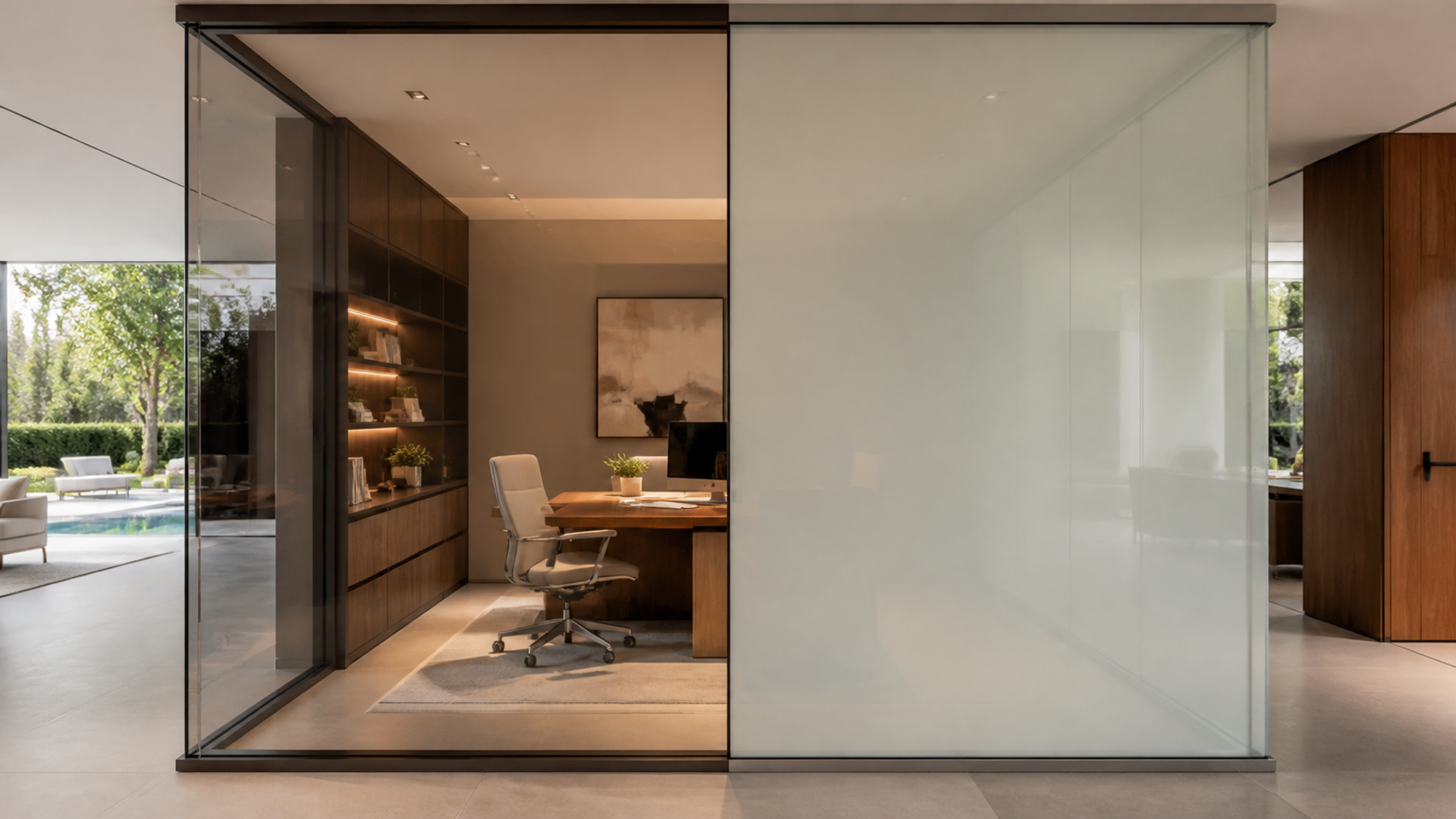
A glass-walled home office creates openness until a confidential call begins. Switchable glazing promises privacy at the touch of a control, but two products are often collapsed into one label: factory-built dynamic glass and film applied to existing glazing. Their opaque states, daylight behaviour, edge details, electrical systems and replacement paths differ. Search demand is durable and adjacent terminology is rising, making a precise retrofit-versus-rebuild guide more useful than a futuristic showcase.
Current demand and source evidence makes switchable privacy glass worth examining now, but timing does not excuse weak claims. Current retailer, destination, manufacturer or platform material is identified below, while recommendations remain conditional on the reader's exact market, dates and requirements.
The short answer for switchable privacy glass
Use professionally laminated privacy glazing for a new partition or a high-finish renovation where uniform appearance, concealed wiring and long service life justify construction. Consider retrofit PDLC smart film when the existing glass is sound, downtime must be limited and a qualified installer can finish edges and controls cleanly. Neither choice provides acoustic privacy by itself; sound isolation needs a separate wall, door and ventilation assessment.
For switchable privacy glass, the decision should survive three checks: the underlying fact is current, the option fits this exact use case, and the downside remains acceptable if a supplier or product detail changes. The E07 headline cannot replace any of those checks.
The E07 comparison matrix
| Decision factor | Laminated switchable glass | Retrofit smart film | Conventional privacy treatment |
|---|---|---|---|
| Installation moment | Best during build or major renovation | Applied to suitable existing glass | Works with minimal electrical work |
| Visual finish | Most integrated when specified early | Edge and wiring quality depend on installer | Predictable but not switchable |
| Privacy state | Uniform product-specific switching | PDLC scatters light for visual privacy | Blind, curtain or fixed frosting blocks view |
| Daylight control | Varies by technology and tint range | Transmits diffuse light when private | Depends on fabric or opacity |
| Power dependency | Requires controls and power | Requires transformer and wiring | Manual options work without power |
| Acoustic effect | Only the glass build-up may help | Film alone adds little isolation | Curtains can soften sound but do not seal it |
| Maintenance | Service the control system and glazing | Protect film edges and surface | Clean or replace familiar components |
| Best fit | Permanent flagship workspace | Controlled retrofit | Budget, resilience or rental constraint |
This E07 table is deliberately shaped around the switchable privacy glass decision. It prevents one large price, famous name or current launch from dominating the factors that determine this article's real outcome.
What the primary evidence currently confirms
Verified point 1. The Glass Association of North America bulletin hosted by SageGlass distinguishes dynamic glazing technologies and describes liquid-crystal glazing as providing strict privacy rather than the same tint behaviour as electrochromic systems.
Verified point 2. SageGlass user documentation shows that dynamic-glass installations include controls and user modes, confirming that the electrical and control design is part of the specification rather than an afterthought.
Reader-visible evidence used for those points:
sageglass.com official or current source —
https://www.sageglass.com/sites/default/files/gana-05-0911_dynamic_glazing_for_high_performance_buildings.pdfsageglass.com official or current source —
https://www.sageglass.com/sites/default/files/user_guide_sageglass_150506_new_final_modified.pdf
The E07 observation is bounded to the linked pages and this publication run. The changeable facts behind switchable privacy glass—including relevant prices, inventory, dates, descriptions, specifications, staffing or service terms—must be checked on the exact live page before action.
Reading every row without false precision
Installation moment: the E07-1 decision
For Laminated switchable glass, the evidence to test is whether best during build or major renovation. The Retrofit smart film route instead means applied to suitable existing glass. With Conventional privacy treatment, the practical control is that works with minimal electrical work. This installation moment row should be resolved with the exact product, room, route or service in front of the reader; it is not a generic popularity vote. If the evidence is still incomplete, preserve the least irreversible option and set a date to recheck it.
Visual finish: the E07-2 decision
For Laminated switchable glass, the evidence to test is whether most integrated when specified early. The Retrofit smart film route instead means edge and wiring quality depend on installer. With Conventional privacy treatment, the practical control is that predictable but not switchable. This visual finish row should be resolved with the exact product, room, route or service in front of the reader; it is not a generic popularity vote. If the evidence is still incomplete, preserve the least irreversible option and set a date to recheck it.
Privacy state: the E07-3 decision
For Laminated switchable glass, the evidence to test is whether uniform product-specific switching. The Retrofit smart film route instead means pDLC scatters light for visual privacy. With Conventional privacy treatment, the practical control is that blind, curtain or fixed frosting blocks view. This privacy state row should be resolved with the exact product, room, route or service in front of the reader; it is not a generic popularity vote. If the evidence is still incomplete, preserve the least irreversible option and set a date to recheck it.
Daylight control: the E07-4 decision
For Laminated switchable glass, the evidence to test is whether varies by technology and tint range. The Retrofit smart film route instead means transmits diffuse light when private. With Conventional privacy treatment, the practical control is that depends on fabric or opacity. This daylight control row should be resolved with the exact product, room, route or service in front of the reader; it is not a generic popularity vote. If the evidence is still incomplete, preserve the least irreversible option and set a date to recheck it.
Power dependency: the E07-5 decision
For Laminated switchable glass, the evidence to test is whether requires controls and power. The Retrofit smart film route instead means requires transformer and wiring. With Conventional privacy treatment, the practical control is that manual options work without power. This power dependency row should be resolved with the exact product, room, route or service in front of the reader; it is not a generic popularity vote. If the evidence is still incomplete, preserve the least irreversible option and set a date to recheck it.
Acoustic effect: the E07-6 decision
For Laminated switchable glass, the evidence to test is whether only the glass build-up may help. The Retrofit smart film route instead means film alone adds little isolation. With Conventional privacy treatment, the practical control is that curtains can soften sound but do not seal it. This acoustic effect row should be resolved with the exact product, room, route or service in front of the reader; it is not a generic popularity vote. If the evidence is still incomplete, preserve the least irreversible option and set a date to recheck it.
Maintenance: the E07-7 decision
For Laminated switchable glass, the evidence to test is whether service the control system and glazing. The Retrofit smart film route instead means protect film edges and surface. With Conventional privacy treatment, the practical control is that clean or replace familiar components. This maintenance row should be resolved with the exact product, room, route or service in front of the reader; it is not a generic popularity vote. If the evidence is still incomplete, preserve the least irreversible option and set a date to recheck it.
Best fit: the E07-8 decision
For Laminated switchable glass, the evidence to test is whether permanent flagship workspace. The Retrofit smart film route instead means controlled retrofit. With Conventional privacy treatment, the practical control is that budget, resilience or rental constraint. This best fit row should be resolved with the exact product, room, route or service in front of the reader; it is not a generic popularity vote. If the evidence is still incomplete, preserve the least irreversible option and set a date to recheck it.
Visual privacy is not information security
An opaque partition can prevent line-of-sight exposure, yet voices may travel through the door, ceiling void or ventilation path. Screens can reflect in adjacent surfaces, and meeting audio can leave through open microphones. Build a threat model for sight, sound, recording and network access separately. The glass solves only the visual component it is specified to solve.
Edge treatment decides whether a retrofit looks premium
Applied film needs straight cuts, consistent gaps, protected busbars and a planned cable route. Ask the installer for close photographs of corners, door junctions and curved sections from completed work. Inspect the glazing for scratches and coatings before approving compatibility. A technically functioning film can still fail the room if wiring and edges remain visually intrusive.
Define the safe state during power loss
Some technologies change state when powered; the desired fail condition depends on the room. A private office may require visual blocking during a fault, while a glazed corridor may need openness for safety and supervision. Document what happens after loss of mains power, control failure and fire-alarm activation. Include manual blinds if business continuity requires guaranteed privacy.
Controls should be simpler than the meeting
Provide a local switch that works without an app, then add scenes or automation only if needed. Labeling must be discreet but understandable to guests. Integrate occupancy logic carefully: automatic clearing at the wrong moment can expose a screen. Commission every scene from inside and outside the room, in daylight and after dark.
Three owner-specific decisions for switchable privacy glass
New-build executive study
Specify laminated glass, controls, door seals and acoustic targets together. Hide the electrical infrastructure before finishes are closed. Define the fact that would reverse this choice and preserve it in the trip, purchase or technical record.
Retrofit apartment office
Survey the existing glass and landlord constraints, then price professional film installation against a high-quality blind. Preserve a reversible fallback. Define the fact that would reverse this choice and preserve it in the trip, purchase or technical record.
Client-facing conference room
Test privacy from every public approach and define fail-safe behaviour. Pair the visual system with sound masking or construction where confidential meetings require it. Define the fact that would reverse this choice and preserve it in the trip, purchase or technical record.
The E07 verification checklist
Identify whether the project is new build or retrofit.
Confirm the exact switching technology.
Survey glass coatings and condition.
Specify the private and power-loss states.
Plan concealed power and controls.
Assess acoustic privacy separately.
Inspect sample edges and corners.
Test night-time visibility.
Record cleaning restrictions.
Keep a manual privacy fallback.
Complete the E07 checklist against the exact switchable privacy glass option and save the source date behind any fact that can reverse this recommendation. In this decision boundary, unknown does not mean zero, unavailable or safe; it means the choice remains open.
Related VERTU reading
These VERTU links provide adjacent context for switchable privacy glass readers; they are not evidence for the external claim evaluated in article E07.
Final decision
Use professionally laminated privacy glazing for a new partition or a high-finish renovation where uniform appearance, concealed wiring and long service life justify construction. Consider retrofit PDLC smart film when the existing glass is sound, downtime must be limited and a qualified installer can finish edges and controls cleanly. Neither choice provides acoustic privacy by itself; sound isolation needs a separate wall, door and ventilation assessment.
For article E07, the disciplined switchable privacy glass choice is the one whose critical assumptions can be verified now and whose failure mode remains manageable. If its decisive term is unavailable, choose a reversible alternative or wait for stronger primary evidence instead of converting attention into certainty.
![How to Scan Receipts and Documents with Your Phone [Full Guide]](https://cdn.sanity.io/images/e0gp1l2g/production/0db13feec1d5e72b8a8a5f976d1f3e86619c9228-3840x1860.webp?w=180&h=180&q=78&auto=format&fit=crop)
![How to Scan Receipts and Documents with Your Phone [Full Guide]](https://cdn.sanity.io/images/e0gp1l2g/production/0db13feec1d5e72b8a8a5f976d1f3e86619c9228-3840x1860.webp?w=800&h=450&q=82&auto=format&fit=crop)
![Top 10 Two-Tone Carbon-Fibre Watches for Men [2026 List]](https://cdn.sanity.io/images/e0gp1l2g/production/18870799ba33fab0e038968359cd5772d7d7db30-1024x576.webp?w=800&h=450&q=82&auto=format&fit=crop)
![Top 10 Luxury Watches with Digital Complication Displays for Men [Latest]](https://cdn.sanity.io/images/e0gp1l2g/production/c4f6bf8c080f291c39f7cc85c7344ecff2fd3799-1024x553.webp?w=800&h=450&q=82&auto=format&fit=crop)