

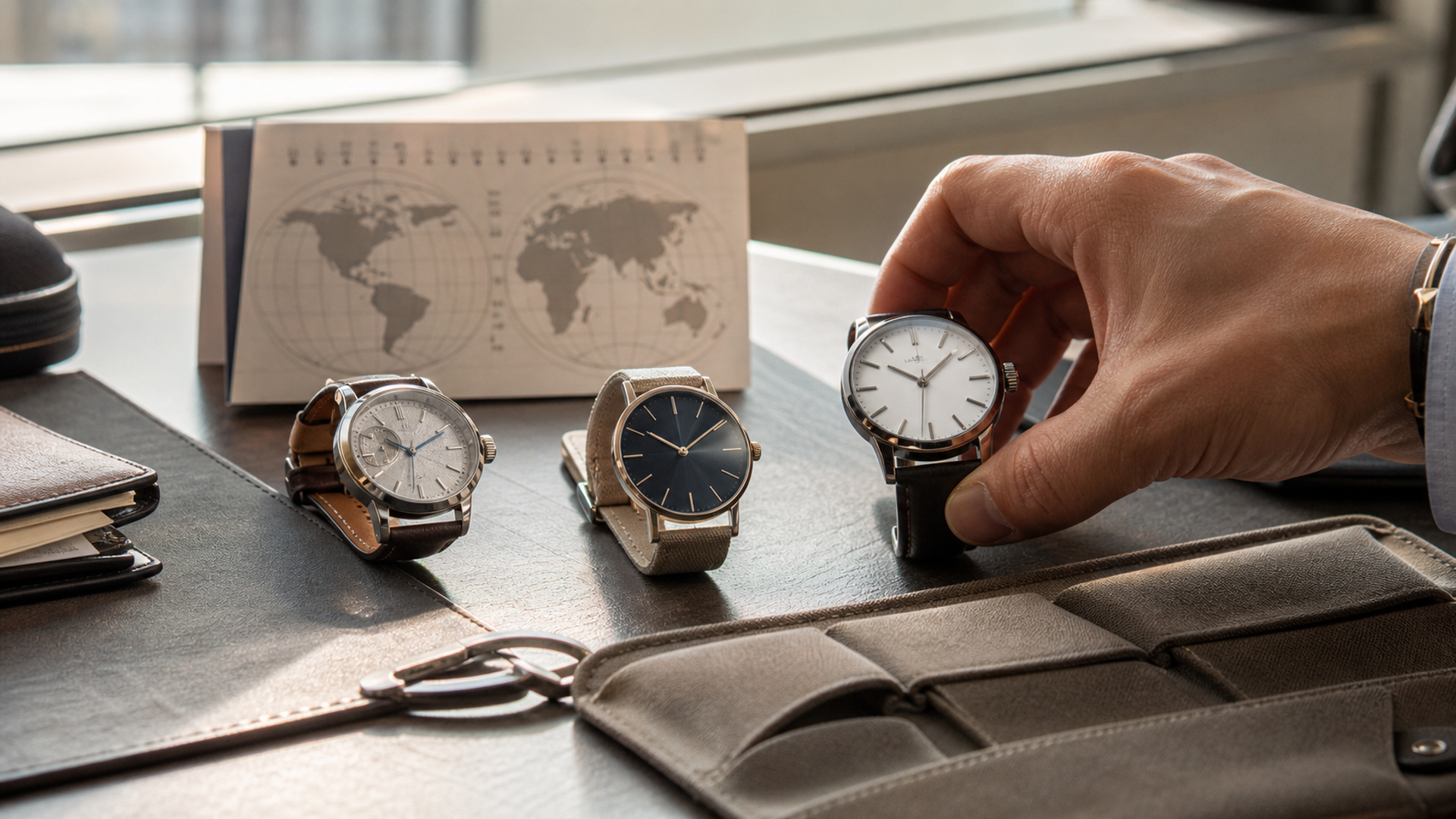
The best travel watch movement depends on what you refuse to manage while away. Choose mechanical if the movement itself is part of the pleasure and you accept winding, setting and periodic specialist service. Choose quartz if immediate accuracy and low attention matter most. Choose solar quartz if you want quartz convenience with less dependence on routine battery replacement, provided the watch receives enough light.
That answer is more useful than declaring one technology superior. A weekend collector, a monthly long-haul traveller and someone leaving a watch in a safe for half a year have different failure points. The right movement is the one whose maintenance pattern fits your actual use.
Quick comparison: mechanical, quartz and solar
| Ownership question | Mechanical | Battery quartz | Solar quartz |
|---|---|---|---|
| Ready after months unused? | May need winding and setting | Usually, if battery is healthy | Usually, if charge was maintained |
| Timekeeping attention | Highest | Lowest | Low |
| Routine energy source | Mainspring wound by hand or wrist | Replaceable battery | Light charging an internal cell |
| Emotional and craft appeal | Highest for many collectors | Usually functional | Technology-led |
| Service dependency | Specialist mechanical service | Battery and seals, plus model-specific service | Model-specific cell and electronics service |
| Best travel fit | Enthusiast who enjoys interaction | Traveller who wants certainty | Frequent traveller who wants low intervention |
These are category tendencies, not guarantees. A movement's real performance depends on the calibre, case, age, service history and how the watch is used. Compare the specifications and service guidance for the exact reference before buying.
Mechanical: choose ritual and repairable complexity
A mechanical movement stores energy in a mainspring and releases it through an escapement. A hand-wound watch asks the owner to wind it. An automatic adds a rotor that winds the mainspring through wrist movement. Neither needs a disposable battery to keep ticking, but both depend on lubrication, adjustment and a network capable of servicing that calibre.
For travel, the attraction is not efficiency. It is continuity with watchmaking: the movement remains a small machine whose operation can be seen, heard and felt. Setting a destination time or winding a watch at breakfast can be a pleasure rather than friction.
The practical costs are real. Power reserve is finite, so a watch left in a hotel safe may stop. Accuracy can vary with position, shock, magnetism, temperature and the state of service. Complications also increase reset time. A perpetual calendar that stops can be less convenient on a two-day trip than a simple three-hand watch.
Patek Philippe's care guidance recommends winding a manual watch in the morning and notes that its self-winding movements commonly offer 38 to 48 hours of power reserve, with exceptions. Those numbers apply to Patek Philippe's own references, not all mechanical watches, but they illustrate the question every traveller should ask: will the specific watch still be running when you put it on again?
Mechanical is right for you if:
you enjoy winding, setting and understanding the movement;
you already use an authorised or trusted specialist service network;
the trip includes occasions where the watch's craft matters to you;
you accept that a stopped watch is an ownership interaction, not a defect.
Battery quartz: choose accuracy with minimal ceremony
A quartz movement uses an electronic oscillator regulated by a quartz crystal. In ordinary ownership, it is normally more accurate and less sensitive to position than a mechanical movement. It can sit unworn for weeks and still show the correct time when picked up, assuming its battery remains healthy.
That is a strong travel advantage. A quartz watch can serve as the dependable reference while a mechanical piece travels for enjoyment. It is also useful for an infrequently worn formal watch: the owner is less likely to discover it has stopped immediately before an event.
Quartz is not maintenance-free. Batteries expire, seals age and water resistance should not be assumed after the case has been opened. Patek Philippe states that batteries in its quartz movements last two to three years and directs owners to an authorised service point for replacement. Other brands and models differ, so use the maker's interval rather than treating two to three years as universal.
The travel risk is timing. A battery that fails during a trip may require a service centre willing to work on the model and pressure-test it after replacement. If the watch has a low-battery indicator, respond before departure rather than trying to extract one more journey from it.
Battery quartz is right for you if:
you want to pick up the watch and leave without setting it;
accuracy matters more than mechanical theatre;
the watch spends long periods unworn;
you can schedule battery and seal service before failure.
Solar quartz: choose low intervention, not zero care
A solar watch is still generally a quartz watch; it converts light into electrical energy and stores it in a rechargeable cell. Citizen describes its Eco-Drive technology as able to use light ranging from sunshine to indoor illumination, with more than six months of operation from a full charge for the technology it discusses. Exact reserve varies by model.
For frequent travel, that combination is persuasive. You gain quartz timekeeping and reduce routine battery-replacement anxiety. A watch that receives regular light can remain ready across changing time zones without daily interaction.
The phrase “powered by light” can create the wrong habit, however. Leaving a solar watch in darkness for months is not the same as charging it. Some dials admit more light than others, reserves differ, and extreme temperatures remain unhelpful to any watch. Read the model's charging table and avoid trying to recover a depleted watch through intense heat on a car dashboard.
Solar quartz is right for you if:
you travel often and want low intervention;
the watch will receive regular, appropriate light;
you value practical autonomy more than a mechanical movement;
you are willing to follow model-specific charging and service guidance.
Match the movement to the journey
| Travel pattern | Best starting point | Reason |
|---|---|---|
| Two-day business trip | Quartz or solar | Immediate readiness and low attention |
| Three-week multi-country journey | Solar or traveller-focused mechanical | Solar minimises intervention; mechanical works for an engaged owner |
| Collector's weekend | Mechanical | The interaction is part of the experience |
| Watch stored for months | Quartz, or solar with a light plan | Mechanical will probably need resetting; solar cannot live indefinitely in darkness |
| Remote destination | Simple quartz or solar | Fewer daily dependencies and easy time reference |
| Formal event after arrival | Quartz backup plus chosen mechanical piece | Redundancy without abandoning character |
Movement is only one travel variable. Case material affects weight and wear, so compare titanium, ceramic and steel watch cases separately. Documentation, insurance and border handling also deserve their own luxury-watch travel checklist.
Collectors deciding between a small independent maker and a larger house should assess service reach before travel. The independent watchmaker versus major maison framework explains why originality and serviceability should be considered together.
Five questions to ask before buying
How long can this exact reference run or remain charged when unworn?
What warning does it give before energy is exhausted?
Who can service it in the regions where I spend time?
How complicated is it to reset after it stops?
Would I still enjoy its ownership routine after the novelty fades?
The fifth question prevents the most expensive mistake. Buyers often choose the movement they admire in theory rather than the one they will maintain in practice. A mechanical watch neglected because setting it feels tiresome is not a better ownership outcome than a carefully chosen solar or quartz reference worn constantly.
Test the travel tasks before deciding
Try the controls with the watch on your wrist. A movement can be suitable on paper yet frustrating if changing the date requires repeated crown operations or if local time cannot be adjusted without stopping the seconds. Frequent flyers should ask whether the hour hand moves independently and whether the date can be corrected safely in both directions on that calibre.
Mechanical owners must learn the maker's restricted period for manual calendar adjustment. On many movements, changing the date while the mechanism is preparing its midnight change can damage components. The exact hours vary, so the manual—not a generic rule—must govern.
For quartz and solar watches, check the low-charge warning and battery or cell service route before a long trip. A seconds hand jumping at unusual intervals may be a warning rather than a fault. Solar does not remove maintenance; seals, gaskets and the rechargeable cell still age.
Finally, consider magnetic exposure. Ordinary airport screening is not a reason to panic, but powerful magnetic closures, speakers and specialist equipment can affect some mechanical watches. If timekeeping changes abruptly, compare it with a reliable reference and arrange diagnosis rather than repeatedly correcting the hands.
Schedule routine service before, not immediately after, a consequential journey. A freshly serviced watch needs enough ordinary wear to reveal a crown, gasket or regulation issue while the owner is still near the service centre. Keep the service receipt and water-resistance result with the travel records, especially when the itinerary includes swimming, humidity or rapid temperature changes.
The practical verdict
For pure travel convenience, solar quartz is the strongest all-round starting point, with battery quartz close behind. For collecting pleasure, mechanical remains distinctive because its constraints are part of its character. None is universally best.
Choose the movement whose failure mode you are prepared to handle. If you dislike winding and resetting, do not romanticise that work. If periodic battery service feels more intrusive than a morning ritual, mechanical may suit you. If you want a watch that quietly stays ready, solar deserves more consideration than its place in traditional collecting debates suggests.
![How to Scan Receipts and Documents with Your Phone [Full Guide]](https://cdn.sanity.io/images/e0gp1l2g/production/0db13feec1d5e72b8a8a5f976d1f3e86619c9228-3840x1860.webp?w=180&h=180&q=78&auto=format&fit=crop)
![How to Scan Receipts and Documents with Your Phone [Full Guide]](https://cdn.sanity.io/images/e0gp1l2g/production/0db13feec1d5e72b8a8a5f976d1f3e86619c9228-3840x1860.webp?w=800&h=450&q=82&auto=format&fit=crop)
![Top 10 Two-Tone Carbon-Fibre Watches for Men [2026 List]](https://cdn.sanity.io/images/e0gp1l2g/production/18870799ba33fab0e038968359cd5772d7d7db30-1024x576.webp?w=800&h=450&q=82&auto=format&fit=crop)
![Top 10 Luxury Watches with Digital Complication Displays for Men [Latest]](https://cdn.sanity.io/images/e0gp1l2g/production/c4f6bf8c080f291c39f7cc85c7344ecff2fd3799-1024x553.webp?w=800&h=450&q=82&auto=format&fit=crop)