
Introduction
A top-tier luxury concierge service in 2026 is no longer defined by a velvet-rope promise. It is defined by delivery: a mobile-first interface, a real human team behind it, and the ability to execute quickly across borders without turning your life into a trail of forwarded emails.
At its best, a luxury concierge service covers three things at once: access (getting in), logistics (making it happen), and risk management (doing it quietly, correctly, and with contingency).
You benefit most when your calendar is tight, your preferences are precise, and the cost of a mistake is high. That might be a last-minute table in a city you landed in two hours ago, a complex family itinerary with medical constraints, or a high-profile event where discretion matters as much as seating.
The hard part in 2026 is not finding a “concierge.” It is navigating provider models, pricing structures, privacy posture, and the new reality of AI-assisted workflows.
Key TakeawayChoose based on how a provider works (model + governance), not on how impressive the brand list sounds.
What defines a top-tier luxury concierge service today
Mobile-first, human + AI delivery
Top-tier providers now behave like a product as much as a service. Requests start on a phone, updates arrive on a phone, and confirmations live in one thread rather than across ten inboxes.
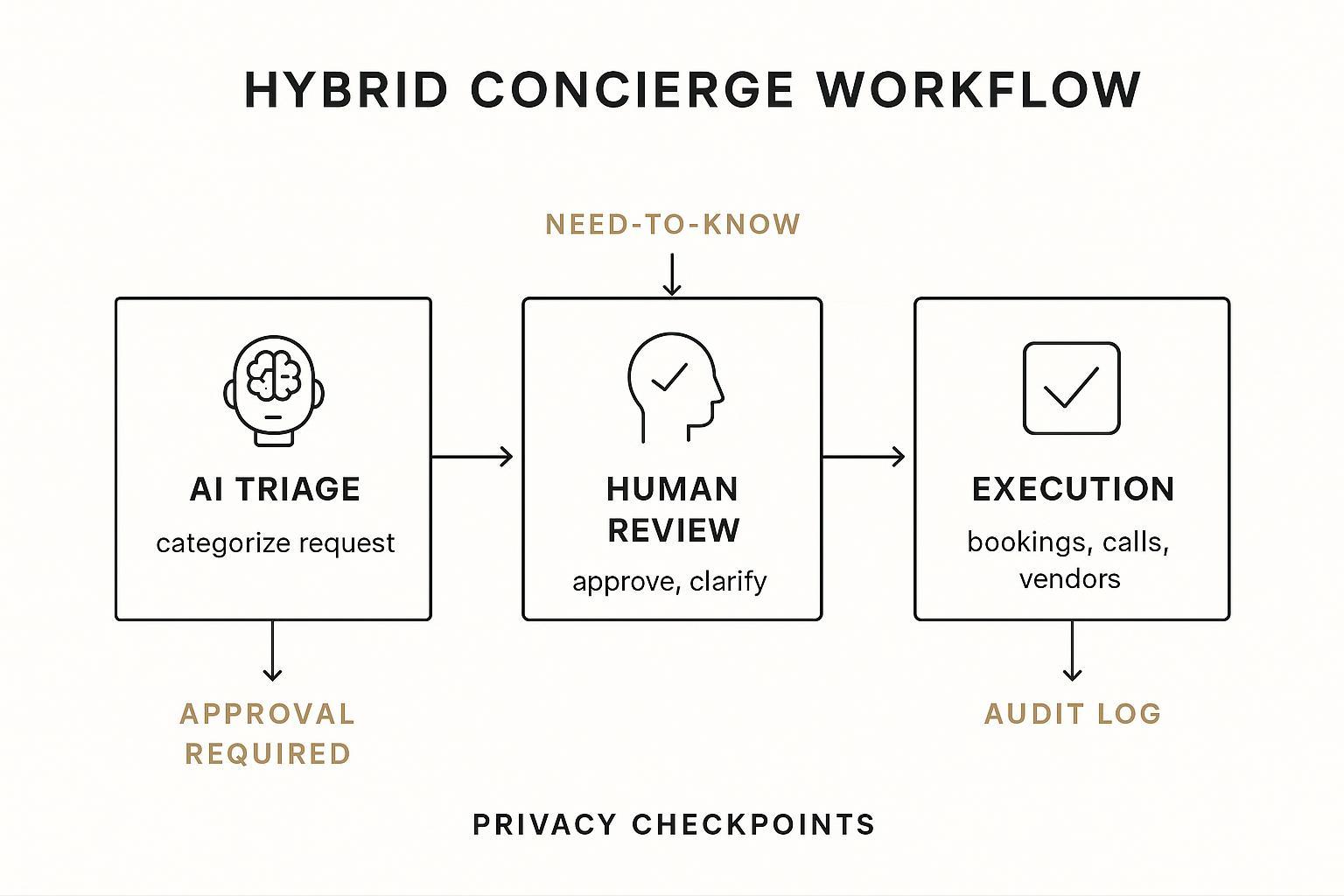
AI tends to sit at the front of the workflow. It sorts requests, surfaces preferences, proposes options, and flags constraints. The human team stays accountable for judgment calls: vendor selection, trade-offs, and anything with reputational, privacy, or safety risk.
If a provider is “AI-first” but can’t explain where a human steps in, treat that as an operational red flag.
Bespoke outcomes across lifestyle pillars
A high-functioning lifestyle management concierge is judged by outcomes across the pillars you actually use:
Travel and on-the-ground logistics
Dining (including last-minute and high-demand)
Events and ticketing
Shopping and sourcing
Household and personal administration
The difference between mid-tier and top-tier is not whether they can book a hotel. It is whether they can handle the second-order detail: dietary nuance communicated discreetly, transfers that match security constraints, contingencies when the plan changes.
Verified access, speed, and discretion
Speed matters, but it is not the goal. The goal is verified access with low friction.
In practice, that means:
They can explain their partner network and how requests are fulfilled.
They can set expectations clearly (what is feasible, what takes time, and what requires approvals).
They treat discretion as a process, not a slogan.
Leading providers in the US
The US market is easiest to understand if you separate providers by operating model. The names below are examples, not a definitive ranking.
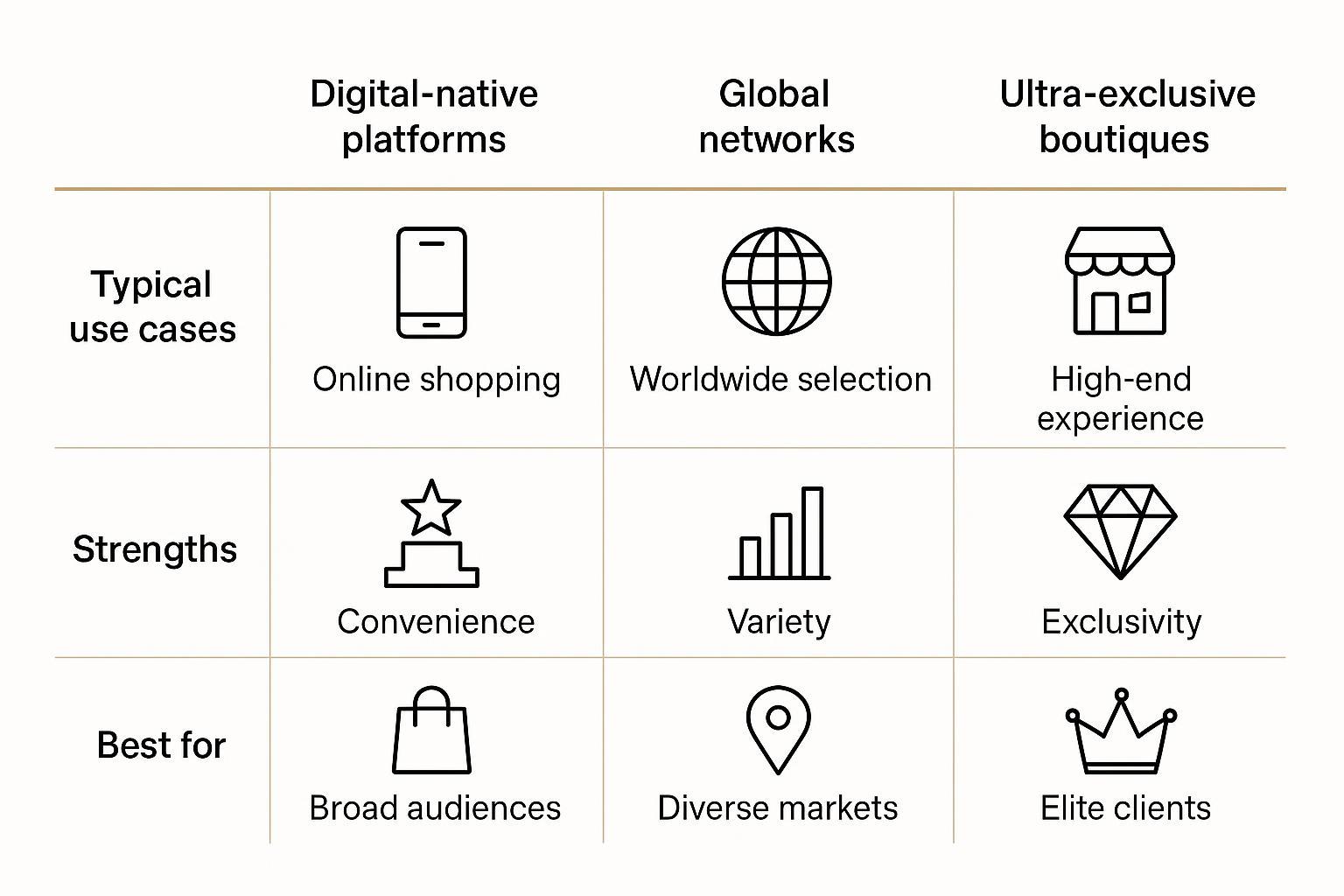
Digital-native platforms (e.g., Velocity Black)
Digital-native platforms are built around an app-first experience and a high-velocity request flow. They are often strong for frequent, repeatable requests: dining, tickets, travel planning, and sourcing.
Velocity Black presents itself as “the future of concierge, available 24/7/365” on its official site, with core coverage spanning reservations, travel, events, and luxury goods via a mobile interface (Velocity Black).
What this model does well:
Quick turnaround for routine-to-complex lifestyle requests
A clean mobile request history (useful when you have multiple parallel plans)
Consistent service for members who use concierge weekly, not annually
Where it can be weaker:
Extremely bespoke edge cases that rely on deep personal relationships
Multi-party coordination where approvals and identity controls are the main work
Global networks (e.g., Quintessentially, John Paul)
Global networks trade “app speed” for depth: partner coverage across cities, relationship managers, and an operating cadence designed for cross-border life.
Quintessentially describes itself as a global luxury lifestyle management group with 24/7 support and extensive international coverage in its US concierge offering (Quintessentially personal concierge services) and broader services overview (Quintessentially services).
John Paul describes a 24/7 worldwide concierge service designed to handle everyday and extraordinary requests, often deployed through partner brands (John Paul premium concierge service).
What this model does well:
Complex travel spanning multiple jurisdictions
Deep partner networks for hospitality and access
Ongoing lifestyle management with a more relationship-led rhythm
Ultra-exclusive boutiques (e.g., Knightsbridge Circle)
Boutiques sit at the extreme end: smaller membership, higher-touch coverage, and a posture closer to “extension of your personal office” than “membership benefits.”
Knightsbridge Circle publicly outlines its membership positioning and service promises, including response-time expectations and an emphasis on limited member-to-manager ratios (Knightsbridge Circle pricing information).
What this model does well:
High-stakes, high-visibility outcomes
Proactive planning and contingency
A narrower client base, which can support tighter discretion
Membership tiers and pricing
Entry, premium, invitation-only tiers
Most luxury concierge membership offers cluster into three tiers, even if the naming differs.
Entry tiers are usually built for lighter usage: a few key requests per month, more standardized support, and fewer specialist lanes.
Premium tiers typically add faster response expectations, deeper partner access, and a relationship manager who learns preferences well enough to be proactive.
Invitation-only tiers tend to be about capacity protection. The fee is not only a price; it is a throttle that keeps the client-to-staff ratio low.
Key TakeawayIf you are comparing concierge service pricing, compare capacity and accountability, not just the annual fee.
Subscription, initiation, bespoke fees
In 2026, pricing is best understood as a commercial model rather than a number on a page:
- Subscription membershipa predictable fee for ongoing access.
- Initiation or joining feescommon in ultra-exclusive tiers to control demand.
- Bespoke retainersfor “personal office” style coverage.
- Pass-through coststhe third-party costs of travel, dining, tickets, and goods.
Collector’s note: If a provider refuses to explain where fees end and pass-through begins, you are not buying discretion. You are buying ambiguity.
Value drivers: access, SLA, partner depth
You are paying for three things:
- Accesspartner relationships, allocations, and the ability to source under constraints.
- SLA and capacityresponse expectations and how protected their staff bandwidth really is.
- Partner depthwhether they can execute in the cities you actually use, not just in their marketing narrative.
Privacy, security, discretion
Contracts, NDAs, and vendor controls
At the top end, confidentiality is operational. A well-run private concierge service should be able to describe how it limits who sees what, not just hand you a generic NDA.
One useful framing is “identity minimization”: when possible, vendors receive instructions without receiving your identity. AC Private describes this operational approach as part of what “absolute discretion” looks like in day-to-day execution (“Absolute discretion” guidance).
In practice, ask for:
NDAs that flow down to subcontractors and partner vendors
Clear subprocessor rules (including any AI tools used in the workflow)
A written deletion/retention policy for itineraries, IDs, and payment artifacts
Data security: encryption, audits, access
The security baseline is not exotic. It is discipline.
Look for:
Encryption in transit and at rest
Named-user access (no shared logins)
Multi-factor authentication for staff accounts
Auditability: who accessed what, when, and why
In this context, the device matters because it is the control plane for your life. For a security-first posture, it helps when your mobile setup supports strong encryption and clear data-protection practices, rather than scattering sensitive details across unmanaged apps. VERTU’s overview of data protection and cybersecurity features is a useful internal reference point for how a personal device can frame privacy expectations.
Human oversight and need-to-know gates
Human oversight is not a slogan, either. It is a gate.
A top-tier operator should be able to separate:
Routine execution (bookings, confirmations)
Sensitive execution (identity, companions, security arrangements)
High-risk execution (medical, legal, political exposure)
This is also where mobile private communication becomes more than “nice to have.” If you are coordinating assistants, vendors, and travel changes in motion, you want a predictable approach to secure channels and permissions.
Collector’s note: Ask whether the provider supports a secure concierge communication workflow that avoids copying sensitive details into unmanaged chats and requires explicit approval before identity is shared.
VERTU’s discussion of private communication on mobile devices can help readers think about what “secure-by-default” looks like in daily practice.
(在这一点上,VERTU 的相关实践更适合被理解为“安全沟通的工作方式”示例:把敏感信息的流转限制在必要范围内,明确授权边界,优先使用更可控、更可审计的通信渠道。重点不是功能堆砌,而是让“AI 助理 + 人工服务”在移动端也能遵循最小权限与知情必要原则。)
How to verify: Ask the provider to walk you through a real request and identify each privacy boundary: what data is captured, where it is stored, and which steps require explicit approval.
2026 trends and adjacencies
Predictive AI agents with human override
In 2026, the most important shift is that AI is moving from “answering” to “executing.” That makes governance central.
Deloitte Digital frames 2026 as a turning point for luxury adopting digital and agentic AI, with the emphasis on integrating AI into critical functions under clear governance rather than endless pilots (Deloitte Digital perspective on agentic AI in luxury).
For concierge workflows, the buyer-friendly version of that governance is simple:
AI can triage and propose.
A human must approve high-stakes decisions.
Execution should leave an audit trail.
Blockchain, identity, and access logs
“Blockchain” in concierge is less about speculation and more about logs. As more requests pass through AI systems and multiple vendors, the value is in stronger identity verification and immutable access histories.
You do not need a provider to market Web3 language to benefit from this. You need them to answer practical questions:
Can you separate identity from itinerary in vendor workflows?
Do they maintain access logs for sensitive documents?
Can you require explicit approval before identity is shared?
Wellness and longevity integration
Wellness is no longer a side category. It is becoming part of how affluent clients allocate attention and spending.
IMD’s 2026 luxury trends framing explicitly highlights wellness and longevity as central themes for luxury brands and experiences, not peripheral add-ons (IMD on luxury trends 2026).
In concierge terms, this shows up as:
Travel planning that includes recovery time and sleep protection
Longevity clinic coordination and vetted practitioner sourcing
“Less, but better” calendars, curated around health constraints
Conclusion
How to choose confidently in 2026
Start by choosing a model, not a logo.
If you want speed and frequent usage, digital-native platforms can be an efficient fit. If you want cross-border depth and relationship-led support, global networks are often stronger. If you need the highest discretion and capacity protection, boutiques exist for that reason.
Apply a security-first selection checklist
Use these questions in your first call:
What data do you collect for a routine request, and what do you refuse to collect?
Which steps require human approval, and how is that enforced?
Who are your subprocessors and partners, and what confidentiality obligations flow to them?
What secure channels do you support for sensitive details?
What is your retention and deletion policy for IDs, itineraries, and payment artifacts?
Align membership tier to your real needs
Pay for protected capacity only if you will use it. If your requests are occasional, a lighter tier may be sufficient. If your life is travel-heavy and high-stakes, a premium tier can pay for itself in reduced friction and fewer mistakes.
Disclosure: This article references VERTU pages. Editorial judgment remains the priority.