

-vsmj6q26.webp)
Introduction
A smart ring makes sense when you want sleep and recovery data with almost no screen time. But in 2025–2026, many high-end buyers are moving in the opposite direction: they want more discretion, more craft, and more control over where their data lives.
For some, the ring stops feeling “invisible” once you notice it on long travel days, in the gym, or at formal events. For others, it’s battery anxiety, sizing, or simply the reality that a ring is still a single, narrow form factor.
A luxury alternative to smart rings tends to fall into three buckets.
Luxury smartwatches when you want a real instrument on the wrist: navigation, connectivity, and a mature health stack.
Designer bands and bracelets when you want continuous tracking with fewer distractions (and often better battery reality).
Pendants and premium audio when you want comfort, style flexibility, and “always-on” utility that doesn’t look like a gadget.
In this guide you’ll learn how to evaluate alternatives by craft, wellness depth, battery reality, ecosystem, privacy posture, and pricing structure—so you can choose what fits your life, not what happens to be trending.
Luxury smartwatches lead
Luxury smartwatches lead because they solve a different problem than rings: they’re not only about collecting data—they’re about doing something with it.
If you want a single device that can handle training, travel, and communication while still signaling taste through materials, this is usually the cleanest upgrade path.
Key TakeawayIf you want an alternative to smart rings that can replace more of your daily kit (maps, calls, messages, safety), start with a luxury smartwatch—then choose by battery reality and ecosystem.
Apple Watch Ultra 3 and Hermès Series 11
If you live inside Apple’s ecosystem, the Apple Watch remains the most complete “wrist computer.” Apple positions Apple Watch Ultra 3 as its most advanced sports and adventure watch, with up to 42 hours of battery life in normal use and up to 72 hours in Low Power Mode, according to Apple’s “Introducing Apple Watch Ultra 3” (2025).
The luxury angle is less about raw spec sheets and more about cohesion: Apple’s health features, notification handling, and services feel designed as one system.
Apple Watch Hermès is for the buyer who wants that ecosystem depth—but with a visible shift in materials, bands, and finishing. Apple highlights titanium cases and Hermès-specific bands (knit polyamide yarn and molded rubber options) alongside exclusive faces on the Apple Watch Hermès collections.
Collector’s note: In the high-end segment, “luxury” is often less about additional sensors and more about wearability over time: clasp quality, band comfort, finishing, and how well the device disappears under a cuff when you need it to.
TAG Heuer Connected Calibre E5
TAG Heuer’s Connected line exists for a very specific kind of buyer: you like the idea of a smartwatch, but you want it to still feel like a watchmaker’s object.
The Connected Calibre E5 range is positioned around watchmaking cues—case finishing, interchangeable straps, and materials—while keeping the daily essentials (notifications, activity tracking, calls) in play. Coverage notes variants in steel with ceramic bezels and black DLC-coated titanium, plus sapphire crystal on certain models, in WorldTempus on TAG Heuer Connected Calibre E5.
If you’re cross-platform (iOS and Android) and care about the object quality of the watch as much as the metrics, TAG Heuer’s approach is often more aesthetically satisfying than mainstream sport-first designs.
Garmin Marq Gen 2 lineup
Garmin’s MARQ line is the strongest argument for the “luxury tool watch” approach: premium materials plus serious sport capability, with battery life that changes how you live with the device.
Garmin describes MARQ (Gen 2) watches as being built with Grade-5 titanium and a domed sapphire lens, and claims an “enduring battery life of up to 16 days in smartwatch mode” in Garmin’s MARQ (Gen 2) press release.
For frequent travelers, this matters more than it sounds. Fewer charging moments means fewer data gaps—and fewer moments where your “health device” is the one thing you forgot to pack a cable for.
Designer bands and bracelets
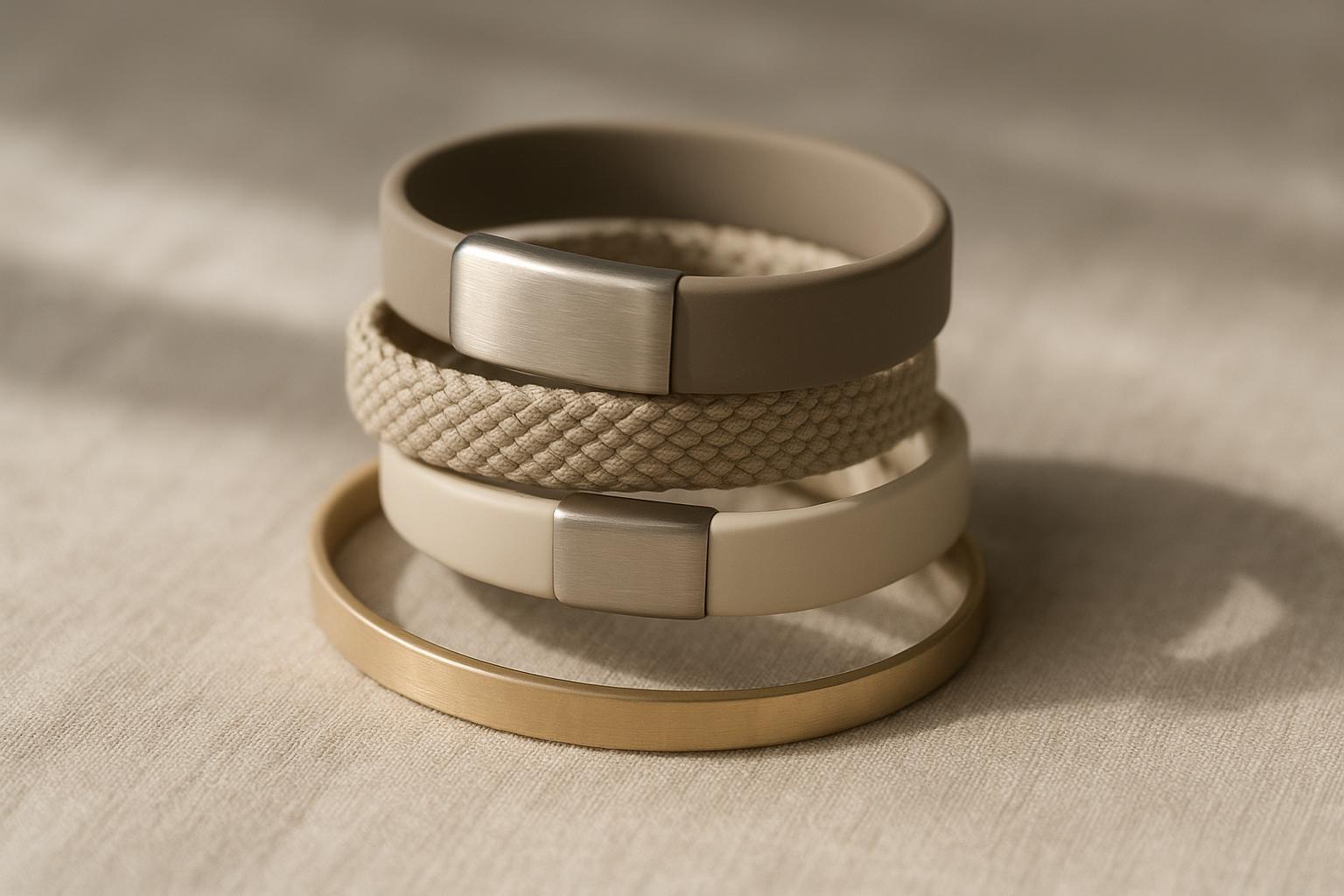
Designer bands and bracelets are the alternative for people who like the outcomes of tracking (sleep, recovery, readiness) but don’t want a mini-phone on the wrist.
The “quiet luxury” appeal is straightforward: a band can disappear under tailoring, doesn’t raise questions in a meeting, and is often more comfortable than a ring during training.
WHOOP 5.0 and WHOOP MG
WHOOP sits in the screenless category: you wear it for continuous tracking and review results in the app rather than being pulled into notifications.
WHOOP positions both WHOOP 5.0 and WHOOP MG as screen-free wearables with 14+ days of battery life, per its launch coverage in Introducing WHOOP 5.0 and WHOOP MG.
What matters for a luxury buyer is the workflow: this is typically the cleanest path if you want recovery and sleep data without adding another surface for alerts.
Bellabeat Ivy bracelet/pendant
Bellabeat Ivy is a clear example of “wellness jewelry” thinking: it is designed as an elegant bracelet, with data kept private until you choose to open the app.
Bellabeat describes Ivy as tracking metrics such as heart rate, respiratory rate, cardiac coherence, activity, and sleep on the Bellabeat Ivy bracelet.
If rings feel too specific—too tied to one look or one hand—Ivy’s bracelet approach is often easier to style across wardrobes.
Discreet luxury band options
At the high end, “band options” is less about which device is popular and more about what you can live with every day:
If you want fewer interruptions: choose screenless tracking over smartwatch-style notifications.
If you travel frequently: prioritize multi-day battery and charging convenience.
If you dress formally: look for neutral materials, refined clasp hardware, and a silhouette that reads like jewelry rather than sports gear.
How to verify: Before you buy, check three things in the companion app settings: what data is collected by default, what can be exported, and what requires an account/cloud sync. If the answers are vague, that’s a red flag—especially in the luxury segment.
Pendants and premium audio
This is the category many ring buyers miss: wearables that deliver utility without asking you to change your style.
Smart pendant wearables
A smart pendant wearable typically prioritizes comfort, discretion, and “always-on” presence. In practice, this form factor is best when you care about lightweight tracking and habit reinforcement more than deep sport metrics.
If you’re choosing a pendant for luxury reasons, focus on the fundamentals: build quality, attachment system, charging method, and whether the app experience is quiet enough to match the aesthetic.
B&O Beoplay EX earbuds
Premium audio is an underrated alternative to rings because it’s already part of how many executives move through the day: calls, travel, and focus.
Bang & Olufsen positions Beoplay EX as “wireless noise-cancelling earbuds” with active noise cancellation in a luxury design frame on the B&O Beoplay EX earbuds.
For a buyer who wants discretion, the advantage is simple: earbuds don’t broadcast “health tracking.” They broadcast taste—and they solve a real daily problem.
Buyer's guide for HNWIs
If you’re buying at the high end, the decision is rarely “which device has more sensors.” It’s: what becomes effortless—and what becomes annoying.
Craftsmanship and visible status
Luxury wearables are judged the way watches and jewelry are judged.
Materials you can feel: titanium, sapphire crystal, ceramic, refined strap textiles.
Finishing and hardware: clasp quality and edge finishing matter more than spec sheets.
Design restraint: a device that looks expensive without shouting about it.
In other words, visible status is less about branding and more about quiet confidence—a piece that looks intentional.
Wellness depth and battery reality
This is where many ring buyers miscalculate.
A ring is comfortable for sleep, but its battery and charging cadence can still create gaps. Meanwhile, some luxury watches (and some screenless bands) can give you longer continuity—especially on travel.
When you compare options, be honest about your real week.
Do you want 24/7 tracking, or only sleep and recovery?
Will you tolerate daily charging, or do you need multi-day freedom?
Do you want training guidance, or just clean baseline metrics?
Ecosystem and privacy choices
For HNWIs, the most expensive failure is not a dead battery—it’s a sloppy data boundary.
Start with ecosystem reality. A smartwatch can be deeply tied to your phone OS and services. A screenless band may feel more platform-agnostic. A pendant may prioritize discretion but rely heavily on a single app experience.
Then evaluate privacy like an executive would evaluate any sensitive workflow:
Data flow: what lives on-device vs what requires account sync.
Permissions: what the app can read/write on your phone.
Separation: whether you can keep “work” and “personal” boundaries clean.
If your use case includes confidential communications, travel coordination, and high-sensitivity accounts, it can be useful to pair a discreet wearable with a phone setup designed for that kind of control. VERTU’s perspective on the highest-risk moments—often the “handoff” between apps, permissions, and cached data—is outlined in its guide to luxury AI phone privacy protection.
And if you value a concierge-style ownership layer (where support is part of the product, not a ticket queue), VERTU also frames that experience through its exclusive VERTU concierge service and its broader view on luxury phones: discretion, security, and service.
Conclusion
The fastest upgrade path beyond smart rings is to decide what you actually want from the wearable.
If you want a wrist instrument, start with a luxury smartwatch.
If you want continuous tracking without distractions, consider a screenless band or a jewelry-forward bracelet.
If you want discretion through convenience, add premium audio to your daily kit.
How to choose comes down to three anchors: ecosystem, travel/battery reality, and style priorities. When those align, the “best wearable” becomes obvious.
A final timing note: in the high end, waiting for the right edition and the right materials is often the smartest move. The device you’ll still enjoy wearing next year is the one that looks and feels like it belongs to you.
Disclosure: This article references VERTU pages. Editorial judgment remains the priority.
![Top 10 Tourbillon Watches for Men [2026 Latest]](https://cdn.sanity.io/images/e0gp1l2g/production/8cb6bc45133cf9453382fc7d074465af588bb610-1800x1080.webp?w=180&h=180&q=78&auto=format&fit=crop)
![Top 10 Tourbillon Watches for Men [2026 Latest]](https://cdn.sanity.io/images/e0gp1l2g/production/8cb6bc45133cf9453382fc7d074465af588bb610-1800x1080.webp?w=800&h=450&q=82&auto=format&fit=crop)
![Top 10 Anniversary Gift Watches for Men [Full Guide]](https://cdn.sanity.io/images/e0gp1l2g/production/00dfa030a876edbe6ea7b146f6b1d8197c7656b0-3840x1860.webp?w=800&h=450&q=82&auto=format&fit=crop)