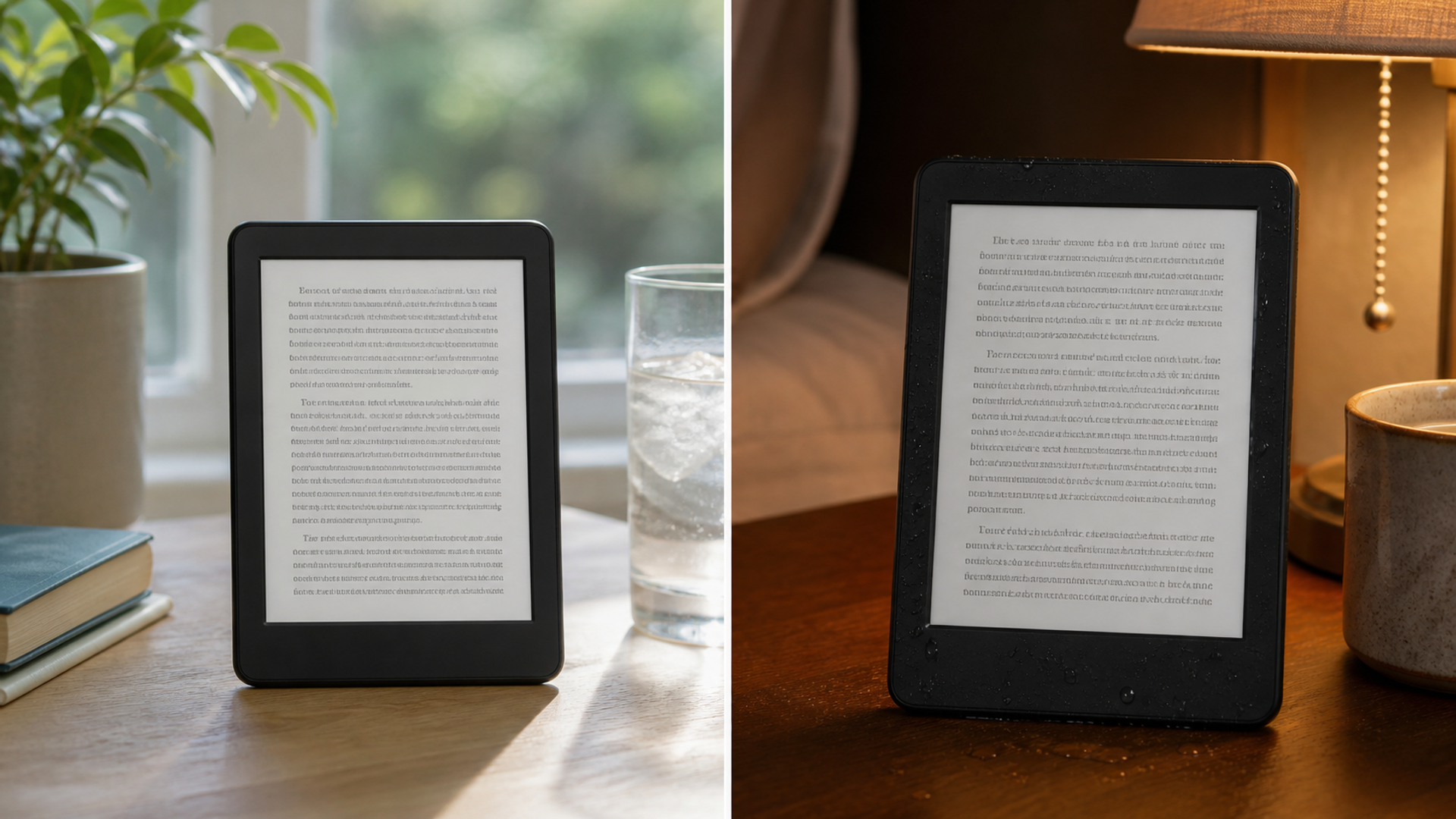
Kindle is both Amazon's e-reader family name and the name of its entry model, while Paperwhite is a step-up line within that family. Generation matters: screen size, front light, warmth control, waterproofing, storage and software support change over time. The right comparison is between two exact devices sold in the buyer's market, not between remembered labels.
Start with where you read
Choose the base Kindle when low weight, lower cost and straightforward dry-environment reading dominate. Choose Paperwhite when its exact larger display, lighting controls, waterproofing or battery claims solve a recurring habit. Keep the current reader when software, battery and library access remain sound and the upgrade lacks a measurable reading benefit.
| Decision factor | Base Kindle | Kindle Paperwhite | Keep the current reader |
|---|---|---|---|
| Reading location | Dry commuting and home reading dominate | Bath, pool or variable light recur | The current device already covers the route |
| Screen | Compact size and low mass are preferred | The exact larger display improves comfort | A larger panel would reduce portability |
| Front light | Basic adjustable light is enough | Warmth and finer control matter at night | External room light solves the issue |
| Water exposure | Waterproofing is not needed | The exact model's water-resistance terms cover the use | Avoid risky locations instead of upgrading |
| Library and software | The account and formats work | The account and formats work with added hardware value | Unsupported formats require another ecosystem |
| Upgrade value | Lower purchase cost wins | Recurring benefits justify the premium | Battery service or continued use is stronger |
This kindle vs paperwhite matrix is the article's working value object. Read the kindle vs paperwhite rows together: the decisive failure mode depends on this topic's evidence, operating context and reader objective.
What the model names establish
Evidence 1. Amazon's device-identification guidance uses model and generation details because Kindle hardware with similar names can have different specifications.
Evidence 2. Paperwhite features vary by generation, so display size, lighting, waterproof rating and storage must be checked on the exact product page or device information screen.
Evidence 3. E-ink refresh behaviour differs from a tablet display and suits text reading, but it does not make every PDF, comic, browser page or note-taking workflow equally comfortable.
Evidence 4. Battery claims depend on brightness, wireless use and reading duration; an older battery's real endurance should be measured before replacement.
Reader-visible sources checked for this article:
digprjsurvey.amazon.com — reader-visible current or official evidence
digprjsurvey.amazon.com — reader-visible current or official evidence
For kindle vs paperwhite, these sources establish only the claims inside their documented scope. Recheck every changeable specification, availability condition, price, policy or service term in the relevant market before acting.
Test a complete reading week
Read reading location as a stop/go test: dry commuting and home reading dominate supports the first option; bath, pool or variable light recur supports the second; and the current device already covers the route supports the third. Record which source proves the condition and when it was checked.
A buyer can resolve screen without starting from a brand preference. Ask whether compact size and low mass are preferred; compare that with whether the exact larger display improves comfort; then use a larger panel would reduce portability as the third route's safeguard. An unknown condition stays unknown.
On front light, popularity is not enough. The evidence for option one is that basic adjustable light is enough. Option two means warmth and finer control matter at night. Option three is rational where external room light solves the issue. Recheck any changeable term immediately before commitment.
The decision changes at water exposure. Choose the first path only if waterproofing is not needed; move to the second when the exact model's water-resistance terms cover the use; use the third when avoid risky locations instead of upgrading. Save the downside that would make this row fail.
For library and software, the first route works when the account and formats work; the second requires the account and formats work with added hardware value. The control for the third is unsupported formats require another ecosystem. Verify this row against the exact product, property, account or environment before it can reverse the decision.
The upgrade value row exposes a practical boundary. Route one assumes lower purchase cost wins, while route two is defensible only when recurring benefits justify the premium. Route three depends on battery service or continued use is stronger. If that evidence is absent, keep the more reversible option.
Facts that would reverse the current choice
Reversal control 1 — Reading location. Before choosing Base Kindle, write down how the decision changes if “Dry commuting and home reading dominate” proves false. Do the same for Kindle Paperwhite and “Bath, pool or variable light recur”. Keep the Keep the current reader route available until “The current device already covers the route” is verified. This control belongs to kindle vs paperwhite; update it from the cited source or exact supplier rather than copying a generic checklist.
Reversal control 2 — Screen. Before choosing Base Kindle, write down how the decision changes if “Compact size and low mass are preferred” proves false. Do the same for Kindle Paperwhite and “The exact larger display improves comfort”. Keep the Keep the current reader route available until “A larger panel would reduce portability” is verified. This control belongs to kindle vs paperwhite; update it from the cited source or exact supplier rather than copying a generic checklist.
Reversal control 3 — Front light. Before choosing Base Kindle, write down how the decision changes if “Basic adjustable light is enough” proves false. Do the same for Kindle Paperwhite and “Warmth and finer control matter at night”. Keep the Keep the current reader route available until “External room light solves the issue” is verified. This control belongs to kindle vs paperwhite; update it from the cited source or exact supplier rather than copying a generic checklist.
Reversal control 4 — Water exposure. Before choosing Base Kindle, write down how the decision changes if “Waterproofing is not needed” proves false. Do the same for Kindle Paperwhite and “The exact model's water-resistance terms cover the use”. Keep the Keep the current reader route available until “Avoid risky locations instead of upgrading” is verified. This control belongs to kindle vs paperwhite; update it from the cited source or exact supplier rather than copying a generic checklist.
Reversal control 5 — Library and software. Before choosing Base Kindle, write down how the decision changes if “The account and formats work” proves false. Do the same for Kindle Paperwhite and “The account and formats work with added hardware value”. Keep the Keep the current reader route available until “Unsupported formats require another ecosystem” is verified. This control belongs to kindle vs paperwhite; update it from the cited source or exact supplier rather than copying a generic checklist.
Reversal control 6 — Upgrade value. Before choosing Base Kindle, write down how the decision changes if “Lower purchase cost wins” proves false. Do the same for Kindle Paperwhite and “Recurring benefits justify the premium”. Keep the Keep the current reader route available until “Battery service or continued use is stronger” is verified. This control belongs to kindle vs paperwhite; update it from the cited source or exact supplier rather than copying a generic checklist.
Identify exact generations
Record model number, release generation, storage, firmware and market. Compare current official specifications line by line rather than using an old review for a newer device.
Run a seven-day reading log
Track minutes, lighting, hand fatigue, page turns, charging and water exposure across commuting, bed and travel. The recurring friction becomes the upgrade requirement.
Test difficult documents
Open the largest PDF, borrowed library book, annotation workflow and multilingual title actually used. Confirm account region and lending support before hardware prestige.
Price ecosystem switching
Include cases, subscriptions, library access, exported notes and resale. A small hardware gain can be outweighed by lost access or duplicated purchases.
Three reading habits
Light commuter reader
The base Kindle can win when compact weight and price matter more than display size. Define the fact that would reverse this recommendation before committing.
Night and poolside reader
Paperwhite can justify its premium when the exact lighting and water-resistance features are used often. Define the fact that would reverse this recommendation before committing.
Owner of a healthy recent device
Keeping the current reader is stronger when the new model does not change a recurring task. Define the fact that would reverse this recommendation before committing.
Action checklist
Record exact model numbers.
Compare current generations.
Weigh devices with cases.
Test night lighting.
Open real PDFs.
Verify library support.
Measure old battery.
Check waterproof terms.
Price accessories.
Define the upgrade trigger.
Continue the decision
The linked VERTU articles expand adjacent parts of the kindle vs paperwhite decision. They do not substitute for the external evidence above.
The Kindle-Paperwhite verdict
Choose the base Kindle when low weight, lower cost and straightforward dry-environment reading dominate. Choose Paperwhite when its exact larger display, lighting controls, waterproofing or battery claims solve a recurring habit. Keep the current reader when software, battery and library access remain sound and the upgrade lacks a measurable reading benefit.
Keep the kindle vs paperwhite decision reversible until its material cost, safety, access, privacy and compatibility facts are verified. Unknown evidence stays unknown; it is never silently scored as favourable.