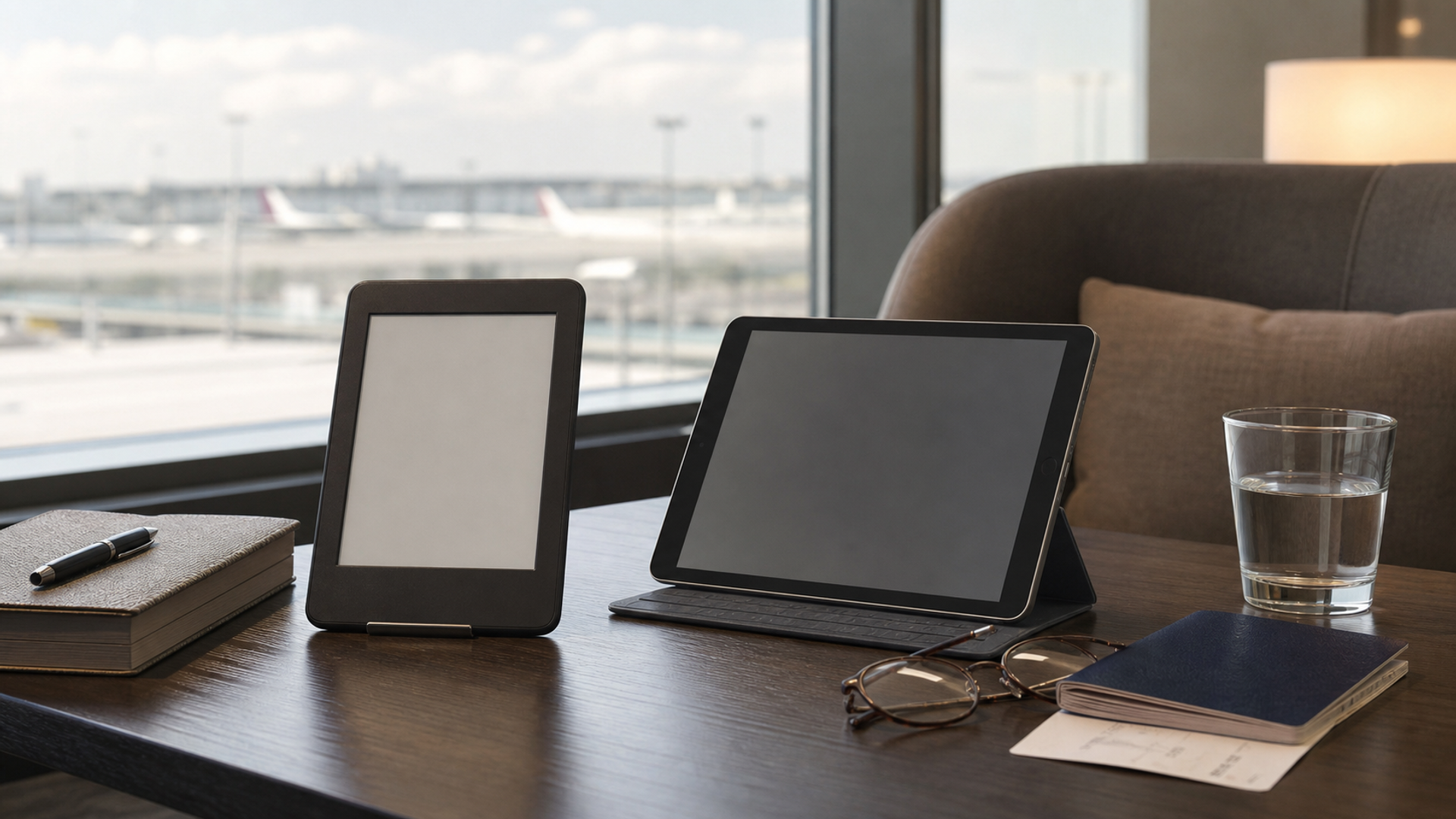
An e-reader and a tablet both fit in a business traveller’s bag, but they create different reading environments. An e-reader prioritises a focused reading surface and long battery life; a tablet adds documents, video, email and annotation at the cost of more distraction and more charging. The best choice depends on what the traveller reads, how often they work offline and whether one device must replace several others.
Choose the reading behaviour
Choose a dedicated e-reader when long-form reading, low distraction and battery endurance lead; a tablet when documents, meetings, colour content and broad apps matter; or a two-device kit when reading quality and work capability are both non-negotiable. Check library access, file formats, screen comfort, connectivity and charging before treating a headline screen size as the answer.
| Decision factor | Dedicated e-reader | Tablet-led travel device | Two-device reading kit |
|---|---|---|---|
| Reading pattern | Long-form books dominate | Documents, colour and mixed media matter | Reading and work are both essential |
| Battery | Multi-day reading without charging is valued | Daily charging is acceptable | Two devices share the workload |
| Distraction | A focused surface is a feature | Apps and notifications are useful | Reading is separated from work |
| Documents | Simple PDFs and notes are enough | Markup, calls and office apps matter | A full work workflow is required |
| Travel conditions | Low glare and compact weight lead | Connectivity and versatility lead | Bag space is available |
| Library and files | The chosen store and formats fit | Many services and formats are needed | Books and work files are kept separate |
This best e reader 2026 matrix is the article's working value object. Read the best e reader 2026 rows together: the decisive failure mode depends on this topic's evidence, operating context and reader objective.
What display and library evidence can prove
Evidence 1. Amazon’s current Kindle information describes the Paperwhite as a dedicated reading device; exact display, lighting, storage and waterproofing claims belong to the current model page.
Evidence 2. Kobo’s e-reader catalogue shows a different ecosystem and model range, so library, file and regional availability should be checked for the traveller’s market.
Evidence 3. Apple’s current iPad information demonstrates the tablet’s broader app, colour and document capability, but that versatility also creates more charging and notification choices.
Evidence 4. Project Gutenberg’s open ebook catalogue demonstrates that content availability is part of an e-reader decision; exact titles, formats and rights still need to be checked for the reader’s market.
Reader-visible sources checked for this article:
amazon.com — reader-visible current or official evidence
kobo.com — reader-visible current or official evidence
apple.com — reader-visible current or official evidence
gutenberg.org — reader-visible current or official evidence
For best e reader 2026, these sources establish only the claims inside their documented scope. Recheck every changeable specification, availability condition, price, policy or service term in the relevant market before acting.
Compare an e-reader with a tablet
On reading pattern, popularity is not enough. The evidence for option one is that long-form books dominate. Option two means documents, colour and mixed media matter. Option three is rational where reading and work are both essential. Recheck any changeable term immediately before commitment.
The decision changes at battery. Choose the first path only if multi-day reading without charging is valued; move to the second when daily charging is acceptable; use the third when two devices share the workload. Save the downside that would make this row fail.
For distraction, the first route works when a focused surface is a feature; the second requires apps and notifications are useful. The control for the third is reading is separated from work. Verify this row against the exact product, property, account or environment before it can reverse the decision.
The documents row exposes a practical boundary. Route one assumes simple PDFs and notes are enough, while route two is defensible only when markup, calls and office apps matter. Route three depends on a full work workflow is required. If that evidence is absent, keep the more reversible option.
Read travel conditions as a stop/go test: low glare and compact weight lead supports the first option; connectivity and versatility lead supports the second; and bag space is available supports the third. Record which source proves the condition and when it was checked.
A buyer can resolve library and files without starting from a brand preference. Ask whether the chosen store and formats fit; compare that with whether many services and formats are needed; then use books and work files are kept separate as the third route's safeguard. An unknown condition stays unknown.
Facts that would reverse the current choice
Reversal control 1 — Reading pattern. Before choosing Dedicated e-reader, write down how the decision changes if “Long-form books dominate” proves false. Do the same for Tablet-led travel device and “Documents, colour and mixed media matter”. Keep the Two-device reading kit route available until “Reading and work are both essential” is verified. This control belongs to best e reader 2026; update it from the cited source or exact supplier rather than copying a generic checklist.
Reversal control 2 — Battery. Before choosing Dedicated e-reader, write down how the decision changes if “Multi-day reading without charging is valued” proves false. Do the same for Tablet-led travel device and “Daily charging is acceptable”. Keep the Two-device reading kit route available until “Two devices share the workload” is verified. This control belongs to best e reader 2026; update it from the cited source or exact supplier rather than copying a generic checklist.
Reversal control 3 — Distraction. Before choosing Dedicated e-reader, write down how the decision changes if “A focused surface is a feature” proves false. Do the same for Tablet-led travel device and “Apps and notifications are useful”. Keep the Two-device reading kit route available until “Reading is separated from work” is verified. This control belongs to best e reader 2026; update it from the cited source or exact supplier rather than copying a generic checklist.
Reversal control 4 — Documents. Before choosing Dedicated e-reader, write down how the decision changes if “Simple PDFs and notes are enough” proves false. Do the same for Tablet-led travel device and “Markup, calls and office apps matter”. Keep the Two-device reading kit route available until “A full work workflow is required” is verified. This control belongs to best e reader 2026; update it from the cited source or exact supplier rather than copying a generic checklist.
Reversal control 5 — Travel conditions. Before choosing Dedicated e-reader, write down how the decision changes if “Low glare and compact weight lead” proves false. Do the same for Tablet-led travel device and “Connectivity and versatility lead”. Keep the Two-device reading kit route available until “Bag space is available” is verified. This control belongs to best e reader 2026; update it from the cited source or exact supplier rather than copying a generic checklist.
Reversal control 6 — Library and files. Before choosing Dedicated e-reader, write down how the decision changes if “The chosen store and formats fit” proves false. Do the same for Tablet-led travel device and “Many services and formats are needed”. Keep the Two-device reading kit route available until “Books and work files are kept separate” is verified. This control belongs to best e reader 2026; update it from the cited source or exact supplier rather than copying a generic checklist.
Start with the document queue
List what is read on flights, in hotels and between meetings: novels, reports, marked-up PDFs, slides or email. If the queue is mostly long-form text, an e-reader’s focus can be a meaningful advantage. If the traveller needs colour charts, signatures, collaboration or multiple work apps, a tablet is more appropriate. Keep the document workflow concrete rather than calling every file a PDF problem.
Test a full travel day
Use the device from the airport to the hotel with the same brightness, case and charging kit planned for the trip. Note eye comfort, reflections, battery, keyboard need and the temptation to switch apps. The best travel device reduces friction during the tired part of the itinerary, not only in a controlled home test.
Check library and file access by region
Verify the store, subscription, library-lending path, file formats, DRM, offline downloads and account logins in the market where the device will be used. A device with an excellent screen is not useful when the traveller cannot legally or conveniently open the intended reading material offline.
Make distraction an explicit design choice
A tablet can combine maps, messages, video calls and documents, but notifications can fragment reading. Use focus modes, separate profiles or a dedicated e-reader when attention is valuable. Do not assume willpower is a product feature; configure the device so the preferred behaviour is easy.
Three reading-device situations
Long-haul reader
A dedicated e-reader is persuasive when books and long reports dominate and the traveller wants a calm, low-charge device. Define the fact that would reverse this recommendation before committing.
Executive who edits documents
A tablet wins when markup, colour, meetings and apps are central to the trip. Define the fact that would reverse this recommendation before committing.
High-frequency reader with a full work kit
Two devices can be rational if the reading experience is valuable enough to justify the extra weight and charging. Define the fact that would reverse this recommendation before committing.
Action checklist
List the exact travel documents.
Test the screen in daylight and cabin light.
Check offline access and file formats.
Verify library and store availability.
Measure a full day’s battery use.
Configure focus and notification modes.
Check case and charging weight.
Test notes and PDF markup.
Confirm support in the destination market.
Keep account recovery available offline.
Continue the decision
The linked VERTU articles expand adjacent parts of the best e reader 2026 decision. They do not substitute for the external evidence above.
The e-reader verdict
Choose a dedicated e-reader when long-form reading, low distraction and battery endurance lead; a tablet when documents, meetings, colour content and broad apps matter; or a two-device kit when reading quality and work capability are both non-negotiable. Check library access, file formats, screen comfort, connectivity and charging before treating a headline screen size as the answer.
Keep the best e reader 2026 decision reversible until its material cost, safety, access, privacy and compatibility facts are verified. Unknown evidence stays unknown; it is never silently scored as favourable.