The practical answer to how to travel with watches is to give each piece its own protected space, pack only the watches you expect to wear and establish a repeatable routine for changing between them. With more than one watch, the task is managing the unworn pieces as carefully as the one on your wrist. Start with the itinerary, then check the fit of each watch inside its actual travel compartment.
Key Takeaways
- Assign each watch a clear role before deciding how many to pack.
- Use a separate, properly fitted compartment for every unworn watch.
- Check clearance around the case, crown, clasp and any decorative setting.
- Keep chargers and other loose accessories apart from watch surfaces.
- Change one watch at a time and return the removed piece to its assigned place.
Which watches should you travel with?
Give each proposed watch a reason to make the journey. Write a brief itinerary with the occasions you expect, then name the piece you would actually choose for each. The aim is a useful rotation rather than a miniature version of the whole collection.
A second watch might be intended for an evening occasion, a different strap preference or a change in personal style. Treat those as your reasons, not evidence that either watch is suitable for swimming, sport or a particular environment. Check the maker's instructions before assigning a demanding activity to a watch.
Review the overlaps. If two pieces would serve the same occasions and neither is a clear preference, consider leaving one at home. This is an editorial packing rule, not a universal maximum. A longer trip may justify more variety, but every additional watch should have an assigned compartment and a realistic place in the rotation.
Finish by deciding which watch you will wear at departure and where the other pieces will go. Avoid solving that question while standing beside an open bag with loose watches on the bed.
What watch case should you use for travel?
Use the watch itself to check the proposed holder, not merely its advertised capacity. A case described as holding several watches still needs to accommodate your particular shapes, straps and clasps. As an editorial check, place one watch in its intended compartment and examine its position before closing the container gently.
Look for clearance around the crown, pushers, case edges and strap attachment points. Check whether the clasp rests against the back of the watch or against another hard surface. The aim is separation without forcing the watch into a position that requires pressure to close the lid.
If a cushion is used, check the strap around that cushion rather than tightening it simply to stop movement. Ask the case maker about a suitable holder when the fit is uncertain. A loose sleeve around an unsuitable cushion does not establish that the complete arrangement is appropriate.
For a wide or sculpted watch, check the height as well as the width. Inspect the lid while it is still open and confirm that a hinge, zip or fastening will not need to press against the watch when closed. Do not test clearance by forcing the container shut.
How should you carry more than one watch through travel?
Arrange each piece so that it has its own space throughout the journey. In its watch-care guidance, AIG recommends a padded jewellery portfolio or watch box for unworn watches during travel and advises carrying them by hand. That is collection-care guidance, not a promise of protection or a statement of airline baggage rules.
For a multi-watch arrangement, examine what happens when the carrier is held in the positions you would normally use. Keep the container closed for this check and handle it gently; there is no reason to shake a packed watch case. Reopen it and look for obvious movement or contact that calls for a different holder.
Keep charging cables, spare straps, tools and other loose items in a separate accessory pouch. If your carrier has a dedicated accessory section, verify that its contents cannot intrude into a watch compartment. Do not rely on an unfastened flap as the only separation between a connector and a watch face.
Pack only accessories confirmed for the relevant model. Label similar-looking items so that you can identify the correct one without trial and error. Treat any charging or care procedure as model-specific rather than borrowing instructions from another watch in the same bag.
Account for shape and decorative detail
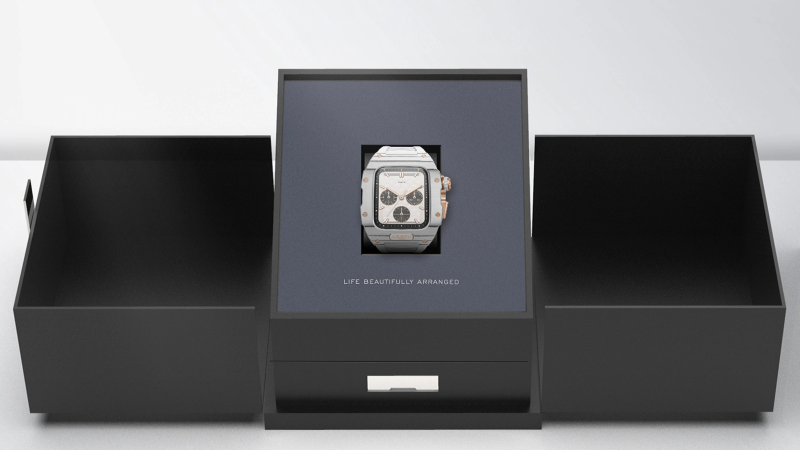
Different designs justify different packing checks. The current VERTU knowledge material describes the Grand Watch with a tonneau, or barrel-shaped, exterior and a sapphire mirror. For travel planning, use that documented form as a reason to check the holder's shape and clearance, not as proof of resistance to knocks.
The Fusion Hamlet Design Diamond Watch Limited Edition is a gem-set design in VERTU's Fusion family. For a piece with decorative setting, ask the maker about the appropriate travel support and inspect where the lining would touch it. Do not assume that a holder used for a plain case will suit every embellished design.
These examples illustrate two questions: does the carrier support the watch's actual form, and does it leave room for the exterior details? They do not establish that the watches need identical holders or that one design is inherently a better travel choice.
If the correct packing arrangement is unclear, seek model-specific guidance before departure. Avoid improvising a tight wrap around settings, controls or protruding details simply to make the piece fit an available slot.
Make changing watches a short, consistent process
Change one watch at a time over a clear, stable surface. This is a suggested handling routine: prepare the empty compartment, remove the worn watch, return it to that space, then take out the next piece. Keep the carrier within reach so that neither watch needs a temporary place on a bathroom ledge or bedside edge.
- Prepare: clear a suitable area and identify the compartment reserved for the watch you are removing.
- Return: put the removed piece into its holder, checking that its strap and clasp sit as intended.
- Select: remove the next watch without leaving other compartments unnecessarily open.
- Reset: close the carrier and put the accessory pouch back in its agreed place.
Keep the same compartment assignments during the trip. A small packing note can identify the watches and their spaces without becoming another elaborate inventory system. The value is a clear answer to a simple question: where should each unworn piece be now?
Do not combine a watch change with cleaning, strap adjustment and charging unless you have the correct instructions and a suitable place for each task. Separate the jobs so that an interrupted routine does not leave several loose components spread across the room.
Run a departure and return check
Before leaving each accommodation, check the carrier, accessory pouch and any place you actually used for charging. Count the watches against the rotation you packed, including the one on your wrist. Confirm the carrier is closed before placing it back in your bag.
On returning home, unpack deliberately rather than leaving the travel case buried in luggage. Look over the pieces in good light and follow their individual care instructions. If you notice a loose decorative element, an unusual clasp position or visible damage, ask the appropriate service contact before attempting an improvised repair.
This guide concentrates on physical organisation and handling. Insurance, customs, documentation and destination-specific security decisions require their own preparation; a well-arranged carrier does not answer those questions.
What should be checked at the security checkpoint?
TSA's travel checklist advises removing bulky jewellery and placing valuable items in carry-on luggage when required. It does not provide a universal rule that every watch must go through a detector on the wrist. Use a case with a separate padded compartment for each watch, keep it under your control and follow the officer's instructions. Check the case's actual internal dimensions against the watch and bracelet; there is no single safe case size for all watches.
Frequently asked questions
How many watches should I take?
Take the smallest rotation that serves your actual plans. Add another only when you can explain its role and provide an appropriate separate compartment.
Can two watches share one compartment?
Choose separate spaces instead. Before departure, check each holder with the individual watch and avoid arrangements that leave cases, clasps or decorative details touching one another.
Should I pack every charger I own?
No. Identify the charging equipment confirmed for the watches you are taking, and keep it apart from their surfaces. Check any applicable carrier requirements separately.
Conclusion
A useful travel rotation is easy to pack, change and account for. Give each watch a role, a suitable compartment and a consistent return routine. That is the most practical starting point for how to travel with watches: organise the unworn pieces, keep loose hardware separate and leave no watch dependent on a temporary resting place.