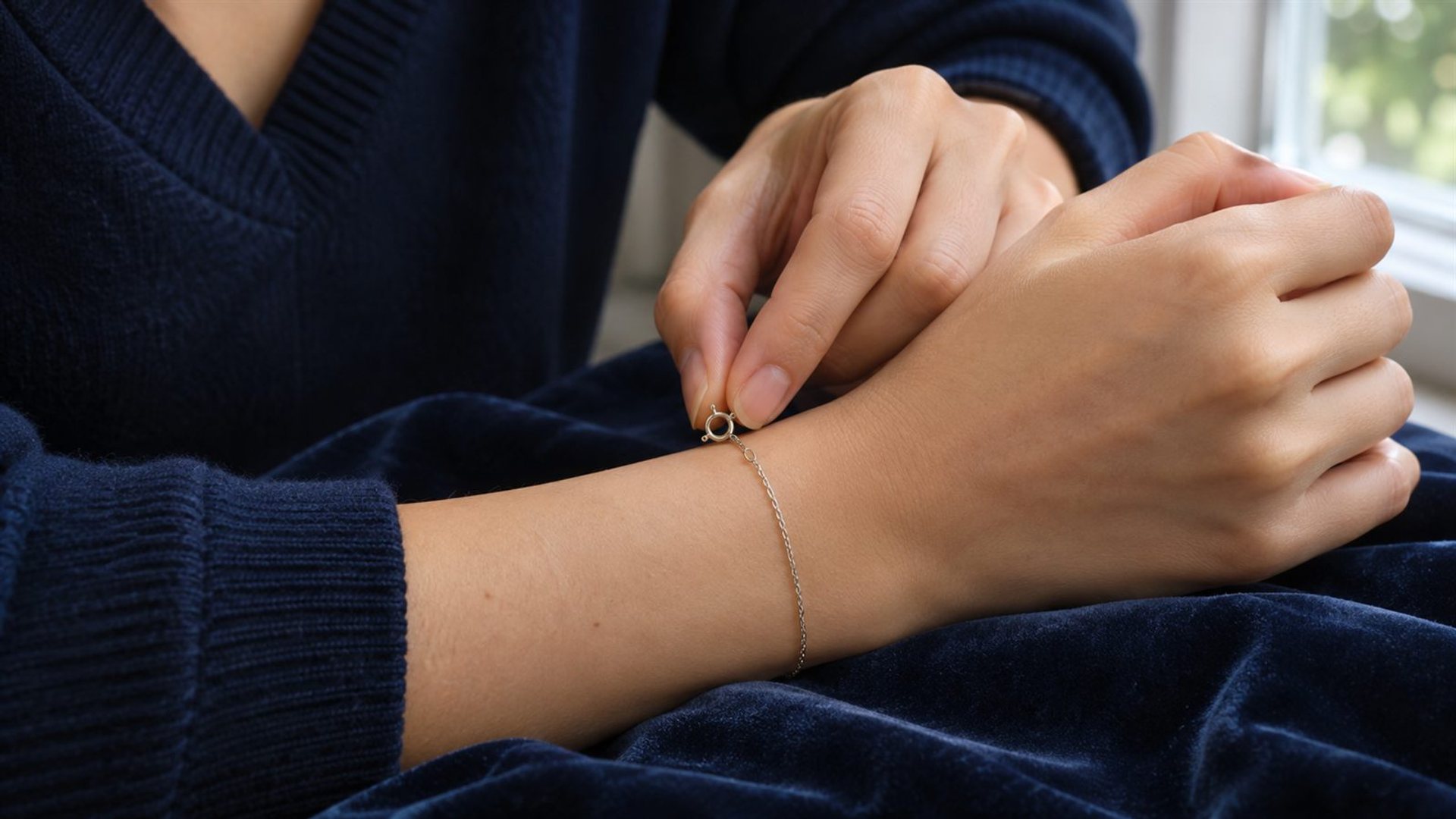
How to put on a bracelet by yourself depends on the clasp. First identify the closure, sit over a soft surface, lay the bracelet around your wrist and hold its loose end steady. Then use your free hand to bring the other end into place. A lobster clasp, toggle and hinged bangle each needs a different movement; forcing a catch you do not recognise can damage a valuable piece.
What should you do before trying to fasten it?
Look closely at the clasp while the bracelet is off your wrist. Open and close it once over a folded towel or soft mat so you understand which part moves and which part must remain still. Remove rings or other bracelets that could catch on the mechanism. Good light and a stable chair make a greater difference than speed. If the piece is delicate, place a second soft surface under your hands so a slip does not send it to the floor.
Check the fit. If the chain barely reaches around your wrist, fastening it one-handed will be difficult even with the right technique. A bracelet that is too loose can slide away just as you catch the clasp. Do not pull hard to make the ends meet. Adjust an intended sizing section only according to the maker's instructions. If the bracelet uses a proprietary opening, read its manual before trying a generic jewellery trick.
How do you fasten a lobster clasp alone?
A lobster clasp has a small spring-operated gate that hooks onto a ring. Place the bracelet around the wrist with the ring end resting near the underside, where you can see it. Hold that ring against the wrist with a fingertip of the same hand, or carefully use a removable jewellery helper designed to hold the end without pressure on stones or plating. With your free hand, open the gate, guide it around the ring and release it fully.
Pause before letting go. A gate that catches only the edge of the ring may appear closed while still being insecure. Check visually that the ring sits inside the clasp and that the spring gate has returned to its resting position. Give a very light, controlled pull over your soft work surface. If the gate sticks or does not close, stop using the bracelet and arrange a repair assessment. Do not bend the clasp with pliers.
A piece of low-tack tape is sometimes suggested to hold a chain end temporarily. It can leave residue or pull a finish, so it is unsuitable for many plated, pearl-set, leather or delicate pieces unless the maker approves it. The same caution applies to clips or hooks improvised from household objects. A purpose-made helper with a smooth grip is preferable, but even that should avoid the decorative face and any vulnerable setting.
What is the easiest way to close a toggle bracelet?
A toggle consists of a bar and a loop. The bar passes through the loop lengthwise and turns across it to hold the bracelet closed. Rest the loop on the inside of your wrist and hold it steady with the hand wearing the bracelet. Use the free hand to pass the bar fully through, then let it settle perpendicular to the opening. Check that the bar has not slipped back through.
Toggle security depends on its proportions and the bracelet's fit. If the loop is unusually large relative to the bar, or the bracelet is very loose, it may come undone during ordinary movement. A method that helps you fasten the piece does not fix a poor-fitting closure. Test the bracelet gently over a soft surface, and ask the maker or a qualified jeweller about adjustment if it repeatedly releases.
How do hinged and fold-over clasps differ?
Hinged bangles and fold-over clasps often need two sections aligned before they click. Open the bracelet on the soft surface and identify the intended hinge path. Place it around the wrist without twisting the hinge, then use the free hand to fold the moving section in the direction shown by the maker. Press only where the instructions indicate. A reassuring click can be useful, but not every design has the same sound or pressure.
Cartier's Panthère bracelet instructions demonstrate a particular fold-over sequence. They are instructions for that Cartier design only. Tiffany's Lock instructions likewise specify an opening notch for its own bangle. Do not transfer either method to a bracelet with a different hinge. If the halves do not align naturally, remove the piece and check the exact model guidance.
Some screw-secured bracelets are intentionally difficult to put on alone. Cartier advises assistance for certain LOVE bracelet configurations. If a product manual calls for a second person or a dedicated tool, follow that instruction rather than trying to accomplish the same task with one hand. The goal is to wear the piece safely, not to prove that every clasp can be managed solo.
Can you slide a bracelet over your hand instead?
Only if the bracelet is designed to stretch or pass over the hand without opening. A rigid bangle may be made for that route, but a closed chain or hinged bracelet may not be. Pandora's product guidance explicitly says its relevant bracelet clasp should be opened for putting it on and taking it off; rolling the closed bracelet over the hand can strain its construction. Use the instructions for your exact piece.
Trying to pull a too-small chain across the knuckles can stress links and settings, even if it eventually reaches the wrist. If the hand is larger than the bracelet's intended opening, a clasp extender or a different size may be the answer, provided the maker offers one. Do not rely on a temporary stretch that the material was never designed to tolerate.
What should LUMINA AI Bracelet owners check?
The VERTU LUMINA AI Bracelet is described on its official page as an adjustable jewellery-led connected bracelet with mother-of-pearl, zircon and gold-plated stainless steel. The published wearing range is 140–200 mm. Those facts help an owner think about fit and protecting the decorative surface, but they do not establish a specific one-handed clasp sequence. Check the instructions for the exact LUMINA edition or ask VERTU support to demonstrate the closure before using a generic method.
A connected bracelet introduces parts that should not be treated like an ordinary loose chain. Avoid pulling on its central element, inserting a tool near electronics, or soaking the piece in an attempt to loosen a clasp. If you cannot identify the moving part, put it down and seek model-specific guidance. The LUMINA fit guide is a separate resource for checking how the adjustable range sits on a wrist; fit and fastening are related but different decisions.
How can you avoid dropping or damaging the bracelet?
Work above a soft table or bed rather than standing over tile. Keep the bracelet within a small area so a dropped end does not swing against a hard surface. Do not fasten it while walking or holding another object. If the clasp is tiny, pause and use better lighting rather than repeatedly pinching it. A mirror can help you see the underside, but direct sight over a table is usually more controllable.
Once closed, check three things: the catch is fully seated, any secondary safety element is engaged, and the bracelet can move comfortably without sliding off. This is a light inspection, not a force test. If the closure opens unexpectedly, take the piece off. Repeated attempts to bend it tighter may hide wear or cause further damage. Ask the maker or a qualified jeweller to inspect the mechanism.
Frequently asked questions
Can I use tape to hold the bracelet end?
Only if the maker says the adhesive is safe for that finish. Residue or pulling can mark delicate materials. A smooth purpose-made holder or another person's help may be safer.
Why won't my lobster clasp close?
The ring may be misaligned, the gate may be obstructed or the spring may be faulty. Stop if a gentle repositioning does not solve it; do not force the metal.
Is every bracelet designed for one-handed fastening?
No. Some proprietary and screw-secured designs call for another person or a specific tool. Follow the exact product instructions.
Should I keep wearing a bracelet with a loose clasp?
No. A closure that releases under light normal handling risks loss. Remove it and seek an appropriate service assessment.
Conclusion
Learning how to put on a bracelet by yourself starts with recognising its clasp and creating a safe place to work. Stabilise one end, close the other without force, then verify that the catch is seated. Lobster, toggle and hinged designs require different movements; an unfamiliar or unreliable closure deserves maker-specific help. For a connected piece, consult the VERTU LUMINA AI Bracelet details and its current instructions before attempting a generic jewellery method.