Watch movement types tell you how a watch gets its energy and keeps time. For a first purchase, the practical choice is usually between hand-wound mechanical, automatic mechanical and quartz; light-powered quartz adds another ownership pattern. None is inherently the “best” watch. Your choice depends on how often you wear it, how much setting you welcome, and whether precision or mechanical character matters more.
What is a watch movement?
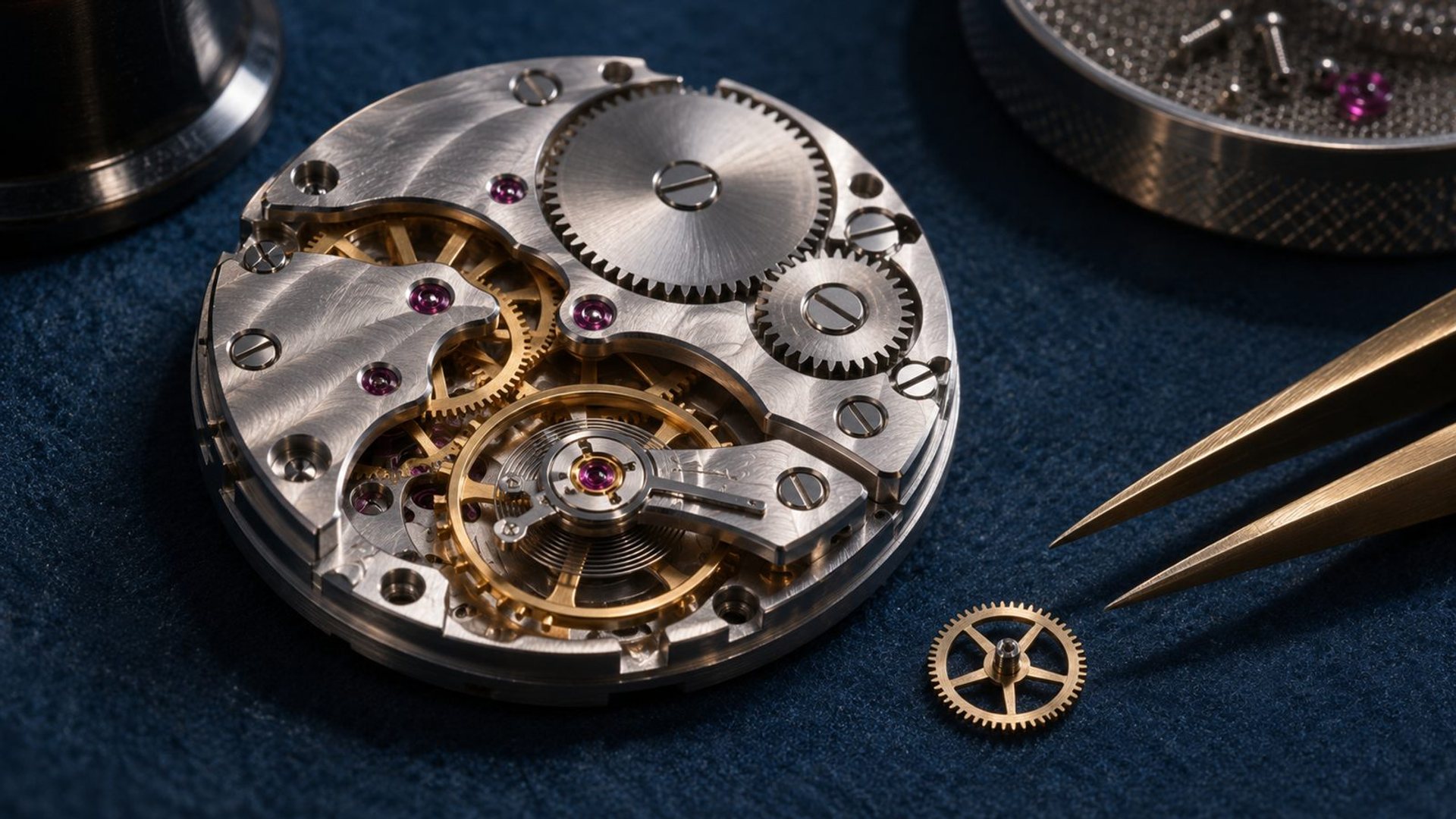
The movement is the system that drives a watch's display and regulates its pace. In a traditional analogue watch, the hands can look similar even when the machinery beneath them is entirely different. A mechanical movement releases energy stored in a mainspring through a train of wheels and a regulating system. A quartz movement uses electrical power and a quartz oscillator to time the hands or digital display. The visible dial alone does not establish which system is inside.
For buying purposes, separate three questions. Where does energy come from? How is time regulated? What does the owner need to do to keep the watch running? This avoids a common confusion: “automatic” describes a way of winding a mechanical mainspring, while “solar” describes a way of charging an electronically regulated watch. Neither label, by itself, is a quality grade.
How does a manual-wind movement work?
A manual-wind watch stores energy when you turn its crown. The mainspring then releases that energy as the movement runs. It is a deliberate routine: you wind the watch at intervals specified by its maker and reset it if it runs down. The appeal is the direct connection to the mechanism and, sometimes, a case design without an automatic rotor. The cost is that the owner must remember the routine.
A first-time buyer should ask for the calibre, stated power reserve, winding instructions and service guidance for the exact reference. Do not assume that a hand-wound watch needs attention at precisely the same hour every day; reserve varies. Nor should you force the crown after resistance. The owner's manual, not a generic online rule, should govern winding. If you rotate between several watches, expect to set a manual model whenever its reserve has expired.
What makes an automatic movement different?
An automatic watch is still mechanical. A moving weight, usually called a rotor, winds the mainspring as the watch moves with its wearer. This can make daily ownership convenient for someone who wears the same watch often. It does not make the watch self-sustaining while it sits unworn in a drawer. If its stored energy runs out, it stops and needs setting again.
Activity and wear time affect winding. A desk-bound day may not contribute the same energy as an active one, and the maker's instructions may recommend an initial manual wind. Seiko's mechanical-watch guidance explains that wearing conditions, temperature and the amount wound can alter a movement's daily rate. That is a more useful expectation than a promise that every automatic watch keeps identical time in every situation.
Before buying, check power reserve, accuracy specification, crown operation, warranty and service options for the actual calibre. Ask whether the reference can be manually wound and whether it has a stop-seconds function if precise setting matters to you. An automatic watch suits an owner who enjoys mechanics and tolerates occasional resetting; it is less convenient for someone who wants to leave a watch untouched for weeks and find it running.
Why do buyers choose quartz?
A quartz watch uses an electronically regulated oscillator. In many models a replaceable battery supplies power; in others the energy source differs. Quartz is often chosen for straightforward setting and dependable timekeeping with less day-to-day attention than a mechanical watch. The exact accuracy, battery life and replacement procedure remain model-specific, so ask for the published specification rather than assuming all quartz watches perform alike.
Quartz does not mean disposable, and mechanical does not automatically mean superior craftsmanship. Case design, dial execution, durability, repairability and after-sales service are separate questions. A well-made quartz watch may be the better daily companion for someone who needs the time ready at a glance and does not want to wind or reset it after a quiet week. A buyer who values a visible escapement or a winding ritual may still prefer mechanical ownership.
Is light-powered quartz a separate movement type?
It is best understood as a quartz watch with a different way to obtain energy. A light-sensitive component converts available light to electricity and charges a storage cell. Citizen's Eco-Drive explanation describes its own light-powered technology; its charging and running claims apply to the specified Citizen models, not every light-powered watch. This option can reduce routine battery changes, but it still needs the light exposure and maintenance described in its manual.
Ask how the chosen model charges, how long it can run after a full charge, what happens in extended darkness and how the storage cell is serviced. The attraction is convenience for someone who wants quartz regulation with a different charging habit. It is not an automatic mechanical movement simply because the owner need not change a conventional battery regularly.
Where do Spring Drive and hybrid systems fit?
Some technologies resist a simple three-box chart. Seiko describes Spring Drive as using a mainspring with a regulator that controls mechanical, electrical and electromagnetic energy, rather than a conventional escapement. It has its own behaviour, ownership instructions and model specifications. Calling it merely “automatic” or merely “quartz” misses the mechanism that makes it different.
Other hybrids can combine mechanical-looking displays with electronic timing or power generation. Read the maker's exact calibre description. If a sales page uses a broad label without naming how power is stored and time regulated, ask for clarification. A first watch purchase does not require memorising every hybrid. It requires being able to identify which daily responsibilities belong to the watch you are considering.
How should a first-time buyer compare the options?
Begin with frequency of wear. If this will be your only watch and you enjoy a small daily ritual, manual winding can be satisfying. If it will be worn most days and you want mechanical character without a separate winding routine, an automatic is a logical candidate. If you alternate watches or need one ready after long periods in a drawer, quartz may be easier. If regular light exposure fits your habits, light-powered quartz deserves consideration.
Next, compare the costs of ownership rather than only the ticket price. Ask about service availability, intervals recommended by the manufacturer, parts support, battery or storage-cell replacement, water-resistance checks after opening the case and warranty exclusions. Mechanical service and electronic component work are different jobs. A retailer who cannot answer how the exact model is supported after sale has left out a significant part of the buying decision.
Finally, try the watch on. Movement type will not rescue a case that is uncomfortable or a dial that is hard to read. Check thickness under your cuff, crown comfort, weight, legibility and how quickly you can set it. Photographing a specification sheet is useful; wearing the reference for a few minutes tells you whether you want to live with the whole object.
Is a connected watch another kind of movement?
A connected watch follows a different design logic: electronic display, software and rechargeable power are central to its ownership. It should not be sold as though its movement were a hand-wound or automatic mechanical calibre. The VERTU Grand Watch collection is a relevant example for a buyer considering a connected watch alongside traditional timepieces. Its appeal should be assessed through the specific model's display, compatibility, charging and service terms, not through mechanical-movement language.
VERTU's Fusion Hamlet Diamond Watch likewise presents a display-led connected product in its official listing. The ornate exterior does not turn it into a mechanical watch. Compare it with a manual, automatic or quartz analogue watch only after deciding whether you want connected functions and their software and charging commitments. Ask about current regional availability and exact configuration before purchase; neither a product name nor its appearance proves a particular internal calibre.
Frequently asked questions
Is automatic better than quartz?
No. Automatic is attractive for its mechanical system and wearing ritual; quartz may better suit a buyer who prioritises ready-to-use precision and less frequent resetting. Compare the exact models and service support.
Will an automatic watch run forever if I wear it?
No. It needs enough movement to replenish its reserve, and it can stop when unworn or insufficiently wound. Follow the manufacturer's setting and winding instructions.
Does a sweeping seconds hand prove a watch is mechanical?
No. Hand motion is a clue, not proof of a movement type. Check the stated calibre and manufacturer documentation.
Does a light-powered watch have a battery?
It uses electrical storage, but the precise cell and replacement requirements depend on the model. Check the maker's instructions rather than assuming maintenance-free operation.
Conclusion
Understanding watch movement types means matching power source and regulation to the life you actually lead. Choose manual for a deliberate winding ritual, automatic for frequently worn mechanical character, or quartz for simpler readiness; consider light-powered variants and connected watches on their own terms. Compare the exact reference's specifications and after-sales support before deciding, and explore VERTU Grand Watch only if a connected alternative belongs in your shortlist.