To pack a fountain pen for air travel, choose a fill state that suits its mechanism, check that the cartridge or converter is secure, cap the pen firmly and protect it in a case with a small secondary bag. Keep the nib upward where practical, then open it over a tissue after landing. This reduces the consequences of a leak; no packing method guarantees that every pen will remain dry through every pressure and temperature change.
Why can a fountain pen leak during a flight?
A fountain pen contains liquid ink and usually some air. As the aircraft climbs and cabin conditions change, air inside the ink system can expand and push ink toward the feed and nib. A pen with a partly filled reservoir may have more air space than a full one. Movement, a loose filling unit or ink already pooled in the cap can add to the mess. The exact behaviour depends on the pen's construction, not merely on its price.
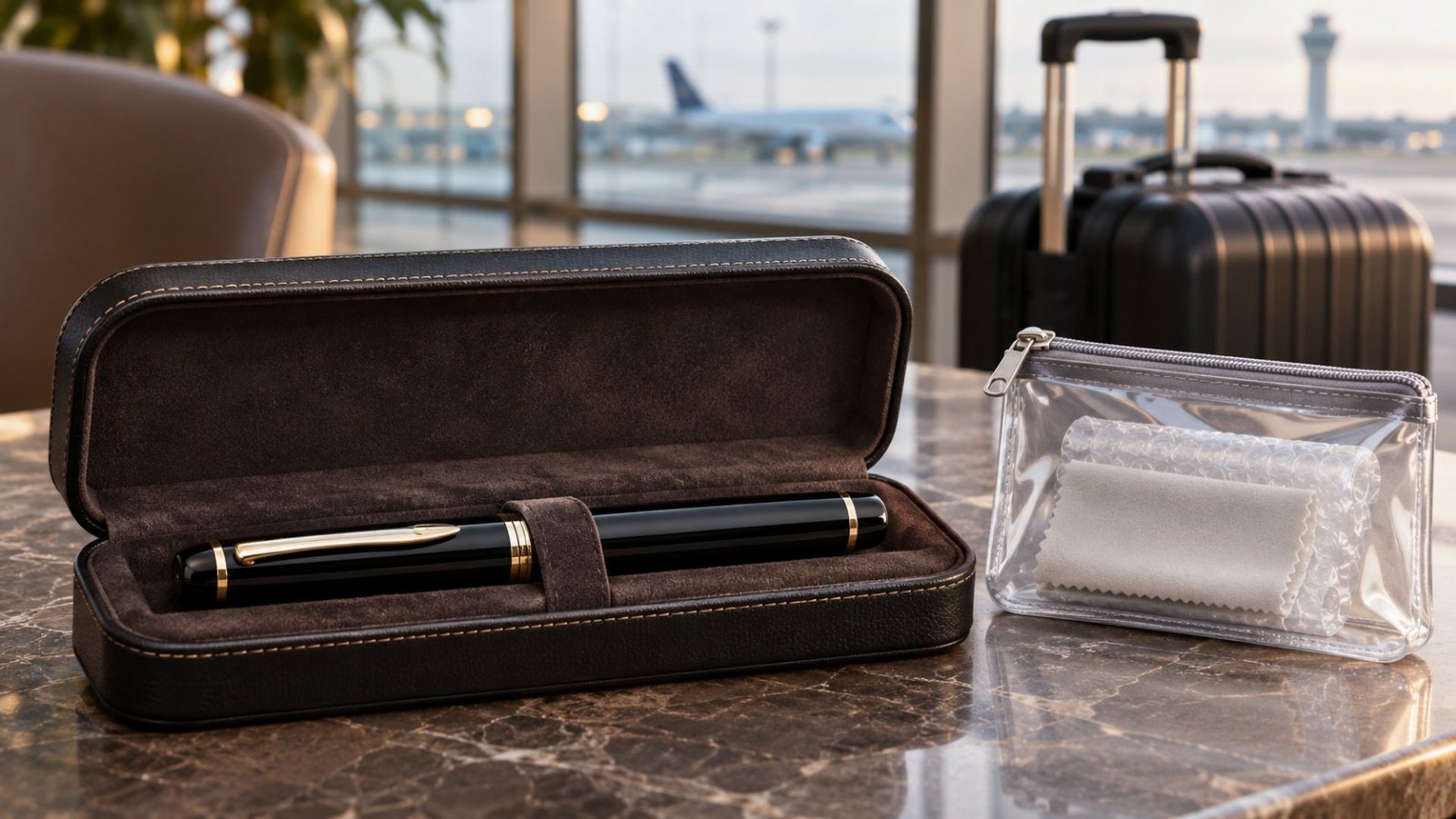
The practical task is to control where ink can travel and to protect other possessions if it escapes. A tight cap helps contain ink near the nib, but it is not necessarily a watertight seal. A pen sleeve protects the finish against abrasion; a small bag or pouch around that sleeve can protect clothing and documents. Think of physical protection and leak containment as two separate layers.
Montblanc's official flight advice recommends a fully filled pen, or a fresh cartridge for a cartridge model, and carrying it nib-up. This is useful maker-specific guidance, not a universal instruction for all filling systems. If your pen maker gives different advice, follow that advice. An empty, cleaned pen can be a conservative choice if you will not need to write until after the trip and can refill safely on arrival.
Choose a fill state before you leave
Decide whether you need to write in transit or immediately after landing. If yes, inspect the filling system rather than filling the pen at the airport in a hurry. A converter should be seated properly, a cartridge should be fully engaged and a piston should operate as the maker describes. Wipe the nib section and the inside of the cap so you can distinguish a fresh leak from old ink. Test a few lines on ordinary paper before packing.
For a model whose maker recommends travelling full, fill it according to the manual and avoid leaving a large air gap. Do not overfill or force an unfamiliar mechanism. If it uses cartridges, a fresh sealed cartridge may be simpler to manage than a half-used one, but only if it is compatible with the pen. Carry a spare in its original packaging or a small protective container; loose cartridges can crack or be misplaced among hard objects.
If you choose to travel empty, clean and dry the pen in advance using the manufacturer's procedure. Emptying it just before boarding can leave ink in the feed or cap. Allow enough time to inspect it after cleaning. An empty pen avoids reservoir ink escaping but does not protect a delicate nib from a drop, so it still belongs in a case. Do not improvise with tape across the nib or force tissue into the cap; both can damage the instrument.
How should the pen sit inside a travel case?
Use a case that prevents the pen from rolling or being crushed, especially if the cap has sculptural or stone-set details. A soft sleeve can protect a finish from keys and zips; a more structured case can shield the pen from pressure in a crowded bag. Neither replaces a leak barrier if you are carrying the pen inked. Put the protected pen in a small sealed pouch that can be cleaned or replaced if ink escapes.
Place the case where it is unlikely to be bent by a laptop or bag frame. If possible, carry it nib-up in an accessible pocket rather than horizontally at the bottom of a suitcase. You cannot keep a pen vertical throughout an entire journey, and it is better to admit that limit than to promise a precise orientation. The goal is to avoid unnecessary inversion during the phases when cabin conditions change.
Keep the pen away from a passport, pale shirt or important contract. A small ink leak can spread far through paper or fabric. For a valuable or sentimental piece, take a condition photograph before departure and carry it in cabin baggage where you can keep track of it. This is ordinary preparation, not a guarantee about airline liability. Check any insurance or travel policy separately if that matters to you.
Pack spare ink as a separate item
Spare cartridges and bottled ink are different packing problems. Keep cartridges sealed and cushioned. For a bottle, close its cap as the maker directs, place the bottle upright in a leak-resistant secondary bag and protect it against impact. Check the bottle's printed capacity rather than relying on how much ink remains inside. A partially used large bottle can still exceed a cabin container limit.
For departures subject to US Transportation Security Administration rules, the TSA travel checklist describes the 3-1-1 arrangement: each carry-on liquid container is 3.4 ounces or less, with containers fitting in one quart-sized clear bag. Check current rules for every departure and transfer point, because another country may apply different procedures. Our fountain pen airport-security guide covers the screening question in detail; the advice here concerns packing against leaks and damage.
If you need a large ink bottle at the destination, compare checked-baggage rules and the risk of rough handling, or buy ink after arrival. A checked bag removes one cabin-liquid concern but can still leak onto clothes. A small travel case for the pen and a separate bottle bag make inspection and cleanup easier than one ornate box containing everything.
What to do before boarding and after landing
Before boarding, confirm that the cap is seated, the filling unit is secure and the pen sleeve is closed. Put a tissue where you can reach it without emptying the bag. Do not uncap the pen repeatedly during ascent or descent simply to check it; opening a pen with ink near the nib can create the mess you were trying to avoid. If you must write in flight, open it carefully over paper and recap it before stowing.
After landing, let the pen settle, then remove it from the pouch over a tissue. Open the cap away from documents and inspect the nib, grip and inside of the cap. A trace of ink inside the cap can be wiped according to the maker's care guidance; a recurring heavy leak may indicate a filling or seal issue. Do not assume it was caused solely by the flight. The VERTU writing-instrument service guide provides a broader care starting point, while the product maker should answer a model-specific fault.
How to handle a VERTU Marengo Fountain Pen
The current VERTU Marengo product page describes cartridge and converter filling and a sculpted cap. VERTU's product knowledge base also identifies its writing system, but neither source establishes a universal flight-leak guarantee. For Marengo, check the selected cartridge or converter, protect the cap and finish in a case and ask VERTU for specific flight-care advice if the pen has leaked before. Do not rely on a broad claim that a writing instrument is “flight-tested” without a relevant test method or service instruction.
Marengo's substantial form makes a snug case especially useful: the instrument should not swing freely against a laptop or other metal objects. Check the case's internal length and clearance around the cap before choosing it; a case marketed for a typical slim pen may not fit every edition. If the pen is bespoke or has unusual decoration, obtain the maker's storage advice rather than pressing it into a generic leather loop.
Frequently asked questions
Should a fountain pen be full or empty on a plane?
Follow the maker's guidance for the exact mechanism. Some makers recommend a fully filled pen to reduce air space; an empty, properly cleaned pen is an option when you can refill later. Neither choice removes the need for a protective case.
Should I put the pen in a plastic bag?
A small secondary bag is sensible leak containment around a capped, protected pen. It does not replace a sleeve or hard case for physical protection and does not guarantee the pen itself will not leak.
Can I carry bottled ink in my cabin bag?
Often, if it meets the applicable liquid rules. For US screening, check the current TSA 3-1-1 limits and the container's stated capacity. Other routes may differ.
What if ink is inside the cap after landing?
Open over a tissue, clean according to the maker's instructions and inspect the filling system. If heavy leakage recurs, seek model-specific service advice before the next trip.
Conclusion
A good flight routine starts before the airport: choose a model-appropriate fill state, check the mechanism, cap and case the pen, and separate spare ink from the instrument. Keep it nib-up where practical and inspect it carefully on arrival. Those modest steps reduce the chance and cost of a leak without pretending that pressure changes can be abolished.