

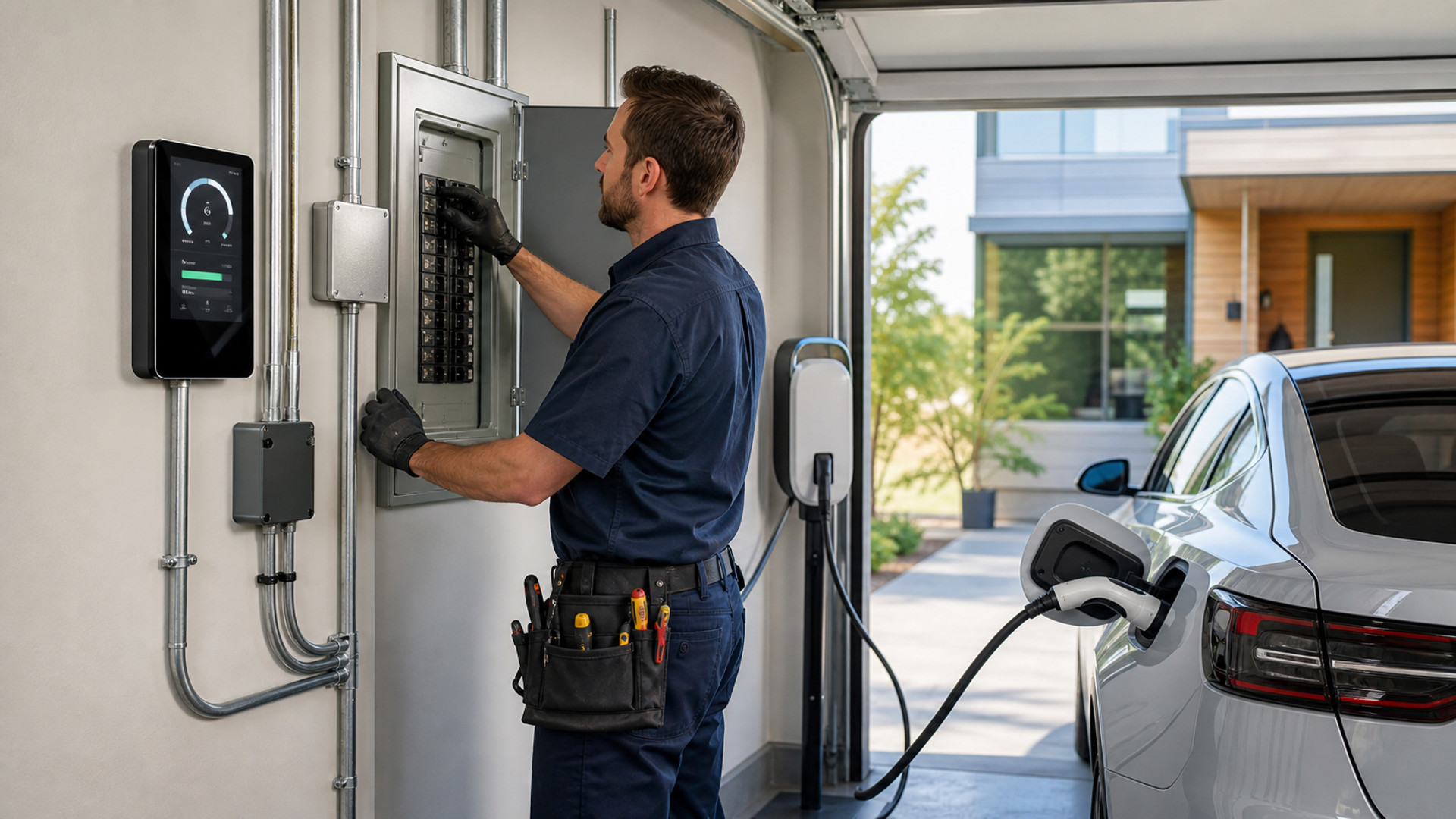
A home EV charger is an electrical project before it is a gadget. Faster equipment does not guarantee faster charging if the car, circuit or building cannot accept it. The useful design starts with daily mileage, overnight dwell time, service capacity, cable route and the possibility of a second electric vehicle.
Start with energy, not amps
Install only the power level the vehicle and home can use safely, then prioritise a clean cable route, certified equipment, load management, tariff scheduling and qualified installation. A modest circuit that reliably restores daily mileage can be better than an expensive upgrade built around maximum theoretical speed.
| Decision factor | Lower-power Level 2 | Higher-power Level 2 | Managed multi-vehicle system |
|---|---|---|---|
| Daily mileage | Enough for predictable moderate driving | Useful for high mileage or short dwell time | Balances two vehicles against household demand |
| Electrical capacity | May fit existing service with fewer changes | Can require panel or service upgrades | Uses dynamic control to avoid simultaneous peaks |
| Vehicle acceptance | Matches many overnight needs | Only helps if the vehicle accepts the rate | Allocates power based on connected vehicles |
| Tariff scheduling | Basic timers may be sufficient | Smart scheduling can reduce peak cost | Coordinates vehicles and household tariff windows |
| Solar and battery | Can use simple timed surplus charging | Needs controls to avoid importing at peak | Best when integrated with energy-management logic |
| Future expansion | Conduit and cable sizing can preserve options | Provides headroom but may overspend today | Designed for a second vehicle from the outset |
This home EV charger comparison matrix is the article's working value object. Read the rows together: the decisive failure mode depends on this topic's evidence, operating context and reader objective.
What official guidance establishes
Evidence 1. The US Alternative Fuels Data Center explains the distinction between charging levels and the role of home electrical infrastructure.
Evidence 2. Tesla's Wall Connector support materials show that installation, commissioning and vehicle compatibility are part of the system rather than properties of the box alone.
Evidence 3. ChargePoint's Home Flex materials illustrate app scheduling and variable circuit configurations, but local codes and qualified installation remain authoritative.
Reader-visible sources checked for this article:
afdc.energy.gov — reader-visible current or official evidence
tesla.com — reader-visible current or official evidence
chargepoint.com — reader-visible current or official evidence
For home EV charger comparison, these sources establish only the claims inside their documented scope. Recheck every changeable specification, availability condition, price, policy or service term in the relevant market before acting.
Design the installation
A buyer can resolve daily mileage without starting from a brand preference. Ask whether enough for predictable moderate driving; compare that with whether useful for high mileage or short dwell time; then use balances two vehicles against household demand as the third route's safeguard. An unknown condition stays unknown.
On electrical capacity, popularity is not enough. The evidence for option one is that may fit existing service with fewer changes. Option two means can require panel or service upgrades. Option three is rational where uses dynamic control to avoid simultaneous peaks. Recheck any changeable term immediately before commitment.
The decision changes at vehicle acceptance. Choose the first path only if matches many overnight needs; move to the second when only helps if the vehicle accepts the rate; use the third when allocates power based on connected vehicles. Save the downside that would make this row fail.
For tariff scheduling, the first route works when basic timers may be sufficient; the second requires smart scheduling can reduce peak cost. The control for the third is coordinates vehicles and household tariff windows. Verify this row against the exact product, property, account or environment before it can reverse the decision.
The solar and battery row exposes a practical boundary. Route one assumes can use simple timed surplus charging, while route two is defensible only when needs controls to avoid importing at peak. Route three depends on best when integrated with energy-management logic. If that evidence is absent, keep the more reversible option.
Read future expansion as a stop/go test: conduit and cable sizing can preserve options supports the first option; provides headroom but may overspend today supports the second; and designed for a second vehicle from the outset supports the third. Record which source proves the condition and when it was checked.
Facts that would reverse the current choice
Reversal control 1 — Daily mileage. Before choosing Lower-power Level 2, write down how the decision changes if “Enough for predictable moderate driving” proves false. Do the same for Higher-power Level 2 and “Useful for high mileage or short dwell time”. Keep the Managed multi-vehicle system route available until “Balances two vehicles against household demand” is verified. This control belongs to home EV charger comparison; update it from the cited source or exact supplier rather than copying a generic checklist.
Reversal control 2 — Electrical capacity. Before choosing Lower-power Level 2, write down how the decision changes if “May fit existing service with fewer changes” proves false. Do the same for Higher-power Level 2 and “Can require panel or service upgrades”. Keep the Managed multi-vehicle system route available until “Uses dynamic control to avoid simultaneous peaks” is verified. This control belongs to home EV charger comparison; update it from the cited source or exact supplier rather than copying a generic checklist.
Reversal control 3 — Vehicle acceptance. Before choosing Lower-power Level 2, write down how the decision changes if “Matches many overnight needs” proves false. Do the same for Higher-power Level 2 and “Only helps if the vehicle accepts the rate”. Keep the Managed multi-vehicle system route available until “Allocates power based on connected vehicles” is verified. This control belongs to home EV charger comparison; update it from the cited source or exact supplier rather than copying a generic checklist.
Reversal control 4 — Tariff scheduling. Before choosing Lower-power Level 2, write down how the decision changes if “Basic timers may be sufficient” proves false. Do the same for Higher-power Level 2 and “Smart scheduling can reduce peak cost”. Keep the Managed multi-vehicle system route available until “Coordinates vehicles and household tariff windows” is verified. This control belongs to home EV charger comparison; update it from the cited source or exact supplier rather than copying a generic checklist.
Reversal control 5 — Solar and battery. Before choosing Lower-power Level 2, write down how the decision changes if “Can use simple timed surplus charging” proves false. Do the same for Higher-power Level 2 and “Needs controls to avoid importing at peak”. Keep the Managed multi-vehicle system route available until “Best when integrated with energy-management logic” is verified. This control belongs to home EV charger comparison; update it from the cited source or exact supplier rather than copying a generic checklist.
Reversal control 6 — Future expansion. Before choosing Lower-power Level 2, write down how the decision changes if “Conduit and cable sizing can preserve options” proves false. Do the same for Higher-power Level 2 and “Provides headroom but may overspend today”. Keep the Managed multi-vehicle system route available until “Designed for a second vehicle from the outset” is verified. This control belongs to home EV charger comparison; update it from the cited source or exact supplier rather than copying a generic checklist.
Calculate the overnight requirement
Convert the household's typical daily distance into an energy estimate using the vehicle's real consumption, then add a winter or adverse-weather margin. Divide by the hours parked at home. This establishes the average power required to recover the day, which is usually lower than the charger's headline maximum. Keep occasional long journeys separate from the daily design.
Audit the electrical service
A qualified electrician should inspect panel capacity, existing large loads, earthing, cable route and local protection requirements. Heat pumps, induction cooking, pools and home batteries may already shape peak demand. Dynamic load management can sometimes avoid a costly service upgrade by reducing vehicle charging when the house needs power elsewhere.
Plan the cable as a physical object
Park the car in both normal orientations and trace the connector route without stretching across a walkway. Consider rain, drainage, impact protection, garage doors and the location of the vehicle's charge port. A neat holster and correct cable length improve daily use and reduce trip hazards more than a polished app.
Preserve the second-car option
Even a one-EV household should consider conduit, panel space, network coverage and mounting for a second unit. Two independent chargers running at full power may be unnecessary. A managed pair can share capacity according to departure times. Document ownership of accounts and access before a property sale or tenancy change.
Four household profiles
A predictable commuter
A lower-power Level 2 circuit may comfortably restore the daily drive overnight. Spend first on installation quality, tariff scheduling and a good cable route. Define the fact that would reverse this recommendation before committing.
A high-mileage driver
Higher power can be justified when the vehicle accepts it and overnight dwell time is short. Verify whether the electrical upgrade changes the economics. Define the fact that would reverse this recommendation before committing.
A two-EV household
Choose a managed system or coordinated schedules. Model simultaneous arrival, next-day departure and household peak loads rather than simply doubling charger capacity. Define the fact that would reverse this recommendation before committing.
Action checklist
Estimate daily energy use.
Confirm vehicle AC charge acceptance.
Measure overnight dwell time.
Get a qualified electrical assessment.
Check local permits and incentives.
Design a safe cable route.
Test Wi-Fi or wired connectivity.
Configure off-peak scheduling.
Plan for a second vehicle.
Store commissioning and warranty records.
Continue the decision
The linked VERTU articles expand adjacent parts of the home EV charger comparison decision. They do not substitute for the external evidence above.
The charger verdict
Install only the power level the vehicle and home can use safely, then prioritise a clean cable route, certified equipment, load management, tariff scheduling and qualified installation. A modest circuit that reliably restores daily mileage can be better than an expensive upgrade built around maximum theoretical speed.
Keep the home EV charger comparison decision reversible until its material cost, safety, access, privacy and compatibility facts are verified. Unknown evidence stays unknown; it is never silently scored as favourable.
![How to Scan Receipts and Documents with Your Phone [Full Guide]](https://cdn.sanity.io/images/e0gp1l2g/production/0db13feec1d5e72b8a8a5f976d1f3e86619c9228-3840x1860.webp?w=180&h=180&q=78&auto=format&fit=crop)
![How to Scan Receipts and Documents with Your Phone [Full Guide]](https://cdn.sanity.io/images/e0gp1l2g/production/0db13feec1d5e72b8a8a5f976d1f3e86619c9228-3840x1860.webp?w=800&h=450&q=82&auto=format&fit=crop)
![Top 10 Two-Tone Carbon-Fibre Watches for Men [2026 List]](https://cdn.sanity.io/images/e0gp1l2g/production/18870799ba33fab0e038968359cd5772d7d7db30-1024x576.webp?w=800&h=450&q=82&auto=format&fit=crop)
![Top 10 Luxury Watches with Digital Complication Displays for Men [Latest]](https://cdn.sanity.io/images/e0gp1l2g/production/c4f6bf8c080f291c39f7cc85c7344ecff2fd3799-1024x553.webp?w=800&h=450&q=82&auto=format&fit=crop)