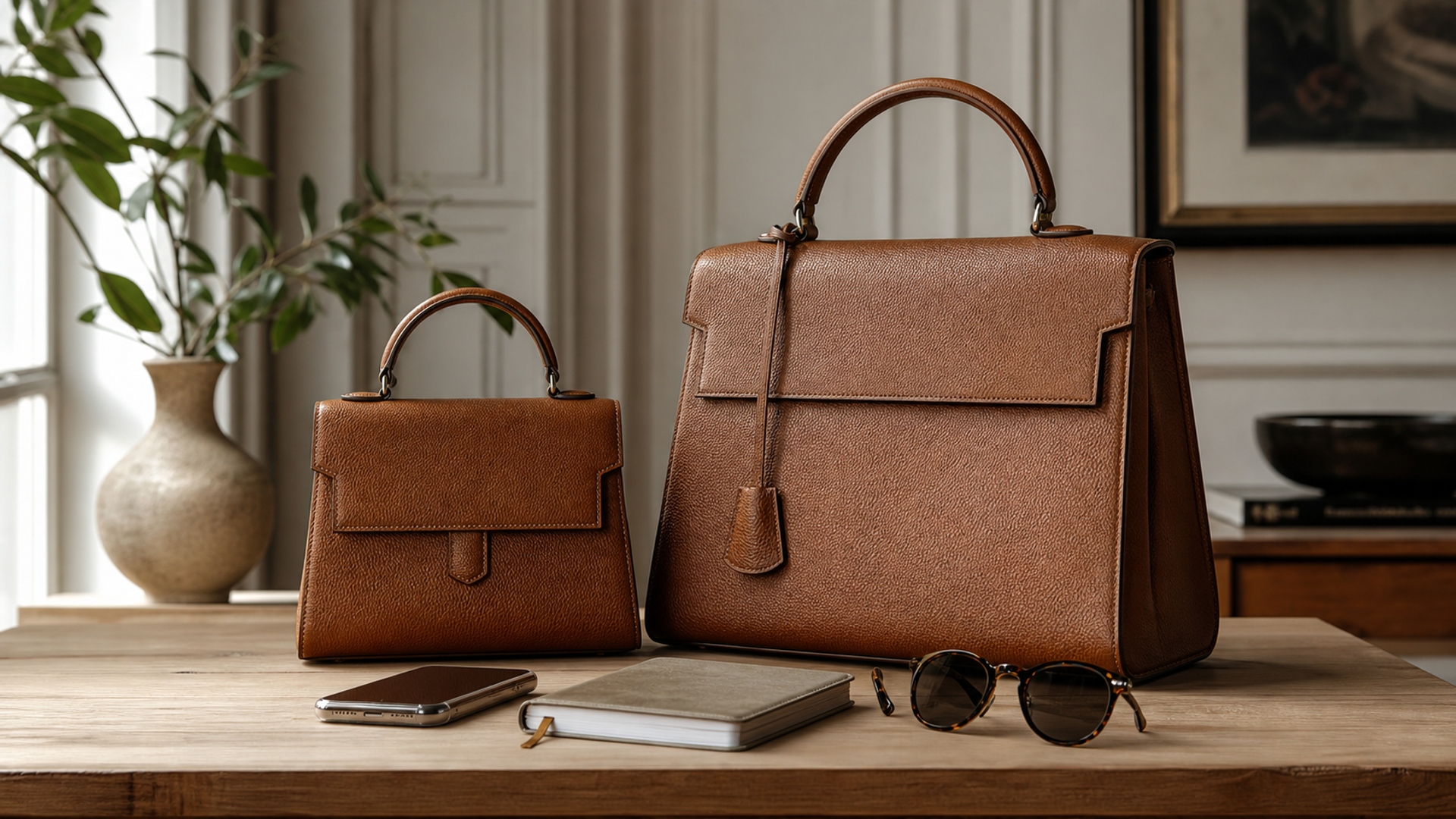
Choose the Kelly 25 if you routinely carry only a phone, slim cardholder, keys and a few small personal items. Choose the Kelly 28 if you want enough margin for eyewear, a larger wallet, travel documents or a second hard case without turning every outing into a packing exercise. The 25 is the more deliberate compact choice; the 28 is usually the easier everyday size.
That answer is more useful than declaring one size universally “better”. A structured top-handle bag does not behave like a soft tote. The shape of the opening, the placement of the closure and the stiffness of the leather all affect what can be loaded comfortably. Three centimetres in nominal base length can therefore produce a bigger practical difference than the number suggests.
The choice also changes with construction. A sharply structured Sellier Kelly and a softer Retourne Kelly of the same nominal size do not present, pack or sit against the body in quite the same way. The right decision is a combination of size, construction, daily object list and desired proportion.
The Kelly 25 versus 28 decision matrix
| Decision factor | Kelly 25 | Kelly 28 | Practical winner |
|---|---|---|---|
| Minimal phone-cardholder-keys load | Comfortable when objects are compact | Comfortable with unused margin | Kelly 25 for deliberate minimalism |
| Full-size eyewear case plus daily essentials | Possible, but object shape can dominate the interior | Easier to arrange without forcing the closure | Kelly 28 |
| Day-to-evening transition | More jewel-like and concise | Still polished, with a stronger daytime presence | Kelly 25 for evening emphasis |
| Airport or rail day | Tight once passport, battery and eyewear are added | More forgiving for travel documents and small accessories | Kelly 28 |
| Petite or compact visual proportion | Makes less visual impact across the torso | Reads as a more traditional day bag | Personal proportion test required |
| Sellier construction | Crisp, formal and capacity-sensitive | Structured but with more packing margin | Kelly 28 for utility |
| Retourne construction | Softer presentation; still compact | Relaxed and generally easier for daily use | Kelly 28 for daily flexibility |
| Collecting logic | Desirability depends on the complete specification and condition | Same: size alone does not determine value | Neither without object-level assessment |
This matrix is a decision aid, not a fit guarantee. Phones, sunglasses cases, portable batteries and key pouches vary substantially. A buyer should test the exact objects, in the exact bag, rather than rely on a generic online packing list.
What “25” and “28” actually tell you
Kelly sizes are conventionally identified by the approximate length of the base in centimetres. Sotheby's explains this nomenclature in its guide to Hermès Kelly bags, which is why the Kelly 25 and Kelly 28 labels provide a useful first comparison.
They do not provide a complete capacity specification. The nominal number does not tell you the clear opening width, the space displaced by the bag's construction or how a rigid glasses case will interact with a phone and wallet. Nor does it mean that every Kelly 25 or 28 will feel identical. Leather, lining, age, storage history and Sellier or Retourne construction all influence the physical experience.
Hermès presents the Kelly as a design with a long history and recognisable closure architecture on its official Kelly collection page. Those defining elements are part of its character, but they also explain why packing should be considered rather than assumed. Opening and closing a carefully structured bag is a different interaction from dropping objects into an open tote.
The useful interpretation is therefore simple: 25 versus 28 is a proportion and capacity starting point, not a substitute for a personal fit test.
When the Kelly 25 makes more sense
The Kelly 25 works best when compactness is the purpose, not an inconvenience to overcome. It suits a wearer who has already reduced the daily load to essentials and wants the bag to remain visually concise.
A realistic compact load might include a phone, slim cardholder, key or small key pouch, lipstick and one or two flat personal items. Even then, object geometry matters. A bulky car key, thick bifold wallet or large hard eyewear case can consume disproportionate room. Two objects may fit individually but become awkward when their rigid edges compete for the same space.
This is why the Kelly 25 should not be bought with a plan to “make it work” through continual rearrangement. If the daily routine always requires sunglasses, a battery pack, medication, travel documents and multiple keys, the compact size may impose friction every time the bag is used. Removing protective cases merely to satisfy a nominal size is usually the wrong trade.
Where the 25 excels is intentional editing. It can move from a daytime appointment to dinner without reading as an oversized day bag. It creates a strong, concentrated proportion and keeps the contents disciplined. For someone who already separates work equipment into another bag, that discipline may be a feature.
The 25 is also a sensible answer when the bag is meant to be one object within an outfit rather than the day's primary carrier. It should not be confused with a small work bag or a practical travel catch-all. Its success depends on accepting its compact brief.
When the Kelly 28 is the more practical choice
The Kelly 28 gives the same recognisable design more breathing room. The extra nominal base length does not turn it into a laptop tote, but it often reduces the number of daily compromises.
For many owners, the decisive object is not the phone; it is the hard eyewear case. Add a larger wallet, keys and a small personal pouch, and a compact interior becomes crowded quickly. The 28 is more likely to let those objects coexist without stacking them tightly against the closure. That margin is valuable when the contents must be accessed repeatedly during the day.
Travel strengthens the case for the 28. A passport, boarding pass or document wallet, charging cable and small battery add flat and three-dimensional objects to the load. The larger size gives more room to separate them, although any buyer should still avoid overpacking or treating the bag as luggage.
The 28 also tends to read more clearly as a day bag. That can be an advantage with tailoring, coats or a taller frame, where the 25 may appear more decorative. Yet proportion is not governed by height alone. Shoulder width, coat volume, preferred carrying position and the visual scale of jewellery and footwear all affect the result.
Sotheby's Kelly buying guide broadly positions the 25 as compact and the 28 as a versatile option. The important point is not to copy another collector's preference. It is to decide whether the added capacity solves a repeated real-world problem.
Sellier versus Retourne changes the decision
Size comparisons often become misleading because construction is treated as a cosmetic detail. It is not.
Sotheby's describes Sellier Kelly bags as having visible external stitching and sharper, more architectural edges, while Retourne construction produces a softer outline because the bag is turned after stitching. The distinction is set out in its ultimate Kelly guide.
A Sellier Kelly generally presents as crisper and more formal. That clarity can make a Kelly 25 look especially precise, but the structured form also discourages optimistic packing. Rigid objects meet rigid boundaries. A Sellier 25 is therefore most convincing when the load is genuinely small.
A Retourne Kelly has a softer visual character and may feel more forgiving in use, but it should not be interpreted as infinitely flexible. Leather should not be stretched around hard objects, and the closure should not be forced. The softer silhouette can make a 28 feel less severe as an everyday bag, which is one reason construction and size should be chosen together.
The cleanest comparison is four-way rather than two-way:
Kelly 25 Sellier: the most compact and architectural option; strongest when formal proportion matters more than capacity.
Kelly 25 Retourne: compact with a softer presence; still dependent on a tightly edited load.
Kelly 28 Sellier: structured daytime polish with more practical margin.
Kelly 28 Retourne: the most relaxed and forgiving everyday proposition of the four, without becoming a large work bag.
Material can further alter the impression, so these are directional judgements rather than universal physical laws.
Run an object test, not an imaginary lifestyle test
The most reliable decision can be made with the objects already used every week. Place them on a table and divide them into three groups.
Non-negotiable objects are carried almost every time: phone, keys, payment cards, essential medication and perhaps eyewear. Situational objects appear several days a week: battery, passport, cosmetics or a compact notebook. Just-in-case objects are carried through habit rather than need.
Measure the hard objects and note which cannot be compressed. Then ask four questions:
Can the non-negotiable set sit flat without stacking pressure on the closure?
Can the most frequently used item be removed without emptying the bag?
Does adding one situational object make the arrangement unstable?
Would a slim insert protect the interior, and how much usable room would it remove?
If the 25 accommodates the non-negotiable set with a small amount of free space, it remains a viable everyday option. If it fits only after removing cases, changing wallet or accepting a precise packing order, the 28 is probably the more honest choice.
Do the same test while wearing the outerwear used most often. A size that looks balanced with a light dress may feel different with a winter coat. Test top-handle and shoulder-strap positions where appropriate, but do not overload the strap simply because hands-free carrying is convenient.
Proportion is personal, but it can still be evaluated
Online discussion often reduces bag proportion to the wearer's height. That is too crude. The relationship between bag and body is affected by where the bag lands, the depth and structure of clothing, and how the person wants the bag to register.
The Kelly 25 concentrates visual attention. It can suit a petite frame, but it can also work as a deliberate miniature accent on a taller wearer. The Kelly 28 has a more conventional daytime scale and can hold its own against tailoring or outerwear. Neither outcome is automatically more elegant.
Use photographs taken from the front and side at normal camera distance, not a close wide-angle mirror image. Include the shoes and coat normally worn with the bag. The goal is to assess the whole silhouette rather than inspect the bag in isolation.
Also consider social context. A bag used mainly for dinners may benefit from the 25's restraint. A bag expected to cover meetings, errands and travel connections is more likely to reward the 28's margin. “Most popular” is not a useful proportion rule.
Do not let resale discussion choose the size for you
Collector demand can affect the relative visibility of different sizes, but no size guarantees a financial result. Sotheby's notes across its collector-focused Hermès guide that material, colour, condition, rarity and specification all influence the market. Transaction costs, authenticity work, storage and changing preferences matter as well.
That makes a use-first decision more defensible. A size that remains unworn because it does not hold the owner's essentials is not made better by a general claim about desirability. Likewise, choosing the larger size solely because it appears “more practical” can be wrong when the intended role is evening use and the load is minimal.
Buyers comparing the broader bag families should separate that question from this size decision. Our Hermès Birkin versus Kelly guide addresses shape and access across the two models, while the Birkin 25 versus 30 guide handles a different size system and use case. Neither should be used as a proxy for Kelly 25 versus 28.
Final verdict
The Kelly 25 is the stronger choice for a compact, intentionally edited carry and a more concentrated day-to-evening proportion. It works when the owner regards limited capacity as part of the design brief.
The Kelly 28 is the safer everyday recommendation for anyone who regularly carries a hard eyewear case, larger wallet, travel documents or several small accessories. Its advantage is not excess space; it is the ability to use the bag without a precise packing ritual.
Then adjust for construction. Choose Sellier when sharp formality is central and the load can respect its structure. Choose Retourne when a softer presentation better matches daily use. Above all, test the exact objects in the exact bag. The right Kelly size is the one that closes naturally, presents in the intended proportion and does not ask its owner to redesign everyday life around it.
Related VERTU reading
Sources and verification
Sources were checked for this 3 August 2026 publication package. Terms and specifications can change; recheck the linked source before acting.