

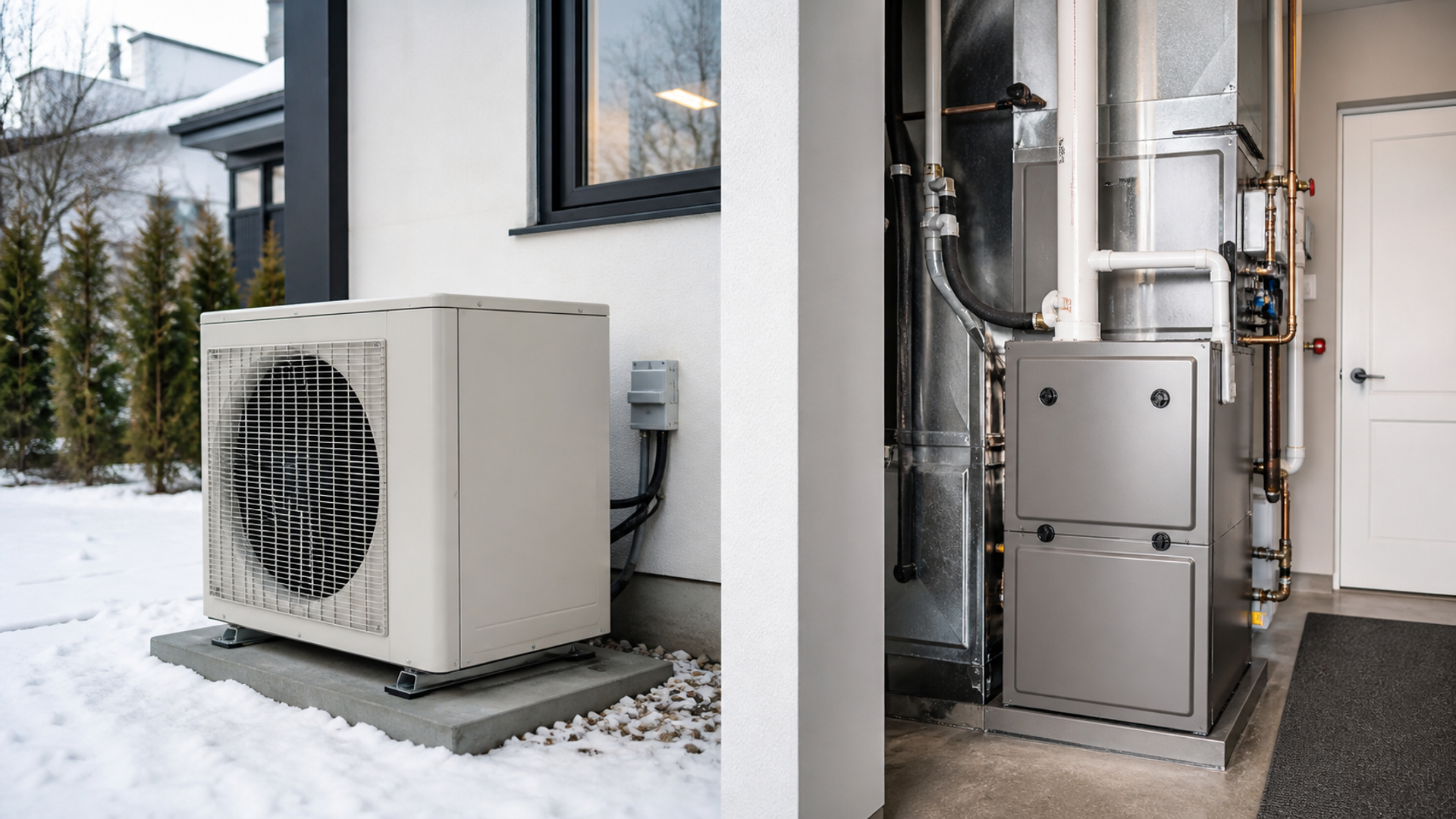
Heat pump versus furnace is a whole-building decision, not an appliance race. An air-source heat pump moves heat and can also cool; a furnace creates heat by burning fuel or using electric resistance. Modern heat pumps can work in cold conditions, but capacity and efficiency change with outdoor temperature. Envelope, ductwork, design load, fuel price, electrical service, refrigerant expertise and backup strategy matter more than a national average.
Start with climate and building load
Choose a correctly sized heat pump when climate-rated performance, electricity, ducts and installer expertise support it, especially when cooling replacement is also due. Choose a furnace when local design conditions, fuel infrastructure and resilient high-temperature output make it the better system. Use dual fuel or a staged envelope-first plan when one technology cannot responsibly cover every condition.
| Decision factor | Heat pump | Furnace | Use a dual-fuel or staged plan |
|---|---|---|---|
| Design temperature | Published low-temperature capacity covers the load | Furnace output reliably covers peak cold | Use dual fuel |
| Envelope | Insulation and air sealing reduce demand | High load remains after practical work | Improve envelope first |
| Ducts | Airflow and static pressure support the system | Existing ducts suit furnace operation | Repair ducts before equipment |
| Utilities | Electrical service and tariff support heat pump use | Fuel supply and venting remain economical | Model both scenarios |
| Cooling | One system replaces heating and cooling | Separate cooling remains suitable | Stage replacements |
| Service | Qualified heat-pump support exists | Furnace expertise and parts are stronger | Choose supported equipment |
This heat pump vs furnace matrix is the article's working value object. Read the heat pump vs furnace rows together: the decisive failure mode depends on this topic's evidence, operating context and reader objective.
How the systems deliver heat
Evidence 1. The US Department of Energy explains that heat pumps transfer heat and can provide both heating and cooling.
Evidence 2. DOE distinguishes air-source, geothermal and other heat-pump systems and stresses climate and installation considerations.
Evidence 3. Heat-pump capacity and efficiency vary with outdoor temperature, so seasonal ratings alone do not prove peak-load fit.
Evidence 4. A furnace decision requires fuel, combustion, venting and carbon-monoxide safety analysis by qualified professionals.
Reader-visible sources checked for this article:
energy.gov — reader-visible current or official evidence
energy.gov — reader-visible current or official evidence
For heat pump vs furnace, these sources establish only the claims inside their documented scope. Recheck every changeable specification, availability condition, price, policy or service term in the relevant market before acting.
Model design temperature and total cost
Read design temperature as a stop/go test: published low-temperature capacity covers the load supports the first option; furnace output reliably covers peak cold supports the second; and use dual fuel supports the third. Record which source proves the condition and when it was checked.
A buyer can resolve envelope without starting from a brand preference. Ask whether insulation and air sealing reduce demand; compare that with whether high load remains after practical work; then use improve envelope first as the third route's safeguard. An unknown condition stays unknown.
On ducts, popularity is not enough. The evidence for option one is that airflow and static pressure support the system. Option two means existing ducts suit furnace operation. Option three is rational where repair ducts before equipment. Recheck any changeable term immediately before commitment.
The decision changes at utilities. Choose the first path only if electrical service and tariff support heat pump use; move to the second when fuel supply and venting remain economical; use the third when model both scenarios. Save the downside that would make this row fail.
For cooling, the first route works when one system replaces heating and cooling; the second requires separate cooling remains suitable. The control for the third is stage replacements. Verify this row against the exact product, property, account or environment before it can reverse the decision.
The service row exposes a practical boundary. Route one assumes qualified heat-pump support exists, while route two is defensible only when furnace expertise and parts are stronger. Route three depends on choose supported equipment. If that evidence is absent, keep the more reversible option.
Facts that would reverse the current choice
Reversal control 1 — Design temperature. Before choosing Heat pump, write down how the decision changes if “Published low-temperature capacity covers the load” proves false. Do the same for Furnace and “Furnace output reliably covers peak cold”. Keep the Use a dual-fuel or staged plan route available until “Use dual fuel” is verified. This control belongs to heat pump vs furnace; update it from the cited source or exact supplier rather than copying a generic checklist.
Reversal control 2 — Envelope. Before choosing Heat pump, write down how the decision changes if “Insulation and air sealing reduce demand” proves false. Do the same for Furnace and “High load remains after practical work”. Keep the Use a dual-fuel or staged plan route available until “Improve envelope first” is verified. This control belongs to heat pump vs furnace; update it from the cited source or exact supplier rather than copying a generic checklist.
Reversal control 3 — Ducts. Before choosing Heat pump, write down how the decision changes if “Airflow and static pressure support the system” proves false. Do the same for Furnace and “Existing ducts suit furnace operation”. Keep the Use a dual-fuel or staged plan route available until “Repair ducts before equipment” is verified. This control belongs to heat pump vs furnace; update it from the cited source or exact supplier rather than copying a generic checklist.
Reversal control 4 — Utilities. Before choosing Heat pump, write down how the decision changes if “Electrical service and tariff support heat pump use” proves false. Do the same for Furnace and “Fuel supply and venting remain economical”. Keep the Use a dual-fuel or staged plan route available until “Model both scenarios” is verified. This control belongs to heat pump vs furnace; update it from the cited source or exact supplier rather than copying a generic checklist.
Reversal control 5 — Cooling. Before choosing Heat pump, write down how the decision changes if “One system replaces heating and cooling” proves false. Do the same for Furnace and “Separate cooling remains suitable”. Keep the Use a dual-fuel or staged plan route available until “Stage replacements” is verified. This control belongs to heat pump vs furnace; update it from the cited source or exact supplier rather than copying a generic checklist.
Reversal control 6 — Service. Before choosing Heat pump, write down how the decision changes if “Qualified heat-pump support exists” proves false. Do the same for Furnace and “Furnace expertise and parts are stronger”. Keep the Use a dual-fuel or staged plan route available until “Choose supported equipment” is verified. This control belongs to heat pump vs furnace; update it from the cited source or exact supplier rather than copying a generic checklist.
Calculate the load
Use a room-by-room professional load calculation rather than replacing by old nameplate size. Include design temperature, insulation, windows, infiltration, occupancy and internal gains. Record the exact model, recipe, room, climate, material or operating condition and the time of the check. Separate observed behaviour from a marketing label, and repeat the test in the intended setting rather than under ideal showroom conditions. If the load is guessed, no efficiency claim can establish comfort or equipment size. Save the evidence that would reverse the choice, because a change in fit, specification, maintenance, service, price or environment must reopen the decision rather than inherit an old conclusion.
Read performance tables
Request capacity and efficiency at local design temperatures and the exact indoor unit combination. Check defrost behaviour, backup heat and balance point rather than relying on one seasonal number. Record the exact model, recipe, room, climate, material or operating condition and the time of the check. Separate observed behaviour from a marketing label, and repeat the test in the intended setting rather than under ideal showroom conditions. If resistance backup dominates expected cold hours, operating cost may reverse the recommendation. Save the evidence that would reverse the choice, because a change in fit, specification, maintenance, service, price or environment must reopen the decision rather than inherit an old conclusion.
Audit distribution
Measure duct leakage, static pressure, airflow, return capacity and room imbalance. For hydronic or ductless alternatives, verify emitter temperature, condensate and placement. Record the exact model, recipe, room, climate, material or operating condition and the time of the check. Separate observed behaviour from a marketing label, and repeat the test in the intended setting rather than under ideal showroom conditions. If distribution cannot deliver the output, replacing the box will not create comfort. Save the evidence that would reverse the choice, because a change in fit, specification, maintenance, service, price or environment must reopen the decision rather than inherit an old conclusion.
Model lifetime risk
Compare equipment, envelope work, electrical upgrade, fuel connection, cooling value, maintenance and repair. Run scenarios for utility-price changes and verify permits, incentives and warranty conditions. Record the exact model, recipe, room, climate, material or operating condition and the time of the check. Separate observed behaviour from a marketing label, and repeat the test in the intended setting rather than under ideal showroom conditions. If local service cannot support the selected refrigerant or controls, theoretical efficiency loses weight. Save the evidence that would reverse the choice, because a change in fit, specification, maintenance, service, price or environment must reopen the decision rather than inherit an old conclusion.
Three climates, three answers
Mild climate replacing air conditioning
A heat pump can combine two functions efficiently. Define the fact that would reverse this recommendation before committing.
Very cold high-load house
A furnace or dual-fuel design may protect peak comfort. Define the fact that would reverse this recommendation before committing.
Leaky home with uneven ducts
Envelope and distribution work should precede equipment selection. Define the fact that would reverse this recommendation before committing.
Action checklist
Calculate room loads.
Use design temperature.
Read capacity tables.
Inspect ducts.
Check electrical service.
Model fuel cost.
Plan backup.
Verify installer certification.
Confirm permits.
Price total ownership.
Continue the decision
The linked VERTU articles expand adjacent parts of the heat pump vs furnace decision. They do not substitute for the external evidence above.
The heating-system verdict
Choose a correctly sized heat pump when climate-rated performance, electricity, ducts and installer expertise support it, especially when cooling replacement is also due. Choose a furnace when local design conditions, fuel infrastructure and resilient high-temperature output make it the better system. Use dual fuel or a staged envelope-first plan when one technology cannot responsibly cover every condition.
Keep the heat pump vs furnace decision reversible until its material cost, safety, access, privacy and compatibility facts are verified. Unknown evidence stays unknown; it is never silently scored as favourable.
![How to Scan Receipts and Documents with Your Phone [Full Guide]](https://cdn.sanity.io/images/e0gp1l2g/production/0db13feec1d5e72b8a8a5f976d1f3e86619c9228-3840x1860.webp?w=180&h=180&q=78&auto=format&fit=crop)
![How to Scan Receipts and Documents with Your Phone [Full Guide]](https://cdn.sanity.io/images/e0gp1l2g/production/0db13feec1d5e72b8a8a5f976d1f3e86619c9228-3840x1860.webp?w=800&h=450&q=82&auto=format&fit=crop)
![Top 10 Two-Tone Carbon-Fibre Watches for Men [2026 List]](https://cdn.sanity.io/images/e0gp1l2g/production/18870799ba33fab0e038968359cd5772d7d7db30-1024x576.webp?w=800&h=450&q=82&auto=format&fit=crop)
![Top 10 Luxury Watches with Digital Complication Displays for Men [Latest]](https://cdn.sanity.io/images/e0gp1l2g/production/c4f6bf8c080f291c39f7cc85c7344ecff2fd3799-1024x553.webp?w=800&h=450&q=82&auto=format&fit=crop)