A diamond grading report is an independent description of a submitted stone under a laboratory's procedures. It is not the diamond, a retail appraisal, a promise of beauty or a guaranteed resale price. Comparing GIA and IGI therefore starts with the exact report number, stone type, measurements and grading scope before any assumption about the laboratory's name.
The short answer for diamond buyers
Choose the individual diamond that offers the best verified combination of cut, colour, clarity, measurements, treatment disclosure, price and seller protections. GIA and IGI both issue report products, but buyers must compare reports of the same type and confirm them with the issuing laboratory. For natural or laboratory-grown diamonds, use the report to narrow the search, inspect the stone or trusted imagery, and obtain a separate appraisal only when insurance value is required.
| Decision factor | GIA-graded stone | IGI-graded stone | Independent recheck or alternative stone |
|---|---|---|---|
| Stone type | Report is for the stated natural or laboratory-grown stone | Report is for the stated natural or laboratory-grown stone | Stone type or treatment disclosure is uncertain |
| Report scope | Services and grading fields match the buying need | Services and grading fields match the buying need | Reports are not like-for-like |
| Verification | Report number and details verify with GIA | Report number and details verify with IGI | Verification fails or physical details conflict |
| Cut evidence | Proportions and trusted images support performance | Proportions and trusted images support performance | Further optical assessment is needed |
| Price | Price is competitive for the exact attributes | Price is competitive for the exact attributes | Seller cannot explain the comparison set |
| Resale and insurance | Market and appraisal needs are understood | Market and appraisal needs are understood | A separate qualified appraisal or different purchase is needed |
This GIA vs IGI diamond certification matrix is the article's working value object. Read the GIA vs IGI diamond certification rows together: the decisive failure mode depends on this topic's evidence, operating context and reader objective.
What grading reports do and do not prove
Evidence 1. GIA's diamond research underpins its grading and identification work, but a laboratory report still describes the submitted stone under a defined service rather than predicting its future market price.
Evidence 2. GIA's grading-service material distinguishes report products and the information they contain, so buyers should compare like-for-like services rather than assuming every document has identical scope.
Evidence 3. GIA provides online report data services that allow a report number and grading details to be checked; the buyer should also match measurements and any inscription to the physical stone.
Evidence 4. IGI states that it applies 4Cs grading to natural and laboratory-grown diamonds and provides report verification, while exact report format, terminology and disclosure should be read on the document itself.
Reader-visible sources checked for this article:
gia.edu — reader-visible current or official evidence
archive.gia.edu — reader-visible current or official evidence
gia.edu — reader-visible current or official evidence
igi.org — reader-visible current or official evidence
igi.org — reader-visible current or official evidence
For GIA vs IGI diamond certification, these sources establish only the claims inside their documented scope. Recheck every changeable specification, availability condition, price, policy or service term in the relevant market before acting.
Compare the stone behind the report
A buyer can resolve stone type without starting from a brand preference. Ask whether report is for the stated natural or laboratory-grown stone; compare that with whether report is for the stated natural or laboratory-grown stone; then use stone type or treatment disclosure is uncertain as the third route's safeguard. An unknown condition stays unknown.
On report scope, popularity is not enough. The evidence for option one is that services and grading fields match the buying need. Option two means services and grading fields match the buying need. Option three is rational where reports are not like-for-like. Recheck any changeable term immediately before commitment.
The decision changes at verification. Choose the first path only if report number and details verify with GIA; move to the second when report number and details verify with IGI; use the third when verification fails or physical details conflict. Save the downside that would make this row fail.
For cut evidence, the first route works when proportions and trusted images support performance; the second requires proportions and trusted images support performance. The control for the third is further optical assessment is needed. Verify this row against the exact product, property, account or environment before it can reverse the decision.
The price row exposes a practical boundary. Route one assumes price is competitive for the exact attributes, while route two is defensible only when price is competitive for the exact attributes. Route three depends on seller cannot explain the comparison set. If that evidence is absent, keep the more reversible option.
Read resale and insurance as a stop/go test: market and appraisal needs are understood supports the first option; market and appraisal needs are understood supports the second; and a separate qualified appraisal or different purchase is needed supports the third. Record which source proves the condition and when it was checked.
Facts that would reverse the current choice
Reversal control 1 — Stone type. Before choosing GIA-graded stone, write down how the decision changes if “Report is for the stated natural or laboratory-grown stone” proves false. Do the same for IGI-graded stone and “Report is for the stated natural or laboratory-grown stone”. Keep the Independent recheck or alternative stone route available until “Stone type or treatment disclosure is uncertain” is verified. This control belongs to GIA vs IGI diamond certification; update it from the cited source or exact supplier rather than copying a generic checklist.
Reversal control 2 — Report scope. Before choosing GIA-graded stone, write down how the decision changes if “Services and grading fields match the buying need” proves false. Do the same for IGI-graded stone and “Services and grading fields match the buying need”. Keep the Independent recheck or alternative stone route available until “Reports are not like-for-like” is verified. This control belongs to GIA vs IGI diamond certification; update it from the cited source or exact supplier rather than copying a generic checklist.
Reversal control 3 — Verification. Before choosing GIA-graded stone, write down how the decision changes if “Report number and details verify with GIA” proves false. Do the same for IGI-graded stone and “Report number and details verify with IGI”. Keep the Independent recheck or alternative stone route available until “Verification fails or physical details conflict” is verified. This control belongs to GIA vs IGI diamond certification; update it from the cited source or exact supplier rather than copying a generic checklist.
Reversal control 4 — Cut evidence. Before choosing GIA-graded stone, write down how the decision changes if “Proportions and trusted images support performance” proves false. Do the same for IGI-graded stone and “Proportions and trusted images support performance”. Keep the Independent recheck or alternative stone route available until “Further optical assessment is needed” is verified. This control belongs to GIA vs IGI diamond certification; update it from the cited source or exact supplier rather than copying a generic checklist.
Reversal control 5 — Price. Before choosing GIA-graded stone, write down how the decision changes if “Price is competitive for the exact attributes” proves false. Do the same for IGI-graded stone and “Price is competitive for the exact attributes”. Keep the Independent recheck or alternative stone route available until “Seller cannot explain the comparison set” is verified. This control belongs to GIA vs IGI diamond certification; update it from the cited source or exact supplier rather than copying a generic checklist.
Reversal control 6 — Resale and insurance. Before choosing GIA-graded stone, write down how the decision changes if “Market and appraisal needs are understood” proves false. Do the same for IGI-graded stone and “Market and appraisal needs are understood”. Keep the Independent recheck or alternative stone route available until “A separate qualified appraisal or different purchase is needed” is verified. This control belongs to GIA vs IGI diamond certification; update it from the cited source or exact supplier rather than copying a generic checklist.
Confirm identity before comparing grades
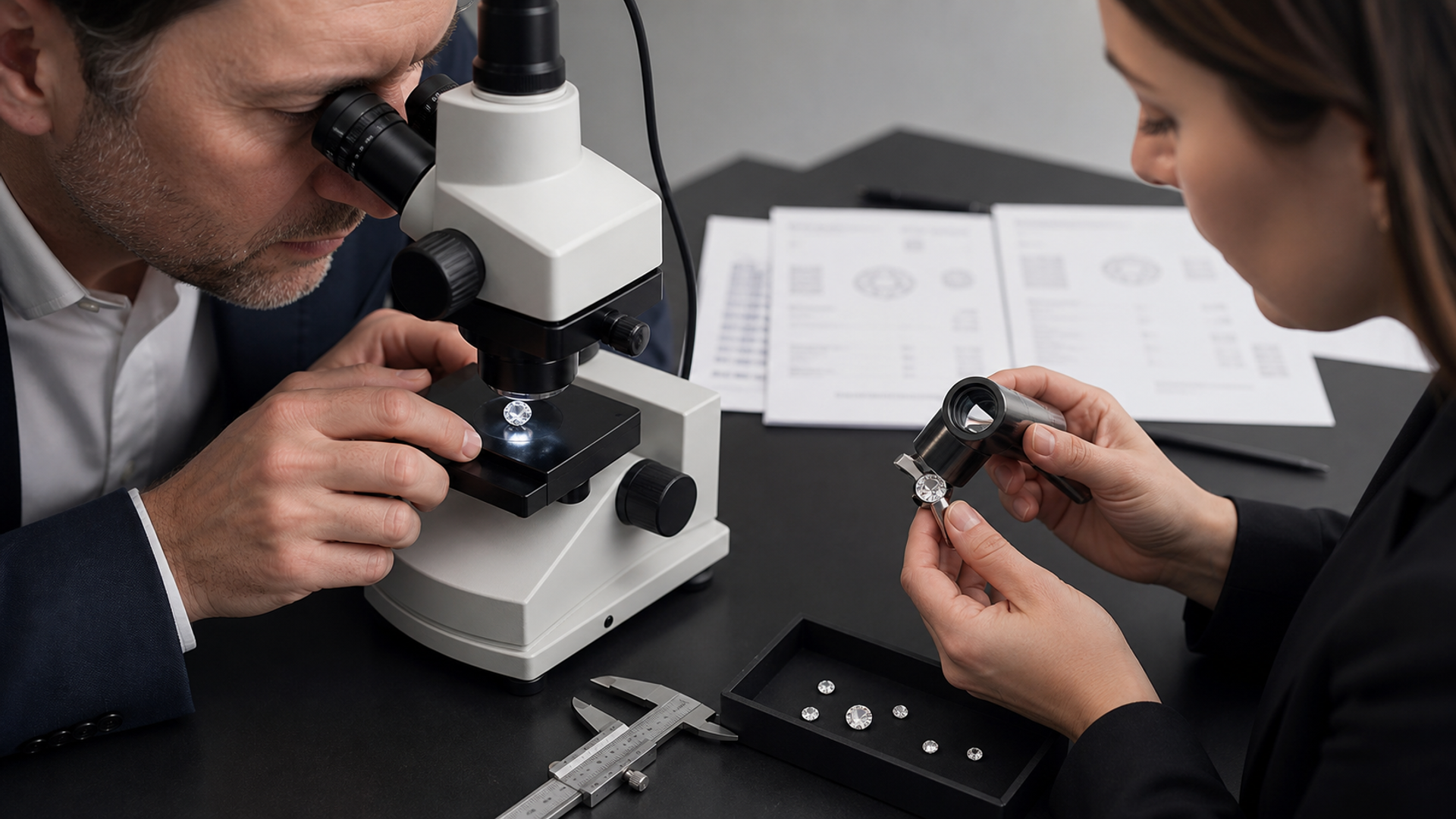
Enter the report number on the issuing laboratory's official site and compare carat weight, measurements, shape, colour, clarity, fluorescence and comments. Check any laser inscription with magnification, understanding that an inscription is one identity aid rather than proof of ownership. A seller should explain discrepancies before money changes hands. Save the verification result and sales listing with the invoice.
Compare cut beyond a headline grade
For round brilliants, review proportions, symmetry, polish and trusted light-performance imagery where available. For fancy shapes, outline, bow-tie, facet pattern and face-up spread require visual assessment because one grade does not capture every preference. Compare stones in consistent lighting or use high-quality neutral video. A slightly lower colour or clarity grade can be a better purchase when cut performance and visible appearance are stronger.
Normalise the price comparison
Compare the same stone type, carat range, shape, cut quality, colour, clarity, fluorescence and seller protections. Separate a laboratory difference from brand markup, setting cost, return policy and financing. If one stone is materially cheaper, identify the attribute creating the discount rather than attributing it automatically to the report issuer. For laboratory-grown diamonds, account for rapid market-price changes and avoid assumptions of retained value.
Separate grading, appraisal and resale
A grading report evaluates gem characteristics under the laboratory service. An appraisal estimates value for a purpose such as insurance and may use a replacement-value basis. A resale offer reflects current buyer demand, liquidity and margin. These are different documents and markets. Obtain a qualified independent appraisal only when needed, and never present an insurance figure as a guaranteed cash exit.
Three purchases that change the laboratory question
A natural round engagement diamond
Either laboratory can be evaluated through the exact report and stone, but the buyer should normalise all 4Cs, proportions, fluorescence, imagery, seller policy and price before deciding. A familiar report alone does not rescue a poorly cut stone. Define the fact that would reverse this recommendation before committing.
A laboratory-grown diamond
Confirm explicit laboratory-grown disclosure, treatment information and current report format. Price the stone for present enjoyment rather than assuming natural-diamond resale behaviour. Define the fact that would reverse this recommendation before committing.
A high-value vintage or unusual stone
If mounting, condition, treatment or identity cannot be resolved from the existing document, an independent qualified examination or laboratory recheck can be more rational than choosing between logos from incomplete evidence. Define the fact that would reverse this recommendation before committing.
Action checklist
Verify the report number on the issuing laboratory site.
Match measurements and any inscription to the stone.
Confirm natural or laboratory-grown disclosure.
Compare like-for-like report services.
Review proportions, fluorescence and comments.
Inspect neutral images or the stone itself.
Normalise price across the same attributes.
Read return, trade-in and setting policies.
Use a separate appraisal only for its stated purpose.
Keep report verification, listing and invoice together.
Continue the decision
The linked VERTU articles expand adjacent parts of the GIA vs IGI diamond certification decision. They do not substitute for the external evidence above.
The GIA vs IGI verdict
Choose the individual diamond that offers the best verified combination of cut, colour, clarity, measurements, treatment disclosure, price and seller protections. GIA and IGI both issue report products, but buyers must compare reports of the same type and confirm them with the issuing laboratory. For natural or laboratory-grown diamonds, use the report to narrow the search, inspect the stone or trusted imagery, and obtain a separate appraisal only when insurance value is required.
Keep the GIA vs IGI diamond certification decision reversible until its material cost, safety, access, privacy and compatibility facts are verified. Unknown evidence stays unknown; it is never silently scored as favourable.