

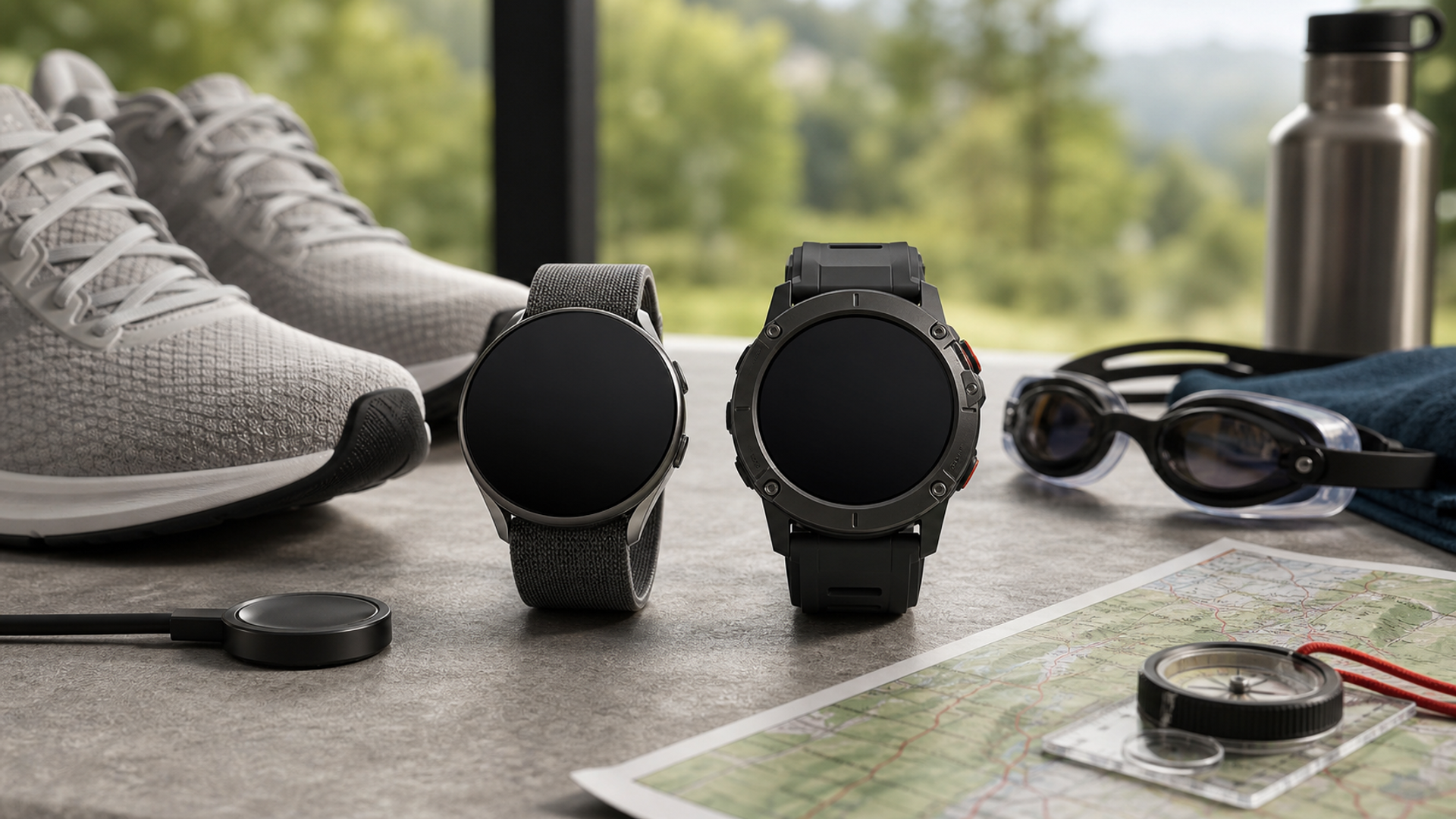
The Galaxy Watch9 and Galaxy Watch Ultra2 run the same current Samsung wearable platform, but they solve different problems. Watch9 is a light, all-day health watch offered in 40mm and 44mm sizes. Watch Ultra2 is a 47mm titanium outdoor watch with an 800mAh battery, brighter display, more storage and diving credentials. The Ultra is not simply the better Watch9, and the Watch9 is not merely the budget version.
Choose Galaxy Watch9 if comfort, sleep tracking, everyday exercise and a watch that disappears under a cuff are the priorities. Choose Galaxy Watch Ultra2 if you regularly need long endurance, bright-light visibility, dual-frequency GPS, trail data, 10ATM water resistance or diving functions. If those Ultra advantages appear only on an imagined annual adventure, the smaller Watch9 is likely to collect better health data because you will wear it more consistently.
Samsung opened pre-orders in selected markets on 22 July 2026 and set general availability for 7 August. The specifications below come from Samsung’s global launch release. Health features can vary by phone, country and regulatory approval, so verify the exact regional feature list before paying for a capability named in another market.
Galaxy Watch9 vs Ultra2: the decision matrix
| Decision | Galaxy Watch9 | Galaxy Watch Ultra2 |
|---|---|---|
| Sizes | 40mm or 44mm | 47mm only |
| Case and weight | Aluminium; 31.5g at 40mm or 34g at 44mm | Titanium; 61.5g |
| Thickness | 8.6mm | 10.7mm; Samsung says 12% thinner than the previous Ultra |
| Display | 1.34-inch/438×438 or 1.47-inch/480×480; sapphire; up to 3,000 nits | 1.52-inch/498×498; sapphire; up to 5,000 nits |
| Battery | 390mAh at 40mm; 445mAh at 44mm | 800mAh |
| Memory and storage | 2GB + 32GB | 2GB + 64GB |
| Durability | 5ATM, IP68 and MIL-STD-810H | 10ATM, IP69K, MIL-STD-810H and EN13319 |
| Platform | Snapdragon Wear Elite, Wear OS 7 and One UI 9 Watch | Same platform |
| Best for | Sleep, everyday wellness, gym, walking, office and lighter wrists | Trail training, long sessions, bright sun, water activity, diving and longer time away from a charger |
| Primary compromise | Less battery, storage and environmental capability | Much heavier, larger and more expensive; comfort must be proven on your wrist |
The United States launch release lists Watch Ultra2 at $699.99 and Watch9 from $379.99 for Bluetooth or $429.99 for LTE. Those are US launch prices, not global equivalents. Compare local tax, LTE plan, bands and pre-order terms rather than converting them directly.
Comfort is a sensor specification
Smartwatch comparisons often treat dimensions as style. For health tracking, fit changes data quality. Optical heart-rate readings, sleep records and temperature trends depend on stable contact; a watch that rotates, lifts during exercise or comes off at night creates gaps no algorithm can repair.
Watch9’s 40mm case weighs 31.5g and the 44mm weighs 34g, excluding the band. Ultra2 weighs 61.5g before its strap. That is not a small difference. Samsung redesigned the Ultra body and introduced a lighter band, but a 47mm case can still overhang a narrow wrist or catch on clothing. Buyers should wear both for at least ten minutes, tighten them as they would for sleep and perform a push-up or wrist extension. Check pressure points at the case corners and sensor bump.
The correct size is not automatically the largest display your wrist can hold. A 40mm Watch9 can be easier to sleep in, while the 44mm provides more battery and a larger interface without approaching Ultra weight. Consistent wear usually produces a more useful personal baseline than occasional readings from a technically superior device.
Battery: capacity is not runtime
The 800mAh Ultra2 battery is the clearest numerical advantage. It is 35% larger than the previous Ultra, according to Samsung. The Watch9 has 390mAh at 40mm and 445mAh at 44mm. In Samsung’s US specification, the 44mm Watch9 is rated for up to 60 hours with the always-on display active, while the 40mm is listed at up to 30 hours. Those figures underline why size matters inside the Watch9 family.
Real endurance depends on display brightness, GPS, LTE, background health measurement, sleep tracking, notifications and ambient temperature. A long trail recording with dual-frequency GPS is not comparable with a day of office notifications. Treat capacity as headroom, then look for tests that reproduce your dominant use.
Charging routine can matter more than maximum duration. Samsung lists about 90 minutes for a full charge on Ultra2 and the 44mm Watch9, and about 80 minutes for the 40mm. A Watch9 owner who charges during a shower or desk session may never feel limited. An Ultra2 owner on a two-day route may value every extra hour. Write down the longest period you realistically spend away from a compatible charger before assigning value to 800mAh.
Display and outdoor visibility
Ultra2 reaches a claimed localised peak of 5,000 nits under high ambient light, compared with up to 3,000 nits for Watch9. Samsung explicitly notes that localised peak brightness is not the same as full-screen sustained brightness and can vary with temperature and use. That qualification matters. Peak numbers are useful in harsh sun, but thermal dimming and interface contrast affect actual readability.
Both watches use sapphire crystal and Super AMOLED displays. In a shop, test a map with small labels, an exercise screen with several metrics and a notification outdoors. Tilt the wrist rather than viewing it straight on. For office use, also check minimum brightness in a dark room and whether the always-on face is discreet enough. The Ultra’s larger, brighter panel is a tool advantage outdoors; it can be visual excess indoors.
Ultra2 earns its name in specific environments
Ultra2’s 10ATM, IP69K, MIL-STD-810H and EN13319 claims differentiate it from Watch9’s 5ATM, IP68 and MIL-STD-810H package. Samsung also adds Trail Run metrics such as elevation, climbing progress and cumulative ascent and descent. It says automatic water tracking can record depth, dive time and water temperature, with additional Mares-developed diving features planned through a separate download.
These labels need careful interpretation. Water-resistance ratings describe test conditions, not blanket permission for every water activity, temperature, chemical or impact. Samsung’s manual and warranty terms should decide acceptable use. A feature scheduled for later is not present value until it is released in your market and confirmed compatible.
The Ultra makes sense for a person who can name a weekly or monthly situation in which the extra capability reduces risk or friction: long hikes, open-water training, trail races, bright-sun navigation or recreational diving within the supported limits. If your outdoor activity is mainly urban running and weekend walks, Watch9 already includes dual-frequency GPS and the same core sensor platform.
Health features: shared platform, different wearing behaviour
Both models use Samsung’s BioActive sensor suite and updated Samsung Health, organised around Activity, Mindfulness, Nutrition, Sleep and Vitals. Samsung highlights Fitness Index, Daily Cardio Load and personalised guidance. Ultra2 adds hydration guidance linked to estimated sweat loss during extended exercise.
Do not treat a smartwatch as a diagnosis. Samsung’s own footnotes state that some features have age, phone and market restrictions and do not replace professional assessment. A sleep-apnoea feature, for example, can be limited to supported countries and compatible Galaxy phones. Verify availability in the Samsung Health Monitor documentation for your country.
The buyer question is not which watch shows more health language on a launch slide. It is which model you can wear tightly enough during exercise, comfortably enough during sleep and consistently enough for trends. For a wider market comparison, see our smartwatch guide for executives, which separates notification utility from health and battery priorities.
Connectivity and phone compatibility
Both watches run Wear OS 7 with One UI 9 Watch, use the Snapdragon Wear Elite platform and support Bluetooth, Wi-Fi, NFC, LTE variants and L1+L5 dual-frequency GPS. Samsung lists compatibility with Android 13 or later and more than 1.5GB of memory, with activation requiring a phone that supports Google Mobile Services.
That wording is a warning for non-Samsung and region-specific setups. Ask whether every desired health feature works on your Android phone, not just whether the watch pairs. Some functions can require a Galaxy handset. Corporate device-management policy, roaming support for the LTE model and carrier eSIM activation also matter to frequent travellers.
Ultra2’s 64GB storage doubles Watch9’s 32GB. The extra space is meaningful if you keep offline maps, music and apps on the watch. It is irrelevant if streaming and phone tethering cover your routine. Storage should be valued from an offline-use list, not as an abstract specification win.
The seven-day decision test
Before buying, model a real week. Count nights you will wear the watch, workouts that need GPS, hours away from charging, occasions requiring formal clothing and any water activity beyond swimming. Then score each model from one to five on comfort, battery headroom, navigation, environmental rating, offline storage and price.
Add two vetoes. The Ultra should be rejected if its case overhangs your wrist or you will remove it for sleep. Watch9 should be rejected if your longest activity regularly approaches its tested endurance or needs a rating it does not carry. This prevents an impressive feature from compensating for a daily failure.
Verdict: buy for the life you repeat
Galaxy Watch9 is the better default. It provides the current processor, core sensors, dual-frequency GPS, sapphire display and updated Samsung Health in a much lighter case. Choose 40mm for minimum weight and smaller wrists; choose 44mm when the larger battery and display justify a modest size increase.
Galaxy Watch Ultra2 is the better instrument when 800mAh endurance, 5,000-nit peak visibility, 64GB storage, 10ATM/IP69K construction, trail metrics or diving support solve a recurring need. It is not automatically the better health tracker because a watch cannot measure the body from a drawer.
The soundest Galaxy Watch9 vs Ultra2 decision is therefore behavioural: choose the model that you will wear through the moments that create useful data. Specification superiority matters only after comfort and routine have passed that test.
![How to Scan Receipts and Documents with Your Phone [Full Guide]](https://cdn.sanity.io/images/e0gp1l2g/production/0db13feec1d5e72b8a8a5f976d1f3e86619c9228-3840x1860.webp?w=180&h=180&q=78&auto=format&fit=crop)
![How to Scan Receipts and Documents with Your Phone [Full Guide]](https://cdn.sanity.io/images/e0gp1l2g/production/0db13feec1d5e72b8a8a5f976d1f3e86619c9228-3840x1860.webp?w=800&h=450&q=82&auto=format&fit=crop)
![Top 10 Two-Tone Carbon-Fibre Watches for Men [2026 List]](https://cdn.sanity.io/images/e0gp1l2g/production/18870799ba33fab0e038968359cd5772d7d7db30-1024x576.webp?w=800&h=450&q=82&auto=format&fit=crop)
![Top 10 Luxury Watches with Digital Complication Displays for Men [Latest]](https://cdn.sanity.io/images/e0gp1l2g/production/c4f6bf8c080f291c39f7cc85c7344ecff2fd3799-1024x553.webp?w=800&h=450&q=82&auto=format&fit=crop)