

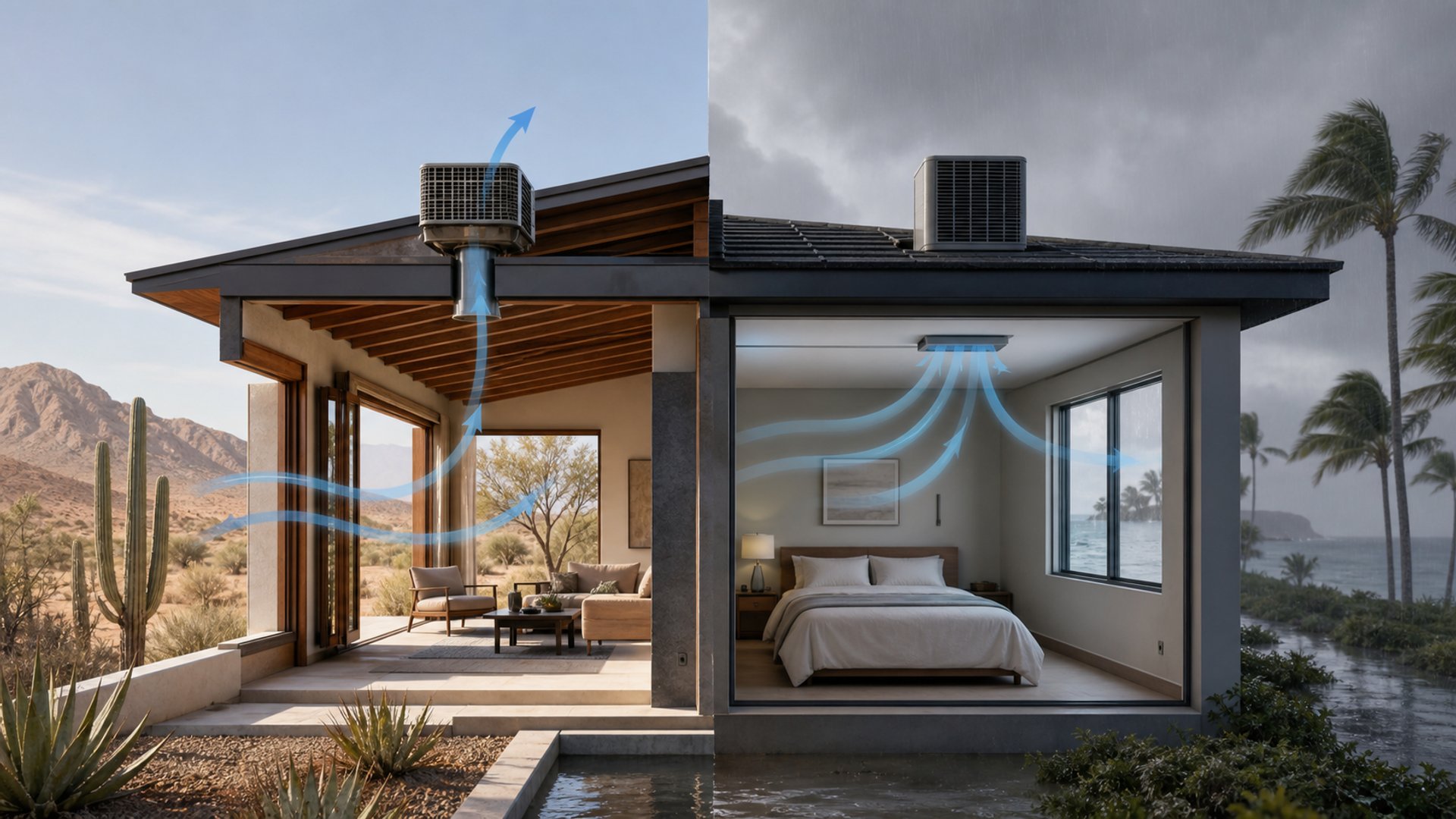
An evaporative cooler and a refrigerated air conditioner do not simply offer two price levels of the same process. Direct evaporative cooling passes air across water and depends on dry outside conditions and planned exhaust; conventional air conditioning moves heat with a refrigeration cycle and can reduce indoor moisture while recirculating controlled air. Outdoor wet-bulb conditions, water quality, ventilation, building leakage and occupancy can reverse the answer. The climate—not the product photograph—must lead the decision.
Plot temperature and humidity together
Choose an evaporative cooler in a reliably arid climate when water, maintenance, airflow and open-window exhaust can be managed. Choose refrigerated air conditioning where humidity is high, tighter temperature control is required or the building must remain closed. Use another cooling or building strategy when shading, insulation, ventilation, fans, heat pumps or mixed-mode operation can solve the actual comfort load more efficiently.
| Decision factor | Evaporative cooler | Refrigerated air conditioner | Use another cooling or building strategy |
|---|---|---|---|
| Climate | Works best when outdoor air is dry | Works across a broader humidity range by exact design | Plot design-day wet-bulb data |
| Moisture | Adds moisture to supply air | Often removes moisture while cooling | Avoid worsening an existing damp problem |
| Air path | Needs outdoor air and a planned exhaust route | Usually recirculates conditioned indoor air | Building leakage changes both |
| Resources | Uses water plus fan and pump electricity | Uses compressor, fans and electricity | Price local water and power |
| Maintenance | Pads, reservoir, scale and seasonal shutdown matter | Filters, coils, drains and refrigerant service matter | Assign a real maintenance owner |
| Control | Performance follows outside wet-bulb condition | Can hold tighter set points within capacity | Size from a professional load calculation |
This evaporative cooler vs air conditioner matrix is the article's working value object. Read the evaporative cooler vs air conditioner rows together: the decisive failure mode depends on this topic's evidence, operating context and reader objective.
Evaporation and refrigeration treat moisture differently
Evidence 1. U.S. Department of Energy home-cooling guidance lists evaporative coolers as an alternative particularly suited to arid conditions.
Evidence 2. DOE's Home Cooling infographic explains that evaporative coolers add moisture while air conditioners reduce indoor moisture as part of cooling.
Evidence 3. Openings and exhaust are part of direct evaporative operation; sealing the building as if it were refrigerated air conditioning can undermine performance.
Evidence 4. Equipment capacity cannot compensate indefinitely for poor shading, air leakage, internal heat or an incorrect climate assumption.
Reader-visible sources checked for this article:
energy.gov — reader-visible current or official evidence
energy.gov — reader-visible current or official evidence
For evaporative cooler vs air conditioner, these sources establish only the claims inside their documented scope. Recheck every changeable specification, availability condition, price, policy or service term in the relevant market before acting.
Test comfort with windows in the correct state
A buyer can resolve climate without starting from a brand preference. Ask whether works best when outdoor air is dry; compare that with whether works across a broader humidity range by exact design; then use plot design-day wet-bulb data as the third route's safeguard. An unknown condition stays unknown.
On moisture, popularity is not enough. The evidence for option one is that adds moisture to supply air. Option two means often removes moisture while cooling. Option three is rational where avoid worsening an existing damp problem. Recheck any changeable term immediately before commitment.
The decision changes at air path. Choose the first path only if needs outdoor air and a planned exhaust route; move to the second when usually recirculates conditioned indoor air; use the third when building leakage changes both. Save the downside that would make this row fail.
For resources, the first route works when uses water plus fan and pump electricity; the second requires uses compressor, fans and electricity. The control for the third is price local water and power. Verify this row against the exact product, property, account or environment before it can reverse the decision.
The maintenance row exposes a practical boundary. Route one assumes pads, reservoir, scale and seasonal shutdown matter, while route two is defensible only when filters, coils, drains and refrigerant service matter. Route three depends on assign a real maintenance owner. If that evidence is absent, keep the more reversible option.
Read control as a stop/go test: performance follows outside wet-bulb condition supports the first option; can hold tighter set points within capacity supports the second; and size from a professional load calculation supports the third. Record which source proves the condition and when it was checked.
Facts that would reverse the current choice
Reversal control 1 — Climate. Before choosing Evaporative cooler, write down how the decision changes if “Works best when outdoor air is dry” proves false. Do the same for Refrigerated air conditioner and “Works across a broader humidity range by exact design”. Keep the Use another cooling or building strategy route available until “Plot design-day wet-bulb data” is verified. This control belongs to evaporative cooler vs air conditioner; update it from the cited source or exact supplier rather than copying a generic checklist.
Reversal control 2 — Moisture. Before choosing Evaporative cooler, write down how the decision changes if “Adds moisture to supply air” proves false. Do the same for Refrigerated air conditioner and “Often removes moisture while cooling”. Keep the Use another cooling or building strategy route available until “Avoid worsening an existing damp problem” is verified. This control belongs to evaporative cooler vs air conditioner; update it from the cited source or exact supplier rather than copying a generic checklist.
Reversal control 3 — Air path. Before choosing Evaporative cooler, write down how the decision changes if “Needs outdoor air and a planned exhaust route” proves false. Do the same for Refrigerated air conditioner and “Usually recirculates conditioned indoor air”. Keep the Use another cooling or building strategy route available until “Building leakage changes both” is verified. This control belongs to evaporative cooler vs air conditioner; update it from the cited source or exact supplier rather than copying a generic checklist.
Reversal control 4 — Resources. Before choosing Evaporative cooler, write down how the decision changes if “Uses water plus fan and pump electricity” proves false. Do the same for Refrigerated air conditioner and “Uses compressor, fans and electricity”. Keep the Use another cooling or building strategy route available until “Price local water and power” is verified. This control belongs to evaporative cooler vs air conditioner; update it from the cited source or exact supplier rather than copying a generic checklist.
Reversal control 5 — Maintenance. Before choosing Evaporative cooler, write down how the decision changes if “Pads, reservoir, scale and seasonal shutdown matter” proves false. Do the same for Refrigerated air conditioner and “Filters, coils, drains and refrigerant service matter”. Keep the Use another cooling or building strategy route available until “Assign a real maintenance owner” is verified. This control belongs to evaporative cooler vs air conditioner; update it from the cited source or exact supplier rather than copying a generic checklist.
Reversal control 6 — Control. Before choosing Evaporative cooler, write down how the decision changes if “Performance follows outside wet-bulb condition” proves false. Do the same for Refrigerated air conditioner and “Can hold tighter set points within capacity”. Keep the Use another cooling or building strategy route available until “Size from a professional load calculation” is verified. This control belongs to evaporative cooler vs air conditioner; update it from the cited source or exact supplier rather than copying a generic checklist.
Build a climate profile
Collect hourly dry-bulb, wet-bulb or humidity data for design days and shoulder seasons. Mark smoke, dust and water-restriction periods. For this evaporative cooler versus air conditioner decision, keep the exact item, setting, date and test condition in one evidence log. Separate a measured result from category shorthand and repeat the check in the intended environment. If humid peaks coincide with cooling need, reverse a direct-evaporative plan. If that reversal condition appears, reopen the decision instead of defending the earlier preference.
Map the building air path
Measure floor area, ceiling height, shading, leakage, window operation and exhaust routes. Identify rooms that cannot receive or release airflow. For this evaporative cooler versus air conditioner decision, keep the exact item, setting, date and test condition in one evidence log. Separate a measured result from category shorthand and repeat the check in the intended environment. If air cannot exit predictably, do not assume whole-home evaporative coverage. If that reversal condition appears, reopen the decision instead of defending the earlier preference.
Estimate water and energy
Use manufacturer performance at relevant conditions and local tariffs. Include bleed-off, scale treatment, pumps, fans, compressor demand and maintenance. For this evaporative cooler versus air conditioner decision, keep the exact item, setting, date and test condition in one evidence log. Separate a measured result from category shorthand and repeat the check in the intended environment. If water scarcity or quality creates high burden, change technology. If that reversal condition appears, reopen the decision instead of defending the earlier preference.
Run an occupied comfort test
Measure temperature, humidity, air speed and noise at bedrooms and work areas. Operate windows and doors exactly as the system requires. For this evaporative cooler versus air conditioner decision, keep the exact item, setting, date and test condition in one evidence log. Separate a measured result from category shorthand and repeat the check in the intended environment. If comfort depends on unsafe openings or unacceptable humidity, reject the setup. If that reversal condition appears, reopen the decision instead of defending the earlier preference.
Plan maintenance and fallback
Schedule pad or filter work, drains, winterisation, professional service and heat-wave backup. Record who responds to a pump, compressor or water failure. For this evaporative cooler versus air conditioner decision, keep the exact item, setting, date and test condition in one evidence log. Separate a measured result from category shorthand and repeat the check in the intended environment. If no safe fallback exists for vulnerable occupants, increase resilience. If that reversal condition appears, reopen the decision instead of defending the earlier preference.
Four climates, four answers
Dry inland home with cross-ventilation
Evaporative cooling can be efficient when water and maintenance are controlled. Define the fact that would reverse this recommendation before committing.
Humid coastal apartment
Refrigerated air conditioning is usually the more defensible mechanism. Define the fact that would reverse this recommendation before committing.
Cool nights and shaded building
Ventilation and fans may delay mechanical cooling. Define the fact that would reverse this recommendation before committing.
Mixed climate with smoke season
A hybrid plan must account for times when outside air should remain closed. Define the fact that would reverse this recommendation before committing.
Action checklist
Collect hourly climate data.
Check wet-bulb conditions.
Map exhaust.
Check water quality.
Price water.
Price electricity.
Calculate cooling load.
Measure occupied rooms.
Plan maintenance.
Plan smoke days.
Plan outage fallback.
Record climate veto.
Continue the decision
The linked VERTU articles expand adjacent parts of the evaporative cooler vs air conditioner decision. They do not substitute for the external evidence above.
The evaporative-cooler-versus-air-conditioner verdict
Choose an evaporative cooler in a reliably arid climate when water, maintenance, airflow and open-window exhaust can be managed. Choose refrigerated air conditioning where humidity is high, tighter temperature control is required or the building must remain closed. Use another cooling or building strategy when shading, insulation, ventilation, fans, heat pumps or mixed-mode operation can solve the actual comfort load more efficiently.
Keep the evaporative cooler vs air conditioner decision reversible until its material cost, safety, access, privacy and compatibility facts are verified. Unknown evidence stays unknown; it is never silently scored as favourable.
![How to Scan Receipts and Documents with Your Phone [Full Guide]](https://cdn.sanity.io/images/e0gp1l2g/production/0db13feec1d5e72b8a8a5f976d1f3e86619c9228-3840x1860.webp?w=180&h=180&q=78&auto=format&fit=crop)
![How to Scan Receipts and Documents with Your Phone [Full Guide]](https://cdn.sanity.io/images/e0gp1l2g/production/0db13feec1d5e72b8a8a5f976d1f3e86619c9228-3840x1860.webp?w=800&h=450&q=82&auto=format&fit=crop)
![Top 10 Two-Tone Carbon-Fibre Watches for Men [2026 List]](https://cdn.sanity.io/images/e0gp1l2g/production/18870799ba33fab0e038968359cd5772d7d7db30-1024x576.webp?w=800&h=450&q=82&auto=format&fit=crop)
![Top 10 Luxury Watches with Digital Complication Displays for Men [Latest]](https://cdn.sanity.io/images/e0gp1l2g/production/c4f6bf8c080f291c39f7cc85c7344ecff2fd3799-1024x553.webp?w=800&h=450&q=82&auto=format&fit=crop)