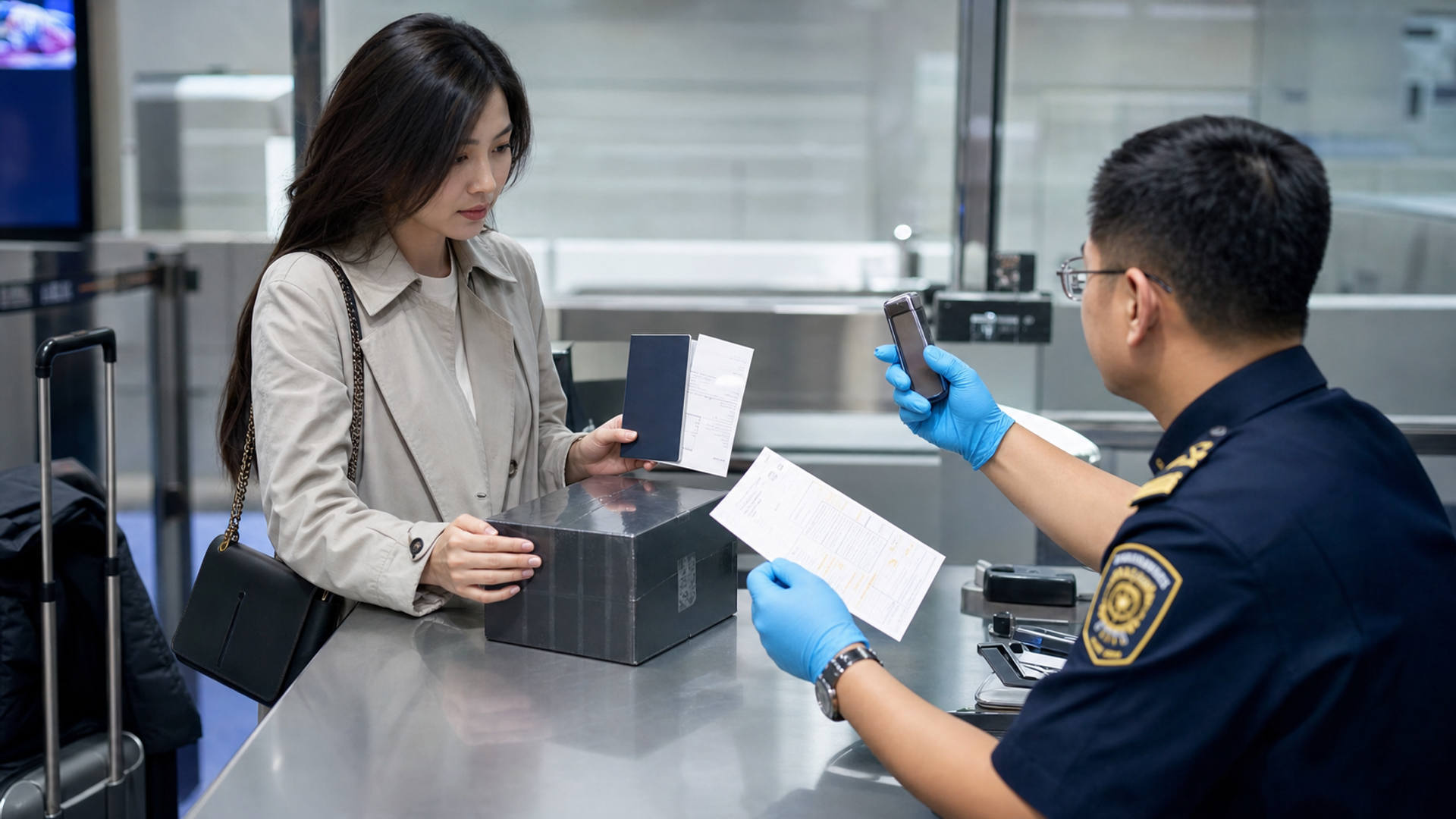
A European VAT refund is not a discount automatically earned at the till. For eligible non-EU residents, it is a retail-export process: the shop creates the correct tax-free record, the traveller exports eligible goods within the allowed period, customs validates the export at the relevant exit point, and the retailer or refund intermediary releases the amount after fees and payment conditions. A missing form, used item, inaccessible checked bag or wrong airport sequence can break the chain.
The European Commission’s current guidance says qualifying non-EU travellers may request a refund for goods taken out of the EU in personal luggage. The traveller must prove residence outside the EU, export the goods within three months of purchase and obtain a stamped or otherwise validated VAT refund document. Each member state can set a minimum purchase amount, and retailers or intermediaries may deduct fees. The VAT rate printed on the receipt is therefore not the cash percentage you should expect back.
Quick answer:** Ask the retailer to issue the tax-free transaction correctly, keep the goods unused and available for inspection, identify the customs process at your final exit from the EU customs area, validate before checking inaccessible baggage, and compare refund options after fees and currency conversion.
The end-to-end VAT refund chain
| Stage | Required action | Evidence to retain | Common failure |
|---|---|---|---|
| Eligibility | Prove permanent residence outside the EU | Passport plus residence evidence if needed | Citizenship confused with residence |
| Purchase | Use a participating retailer and meet the country threshold | Correct invoice and tax-free form/digital record | Name, passport or address entered incorrectly |
| Goods | Keep eligible goods unused and available | Item, packaging where practical and receipt | Item worn, consumed, altered or packed away |
| Route | Identify the correct EU exit customs point | Full itinerary and transfer details | Validation attempted in the shopping city instead of final EU exit |
| Airport | Complete customs validation before the goods become inaccessible | Validation result, form or digital status | Checked baggage handed over first |
| Refund | Submit to the correct retailer/intermediary | Reference number and chosen payment method | Form validated but never returned or completed |
| Home arrival | Declare purchases as required by destination law | Purchase and refund records | EU refund mistaken for import-duty exemption |
The chain is sequential. A fast refund paid before departure can still be reversed if export validation is not completed and returned under the provider’s terms.
Step 1: establish eligibility before shopping
The key European Commission test is permanent address or habitual residence outside the European Union, evidenced by a passport or another recognised identity or residence document. A person holding an EU passport but living permanently outside the EU may qualify if they can prove that residence; a non-EU citizen resident in the EU generally should not assume eligibility merely from nationality.
The goods must be taken out of the EU in personal luggage within the required period. The Commission states three months from purchase, while national implementation and form-validity details can add precision. Services—hotel stays, restaurant bills, transport and many experiences—are not ordinary retail goods exported in luggage. Vehicles, fuel and other categories can have separate rules or exclusions.
Ask the retailer four questions before payment:
Is this shop participating in tax-free retail export for my residence?
What minimum same-day or same-invoice spend applies in this country?
Which operator or direct-retailer process will handle the refund?
What document, digital registration and goods condition are required at exit?
If the staff cannot explain the process, do not treat an estimated refund as part of the purchase budget.
Step 2: make the tax-free record correct at the till
Check every field while still in the shop. The traveller’s name should match the identity document. Passport number, issuing country, permanent address and residence status must be accurate. The invoice should identify the retailer, date, goods and amount. The tax-free record should show the operator and instructions.
For a high-value watch, bag, jewellery item or phone, photograph the receipt and form, but retain the originals if the system uses paper. Record the form or document ID. A photograph is a recovery aid, not automatically a substitute for the original. If the retailer uses a digital platform, verify that the transaction appears in the correct app or account before leaving.
Do not remove labels, resize jewellery, personalise leather or begin using the goods without checking the country and operator rules. Rome Fiumicino’s published traveller guidance, for example, instructs non-EU passengers not to wear or use refund goods and not to remove labels before leaving the EU. A different airport may use a different digital workflow, but customs still needs to be satisfied that the eligible goods are being exported.
Step 3: calculate the realistic refund, not the VAT rate
VAT is included in the gross retail price, so removing a 20% VAT rate does not mean receiving 20% of the sticker price. If an item costs €1,200 including 20% VAT, the VAT component is €200 because €1,000 is the net price and €200 is VAT. The gross-price fraction is 20/120, or about 16.67%.
Then subtract service and payment costs. The European Commission notes that a retailer or intermediary may charge a fee. Global Blue’s current help centre says estimates can be reduced by service fees and currency-conversion fees. Cash, card, bank and digital-wallet options can have different economics.
Use this worksheet:
| Line | Example |
|---|---|
| Gross purchase price | €1,200.00 |
| VAT contained at 20% | €200.00 |
| Operator/service deduction | verify on form |
| Cash or payment-method fee | verify |
| Currency-conversion spread | avoid or quantify |
| Expected net refund | calculate from written offer |
For a luxury purchase, compare the net refund with the total landed cost at home: local import duty, sales or use tax, customs brokerage, insured transport, card foreign-exchange fee and warranty implications. A European refund does not erase the destination country’s import rules.
Step 4: identify the correct customs exit point
The correct location is usually where the goods leave the EU customs area, not necessarily the country where they were purchased. A Paris–Amsterdam–New York itinerary normally points to Amsterdam as the final EU departure, provided the transfer stays within the EU customs route and the goods remain with the traveller. A Paris–London–New York itinerary requires careful treatment because the United Kingdom is outside the EU and the customs-export step may occur before the flight to London.
Connections complicate baggage. If a checked suitcase is tagged through to a non-EU destination, the goods may become inaccessible before the final EU airport’s customs desk. Ask the airline and customs authority where validation must occur and whether an early check-in or landside customs process is required. Do not assume an airport transfer allows you to retrieve the bag.
Build a route card:
shopping country and operator;
departure airport and terminal;
final airport leaving the EU customs area;
whether goods are in cabin or checked baggage;
customs location before or after security;
digital kiosk, app or officer process;
refund-desk operator and opening hours;
minimum safe connection time.
If the route includes Switzerland, Norway, the United Kingdom, overseas territories or a non-EU connection, verify customs-area status rather than using “Schengen” as shorthand. Schengen is primarily a border-movement area; VAT and customs geography are related but not identical.
Step 5: sequence the airport correctly
Arrive earlier than the airline’s ordinary recommendation when the goods are valuable, numerous or checked. The customs officer may ask to see the passport, boarding pass, receipts, tax-free record and unused goods.
The safe sequence is:
Check the flight and obtain the boarding pass if required.
Keep refund goods physically accessible.
Locate the correct customs validation point for the terminal and baggage type.
Complete digital validation or present documents and goods to customs.
Confirm approval rather than assuming a kiosk scan succeeded.
Check baggage only after the procedure permits it.
Submit the validated claim to the correct refund operator or retailer.
Photograph or record the validated status and submission reference.
Airport systems are changing. Schiphol states that its Netherlands VAT-refund process became fully digital on 1 January 2026: eligible Dutch purchases registered by the retailer can be validated through the NL Customs VAT app, with a customs desk fallback. That does not mean a paper form from another country can always be treated identically. Follow the airport’s instructions for each transaction.
Step 6: choose the refund method with eyes open
Cash is immediate but may attract a fee and unfavourable currency availability. A card refund can be slower and can introduce conversion choices. A refund to a card denominated in another currency may include a spread. The clean comparison is the amount that will arrive in your account, in your chosen currency, after every deduction.
Ask:
What exact amount will be paid by each method?
In which currency?
Which exchange rate or markup applies?
How long is the quoted processing time?
What happens if the form needs to be mailed?
How can status be tracked?
Which reference proves submission?
Global Blue advises travellers to keep a photograph or form number before handing over originals. Its help centre also explains that validation and refund are distinct: a form may need to be returned after customs approval, and an advance refund can be debited back if the validated paperwork is not received under the applicable terms.
Three complex itineraries
Shopping in several EU countries, one flight home
Keep each country’s forms separate by operator. Validate at the final EU exit according to the airport and national systems. Do not expect one operator’s desk to process another operator’s payment merely because customs validated both.
Luxury goods in checked baggage
Contact the departure airport and airline before travel. The customs desk may need to inspect the goods before bag drop. Leave packaging practical enough for identification and security screening. Never put irreplaceable documents only inside the checked bag.
Private aviation or rail exit
Do not copy the commercial-airport checklist. Identify the competent customs office, opening arrangement and operator submission route in advance. A concierge or handling agent can help coordinate, but customs validation remains an official act.
Import obligations when you arrive home
A VAT refund proves export from the selling jurisdiction; it does not prove duty-free import into the destination. Check the personal allowance, declaration threshold and restricted-material rules in the country of arrival. Exotic leather, cultural property and high-value watches can raise additional documentary questions.
Keep the invoice, payment evidence, export validation and refund statement. If customs asks for purchase value, do not substitute the post-refund net amount unless local rules explicitly require that basis. Honest declaration protects provenance and can support later insurance or resale.
VERTU’s overseas luxury shopping guide covers authenticity, payment and transport decisions. Travellers carrying a timepiece can pair it with the luxury watch insurance and customs checklist.
The 24-hour airport checklist
Passport and evidence of non-EU residence ready.
Boarding pass or confirmed itinerary available.
Original receipt and tax-free record reconciled.
Names, passport numbers and amounts checked.
Goods unused, labelled where required and accessible.
Final EU customs exit identified.
Checked-baggage sequence confirmed.
Customs and refund-desk hours checked.
Digital app installed and transaction visible if applicable.
Refund method and net amount compared.
Destination customs declaration planned.
Form numbers and documents backed up securely.
Sources and verification
Sources were checked on 22 July 2026. Country thresholds, eligible goods, digital systems, operator fees, airport desks and submission deadlines change. Confirm the retailer, national customs authority, final departure airport and refund operator for the actual itinerary. This guide is general information, not tax or customs advice.
Final decision
The refund is earned by completing the export evidence chain, not by seeing “tax free” in a shop window. Correct data at purchase, unused and inspectable goods, the right final-EU-exit plan and a documented refund submission matter more than any headline percentage. When those steps are planned before airport day, tax-free shopping becomes a calculable transaction instead of a queue-side gamble.