
Introduction
A data sovereignty smartphone for business is a mobile device (and its managed services) designed so your organization can prove where sensitive data is stored, processed, and accessed — and who controls the cryptographic keys. In 2026, that definition has sharpened: it’s no longer enough to say data is encrypted. Regulators, auditors, and customers increasingly expect verifiable controls for jurisdiction, key custody, third-party code, and evidence trails.
This guide is for CIO/CTO/CISO leaders, legal and compliance teams, and IT procurement stakeholders who need to choose a device strategy that holds up under scrutiny.
You will learn:
What a sovereignty-focused business smartphone actually is (and what it’s not)
The business benefits executives can defend
The 2026 compliance anchors that matter most
A practical capability stack and a selection framework you can use in procurement
Key TakeawayIn 2026, “sovereignty” is an evidence problem, not a marketing claim: you need provable control over jurisdiction, keys, and third-party data flows.
Business value
Risk reduction and market access
A sovereignty-aligned mobile stack reduces two categories of risk that show up directly in board-level decisions:
- Regulatory and contractual riskIf your phone fleet handles personal data, customer secrets, or regulated records, you need to demonstrate that data handling aligns with jurisdictional requirements and contractual commitments. That includes your ability to honor opt-out signals, enforce retention, and produce audit evidence.
- Market access and deal velocityMany enterprise and public-sector buyers now treat “where data lives” and “who controls keys” as gating criteria. When mobile is the weakest link, security reviews stall. When mobile can produce clear evidence (controls + logs + attestations), procurement moves.
Control, ownership, and resilience
Data sovereignty is also operational.
Control means you can choose where sensitive data is stored and processed — and can change that choice as regulatory or geopolitical conditions shift.
Ownership means the organization, not a vendor ecosystem, defines access rules and key custody.
Resilience means your business can keep operating when cross-border services, identity providers, or third-party SDKs become constrained.
A sovereignty-ready smartphone program pushes you toward portable controls: policies and cryptographic boundaries that work even when networks, vendors, or regions change.
AI readiness with sovereign data
AI on mobile has matured from “assistant features” to real workflow automation — but it adds a sovereignty problem.
AI systems tend to:
Collect more context (messages, calendar, location, files)
Move data across more services (model providers, telemetry, analytics)
Create new artifacts (summaries, notes, embeddings)
A sovereignty smartphone strategy makes AI adoption safer by forcing two questions upfront:
Where does AI processing happen — on-device, in a controlled tenant, or in a vendor’s general cloud?
How do you prove that the AI pipeline respects consent, retention, and key control?
If you want a practical framing of what “advanced security on AI phones” can include (biometrics, adaptive encryption, and zero-trust-style access patterns), see this overview: advanced security on AI phones.
Compliance landscape 2026
The fast change in privacy and AI governance is the reason “mobile sovereignty” has moved from niche to mainstream.
U.S. state privacy and GPC
U.S. state privacy frameworks increasingly converge on a simple operational reality: you must be able to receive and honor consumer privacy choices at scale, including machine-readable preference signals.
Global Privacy Control (GPC) is the leading example: it’s a browser-level signal that communicates a user’s opt-out preference for certain forms of data processing, and it’s widely discussed as part of the “universal opt-out” trajectory across state laws (see IAPP’s 2025 overview of universal opt‑out signals).
In practice, executives should ask whether their mobile stack can:
Detect and honor opt-out preference signals where applicable
Propagate those preferences through downstream partners and SDKs (analytics, adtech, tracking)
Prove enforcement with logs and configuration evidence (not screenshots)
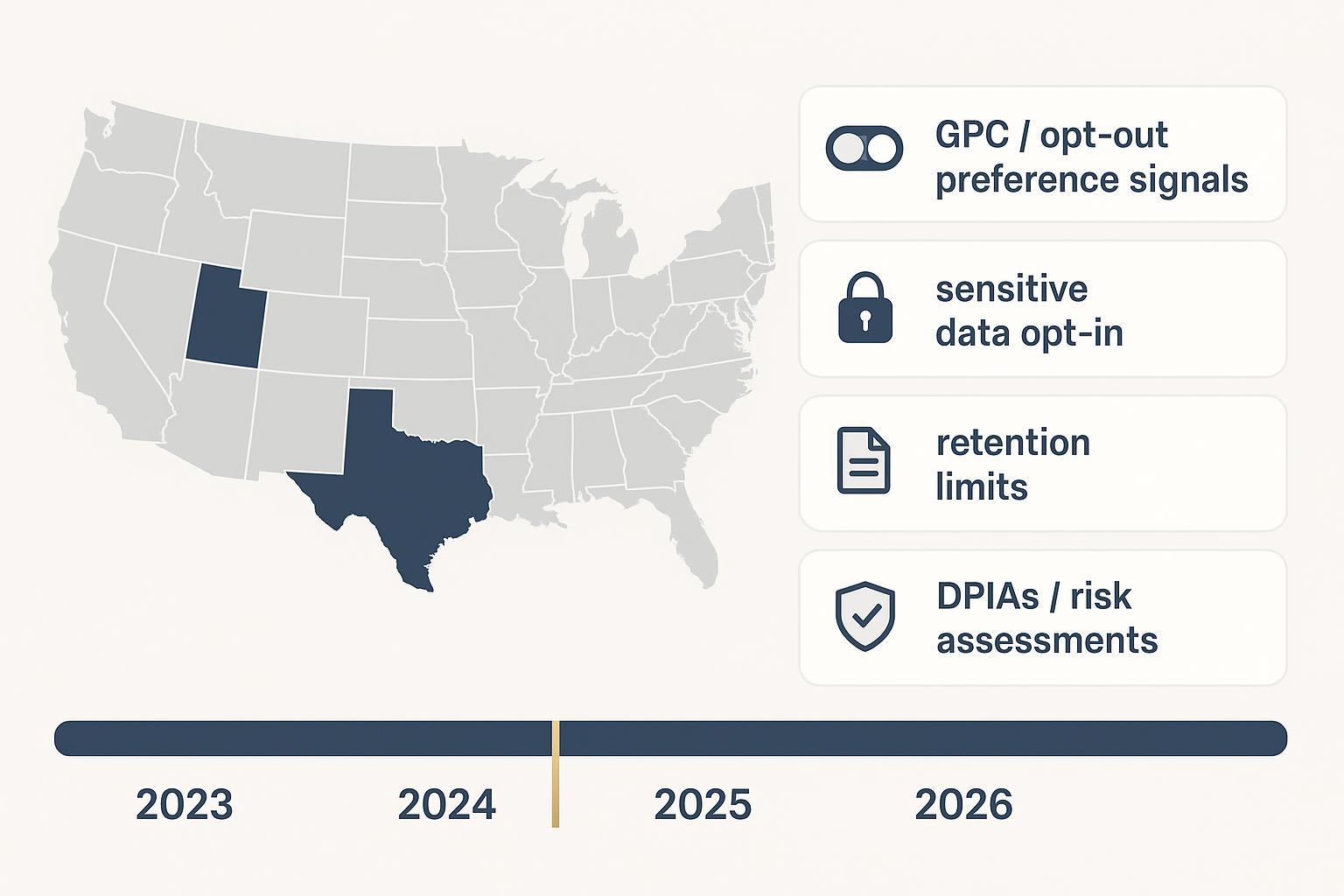
How to verify: Ask vendors to demonstrate a test environment where a preference signal changes downstream behavior (collection, sharing, targeting), and to show the associated audit logs.
Global frameworks (GDPR, DPF/SCCs, EU AI Act)
Cross-border operations add layers. Three anchors matter most in 2026:
1) GDPR transfers: SCCs + “post-Schrems II” discipline If your organization uses EU personal data outside the EEA, Standard Contractual Clauses remain a central mechanism, but they require real implementation work — data transfer impact assessments and, when needed, supplementary technical measures (see the European Commission’s Standard Contractual Clauses (SCCs) page and EDPB Recommendations 01/2020 on supplementary measures (final, 2021)).
2) EU–U.S. Data Privacy Framework (DPF) For eligible transfers to certified recipients, DPF can simplify the transfer mechanism — but the enterprise obligation doesn’t disappear. You still need clarity on scope, vendors, and onward transfers (see EDPB’s 2026 EU–US Data Privacy Framework FAQ).
3) EU AI Act timeline + governance expectations Whether you build AI or deploy it, 2026 is about governance, documentation, and controls — not just capability. The staged applicability and risk-based structure are summarized in the European Commission’s AI Act timeline.
Sectoral rules and audits
Beyond privacy law, most buyers face sector and customer-driven audits:
- Financial servicesencryption validation expectations, incident reporting timelines, and third-party risk governance.
- Healthcare and regulated researchstrict access logging, retention control, and vendor due diligence.
- Public sector and defense-adjacent workhigher assurance requirements around cryptographic modules and evidence quality.
The practical implication: your sovereignty smartphone program must be designed to survive an audit that asks, “Show me the controls. Show me the logs. Show me how you know they’re working.”
Capability stack
Treat sovereignty as a stack. No single control is enough.
Key sovereignty controls (CMK, HSM/TEE, FIPS 140-3)
Start with a simple buyer’s principle: sovereignty without key control is a story.
Key controls to evaluate:
- Customer-managed keys (CMK)Your organization controls the policies governing encryption keys and key usage, rather than relying entirely on provider-managed keys.
- Hardware security modules (HSMs)Hardware-backed key storage and cryptographic operations for higher-assurance environments.
- Trusted execution environments (TEEs)Hardware-isolated execution areas that help protect sensitive code and data in use; see Microsoft’s definition of a Trusted Execution Environment (TEE).
If you operate in environments where cryptographic assurance is audited, do not accept vague claims. Require evidence.
- FIPS 140-3 validationVerify whether cryptographic modules are actually validated by checking NIST’s CMVP validated modules list. “FIPS-capable” is not the same as validated.
Identity and zero trust (MDM/UEM, posture, RBAC)
A sovereignty smartphone still needs enterprise-grade identity and device control.
What strong looks like:
MDM/UEM coverage across corporate-owned and BYOD patterns
Device posture enforcement (OS version, patch level, encryption status, jailbreak/root signals)
Role-based access control (RBAC) in management consoles
Conditional access that can block access when posture fails
A useful anchor for leadership discussions is the “device” pillar in Zero Trust: see NSA’s Zero Trust Device Pillar guidance (2026).
Data minimization, consent, and retention
Sovereignty breaks down quickly when apps and SDKs collect more than your policies allow.
Minimum capabilities to demand:
- Data minimization by defaultonly collect what the workflow requires
- Consent-aware processinguser choices should change behavior, not just change a banner
- Retention enforcementdefined retention windows for logs, cached files, AI artifacts, and exports
You can also sanity-check whether a vendor is serious about privacy-first on-device workflows by asking for a demonstrable split between local processing and cloud calls; this general explainer is a helpful reference point: How to Use Your AI Agent Phone: A Complete Guide to Vertu Agent Q.
This is the point where some executive programs choose a “high-touch” approach: pairing a managed device posture and privacy architecture with concierge-grade service to reduce misconfiguration risk. In a discreet, enterprise context, VERTU is one example of a brand that positions this blend of white‑glove support with AI and blockchain security—useful as a mental model, not as a default answer.
How to choose the right device
Selection should feel like procurement, not like shopping.
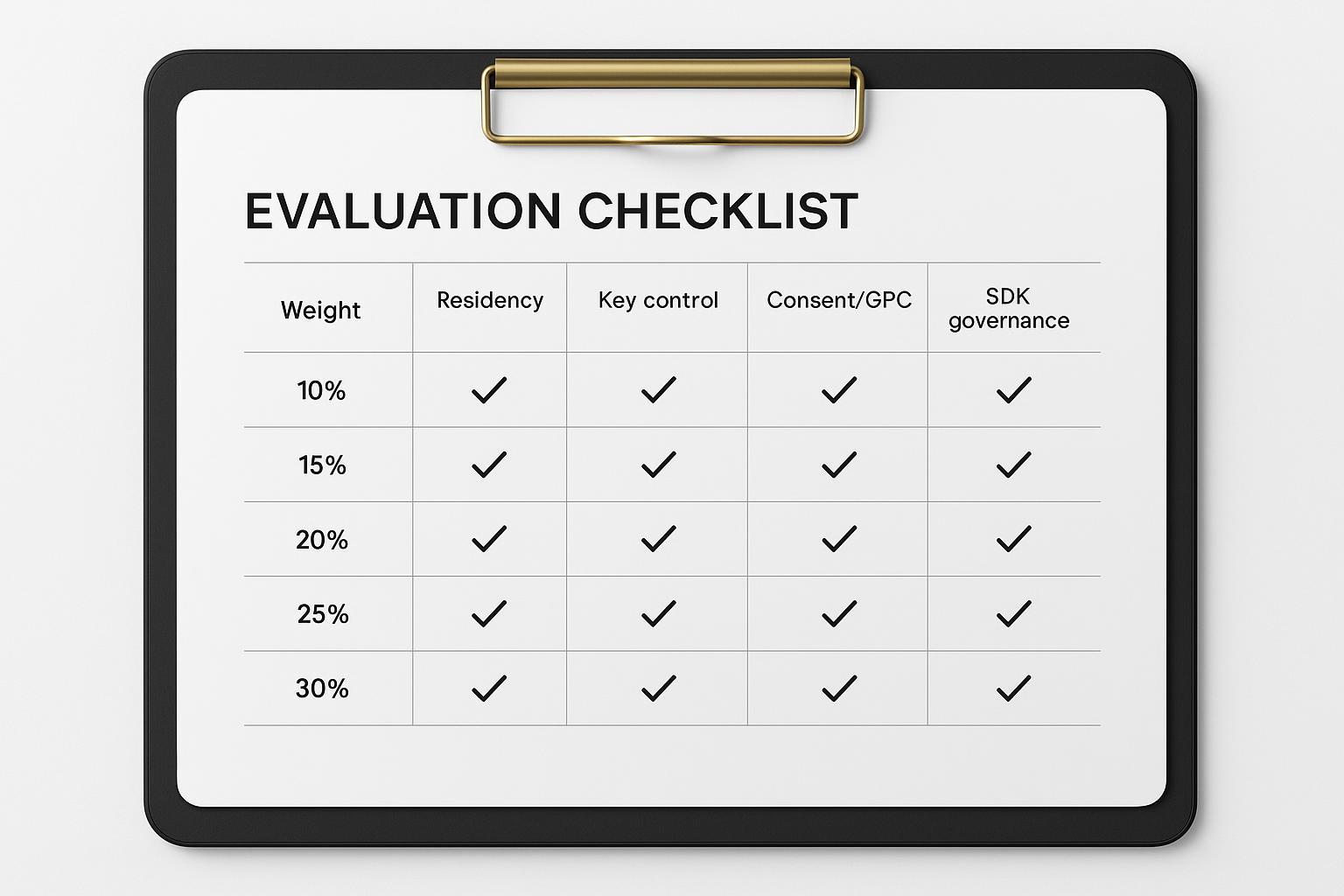
Jurisdiction, hosting, and key control
Start with the three questions that decide most outcomes for any data sovereignty smartphone for business deployment:
Jurisdiction: Which country’s laws can compel access to data, metadata, or keys?
Hosting/data residency: Where is data stored and processed (including telemetry and AI artifacts)?
Key control: Who can technically use keys, rotate keys, or override policy?
Then score vendors against what you can prove.
SDK and ecosystem due diligence
For sovereignty, third-party code is often the real risk surface.
Due diligence questions that matter:
Can you produce an SDK inventory for the baseline build?
Do you have controls to prevent “silent” SDK addition via updates?
Can you disable or replace analytics/telemetry SDKs without breaking core workflows?
Do you have a process for reviewing SDK data flows against consent and retention requirements?
Pro TipTreat SDK governance as part of vendor risk scoring. “We use standard analytics” is not an answer; you need names, versions, and data-flow documentation.
Contracts, SLAs, and attestations
A sovereignty posture that can’t be contracted is fragile.
At minimum, contracts should address:
Where data is stored/processed and how changes are communicated
Incident response SLAs (notification time windows, cooperation duties)
- Audit evidenceSOC 2/ISO 27001 scope, pen-test summaries, and secure development practices
Subprocessor transparency and change management
- Exit and portabilityhow data and keys are handled at termination
Implementation playbook
You’re not “done” when the devices ship. You’re done when you can prove control.
Governance and DPIA-by-design
Make sovereignty operational with a repeatable governance path:
Define data classes (regulated, confidential, internal)
Map mobile data flows by class (apps, SDKs, identity, backups, telemetry)
Run DPIA-style risk assessments for high-risk processing, and keep them living documents
Bind outcomes to enforceable controls (MDM/UEM, key custody, retention)
Deployment patterns and incident readiness
Common enterprise patterns:
- Corporate-owned, business only (COBO)best control; highest IT overhead
- Corporate-owned, personally enabled (COPE)balanced; requires clear separation policies
- BYOD with container/work profilelowest hardware cost; strongest dependence on UEM quality
Incident readiness questions to settle before rollout:
What is the kill-switch process for compromised devices?
How do you revoke keys/access quickly without breaking operations?
How do you preserve evidence while respecting retention and privacy rules?
Evidence, logging, and reporting
Build evidence like you build availability.
Your reporting pack should be able to produce:
Device compliance posture reports (fleet-level)
Key management evidence (rotation, access logs)
Consent/opt-out enforcement evidence (where applicable)
SDK inventory and change logs
Incident timeline templates and post-incident reports
Conclusion
A data sovereignty smartphone for business is now strategic because mobile is where regulated data, cross-border work, and AI-assisted workflows collide.
If you want the outcome executives care about — reduced regulatory risk and competitive advantage — treat sovereignty as a repeatable system:
- Next stepsapply the checklist, run a pilot with real workflows, and verify audit evidence before scaling.
Disclosure: This article references VERTU pages. Editorial judgment remains the priority.