

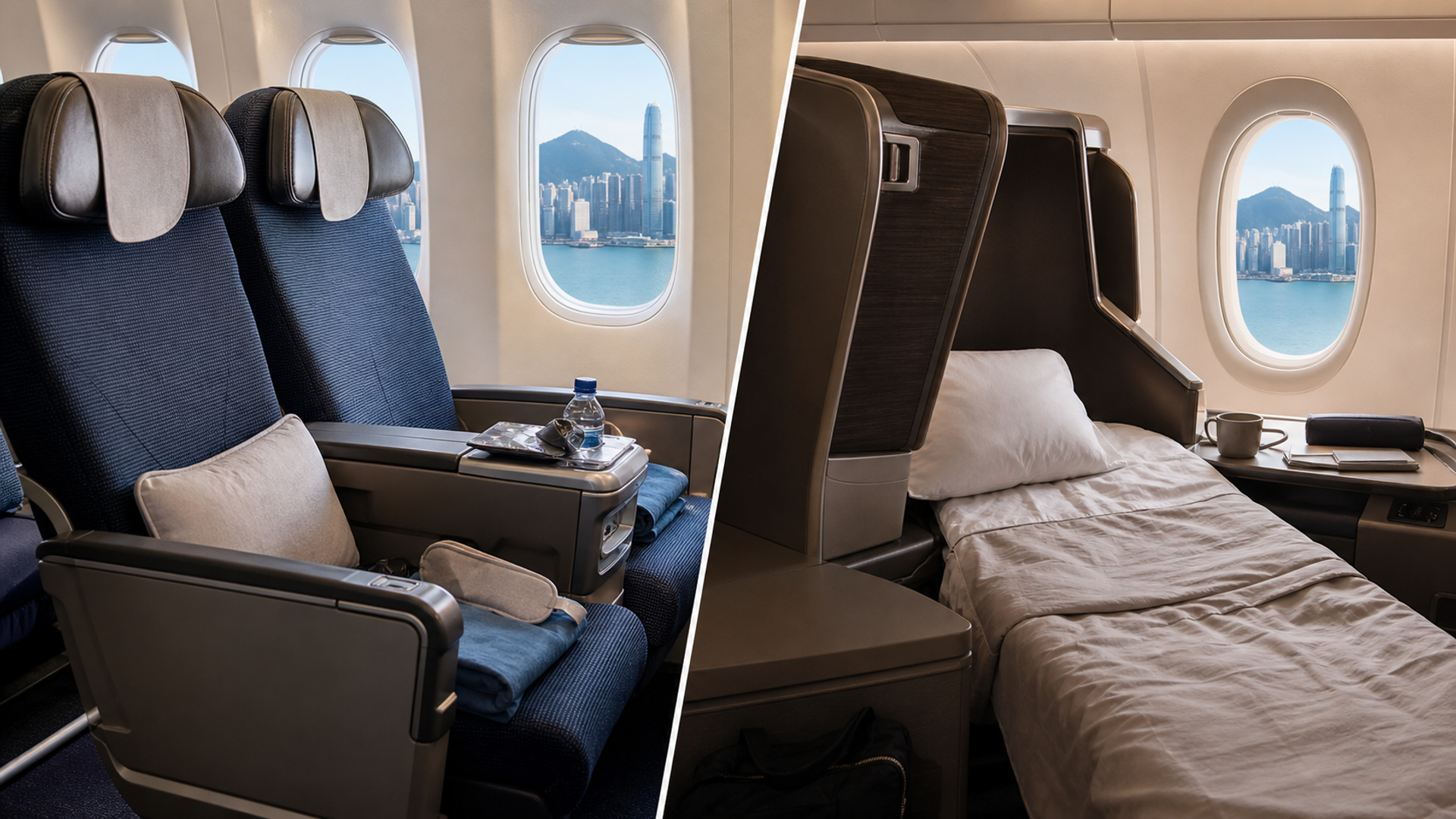
Cathay Pacific Premium Economy and Business Class are both credible long-haul products, yet the difference is not a simple ladder from good to better. Premium Economy is a spacious recliner designed to make an upright journey easier. Business Class adds lounge access and a flat-bed sleep system; on selected 777-300ER aircraft, Cathay's newer Aria Suite adds a privacy door and more enclosed personal space.
The 2026 value question is therefore route-specific. A Hong Kong connection, overnight timing, aircraft generation and the work waiting after arrival can outweigh soft-product details. This comparison separates durable cabin differences from features that depend on aircraft, airport and fare.
Quick answer
Premium Economy is the value choice for daylight travel and passengers who need width, recline and a smaller cabin. Business Class is the stronger choice for overnight flights, long connections through Hong Kong and arrival-critical work. Pay particular attention to whether the sector offers the Aria Suite or another Cathay business seat.
Decision matrix
| Decision factor | Option A | Option B | Practical edge |
|---|---|---|---|
| Core seat | Wide recliner with leg support | Flat-bed business seat | Business for sleep |
| New-product variance | New Premium seat on selected aircraft | Aria Suite on selected 777-300ER | Check aircraft |
| Privacy | Open cabin | Greater separation; door on Aria Suite | Business |
| Lounge | Not normally a cabin benefit | Cathay and partner lounge access | Business |
| Working | Good for short laptop sessions | Larger surface and more control | Business |
| Connection | Terminal comfort depends on ticket/status | Lounge can improve long HKG dwell | Business |
| Sleep | Reclined, not horizontal | Flat bed | Business |
| Best value | Daytime or price-sensitive long haul | Overnight and recovery-led travel | Itinerary-specific |
Map the journey, not just the longest sector
A two-hour connection in Hong Kong and an eight-hour connection are different products even when the seat is identical.
Business lounge access can turn a long dwell into a meal, shower and work period. On a short connection, much of that ground value disappears.
Use this test: Calculate door-to-door awake time and connection friction before pricing the cabin upgrade.
Verify the business-seat generation
Cathay's selected 777-300ER aircraft can feature the Aria Suite, while other aircraft use different business seats.
A privacy door, storage and contemporary controls may matter to a solo executive; a couple may value seat pairing differently.
Use this test: Check the specific flight's aircraft and seat map, then retain flexibility in case the operating type changes.
Premium Economy improves posture, not sleep certainty
More room, a supportive leg rest and deeper recline can reduce fatigue without creating a bed.
Some travellers sleep acceptably in a recliner; others cannot. The upgrade value therefore starts with the passenger's sleep response, not the seat's marketing category.
Use this test: Use your last long-haul experience as evidence and avoid paying for a benefit your body does not use.
The Hong Kong lounge network is a material differentiator
Cathay's business product begins before boarding when lounge access is available.
A proper meal, quieter work area and shower can be worth more on a connection than a second onboard meal. Capacity and opening hours still matter.
Use this test: Check the lounge associated with the departure gate and time rather than assuming every Cathay lounge will be convenient.
Day flights compress the gap
On a daytime journey, both cabins keep the passenger awake for most of the sector.
Business still provides privacy, space and service control, but the flat bed loses part of its advantage. Premium Economy can deliver a strong comfort return.
Use this test: Set a lower acceptable fare multiple for daytime travel than for a night flight.
Overnight travel widens the gap
Horizontal rest is the largest structural difference between the cabins.
A flat bed can protect sleep duration and spinal comfort, but cabin noise, meal timing and personal sleep ability remain limiting factors.
Use this test: Select a quiet seat, request an efficient meal service and protect the sleeping window.
Fare rules can matter more than champagne
Changes, refunds, mileage earning and upgrade eligibility vary by fare family.
A flexible Premium Economy ticket can be more useful than a restrictive Business fare when dates are unstable. Cabin and commercial terms must be compared together.
Use this test: Read the exact fare conditions before treating a higher cabin as the safer booking.
Baggage and priority need a trip-level calculation
Extra allowances and priority handling are valuable only when the traveller uses them.
A cabin bag and mobile boarding pass make some priority benefits nearly invisible. Family travel, samples and long stays can reverse that result.
Use this test: Add avoided baggage fees and saved airport time to the upgrade value, but do not double-count them.
Service consistency has limits
Crew, catering and disruption can vary on any airline.
Business Class buys a more capable product, not a guaranteed perfect journey. Premium Economy should not be dismissed because it has fewer ceremonial touches.
Use this test: Base the choice on hard product and itinerary utility, then treat service extras as upside.
Measure the next day
The most useful post-trip metric is not whether the flight felt luxurious.
Record sleep hours, alertness, pain, work output and recovery time. A repeatable record reveals whether the premium actually protects performance.
Use this test: Use that evidence to set a personal route-and-cabin policy for future Cathay bookings.
Who should choose what
| Traveller or owner | Better fit | Why |
|---|---|---|
| Sydney–Hong Kong daytime | Premium Economy | Space matters more than a bed for many travellers. |
| London–Hong Kong overnight before work | Business Class | Flat-bed sleep and lounge access protect arrival. |
| Long Hong Kong connection | Business Class | Ground comfort becomes part of the product. |
| Flexible leisure itinerary with a large fare gap | Premium Economy | Preserve budget for destination value. |
Common mistakes
Assuming every 777 has the newest Aria Suite.
Ignoring the connection when calculating Business Class value.
Comparing a flexible Premium fare with a restrictive Business fare by cabin alone.
Using one review from a different aircraft as proof of the booked experience.
How to measure personal value
The useful value of Cathay Pacific Premium Economy vs Business Class is the change it produces in a repeated, observable situation. Start with the article's value object—the aircraft, route, seat, lounge, sleep and connection decision matrix—and mark which rows affect your own behaviour. In the Cathay Pacific Premium Economy vs Business Class decision, a feature that never changes a journey, security decision or ownership routine has little practical value even when technically impressive.
Use core seat as the first controlled comparison: one side is wide recliner with leg support, while the other is flat-bed business seat. Then add the frequency of the relevant trip or use, the cost of Cathay Pacific Premium Economy vs Business Class mistakes, and the friction introduced by the more demanding option. For a Cathay Pacific Premium Economy vs Business Class purchase, divide the meaningful premium by expected uses rather than calendar years; for privacy, include the time and support required to keep controls correctly configured.
Create a minimum-success condition for Cathay Pacific Premium Economy vs Business Class. For this Cathay Pacific Premium Economy vs Business Class decision, success might be a full night's sleep, a watch still running on Monday, a phone policy that survives travel, or a bag carrying the real daily load without distortion. If neither Cathay Pacific Premium Economy vs Business Class option meets that condition, defer the purchase, choose another configuration or redesign the trip.
How to verify a changing specification
Facts surrounding Cathay Pacific Premium Economy vs Business Class can change after publication: airlines swap aircraft, manufacturers update references, software support terms move, and pre-owned condition differs from a catalogue description. Treat the current operator or manufacturer page as the Cathay Pacific Premium Economy vs Business Class starting point, not as a guarantee that every individual booking or object matches the general description.
Capture the exact date, model, route, configuration, material, firmware or fare family used for Cathay Pacific Premium Economy vs Business Class. Save the official Cathay Pacific Premium Economy vs Business Class specification and ask the seller or operator to resolve contradictions in writing. If a material Cathay Pacific Premium Economy vs Business Class feature is not identified at transaction level, assign it zero value until confirmed rather than assuming the best possible version.
For Cathay Pacific Premium Economy vs Business Class, repeat the check immediately before the cancellation, return or change window closes. That second Cathay Pacific Premium Economy vs Business Class check protects against substitutions and reveals whether the original decision relied on a benefit that is no longer available. Where Cathay Pacific Premium Economy vs Business Class involves authenticity, law, safety or security, independent specialist verification remains more important than an editorial comparison.
Keep an evidence-backed decision record
A short decision record makes Cathay Pacific Premium Economy vs Business Class auditable. Write the selected Cathay Pacific Premium Economy vs Business Class option, the rejected alternative, the three decisive facts, the sources checked and the condition that would reverse the choice. Attach a Cathay Pacific Premium Economy vs Business Class seat map, reference number, support policy, condition report or packing photograph where relevant. A Cathay Pacific Premium Economy vs Business Class record is especially useful when an assistant, travel coordinator, buyer or family member must act later without reconstructing the reasoning.
Separate measured Cathay Pacific Premium Economy vs Business Class facts from estimates. For Cathay Pacific Premium Economy vs Business Class, published dimensions, official benefits and documented support dates are facts for the referenced configuration; predicted sleep, resale, comfort and future availability are estimates. Label Cathay Pacific Premium Economy vs Business Class uncertainty openly and avoid converting one reviewer's experience into a universal claim.
The decision record for Cathay Pacific Premium Economy vs Business Class should also name an exit path: cancellation, return, service inspection, account suspension or resale review. A Cathay Pacific Premium Economy vs Business Class option with a clear, affordable correction path can be safer than a theoretically superior option whose failure is difficult to reverse.
Review the outcome after real use
Review Cathay Pacific Premium Economy vs Business Class after one representative trip or 30 days of ownership. Record which Cathay Pacific Premium Economy vs Business Class benefits were used, what created friction, what failed to matter and what new constraint appeared. Do not ask only whether Cathay Pacific Premium Economy vs Business Class felt premium; ask whether it solved the problem named in the decision record.
For the Cathay Pacific Premium Economy vs Business Class review, travel decisions should note sleep, delays, connection effort and useful hours after arrival; watch decisions should note comfort, timing, reserve and frequency of wear. For Cathay Pacific Premium Economy vs Business Class mobile privacy, review updates, permissions, account events and recovery readiness; for bags, inspect load, access, shape, marks and how often the object stayed at home.
That review turns Cathay Pacific Premium Economy vs Business Class into evidence for the next decision instead of an isolated opinion. If the Cathay Pacific Premium Economy vs Business Class outcome was weak, change one variable at a time—route, configuration, size, material, policy or use pattern—so the next comparison produces a clear lesson.
A verification checklist before you commit
For Cathay Pacific Premium Economy vs Business Class, confirm the exact reference, aircraft, fare, leather, device or service configuration rather than relying on a category label. Read the current Cathay Pacific Premium Economy vs Business Class manufacturer or operator page, preserve the quoted specification, and identify which facts can change before delivery or departure. Where Cathay Pacific Premium Economy vs Business Class involves money, safety or a high-value object, use a qualified seller, carrier, security team or specialist to verify the individual transaction.
Write the Cathay Pacific Premium Economy vs Business Class decision in one sentence: the option, the problem it solves and the condition that would change the choice. This keeps prestige, scarcity or one Cathay Pacific Premium Economy vs Business Class headline feature from replacing the actual use case. After Cathay Pacific Premium Economy vs Business Class ownership or travel, record what happened so the next decision uses evidence rather than memory.
Where VERTU can be relevant
Eligible VERTU owners planning a multi-city Asia itinerary may ask VERTU Concierge to assist with authorised coordination, such as sourcing alternatives, arranging requested transfers or keeping a complex journey organised. Concierge does not control Cathay inventory, lounge entry or disruption decisions. The traveller must approve purchases and should verify all airline terms directly.
![How to Scan Receipts and Documents with Your Phone [Full Guide]](https://cdn.sanity.io/images/e0gp1l2g/production/0db13feec1d5e72b8a8a5f976d1f3e86619c9228-3840x1860.webp?w=180&h=180&q=78&auto=format&fit=crop)
![How to Scan Receipts and Documents with Your Phone [Full Guide]](https://cdn.sanity.io/images/e0gp1l2g/production/0db13feec1d5e72b8a8a5f976d1f3e86619c9228-3840x1860.webp?w=800&h=450&q=82&auto=format&fit=crop)
![Top 10 Two-Tone Carbon-Fibre Watches for Men [2026 List]](https://cdn.sanity.io/images/e0gp1l2g/production/18870799ba33fab0e038968359cd5772d7d7db30-1024x576.webp?w=800&h=450&q=82&auto=format&fit=crop)
![Top 10 Luxury Watches with Digital Complication Displays for Men [Latest]](https://cdn.sanity.io/images/e0gp1l2g/production/c4f6bf8c080f291c39f7cc85c7344ecff2fd3799-1024x553.webp?w=800&h=450&q=82&auto=format&fit=crop)