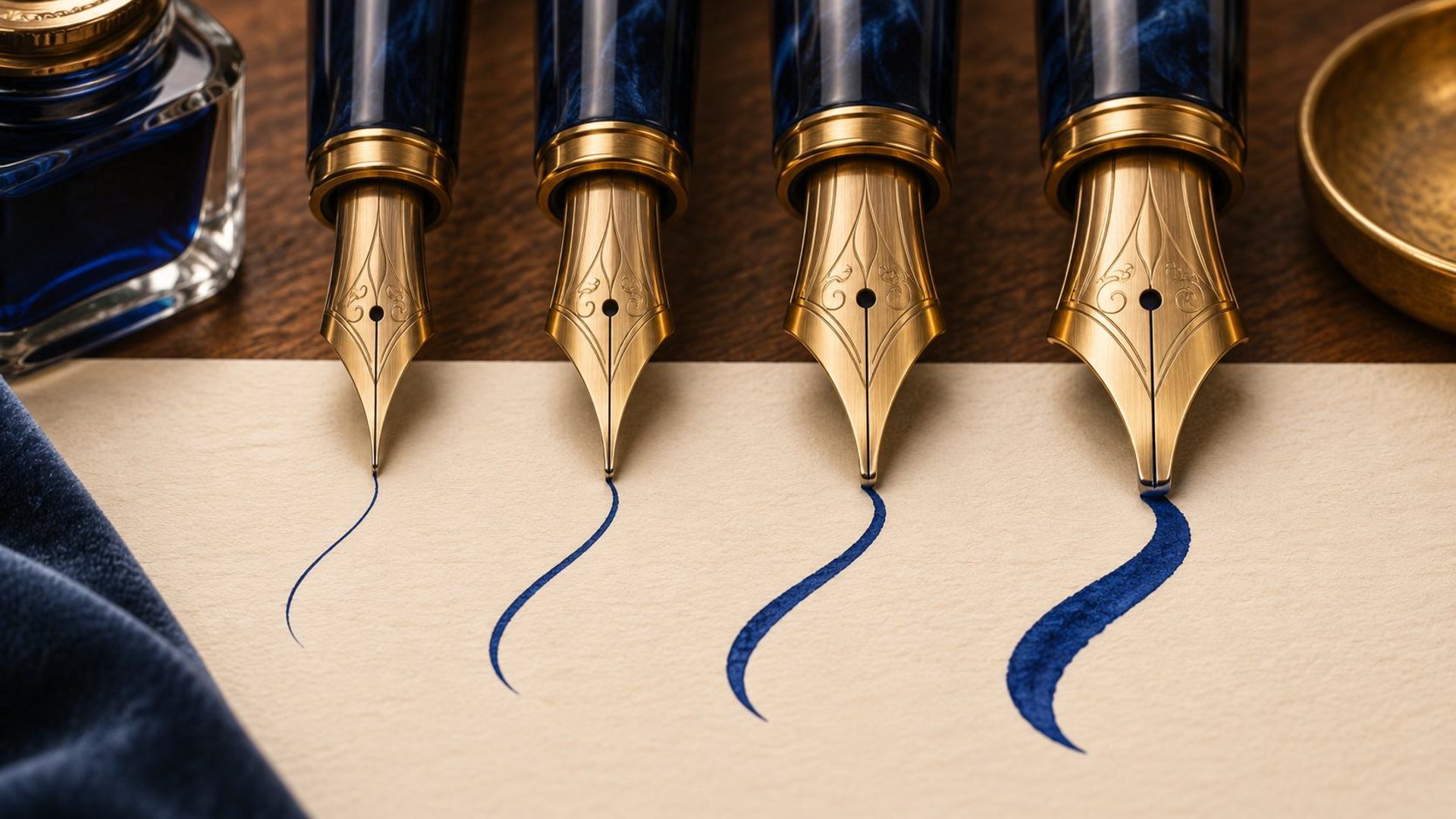
Fountain pen nib sizes should be chosen from your handwriting, paper and intended use, then confirmed with a writing sample from the exact pen. Extra-fine and fine nibs make compact notes easier; medium is a flexible starting point; broad and specialty nibs favor larger, expressive writing. Those labels are relative, not a universal millimeter standard. Ink flow, paper absorbency and your writing angle can make one “fine” line look wider than another.
Key Takeaways
- Start with the space you write in: small planner boxes usually favor a finer point than signatures.
- Compare actual writing samples on the paper you use, not size labels alone.
- EF, F, M and B are broad categories; line width varies by maker, ink, paper and pressure.
- Try the pen at your natural angle and speed to reveal scratchiness or skipping.
- For VERTU Marengo, the official standard edition lists a custom German SCHMIDT nib with an approximately 0.5 mm writing line.
What do EF, F, M and B mean?
They stand for extra-fine, fine, medium and broad. In general, each step offers a wider line and more visible ink character. LAMY describes EF and F as useful for small writing or precise sketching, M as an all-rounder, and B or wider options as suited to expressive signatures and lines. Pelikan uses similar labels but notes that availability depends on the individual pen model. Neither maker's guide promises that every EF or M nib has the same measured width across brands.
Nib geometry also matters. A rounded medium tip behaves differently from an italic or stub edge that creates line variation. An oblique nib is shaped for a particular pen rotation, not automatically for every left-handed writer. Before shopping by an exotic label, watch how you naturally hold a pen. A conventional round nib is the simplest baseline if you want predictable notes. Specialty cuts can be satisfying for lettering but require more attention to angle and alignment.
Which fountain pen nib size works for small handwriting?
An extra-fine or fine nib usually gives letters more room to breathe in a small planner, margin or narrow journal ruling. It can keep loops from filling in and leave space for corrections. However, a very fine point may feel less smooth on coarse paper because it meets fewer fibers at once. If your writing is tiny but you press hard, a delicate EF may feel unpleasant. Try F as a compromise before assuming the thinnest possible line is best.
Make a test paragraph in your usual handwriting size. Include letters with closed counters such as “e,” “a” and “o,” plus numbers and punctuation. If the shapes merge, move narrower or use less absorbent paper. If the line is clear but the tip catches on upstrokes, compare a different nib or smoother paper rather than blaming the size alone. Pelikan's official catalog notes that its EF is suited to small writing and smoother paper; that is a useful rule of thumb, not a universal performance guarantee.
When is medium the sensible first choice?
A medium nib is often the safest first trial for someone who writes ordinary letters, notes and signatures on reasonably good paper. It gives a visible line without demanding large handwriting. Many buyers also perceive it as smoother than an EF because the contact patch is broader, though smoothness depends on tuning and paper. A medium nib shows shading and ink color more readily than a very fine one. The trade-off is that it can make small meeting notes crowded or show more feathering on absorbent office paper.
Test medium with the same ink and paper you will use daily. Write one page at a natural pace, not just your name in a store. Notice dry starts after pauses, excessive wetness, smears and whether the nib glides at your own grip angle. If you routinely write in compact notebooks or need to annotate printed documents, a fine nib may be more practical. If you mainly sign cards and personal letters, medium may have the better balance of comfort and expression.
Who benefits from a broad or specialty nib?
A broad nib gives a more substantial stroke for headings, signatures, cards and large handwriting. It can show ink shading and sheen, but also uses more ink and needs room for letters. On thin paper, a wet broad line may bleed or show through. Stub and italic cuts add a different dimension: their line can vary by writing direction. That effect can make ordinary handwriting decorative, yet the pen may be less tolerant of rotating the barrel as you write.
Do not buy a broad nib solely because it seems luxurious. If you mostly fill small forms or write quick notes on office paper, its everyday cost in space and drying time can outweigh its visual appeal. If you are buying for a gift, ask for a short sample of the recipient's handwriting or choose a model with a supported nib-exchange path. A broad nib is an intentional style choice rather than an upgrade over fine or medium.
How do paper and ink change the apparent line?
Paper absorbency influences how far ink spreads beyond the contact area. On a porous page, a fine nib may look like a medium and develop fuzzy edges; on smooth fountain-pen paper, the same nib may produce a crisp narrower stroke. Ink formulation and flow also matter. A wetter combination makes a line appear fuller and can increase drying time. These interactions explain why a number printed on a nib or in a product listing is not the exact width you will see in every notebook.
Bring two papers to a pen shop: your routine notebook and the office paper you cannot control. Draw a simple grid and write the same sentence with each candidate nib. Wait, then check feathering, show-through and smearing. If you are left-handed or write quickly, pay special attention to how long the ink remains wet where your hand passes. Change one variable at a time. If a line is too wide, trying a different paper may be cheaper than replacing a nib, but a size change may still be right for your writing style.
How should you test a nib in five minutes?
- Hold the pen as you normally would, without adjusting to the salesperson's demonstration angle.
- Write a full sentence slowly, then another at your real note-taking speed.
- Try straight strokes, small loops, numbers and a signature.
- Pause for 20 seconds and see whether the pen starts again cleanly.
- Turn the paper slightly as you would at your desk and watch for skipping.
- Compare the line after it dries on your own paper.
Use light pressure. A fountain pen is designed to deliver ink through capillary action; pressing harder is not the solution to a nib that skips. If one direction scratches, ask whether the demonstration pen is properly aligned before condemning the entire nib size. If possible, test another sample of the same model. This short exercise provides better evidence than a static line-width chart because it includes your grip and your paper.
How do common nib sizes compare?
| Size | Useful starting use | Watch for |
|---|---|---|
| EF | Very small notes, tight margins | Rough paper and heavy pressure |
| F | Everyday notes, small-to-medium writing | Brand-to-brand width differences |
| M | General writing and letters | Feathering in absorbent paper |
| B | Large writing, headings, signatures | Space, ink use and drying time |
| Stub or italic | Deliberate line variation | Angle sensitivity |
These are decision aids rather than measurements. A maker may offer different widths under the same label, and the pen's feed can change how much ink reaches the paper. If you cannot try a pen in person, request a writing sample made with the exact model, ink and paper identified. Close-up photographs without that context can mislead. Also ask about exchange and service policies before ordering a nib that cannot be changed easily.
What is the VERTU Marengo nib specification?
The official VERTU Marengo Fountain Pen standard edition lists a custom German-made SCHMIDT writing system with an approximately 0.5 mm line, plus cartridge or converter filling. Its listed body is gold-plated brass with zirconia accents, about 152.8 × 14.1 mm and around 80 g. Those figures describe this specific edition, not all fountain pens or the bespoke Marengo. A 0.5 mm claim provides a useful starting expectation but does not replace a sample on your paper.
The pen's substantial listed weight is also worth testing for hand comfort. A nib width that looks perfect can feel wrong when the barrel balance tires your grip during a long letter. If Marengo is for occasional signatures or correspondence, its sculptural design and line may be the intended combination; if it is for fast daily notes, try the full writing experience first. The maker recommends quality fountain-pen ink and periodic cleaning of the feed. Confirm current nib, filling accessories and service terms for the exact edition before purchase.
What should you ask before buying?
- Is the nib width measured or only labeled EF, F, M or B?
- Can I see a sample with the same model and ink?
- Can the nib be exchanged or serviced in my region?
- Which cartridges, converter and inks are compatible?
- What paper was used in the published writing sample?
- What happens if the nib skips or arrives misaligned?
These questions make a nib-size decision concrete. A good retailer can distinguish a normal line-width preference from a defect and explain the available remedy. Save the answers with the receipt. If the pen is personalized or bespoke, check whether that changes return rights before engraving or commissioning it. Nib choice is one part of ownership; ink supply, cleaning and body balance determine whether the pen remains pleasant after the first unboxing.
LAMY’s official nib guide lists extra-fine (EF), fine (F), medium (M), broad (B) and 1.1 mm, 1.5 mm and 1.9 mm calligraphy options. Those numbers name LAMY’s calligraphy nibs; they are not universal measured line widths for every brand. Compare a writing sample on your own paper before choosing.
Frequently asked questions
Is fine always 0.5 mm?
No. Nib labels and measured lines vary by maker, ink and paper. Treat any numerical width as a model-specific specification and test the actual result.
Is medium best for a beginner?
It is a useful first trial for ordinary writing, but small handwriting or absorbent paper may favor fine. Choose from a sample of your own notes.
Does a gold nib write wider than steel?
Material alone does not determine line width. Tip shape, feed, ink and paper matter more for the line you see.
Can I change nib size later?
It depends on the pen. Some makers support easy nib replacement; others require service or offer no simple exchange. Check the exact model before buying.
Conclusion
Fountain pen nib sizes are most useful as a shortlist, not a final answer. Begin with your handwriting and paper, compare EF through B by real samples, and consider body comfort and after-sales options. The VERTU Marengo's approximately 0.5 mm SCHMIDT line is a specific reference point; the right choice remains the nib that produces clear, comfortable writing in your own hand.