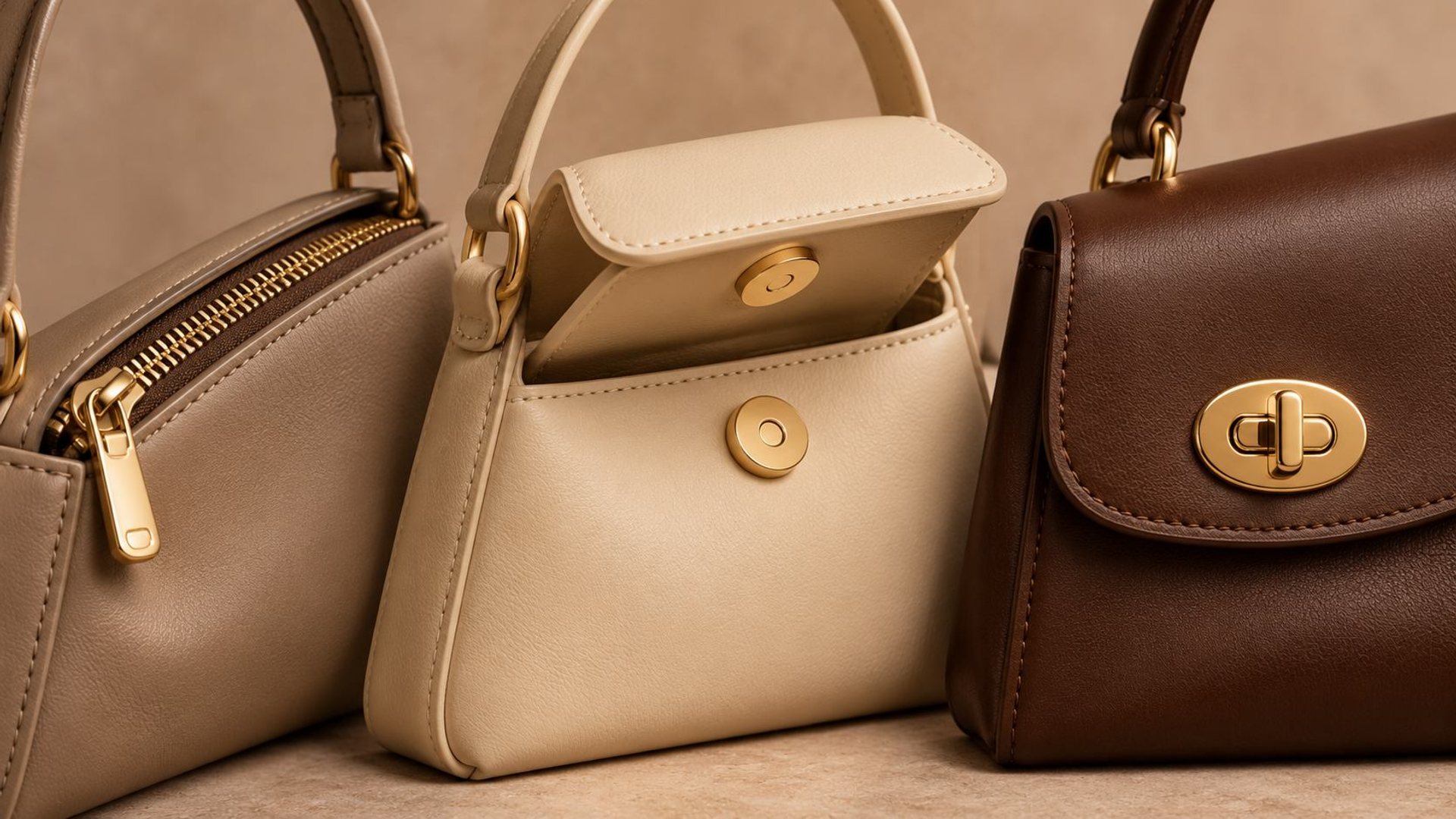
Among common handbag closure types, a magnetic snap is usually quickest to open with one hand, while a full zipper offers a more enclosed opening. A turnlock or clasp can feel secure and deliberate but often takes more alignment. The easiest choice depends on how often you reach into the bag, whether you carry small valuables, and how the opening behaves when the bag is full. Test the actual bag with your normal belongings before assuming a closure name tells the whole story.
Key Takeaways
- Magnetic snaps favor quick access; zippers provide a more fully enclosed compartment.
- Turnlocks and push clasps can be secure but need alignment and a usable grip.
- Drawstrings and flaps change the usable opening even when the hardware is easy to operate.
- Test every closure with one hand, while wearing the bag, and with a realistic load inside.
- For VERTU Catena styles, verify the exact variant's fastening rather than assuming every V-fold design uses the same mechanism.
What are the main handbag closure types?
Most everyday bags use one or more of six arrangements: zipper, magnetic snap, turnlock, push clasp, drawstring, or an open top beneath a flap. A bag can combine them. For example, a tote may have magnetic side snaps, a turnlock on the main opening and an internal zip compartment. That combination lets a buyer choose speed for a notebook and more enclosure for a wallet. Read the product specification closely: “flap closure” describes the shape of the opening but does not tell you what actually keeps the flap shut.
Brand names can obscure function. A sculptural buckle may be decorative while a hidden magnet does the work; a prominent metal plate may conceal a press clasp. Ask to see an opened and closed view. When shopping online, video of someone using the bag is more informative than a still photograph. Count the steps required to get to the item you use most often. If you open a bag twenty times during a commute, even a small extra maneuver can become irritating.
Which closure is easiest with one hand?
A well-positioned magnetic snap is often the simplest because the two sides guide themselves together, though a stiff flap or heavily loaded bag can prevent them meeting. A smooth zipper can also work one-handed if the bag has a firm edge to hold against and a reachable pull. A turnlock usually needs a thumb and forefinger to rotate the hardware while the other hand steadies the flap. Push clasps vary: some release cleanly, others require a precise pinch that is awkward with gloves or limited hand dexterity.
Try the closure while the bag is on your shoulder or across your body, not only on a display table. Reach for your phone, keys and transit card separately. Notice whether the bag swings, whether the top collapses, and whether the strap pulls the opening closed. If you have limited grip strength, a large zipper pull or broad magnetic flap may be easier than a tiny metal button. This is a personal usability test, not a universal ranking of luxury hardware.
How do security and access compare?
| Closure | Access | Enclosure | Typical point to test |
|---|---|---|---|
| Magnetic snap | Fast | Partial | Does it stay shut when full? |
| Full zipper | Moderate | More complete | Does the pull glide around corners? |
| Turnlock | Deliberate | Depends on flap gaps | Can it rotate with one hand? |
| Push clasp | Variable | Depends on bag shape | Is alignment easy? |
| Drawstring | Slower | Adjustable, with top gaps | Can it be tightened evenly? |
| Open top | Fastest | Minimal | Will items spill if tipped? |
A closed-looking bag is not necessarily theft-resistant. Gaps at the side of a flap may leave small objects exposed, and a loosely secured magnetic top can open when the bag tips. A zipper is better at containing contents, yet it still depends on strong stitching and a pull that remains closed. For travel, consider both the exterior fastening and an internal compartment for a passport or wallet. Do not rely on a clasp as a substitute for keeping the bag within sight in crowded places.
When is a zipper the better choice?
A zipper is useful when the bag will be placed under a seat, carried on public transport or packed next to other luggage. It narrows the chance of small objects spilling and keeps the top more enclosed. Examine whether the zipper extends far enough to expose the main compartment. A narrow zip opening can make a roomy bag frustrating to use. Look for neat stitching at both ends, a pull that does not scratch your hand, and teeth that move smoothly without snagging the lining.
Pack the bag with the items you actually carry. A zipper that glides on an empty bag may strain when a tablet or water bottle pushes the sides apart. Do not force a zipper over bulging contents; the stress can damage the track and adjacent leather. If the zipper has a coated metal finish, ask how it is repaired if the pull wears. A good repair path may matter more over years than the first impression of smoothness in a store.
When is a magnetic snap or flap better?
A magnetic snap suits a buyer who values frequent access to a compact set of belongings. It is especially convenient when the bag is carried close to the body and the opening is visible. The risk is a snap that cannot reach its counterpart when the bag is full or when the flap bends. Place your intended items inside and close the bag without pushing down on it. Then walk a few steps and bend gently to see if the fastening remains engaged. Check whether the magnet attracts nearby metal accessories in an annoying way.
A flap may add visual coverage, but its ergonomics depend on length and stiffness. A flap that falls back over the opening while you search for keys can slow the experience even if the hidden magnet is quick. Conversely, a well-balanced flap can protect the opening without much effort. With any leather flap, inspect where repeated bending occurs and whether the edge finish is likely to rub against the fastening. If the bag is a gift, choose a mechanism the recipient can comfortably operate rather than prioritizing a dramatic front view.
What should you check on a turnlock or push clasp?
Open and close it several times under ordinary pressure. A turnlock should rotate without scraping the surrounding trim, and its plate should meet the receiving opening without forcing the leather out of shape. A push clasp should click consistently and release when intended. If either mechanism works only when you press the flap in a very specific spot, loading the bag may make it less reliable. Check screws, plating and the attachment to the leather. Decorative hardware can be visually striking while the load-bearing mount is weak.
Ask how the hardware can be repaired. A loose screw may be simple for a service center; a proprietary broken clasp may require a replacement part. A premium bag's usefulness depends on that after-sales path. Also inspect noise. Some metal clasps rattle while walking, which may be acceptable to one person and distracting to another. Try the closure with gloves if you normally wear them in winter. Small, smooth hardware can be harder to operate in cold weather than it appears on a showroom shelf.
How do VERTU Catena bags illustrate the choice?
The official VERTU Folded V Catena Crossbody Chain Bag page describes a two-tone leather design, V-shaped fold and chain strap. Other Catena listings include quilted leather versions. Those descriptions identify the style and carrying format, but they do not establish one universal closure mechanism across every variant. For a specific purchase, request a clear view of the fastening, the usable opening and its behavior when loaded. A compact crossbody may put different demands on one-handed access than a top-handle bag.
If you are comparing a Catena handbag and crossbody, decide where you will reach for essentials. A top handle can be set down and opened with two hands; a crossbody is often opened while worn. Check whether the chain strap keeps the bag stable when the front flap is lifted. Confirm internal pockets and current dimensions for the exact SKU. This product check is more useful than assuming that a V-shaped front panel has the same function as a turnlock, magnet or zipper.
What is a five-minute closure test?
- Place your usual phone, wallet, keys and one bulky item inside.
- Open and close the bag five times while it rests on a table.
- Repeat while wearing it in your intended carrying position.
- Retrieve one small item with your non-dominant hand.
- Walk, sit and tilt the bag slightly to see whether it remains closed.
- Look for rubbing, snagging, misalignment or excessive pressure at the fastener.
This is a practical demonstration, not a laboratory durability test. It reveals the everyday friction that product photography hides. A bag that feels effortless only when empty may not be right for your actual routine. If shopping remotely, ask the seller to demonstrate the same sequence on video and confirm the return policy before removing tags. Keep any concern about clasp alignment in writing so you can compare the delivered bag with what was shown.
How should you test handbag hardware before buying?
Try a repeatable in-store check: open and close the loaded bag ten times, then look for misalignment, snagging and any change in resistance. Ten cycles are an editorial shopping check, not a laboratory lifetime or pull-force rating. For an example of what a genuine strength figure means, YKK’s JIS S 3015:2019 table gives 150 N, 300 N and 490 N minimum chain crosswise strength for UL, M and H classes of discrete-element zippers on synthetic tape, respectively. The standard measures a specified zipper construction under a defined test; it does not tell us the zipper class, service life or opening force of any handbag in this guide. Ask the bag maker for its exact hardware specification and test evidence before applying a number to a product. Ask the maker whether the exact zipper, magnet or clasp can be serviced: Coach’s repair request form, for example, shows that repair is a product- and brand-specific service question. Do not infer a universal cycle life or tensile strength from a closure type alone.
Frequently asked questions
Is a zipper always more secure than a magnet?
It generally encloses the opening more fully, but security also depends on bag shape, stitching, zipper quality and how you carry it. Neither mechanism makes a bag theft-proof.
Which closure is fastest for commuting?
A magnetic snap or open-top pocket is often quickest for frequent access. Balance that speed against the risk of loose items spilling and use an internal zip pocket for valuables.
Can a handbag clasp be repaired?
Often, but availability depends on the mechanism, replacement parts and the brand's service policy. Ask before buying, especially for distinctive proprietary hardware.
Does a flap tell me how the bag fastens?
No. A flap may cover a magnet, turnlock, push clasp or no fastener at all. Check the exact product specification and a demonstration.
Conclusion
Handbag closure types should be compared by the action you perform every day: open, retrieve, close and carry. A magnetic snap often wins for speed, a zipper for enclosure, and a clasp for a deliberate design feel, but the actual bag's shape and load can change the result. Test the specific VERTU Catena variant or any other bag with your own belongings before deciding which closure is easiest to use.