

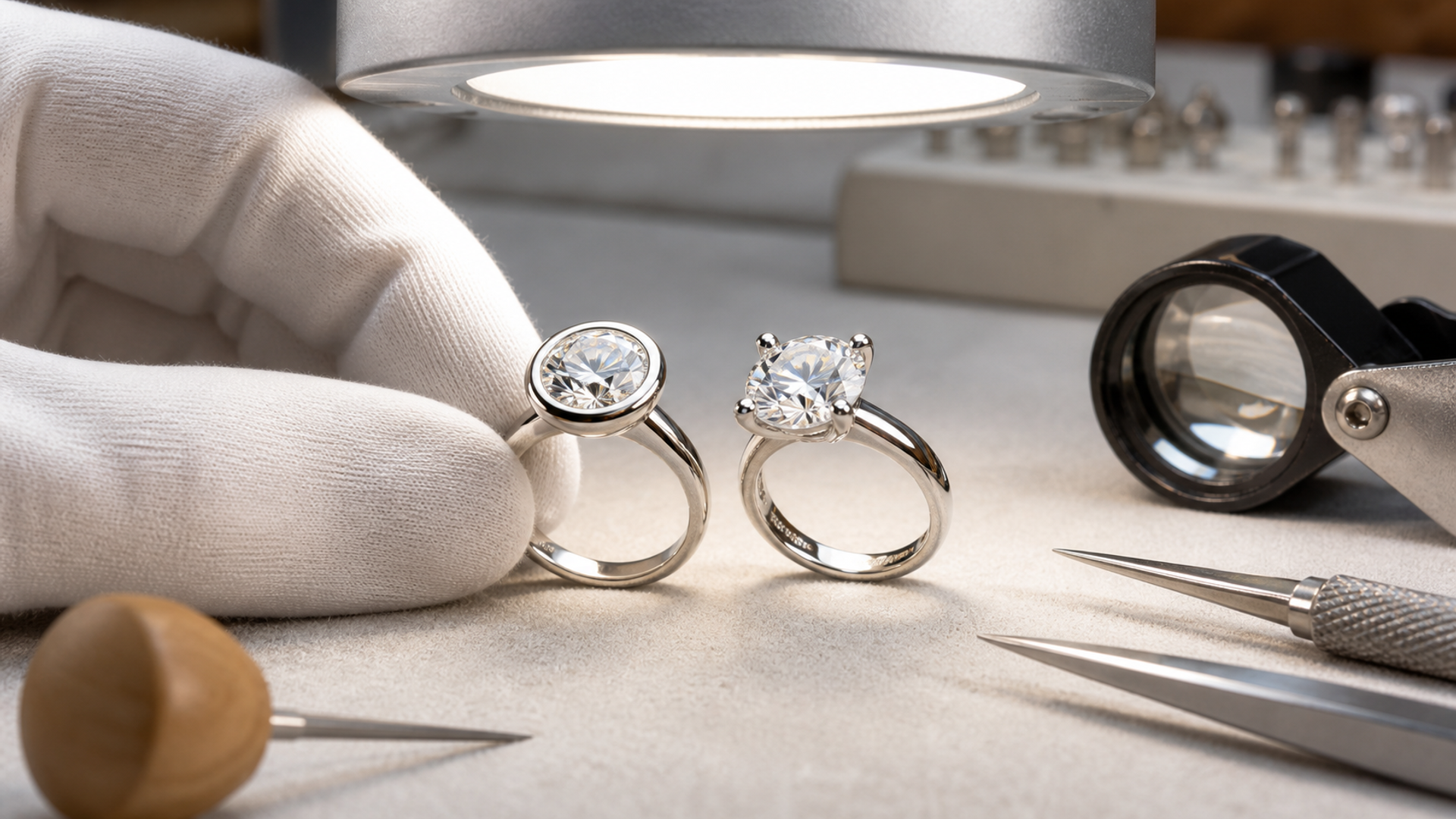
A bezel wraps metal around more of a stone's edge, while prongs hold it at discrete points. That construction changes edge protection, snagging, cleaning, visible outline and maintenance. The best setting is not the one that theoretically admits the most light; it is the one that protects the exact stone through the wearer's real day without hiding the look they value.
Protect the stone before chasing light
Choose a bezel when edge protection and low snagging lead, prongs when an open outline and conventional solitaire appearance lead, or a hybrid when the stone shape needs targeted protection. Have the jeweller design around the exact stone, metal and wear pattern.
| Decision factor | Bezel setting | Prong setting | Partial bezel or protected prong design |
|---|---|---|---|
| Edge protection | Metal surrounds vulnerable edges | Prongs expose more outline | Protect points and thin girdles |
| Snagging | Smooth perimeter suits active wear | Raised prongs are acceptable | Test clothing and gloves |
| Visible outline | Metal frame is part of the design | More of the stone edge remains visible | Choose metal colour deliberately |
| Cleaning | Crevices require a cleaning plan | Under-gallery access may be easier | Inspect exact construction |
| Inspection | Bezel security needs professional checks | Prong wear is visible but periodic | Set an inspection interval |
| Repair | Bezel work requires specialist skill | Prongs can be retipped when appropriate | Confirm local jeweller capability |
This bezel setting vs prong matrix is the article's working value object. Read the bezel setting vs prong rows together: the decisive failure mode depends on this topic's evidence, operating context and reader objective.
What jewellery evidence establishes
Evidence 1. GIA explains that setting style is a material part of engagement-ring design and should be chosen with the stone and wearer in mind.
Evidence 2. Prongs and bezels protect stones differently; neither eliminates the need for inspection after impact or wear.
Evidence 3. Stone shape, girdle condition and points can change which edges need the most protection.
Evidence 4. Metal type, thickness and workmanship influence security more than the category label alone.
Reader-visible sources checked for this article:
gia.edu — reader-visible current or official evidence
gia.edu — reader-visible current or official evidence
For bezel setting vs prong, these sources establish only the claims inside their documented scope. Recheck every changeable specification, availability condition, price, policy or service term in the relevant market before acting.
Match the setting to daily wear
The edge protection row exposes a practical boundary. Route one assumes metal surrounds vulnerable edges, while route two is defensible only when prongs expose more outline. Route three depends on protect points and thin girdles. If that evidence is absent, keep the more reversible option.
Read snagging as a stop/go test: smooth perimeter suits active wear supports the first option; raised prongs are acceptable supports the second; and test clothing and gloves supports the third. Record which source proves the condition and when it was checked.
A buyer can resolve visible outline without starting from a brand preference. Ask whether metal frame is part of the design; compare that with whether more of the stone edge remains visible; then use choose metal colour deliberately as the third route's safeguard. An unknown condition stays unknown.
On cleaning, popularity is not enough. The evidence for option one is that crevices require a cleaning plan. Option two means under-gallery access may be easier. Option three is rational where inspect exact construction. Recheck any changeable term immediately before commitment.
The decision changes at inspection. Choose the first path only if bezel security needs professional checks; move to the second when prong wear is visible but periodic; use the third when set an inspection interval. Save the downside that would make this row fail.
For repair, the first route works when bezel work requires specialist skill; the second requires prongs can be retipped when appropriate. The control for the third is confirm local jeweller capability. Verify this row against the exact product, property, account or environment before it can reverse the decision.
Facts that would reverse the current choice
Reversal control 1 — Edge protection. Before choosing Bezel setting, write down how the decision changes if “Metal surrounds vulnerable edges” proves false. Do the same for Prong setting and “Prongs expose more outline”. Keep the Partial bezel or protected prong design route available until “Protect points and thin girdles” is verified. This control belongs to bezel setting vs prong; update it from the cited source or exact supplier rather than copying a generic checklist.
Reversal control 2 — Snagging. Before choosing Bezel setting, write down how the decision changes if “Smooth perimeter suits active wear” proves false. Do the same for Prong setting and “Raised prongs are acceptable”. Keep the Partial bezel or protected prong design route available until “Test clothing and gloves” is verified. This control belongs to bezel setting vs prong; update it from the cited source or exact supplier rather than copying a generic checklist.
Reversal control 3 — Visible outline. Before choosing Bezel setting, write down how the decision changes if “Metal frame is part of the design” proves false. Do the same for Prong setting and “More of the stone edge remains visible”. Keep the Partial bezel or protected prong design route available until “Choose metal colour deliberately” is verified. This control belongs to bezel setting vs prong; update it from the cited source or exact supplier rather than copying a generic checklist.
Reversal control 4 — Cleaning. Before choosing Bezel setting, write down how the decision changes if “Crevices require a cleaning plan” proves false. Do the same for Prong setting and “Under-gallery access may be easier”. Keep the Partial bezel or protected prong design route available until “Inspect exact construction” is verified. This control belongs to bezel setting vs prong; update it from the cited source or exact supplier rather than copying a generic checklist.
Reversal control 5 — Inspection. Before choosing Bezel setting, write down how the decision changes if “Bezel security needs professional checks” proves false. Do the same for Prong setting and “Prong wear is visible but periodic”. Keep the Partial bezel or protected prong design route available until “Set an inspection interval” is verified. This control belongs to bezel setting vs prong; update it from the cited source or exact supplier rather than copying a generic checklist.
Reversal control 6 — Repair. Before choosing Bezel setting, write down how the decision changes if “Bezel work requires specialist skill” proves false. Do the same for Prong setting and “Prongs can be retipped when appropriate”. Keep the Partial bezel or protected prong design route available until “Confirm local jeweller capability” is verified. This control belongs to bezel setting vs prong; update it from the cited source or exact supplier rather than copying a generic checklist.
Start with the exact stone
Ask the jeweller to inspect shape, girdle, inclusions near the edge and dimensions. A generic setting recommendation cannot replace that assessment.
Rehearse daily contact
List gloves, pockets, exercise, children and work equipment. Test a sample setting against clothing and normal hand movement.
Compare optics honestly
View exact rings in daylight and indoor light. Metal framing can change apparent outline; prongs can interrupt symmetry. Choose the look rather than repeating a universal light claim.
Create an inspection record
Photograph the finished setting, keep stone and metal documents, and follow professional advice for checks after impacts and over time.
Three ring-setting decisions
Active daily wearer
A well-executed bezel can reduce snagging and protect exposed edges. Define the fact that would reverse this recommendation before committing.
Classic solitaire preference
Prongs can preserve the open outline when the wearer accepts inspection and snag risk. Define the fact that would reverse this recommendation before committing.
Pointed stone shape
A hybrid or protected prong design can focus metal where vulnerability is highest. Define the fact that would reverse this recommendation before committing.
Action checklist
Inspect the exact stone.
Review girdle and points.
Describe daily wear.
Test snagging.
Compare in mixed light.
Choose metal thickness.
Confirm cleaning access.
Set inspection timing.
Verify repair skill.
Keep photographs.
Continue the decision
The linked VERTU articles expand adjacent parts of the bezel setting vs prong decision. They do not substitute for the external evidence above.
The setting verdict
Choose a bezel when edge protection and low snagging lead, prongs when an open outline and conventional solitaire appearance lead, or a hybrid when the stone shape needs targeted protection. Have the jeweller design around the exact stone, metal and wear pattern.
Keep the bezel setting vs prong decision reversible until its material cost, safety, access, privacy and compatibility facts are verified. Unknown evidence stays unknown; it is never silently scored as favourable.
Final bezel setting vs prong pre-commitment control
For bezel setting vs prong, record the exact option and the one matrix row that actually decides the purchase. Repeat that topic's own test using the intended wrist, room, bag load, road, software, stone, garment or itinerary. Name the evidence that would reverse the bezel setting vs prong conclusion, then date the manufacturer, programme, jeweller or maker source used for that evidence.
Save the specific bezel setting vs prong configuration assessed, including its market, seller, warranty and return route. If a material dimension, movement, benefit, accessory, setting, construction detail or specification changes, reopen the comparison. The final log must explain why the rejected option lost on this reader's decisive constraint rather than on brand familiarity or one attractive image.
![How to Scan Receipts and Documents with Your Phone [Full Guide]](https://cdn.sanity.io/images/e0gp1l2g/production/0db13feec1d5e72b8a8a5f976d1f3e86619c9228-3840x1860.webp?w=180&h=180&q=78&auto=format&fit=crop)
![How to Scan Receipts and Documents with Your Phone [Full Guide]](https://cdn.sanity.io/images/e0gp1l2g/production/0db13feec1d5e72b8a8a5f976d1f3e86619c9228-3840x1860.webp?w=800&h=450&q=82&auto=format&fit=crop)
![Top 10 Two-Tone Carbon-Fibre Watches for Men [2026 List]](https://cdn.sanity.io/images/e0gp1l2g/production/18870799ba33fab0e038968359cd5772d7d7db30-1024x576.webp?w=800&h=450&q=82&auto=format&fit=crop)
![Top 10 Luxury Watches with Digital Complication Displays for Men [Latest]](https://cdn.sanity.io/images/e0gp1l2g/production/c4f6bf8c080f291c39f7cc85c7344ecff2fd3799-1024x553.webp?w=800&h=450&q=82&auto=format&fit=crop)