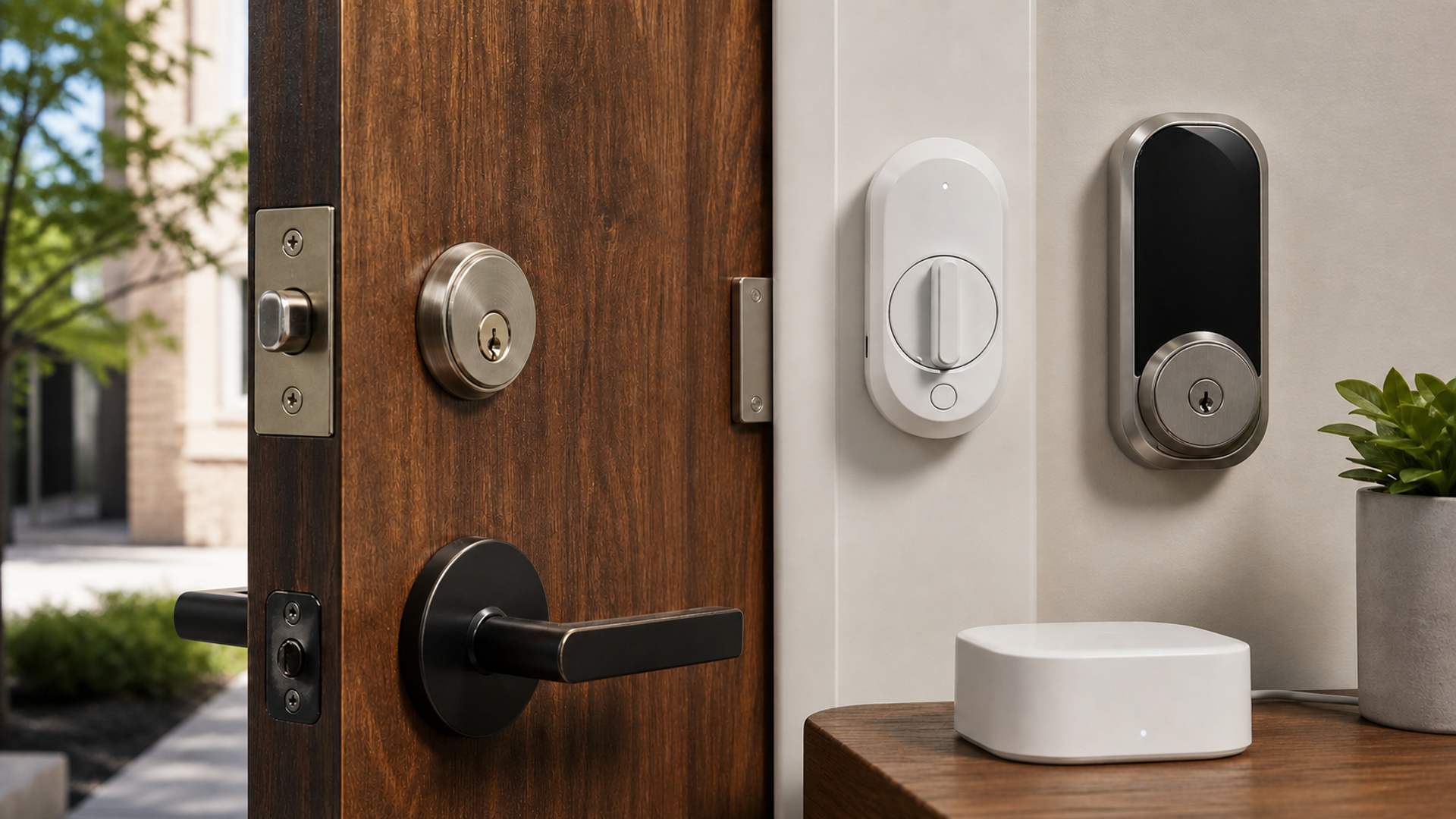
The best smart lock is the one that fits the exact door, preserves a dependable way inside and limits how many parties can observe or control access. A polished app cannot compensate for poor mechanical fit, weak account recovery or an unsupported product. Start with the door, household and failure modes, then compare convenience.
Start with the door and failure plan
Choose a retrofit lock when the existing exterior hardware and key should remain; a full replacement when keypad, cylinder and appearance need one system; or a local-first lock when minimising cloud dependence is the priority. Verify fit, credential revocation, update policy, battery recovery and manual override before buying.
| Decision factor | Retrofit interior lock | Full replacement keypad lock | Local-first connected lock |
|---|---|---|---|
| Door fit | Existing deadbolt geometry is compatible | The full bore, backset and handing are verified | A supported local hub fits the property |
| Daily entry | Phone and original key remain useful | PINs simplify family and guest entry | Local credentials work without internet |
| Guest access | Time-limited app access is acceptable | Unique PINs can be revoked and audited | Credentials stay within the local system |
| Failure recovery | Exterior key and fresh battery route remain | Emergency power and mechanical override are proven | Local administrator access survives an outage |
| Privacy | Cloud permissions and logs are understood | Vendor account and event retention are acceptable | Cloud collection is minimised by design |
| Ownership | The existing lock can be restored | Parts, support and firmware policy are current | Hub maintenance is worth the control gained |
This best smart lock matrix is the article's working value object. Read the best smart lock rows together: the decisive failure mode depends on this topic's evidence, operating context and reader objective.
What security evidence can establish
Evidence 1. NIST's consumer IoT programme treats device identification, configuration, data protection, interface access and software update capability as baseline cybersecurity considerations rather than optional marketing extras.
Evidence 2. NIST IR 8425 frames consumer IoT security around outcomes for the product as a whole, including support information and secure software updates, which makes the vendor's lifecycle policy material to a lock purchase.
Evidence 3. FTC consumer-IoT guidance emphasises truthful security claims and reasonable safeguards; a certification badge or encryption phrase is not a substitute for checking account, update and data practices.
Evidence 4. A smart lock remains a mechanical access device, so bore size, backset, door thickness, handing, alignment and a documented recovery route must be confirmed against the exact installation instructions.
Reader-visible sources checked for this article:
nist.gov — reader-visible current or official evidence
csrc.nist.gov — reader-visible current or official evidence
ftc.gov — reader-visible current or official evidence
schlage.com — reader-visible current or official evidence
For best smart lock, these sources establish only the claims inside their documented scope. Recheck every changeable specification, availability condition, price, policy or service term in the relevant market before acting.
Turn access features into a threat model
The door fit row exposes a practical boundary. Route one assumes existing deadbolt geometry is compatible, while route two is defensible only when the full bore, backset and handing are verified. Route three depends on a supported local hub fits the property. If that evidence is absent, keep the more reversible option.
Read daily entry as a stop/go test: phone and original key remain useful supports the first option; pINs simplify family and guest entry supports the second; and local credentials work without internet supports the third. Record which source proves the condition and when it was checked.
A buyer can resolve guest access without starting from a brand preference. Ask whether time-limited app access is acceptable; compare that with whether unique PINs can be revoked and audited; then use credentials stay within the local system as the third route's safeguard. An unknown condition stays unknown.
On failure recovery, popularity is not enough. The evidence for option one is that exterior key and fresh battery route remain. Option two means emergency power and mechanical override are proven. Option three is rational where local administrator access survives an outage. Recheck any changeable term immediately before commitment.
The decision changes at privacy. Choose the first path only if cloud permissions and logs are understood; move to the second when vendor account and event retention are acceptable; use the third when cloud collection is minimised by design. Save the downside that would make this row fail.
For ownership, the first route works when the existing lock can be restored; the second requires parts, support and firmware policy are current. The control for the third is hub maintenance is worth the control gained. Verify this row against the exact product, property, account or environment before it can reverse the decision.
Facts that would reverse the current choice
Reversal control 1 — Door fit. Before choosing Retrofit interior lock, write down how the decision changes if “Existing deadbolt geometry is compatible” proves false. Do the same for Full replacement keypad lock and “The full bore, backset and handing are verified”. Keep the Local-first connected lock route available until “A supported local hub fits the property” is verified. This control belongs to best smart lock; update it from the cited source or exact supplier rather than copying a generic checklist.
Reversal control 2 — Daily entry. Before choosing Retrofit interior lock, write down how the decision changes if “Phone and original key remain useful” proves false. Do the same for Full replacement keypad lock and “PINs simplify family and guest entry”. Keep the Local-first connected lock route available until “Local credentials work without internet” is verified. This control belongs to best smart lock; update it from the cited source or exact supplier rather than copying a generic checklist.
Reversal control 3 — Guest access. Before choosing Retrofit interior lock, write down how the decision changes if “Time-limited app access is acceptable” proves false. Do the same for Full replacement keypad lock and “Unique PINs can be revoked and audited”. Keep the Local-first connected lock route available until “Credentials stay within the local system” is verified. This control belongs to best smart lock; update it from the cited source or exact supplier rather than copying a generic checklist.
Reversal control 4 — Failure recovery. Before choosing Retrofit interior lock, write down how the decision changes if “Exterior key and fresh battery route remain” proves false. Do the same for Full replacement keypad lock and “Emergency power and mechanical override are proven”. Keep the Local-first connected lock route available until “Local administrator access survives an outage” is verified. This control belongs to best smart lock; update it from the cited source or exact supplier rather than copying a generic checklist.
Reversal control 5 — Privacy. Before choosing Retrofit interior lock, write down how the decision changes if “Cloud permissions and logs are understood” proves false. Do the same for Full replacement keypad lock and “Vendor account and event retention are acceptable”. Keep the Local-first connected lock route available until “Cloud collection is minimised by design” is verified. This control belongs to best smart lock; update it from the cited source or exact supplier rather than copying a generic checklist.
Reversal control 6 — Ownership. Before choosing Retrofit interior lock, write down how the decision changes if “The existing lock can be restored” proves false. Do the same for Full replacement keypad lock and “Parts, support and firmware policy are current”. Keep the Local-first connected lock route available until “Hub maintenance is worth the control gained” is verified. This control belongs to best smart lock; update it from the cited source or exact supplier rather than copying a generic checklist.
Measure the door before comparing apps
Record the lock type, bore diameter, backset, door thickness, edge preparation, handing and clearance around trim. Photograph the inside and outside. Check whether the deadbolt moves freely with the door open and closed; automation should not be asked to overcome a misaligned frame. If the property is rented, listed or governed by building rules, confirm permission before changing hardware.
Model the household credentials
List residents, carers, cleaners, contractors and short-term guests. Decide which people need a permanent credential, a scheduled PIN, a one-time code or no digital access. Test how quickly a lost phone, departed contractor or exposed PIN can be revoked. Shared accounts destroy useful accountability, while excessive notifications encourage users to disable them.
Rehearse power, network and account failure
Turn off Wi-Fi, remove the hub and simulate a flat battery before relying on the lock. Confirm the external power contact or emergency battery method and keep the mechanical key somewhere genuinely reachable. Document who controls the administrator account, where recovery codes live and what happens if the vendor service is unavailable.
Read the support policy as part of the price
A lock can stay on a door far longer than a typical phone. Check the current update commitment, vulnerability-reporting route, replacement parts, battery type, warranty and deletion process when the lock is sold. A cheaper device with uncertain support can create a more expensive replacement cycle and a larger security gap.
Three smart-lock decisions
Owner-occupied city apartment
A retrofit route can preserve the cylinder and exterior appearance while adding controlled guest access. Define the fact that would reverse this recommendation before committing.
Busy family entrance
A full keypad replacement works when several people need independent codes and a clear battery-recovery routine. Define the fact that would reverse this recommendation before committing.
Privacy-sensitive residence
A local-first system is rational when the owner is willing to manage the hub and verify offline behaviour. Define the fact that would reverse this recommendation before committing.
Action checklist
Measure bore, backset and door thickness.
Check deadbolt alignment.
List every credential holder.
Verify PIN and app revocation.
Confirm manual and emergency entry.
Read the update and support policy.
Review data collection and retention.
Test outage behaviour.
Confirm parts, battery and warranty availability.
Document administrator transfer at resale.
Continue the decision
The linked VERTU articles expand adjacent parts of the best smart lock decision. They do not substitute for the external evidence above.
The smart-lock verdict
Choose a retrofit lock when the existing exterior hardware and key should remain; a full replacement when keypad, cylinder and appearance need one system; or a local-first lock when minimising cloud dependence is the priority. Verify fit, credential revocation, update policy, battery recovery and manual override before buying.
Keep the best smart lock decision reversible until its material cost, safety, access, privacy and compatibility facts are verified. Unknown evidence stays unknown; it is never silently scored as favourable.