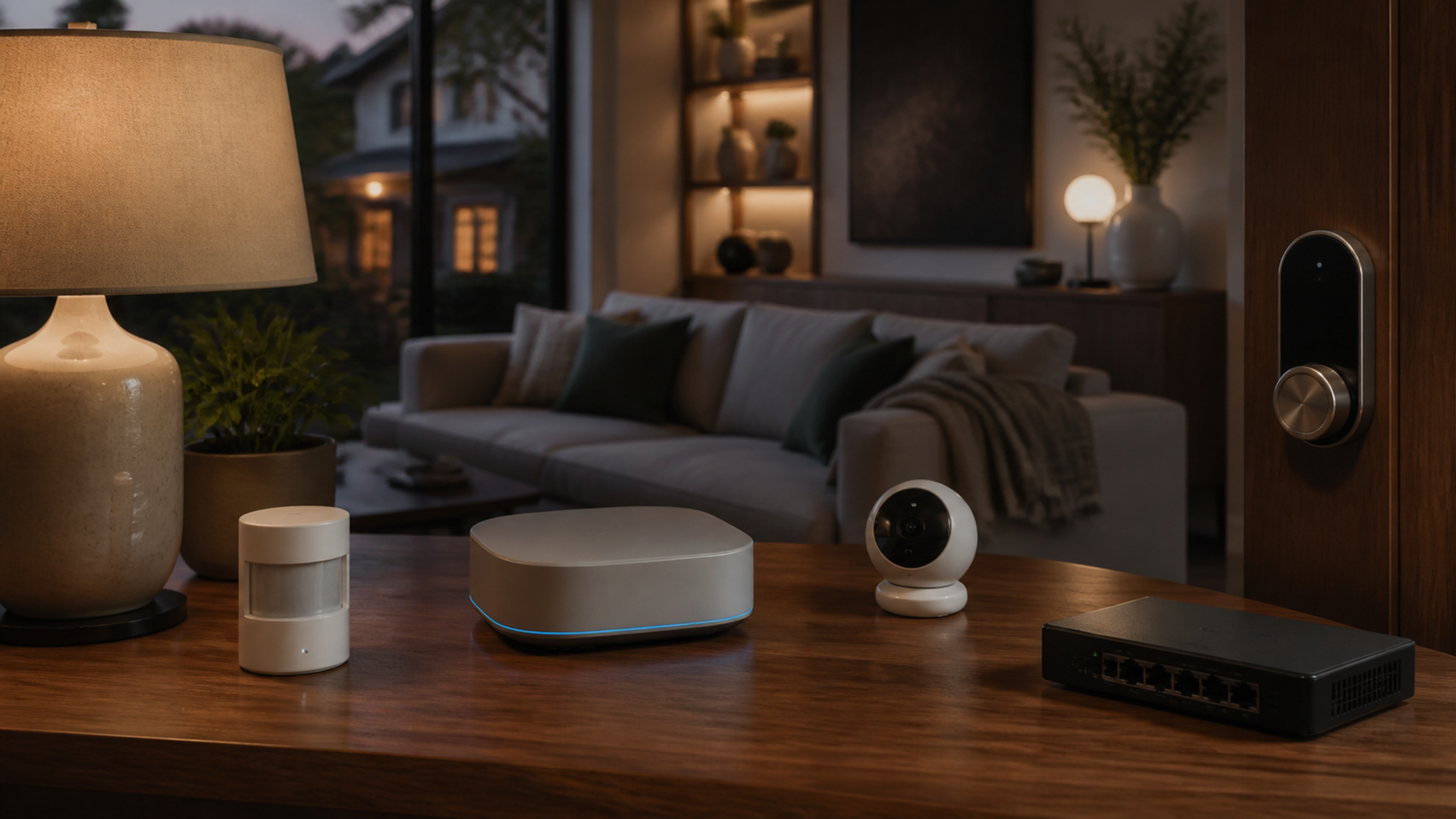
A smart-home hub is the part of the home that decides whether devices cooperate or become a pile of separate apps. It can also become the place where locks, cameras, lighting, presence and routines share a security boundary. The best hub in 2026 is not necessarily the one with the largest compatibility list. It is the one that can keep essential routines understandable, recover when the internet fails, limit cloud access and let a household remove an old phone or resident without breaking the whole home.
The short answer by home architecture
Choose a Matter-capable hub with a clear local-control story when interoperability and resilience matter; choose a platform-first hub when one ecosystem is already dominant; or choose a mixed setup only when you are willing to own more troubleshooting and account recovery. Keep locks and safety devices on a separately tested path and never let a marketing compatibility badge replace a device-level check.
| Decision factor | Matter-capable local hub | Platform-first hub | Mixed specialist setup |
|---|---|---|---|
| Main goal | Interoperability and local resilience | Simple experience inside one ecosystem | Best specialist device for each room |
| Connectivity | Border router and local network are understood | The platform manages most onboarding | Several bridges and networks are maintained |
| Cloud dependence | Essential routines have a local fallback | Cloud features are accepted | Each vendor's outage and account policy differs |
| Privacy | Data paths and microphones are minimised | One account consolidates control | More vendors create more review work |
| Recovery | A spare administrator route is documented | Family roles are simple | The owner maintains a device and bridge map |
| Scale | The hub can handle the planned rooms | Expansion follows the platform's catalogue | Complexity is justified by a real requirement |
This best smart home hub 2026 matrix is the article's working value object. Read the best smart home hub 2026 rows together: the decisive failure mode depends on this topic's evidence, operating context and reader objective.
What compatibility and local control really mean
Evidence 1. The Connectivity Standards Alliance describes Matter as an industry standard intended to improve interoperability among smart-home devices; a Matter logo does not remove the need to verify the device type, controller, firmware and features actually used.
Evidence 2. NIST's IoT cybersecurity guidance frames device security as a lifecycle concern that includes identity, configuration, updates and vulnerability management; a hub should be judged as part of that lifecycle rather than as a decorative control panel.
Evidence 3. Local control can reduce dependence on a remote service for selected routines, but local does not automatically mean private or secure; the home network, mobile app, account, updates and device telemetry still need review.
Evidence 4. Locks, cameras and safety devices deserve a separate failure test because an automation that works for a lamp is not sufficient evidence for a door or an alarm.
Reader-visible sources checked for this article:
csa-iot.org — reader-visible current or official evidence
csrc.nist.gov — reader-visible current or official evidence
For best smart home hub 2026, these sources establish only the claims inside their documented scope. Recheck every changeable specification, availability condition, price, policy or service term in the relevant market before acting.
Design onboarding, privacy and recovery
The main goal row exposes a practical boundary. Route one assumes interoperability and local resilience, while route two is defensible only when simple experience inside one ecosystem. Route three depends on best specialist device for each room. If that evidence is absent, keep the more reversible option.
Read connectivity as a stop/go test: border router and local network are understood supports the first option; the platform manages most onboarding supports the second; and several bridges and networks are maintained supports the third. Record which source proves the condition and when it was checked.
A buyer can resolve cloud dependence without starting from a brand preference. Ask whether essential routines have a local fallback; compare that with whether cloud features are accepted; then use each vendor's outage and account policy differs as the third route's safeguard. An unknown condition stays unknown.
On privacy, popularity is not enough. The evidence for option one is that data paths and microphones are minimised. Option two means one account consolidates control. Option three is rational where more vendors create more review work. Recheck any changeable term immediately before commitment.
The decision changes at recovery. Choose the first path only if a spare administrator route is documented; move to the second when family roles are simple; use the third when the owner maintains a device and bridge map. Save the downside that would make this row fail.
For scale, the first route works when the hub can handle the planned rooms; the second requires expansion follows the platform's catalogue. The control for the third is complexity is justified by a real requirement. Verify this row against the exact product, property, account or environment before it can reverse the decision.
Facts that would reverse the current choice
Reversal control 1 — Main goal. Before choosing Matter-capable local hub, write down how the decision changes if “Interoperability and local resilience” proves false. Do the same for Platform-first hub and “Simple experience inside one ecosystem”. Keep the Mixed specialist setup route available until “Best specialist device for each room” is verified. This control belongs to best smart home hub 2026; update it from the cited source or exact supplier rather than copying a generic checklist.
Reversal control 2 — Connectivity. Before choosing Matter-capable local hub, write down how the decision changes if “Border router and local network are understood” proves false. Do the same for Platform-first hub and “The platform manages most onboarding”. Keep the Mixed specialist setup route available until “Several bridges and networks are maintained” is verified. This control belongs to best smart home hub 2026; update it from the cited source or exact supplier rather than copying a generic checklist.
Reversal control 3 — Cloud dependence. Before choosing Matter-capable local hub, write down how the decision changes if “Essential routines have a local fallback” proves false. Do the same for Platform-first hub and “Cloud features are accepted”. Keep the Mixed specialist setup route available until “Each vendor's outage and account policy differs” is verified. This control belongs to best smart home hub 2026; update it from the cited source or exact supplier rather than copying a generic checklist.
Reversal control 4 — Privacy. Before choosing Matter-capable local hub, write down how the decision changes if “Data paths and microphones are minimised” proves false. Do the same for Platform-first hub and “One account consolidates control”. Keep the Mixed specialist setup route available until “More vendors create more review work” is verified. This control belongs to best smart home hub 2026; update it from the cited source or exact supplier rather than copying a generic checklist.
Reversal control 5 — Recovery. Before choosing Matter-capable local hub, write down how the decision changes if “A spare administrator route is documented” proves false. Do the same for Platform-first hub and “Family roles are simple”. Keep the Mixed specialist setup route available until “The owner maintains a device and bridge map” is verified. This control belongs to best smart home hub 2026; update it from the cited source or exact supplier rather than copying a generic checklist.
Reversal control 6 — Scale. Before choosing Matter-capable local hub, write down how the decision changes if “The hub can handle the planned rooms” proves false. Do the same for Platform-first hub and “Expansion follows the platform's catalogue”. Keep the Mixed specialist setup route available until “Complexity is justified by a real requirement” is verified. This control belongs to best smart home hub 2026; update it from the cited source or exact supplier rather than copying a generic checklist.
Draw the device map before buying the hub
List the lights, locks, sensors, cameras, speakers and routines that matter. Mark which are Matter devices, which require a bridge and which are tied to a vendor account. Then identify the hub, border router and network segment that each needs. This map exposes a common mistake: buying a hub because it supports a protocol while ignoring the particular feature or device type the home actually needs. Keep a dated copy of the map so another household member can restore the system without reverse-engineering it.
Test the home when the internet is absent
Disconnect the external connection in a controlled window and test a light routine, a door status, a local scene and a camera notification. Record what continues, what degrades and what silently waits for the cloud. Restore service and check whether commands are duplicated or delayed. A local fallback should be described in plain language: which actions still work, on which controller, and with what limitations. If the answer is unclear, keep the device out of a safety-critical routine until it is clear.
Make privacy a device-by-device choice
The hub may know when someone is home, which door opened and how rooms are used. Reduce collection where the device permits it, disable microphones and cameras that have no defined purpose, and use separate accounts for household administration and guest access. Review app permissions and cloud retention after firmware updates. A central hub can simplify control while concentrating information, so the purchase should include a plan for deletion, account removal and the replacement of a lost phone.
Design recovery for the non-technical resident
A smart home fails when the one person who configured it is unavailable. Label the hub, bridge, network and reset implications without publishing credentials. Keep a short emergency guide for lights, locks, heating and manual overrides. Give another trusted resident a bounded role and practise removing a phone from the system. Do not put the only reset key behind an automated lock that depends on the system being reset. Good architecture makes the safe manual action obvious.
Three connected-home situations that change the choice
The new-build smart home
A Matter-capable local hub is attractive when the device list is still being chosen and interoperability can be tested from the start. Define the fact that would reverse this recommendation before committing.
The single-ecosystem household
A platform-first hub may reduce support work when the home already owns compatible devices and accepts the account model. Define the fact that would reverse this recommendation before committing.
The collector's mixed home
A mixed setup is defensible when specialist devices solve a real need and the owner maintains a clear bridge, network and recovery map. Define the fact that would reverse this recommendation before committing.
Action checklist
Inventory devices, bridges and routines.
Check exact device types rather than protocol badges.
Map the hub, border router and network.
Test essential actions during an internet outage.
Separate convenience routines from safety routines.
Review cloud, microphone and camera permissions.
Document firmware and account recovery.
Create a bounded guest or second-admin role.
Keep manual controls accessible.
Retest after major firmware or router changes.
Continue the decision
The linked VERTU articles expand adjacent parts of the best smart home hub 2026 decision. They do not substitute for the external evidence above.
The smart-home-hub verdict
Choose a Matter-capable hub with a clear local-control story when interoperability and resilience matter; choose a platform-first hub when one ecosystem is already dominant; or choose a mixed setup only when you are willing to own more troubleshooting and account recovery. Keep locks and safety devices on a separately tested path and never let a marketing compatibility badge replace a device-level check.
Keep the best smart home hub 2026 decision reversible until its material cost, safety, access, privacy and compatibility facts are verified. Unknown evidence stays unknown; it is never silently scored as favourable.