Introduction
You want the best luxury foldable phone for CEOs because it’s not just a screen upgrade—it’s a decision surface. The right foldable reduces friction in three places that matter: travel days, meeting days, and the quiet half-hours where you approve, reply, and move things forward.
This 2026 US-focused guide filters only models you can actually buy stateside—and treats the “executive” part seriously: carrier compatibility, update policy, and aftercare are part of the purchase, not afterthoughts.
You’ll get fast verdicts, a comparison matrix, and a checklist to choose with confidence.
Key TakeawayFor executives, the best foldable is the one you can trust on U.S. networks, keep secure for years, and operate one-handed when your day goes sideways.
Quick Shortlist & Verdicts
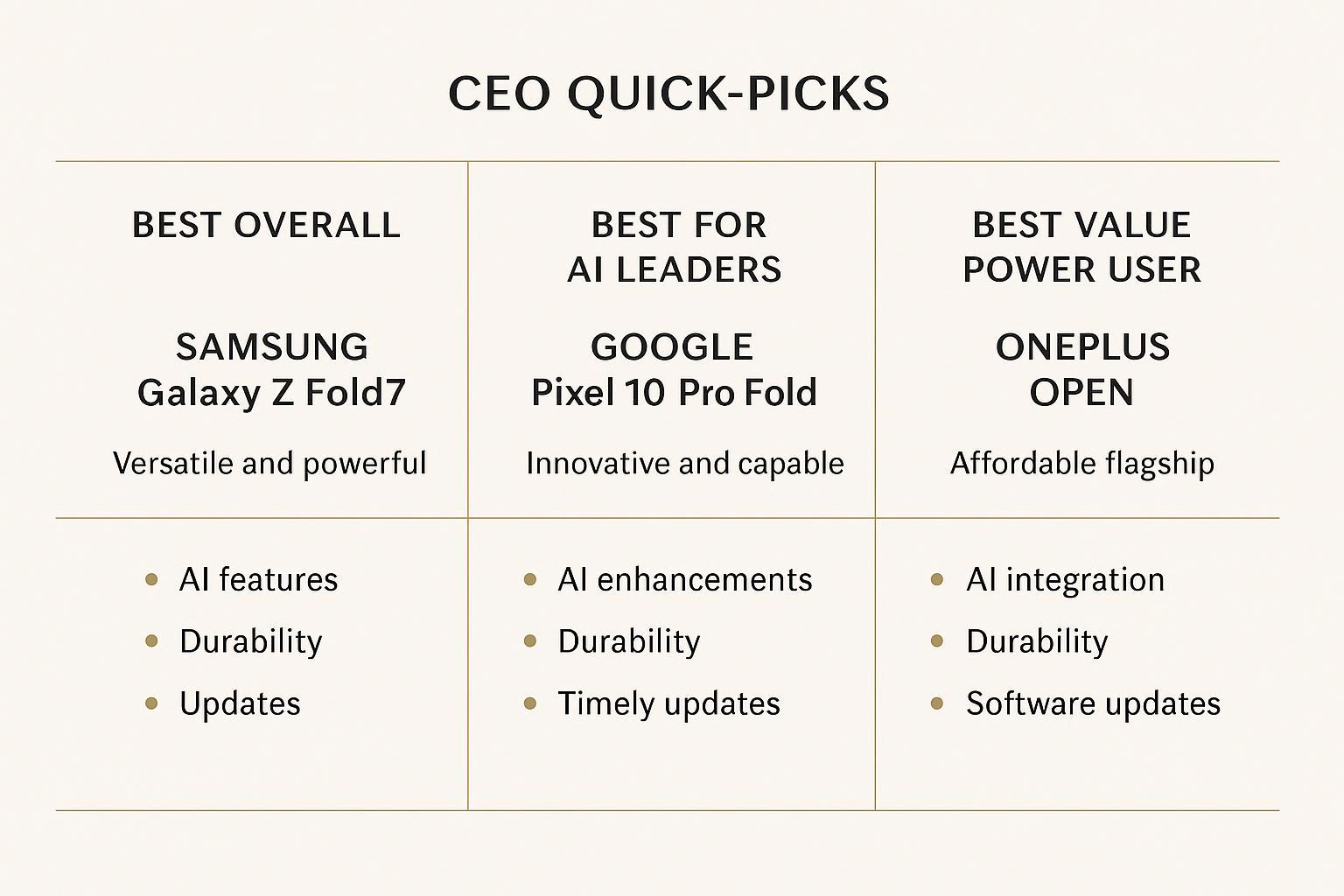
Best Overall — Samsung Galaxy Z Fold7
If you want the most complete “work phone that happens to fold,” Samsung remains the safest default: mature multitasking DNA, a security story enterprises recognize, and a predictable ecosystem.
CEO lens: choose it when reliability and governance beat novelty.
Best for AI Leaders — Google Pixel 10 Pro Fold
If your day is driven by information triage—summaries, translation, and contextual assistance—Pixel is often the cleanest path, especially when you live inside Google Workspace.
CEO lens: choose it when your workflow is AI-first and you want long-term software support clarity.
Best Value Power User — OnePlus Open
If you want the foldable form factor with strong everyday performance and a “do more, faster” feel, OnePlus Open is typically the value pick—provided you verify U.S. carrier compatibility and your preferred update policy expectations.
CEO lens: choose it when you know what you need, dislike bloat, and can do your own diligence on carrier + support.
Comparison Matrix
Display & Multitasking
A foldable earns its keep when it reduces context-switching:
Reading + action at once: your inbox on the left, a contract or deck on the right.
Meeting posture: device half-open on a table for notes, agenda, and follow-ups.
Travel posture: quick checks on the cover screen without unfolding.
What to look for (regardless of brand)
A cover screen that is usable one-handed (you will use it more than you expect).
A stable split-screen experience that doesn’t force constant app re-launching.
A keyboard experience you can tolerate in taxis and tight seats.
Security & Update Policy
This is where “luxury” becomes discipline: security updates are a subscription you pay with your attention.
Update cadence and duration: Your phone is a long-term risk surface. Confirm how long the manufacturer commits to OS and security updates—and how consistently they deliver.
Samsung publishes device update cadence via Samsung Mobile Security’s Security Updates Scope.
Google’s modern policy signals are strong; 9to5Google reported Google extended Pixel 6/7 generation and Pixel Fold support to five years, while newer Pixels moved to seven years in that era of devices—see Google extended Pixel Fold support to 5 years.
Enterprise security posture: For many CEOs, it’s not about being the most technical—it’s about choosing a platform your IT leadership already knows how to defend.
Samsung’s own overview explains Knox as being built “from the chip up,” with a hardware root of trust and real-time protections—see Samsung’s ‘Knox 101’ overview (2026).
Collector’s note: “More AI” is not automatically better. The executive question is where your context goes, what permissions the system needs, and whether it can be constrained.
Durability, Battery & Charging
Foldables have improved, but the physics haven’t changed: hinges, inner screens, and daily folding add wear.
Treat durability like an operational choice:
Hinge + inner-screen resilience: assume you will open/close the device hundreds of times per week.
Protection strategy: plan for a high-quality case and a service/repair path.
Battery realism: a foldable does more; it will also ask more. If your days are travel-heavy, prioritize practical charging behavior (your charger ecosystem, your car setup, your hotel routine) over headline specs.
Executive Buying Checklist
If you’re choosing the best luxury foldable phone for CEOs, this checklist is the fastest way to reduce risk before you buy.
US Availability & Band Support
This is the part many buyers skip—and then regret during the first airport connection.
Buy the U.S.-market, unlocked version whenever possible.
Confirm VoLTE support (a baseline requirement on U.S. networks).
Confirm LTE/5G band coverage for your carrier.
Verify eSIM activation is supported by your carrier for that exact model. Even if your phone supports eSIM, carrier policies can still block activation; an explainer on why this happens is here: carrier whitelists can block eSIM activation.
Practical diligence shortcuts:
Use Kimovil’s frequency checker to sanity-check band compatibility before you buy.
If you’re bringing your own device to a U.S. carrier, compare your model against carrier BYOP requirements such as Tello’s BYOP compatibility requirements (helpful even if you use a different carrier, because it makes the requirements concrete).
⚠️ WarningFor executives who travel, “it works on Wi‑Fi” isn’t acceptable. If eSIM provisioning fails or bands don’t match, the phone becomes a liability the moment your calendar tightens.
AI Productivity & Ecosystem Fit
AI should do three things for you: compress time, reduce cognitive load, and keep boundaries.
Ask:
Where does your work live? Google Workspace, Microsoft 365, mixed stack.
What is the AI allowed to access? Email, calendar, files, messages—each permission is a trade.
What is your “approval posture”? A CEO should be able to review and approve with minimal taps, but with explicit confirmation for anything that changes money, commitments, or reputational exposure.
A pragmatic test before you commit: can the phone reliably handle meeting briefs, travel changes, and document review without you feeling like you’re babysitting it?
Travel, Security & Connectivity
A CEO phone fails in predictable places: roaming, hotel Wi‑Fi, and last-minute changes.
Your checklist:
Two-factor authentication readiness across your critical services.
A backup connectivity plan (secondary eSIM, travel eSIM, or a second device).
A clear separation model for personal vs business spaces.
- Aftercarehow quickly can you replace or service the device if something happens mid-trip?
Top Picks Deep Dive
Samsung Galaxy Z Fold7 — Who Should Buy
Buy the Fold7 if you want the most conservative choice for a high-tempo executive schedule:
You want a foldable that behaves like a mature productivity platform.
You value an enterprise security narrative that IT teams already know how to manage.
You care about predictable security maintenance.
The caveat: don’t buy it “because it’s the newest.” Buy it because your workflow rewards stability.
Google Pixel 10 Pro Fold — Who Should Buy
Buy the Pixel 10 Pro Fold if your day runs on information synthesis:
You want a phone that is built around Google’s AI-first philosophy and Workspace adjacency.
You’re serious about long-term software support and want policy clarity.
You use translation and summarization as daily tools, not occasional features.
The caveat: treat AI permissions like hiring. Grant access slowly. Keep boundaries explicit.
OnePlus Open — Who Should Buy
Buy the OnePlus Open if you’re a power user who knows your own tradeoffs:
You want strong performance and a clean-feeling experience.
You’re comfortable doing US carrier diligence up front (bands + eSIM + BYOP rules).
You prefer a value-first decision without paying for brand halo.
The caveat: confirm support expectations and your carrier’s requirements before you commit.
Ultra‑Luxury Option
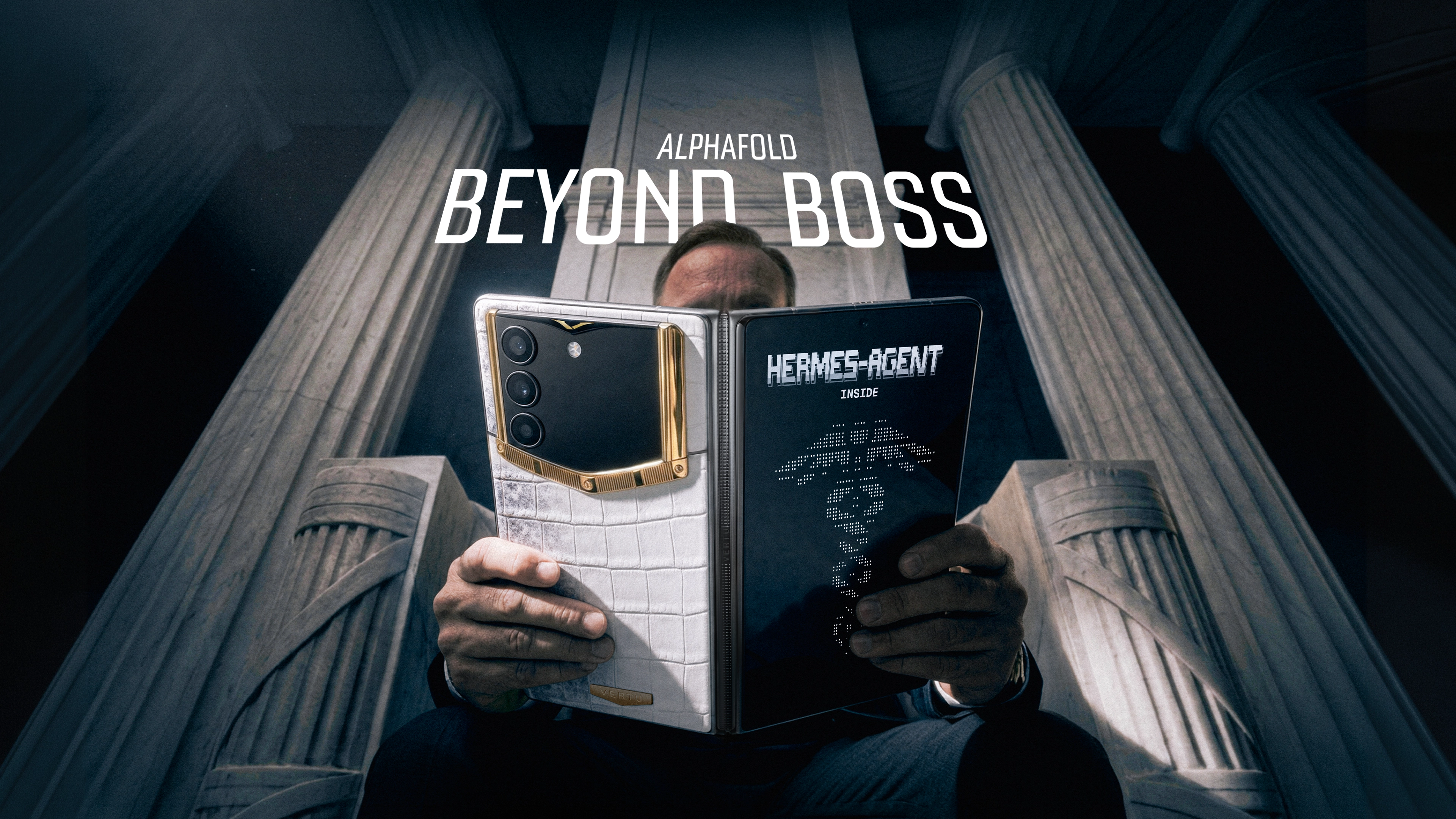
VERTU AlphaFold — Concierge, Materials, AI Agents
Some CEOs don’t want “a phone with features.” They want an ownership model: a device that feels bespoke, stays private, and comes with human judgment when automation shouldn’t be trusted.
The VERTU AlphaFold is positioned around that premise: it treats the foldable as an executive workspace, and frames AI as a controlled workflow layer rather than a novelty feature. On VERTU’s official product materials, Hermes Agent is described as connecting supported apps and turning voice intent into action—see VERTU AlphaFold (Hermes Agent connects 70+ apps).
What matters in practice:
Concierge as part of the device, not an add-on: VERTU describes 24/7 concierge access as “personalized lifestyle management”—see VERTU AlphaFold. For a CEO, that’s valuable when travel changes, reservations, and edge-case logistics create decision drag.
Agentic AI with boundaries: VERTU’s explanation of Hermes Agent emphasizes pillars of Memory / Skills / Soul and highlights the question of whether a system can be “trusted to act—and to stop”—see Hermes Agent’s Memory / Skills / Soul pillars.
Materials and craft as durability + presence: VERTU positions AlphaFold as handcrafted, using rare materials and emphasizing a distinctive ownership feel.
This is not a recommendation for everyone. It’s a different category: if your phone is part security perimeter, part travel operator, and part personal standard, service and governance can matter as much as hardware.
Conclusion
Pick the model that best fits your workflow: AI suite, durability, or charging speed.
Confirm US carrier bands, update policy length, and aftercare before you buy.
Disclosure: This article references VERTU pages. Editorial judgment remains the priority.
![Top 10 Tourbillon Watches for Men [2026 Latest]](https://cdn.sanity.io/images/e0gp1l2g/production/8cb6bc45133cf9453382fc7d074465af588bb610-1800x1080.webp?w=800&h=450&q=82&auto=format&fit=crop)