

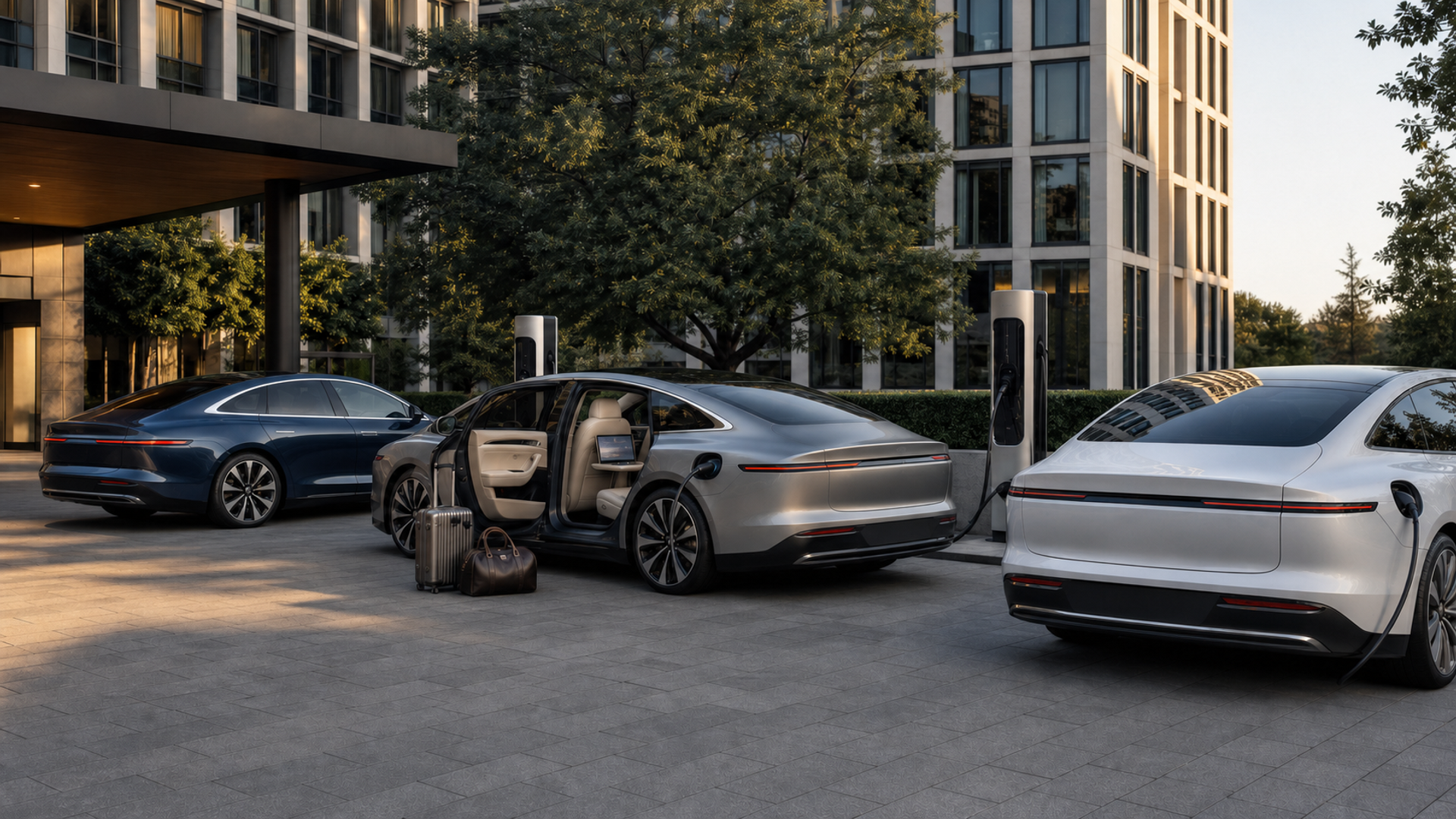
The best luxury electric sedan for 2026 depends on the job. Choose the Lucid Air when US EPA range is the priority; the Mercedes-Benz EQS for a quiet, comfort-led long-distance brief; the Porsche Taycan for driver engagement and very rapid charging; the Audi A6 Sportback e-tron for a balanced range, charging and luggage proposition; and the 2026 BMW i7 when rear-seat theatre is central.
There is no honest single-number winner. European manufacturer pages generally quote WLTP range, while US pages may quote EPA range. The two procedures are not interchangeable, so a 512-mile EPA figure must not be placed in the same ranking as a 542-mile WLTP figure without the test-cycle labels. Real journeys also depend on speed, weather, wheel size, load, battery temperature and the charging network on the route.
The useful comparison is therefore not “which travels furthest on paper?” It is which sedan combines sufficient real-world margin with the cabin, charging behaviour and ownership pattern that matter to you.
2026 luxury electric sedan decision matrix
| Model | Manufacturer range evidence observed | Manufacturer rapid-charge evidence | Rear-seat and luggage brief | Best fit |
|---|---|---|---|---|
| Mercedes-Benz EQS Saloon | Up to 542 miles WLTP on the cited UK page, depending on listed trim | Listed 10–80% times of about 25–27 minutes, derivative-dependent | Comfort-led cabin; cited 610-litre luggage capacity | Quiet long-distance luxury and passenger use |
| Lucid Air | Up to 512 miles EPA for Grand Touring on specified 19-inch wheels; lower figures for other trims | Selected eligible versions claim up to 200 miles added in about 12 minutes on a suitable charger | Long-range packaging with a large-car luxury brief | Maximum cited US EPA range priority |
| Porsche Taycan | Current UK model range lists up to 434 miles WLTP | Up to 320 kW and around 18 minutes from 10–80% under optimal conditions | Driver-focused; rear accommodation is secondary to dynamics | Fast-road driving and short charging stops |
| Audi A6 Sportback e-tron | Up to 468 miles WLTP in the cited powertrain range | About 21 minutes from 10–80% under suitable conditions | Sportback access and a balanced executive-car format | All-round business and touring use |
| BMW i7 | Check the current market and exact derivative; no cross-market headline is used here | Check exact market/derivative; no common peak used here | Optional rear Theatre Screen and luxury-limousine focus | Chauffeured and rear-seat entertainment priority |
All figures above are conditional manufacturer claims from the cited market pages, not results from one independent test. The matrix is designed to preserve those differences rather than erase them.
First, keep EPA and WLTP in separate boxes
Range figures are useful only when their test regime and configuration are visible. EPA and WLTP use different cycles and assumptions. Neither perfectly predicts an individual route, and a mathematical conversion creates false precision.
The right method is to compare cars within the same test regime where possible, then assess route suitability using a margin. If a regular winter motorway journey is 250 miles, do not simply select a vehicle whose headline figure is slightly above 250. Allow for temperature, motorway speed, detours, cabin heating, degradation over time and the desired arrival state of charge.
Charging claims need the same discipline. A peak such as 320 kW describes what the vehicle may accept for part of a charging session under suitable conditions. It is not the average from empty to full. The more useful manufacturer metric is often a conditional 10–80% time, but even that depends on battery preconditioning, charger output, charger sharing, ambient conditions and the state of charge on arrival.
For frequent long-distance use, map the actual chargers on the route before placing an order. A car with an exceptional peak cannot use a charger that does not work or is not available.
Mercedes-Benz EQS: the comfort-led long-distance choice
The EQS remains the clearest option here for buyers who want an electric saloon to reduce effort rather than create drama. Its brief is aerodynamic long-distance travel, a quiet cabin and a technology-rich passenger environment.
Mercedes-Benz UK's current EQS Saloon page lists headline WLTP ranges by trim, with the longest observed claim reaching 542 miles. It also lists derivative-dependent 10–80% charging times in the 25–27 minute area and a 610-litre luggage figure. Those numbers make the EQS a strong paper proposition for touring, but the exact car matters: wheel, trim and equipment selection can alter range.
The EQS suits an owner who values low-noise progress, relaxed motorway work and rear-passenger comfort. Its interface-heavy cabin will not appeal to everyone, so a test drive should include common tasks: changing climate settings, entering a destination, finding a charger and operating rear controls at night.
Choose it when the mission is regular inter-city travel and passenger calm. Do not choose it solely because one derivative owns the largest WLTP number in this group; the Lucid figures use EPA, and route reality may favour the car with the better local charging network.
Lucid Air: the range-led US choice
Lucid Air's defining proposition is how much US EPA range it extracts from a luxury-sedan package. Lucid's current Air comparison page lists 512 miles EPA for Grand Touring on specified 19-inch wheels, alongside lower but still substantial figures for Touring and Pure.
That 512-mile figure should remain in an EPA-labelled box. It is highly relevant to a US buyer comparing EPA-labelled alternatives, but it does not make a valid numerical victory over WLTP figures from UK pages.
Lucid also makes conditional charging claims. Its Air charging guide says eligible configurations can add up to 200 miles in around 12 minutes when connected to a suitable high-power charger. “Up to” matters: trim, charging curve, battery state and charger performance all change the result.
The Air is the strongest candidate for someone who has long US journeys, values range margin and can verify service and charging support in the places the car will actually travel. It also deserves a physical luggage and rear-seat test. Impressive packaging claims do not reveal whether the seat shape, entry angle or controls suit a particular passenger.
Porsche Taycan: the driver's electric luxury sedan
The Taycan is the choice for a buyer who wants the car to feel alive from the driver's seat. Range and charging have improved across the model's development, but its essential distinction remains control response and a lower, more sporting driving position.
Porsche UK's Taycan model page lists current model-range WLTP values reaching 434 miles. Porsche's official charging explanation cites up to 320 kW and approximately 18 minutes from 10–80% under optimal conditions.
That charging claim is compelling for a route with reliable high-power infrastructure and effective battery preconditioning. It should not be treated as a promise that every motorway stop lasts 18 minutes. Arrival state, charger behaviour and temperature remain decisive.
The trade-off is spatial. The Taycan's low roof and sporting package demand a more careful rear-seat and entry test than the upright luxury sedans in the group. A buyer carrying adults in the rear every day should sit behind their own driving position and evaluate foot room, head movement during entry and the view out. Choose the Taycan when driving quality is the non-negotiable; choose another car when the rear cabin is the primary workplace.
Audi A6 Sportback e-tron: the balanced executive answer
The A6 Sportback e-tron is arguably the easiest car here to recommend to an undecided executive-car buyer because it does not rely on one extreme. It combines a long-range electrical architecture, rapid charging and a practical Sportback opening in a recognisable premium format.
Audi UK's battery and range page lists different WLTP bands by powertrain. The longest observed band reaches 468 miles, while Audi cites about 21 minutes from 10–80% under suitable conditions.
The hatch-style rear access is a practical advantage for awkward luggage compared with a conventional boot opening, although buyers should still test the specific cases, pushchairs or equipment they carry. The sloping roof also merits a rear headroom test.
The A6 is the rational all-rounder for business travel: enough range evidence to reduce routine anxiety, a competitive conditional charging time and a body style that can absorb more varied luggage. It may not deliver the theatre of the i7, the range headline of the Lucid or the steering focus of the Taycan. That absence of an extreme can be exactly the point.
BMW i7: the rear-seat theatre choice
The i7 is the most explicit luxury limousine in this comparison. It is not the range leader, but it gives rear-seat experience unusual priority.
BMW's current US i7 model page is useful for checking the live derivative range and configuration, but this guide does not freeze one EPA headline because model-year, wheel and market changes can alter the displayed figure. Verify the exact proposed car in the target market.
BMW UK's i7 equipment page describes an optional 31.3-inch Theatre Screen and rear touch controls. Equipment and packages vary, so the screen should be verified on the proposed car rather than assumed.
The i7 makes sense when an owner is regularly driven, carries clients or values rear entertainment and seat environment more than class-leading range. Its physical size also requires a realistic parking and access check. A limousine that is superb on a motorway may be cumbersome in a narrow private garage or older city car park.
Make the purchase decision around your route
Before choosing a model, build a simple ownership sheet for one normal week and one difficult trip.
Record daily distance, longest no-stop leg, overnight charging availability, winter temperature, regular passenger count and the luggage that must fit. Then identify at least two reliable rapid-charging alternatives on the difficult route. Check the payment method and whether the site has suitable bays, not just the advertised power.
For the home, confirm electrical capacity, parking access and tariff. A long-range car does not compensate for an unreliable home-charging arrangement. For apartment or hotel use, investigate who controls the charger and whether overnight access is dependable.
During test drives, use the rear seats as seriously as the front. Check ride behaviour over broken surfaces, conversation effort at motorway speed, ventilation controls, charging-port placement and luggage loading. If a driver will be employed, have that person test low-speed visibility and turning in the real pickup environment.
Our broader luxury electric cars guide covers body styles beyond saloons. Buyers who need greater ride height or a larger vertical cargo area should instead use the luxury electric SUV guide; neither need should be forced into this sedan shortlist.
Final verdict
Choose the Mercedes-Benz EQS for comfort-led long-distance use, the Lucid Air for the strongest cited US EPA range proposition, the Porsche Taycan for driver involvement and exceptionally rapid conditional charging, the Audi A6 Sportback e-tron for the most balanced executive package, and the BMW i7 for a rear-seat-first limousine experience.
Do not rank them by one mixed-cycle range table. Preserve EPA and WLTP labels, map the actual route, test the rear cabin and verify the exact derivative's equipment. The best luxury electric sedan is not the one with the largest headline. It is the one that creates the least friction on the journeys and in the seat that matter most.
Related VERTU reading
Sources and verification
Sources were checked for this 3 August 2026 publication package. Terms and specifications can change; recheck the linked source before acting.


![Top 10 Luxury Smartwatches for Business Travel [2026]](https://cdn.sanity.io/images/e0gp1l2g/production/8b5e5b21db42a1c5f040e828bd041857353a8eb2-2560x1382.webp?w=800&h=450&q=82&auto=format&fit=crop)