The expensive mistake in premium air travel is rarely choosing an obviously bad product. It is buying the right-sounding label for the wrong itinerary. The useful question is not which option looks most luxurious in a campaign image; it is which verified option improves sleep, time, privacy, recovery or control on the exact date being booked.
This guide compares Window suite, Centre pair and Bulkhead/large-footwell seat using current official material and a live VERTU inventory check. Prices, aircraft, access, schedules and capacity can change. Treat the framework as a way to ask better questions, then confirm the exact booking before payment.
The short answer
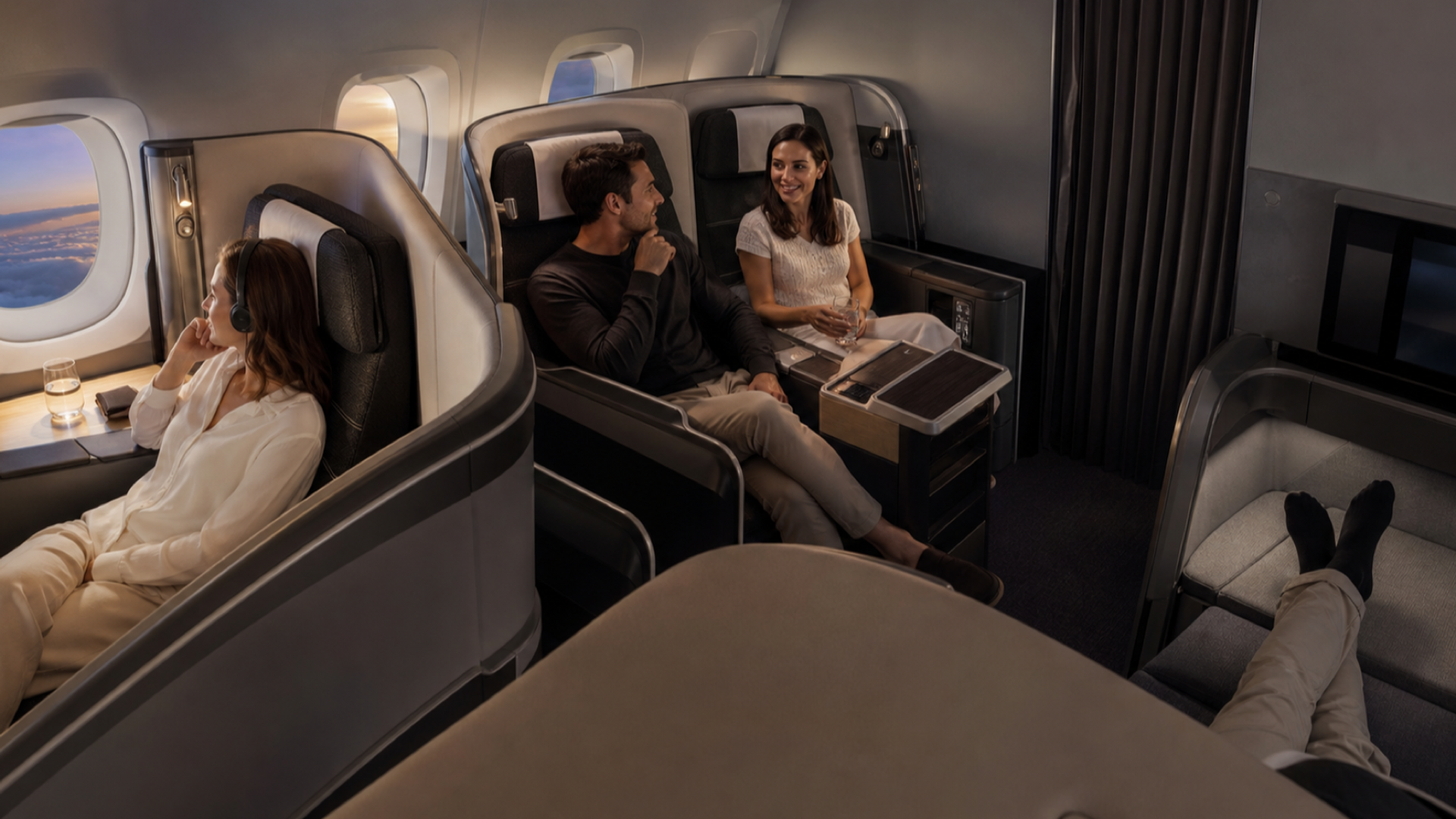
Solo travellers should usually start with a window seat separated from the aisle; couples should assess centre dividers and conversation angle; tall or broad-shouldered sleepers should investigate bulkhead footwells and bed geometry. Avoid galleys, lavatories and bassinet zones unless their convenience solves a specific need.
The decision should survive a late gate change, a different aircraft, a shorter connection or a revised arrival obligation. If it only works when every operational assumption is perfect, it is not a robust premium choice.
Decision matrix
| Decision factor | Window suite | Centre pair | Bulkhead/large-footwell seat |
|---|---|---|---|
| Solo privacy | Usually strongest | Depends on divider | Depends on row exposure |
| Couples | Separated | Often strongest if divider lowers | May be separated by console |
| Sleep space | Check footwell and bed angle | Check shoulder and divider | Often more foot space, but verify |
| Noise risk | Window buffers one side | Two aisle exposures possible | Galley/bassinet proximity possible |
Use the matrix on one itinerary and one travel date. Comparing different dates, fares or passenger combinations can make the more expensive option appear better for reasons unrelated to the product itself.
What the official material confirms
Airlines publish fleet, cabin and product pages, but the exact seat must be verified on the operating flight. Qatar Airways markets Qsuite features, Singapore Airlines publishes several Business Class products, British Airways fleet pages show aircraft-dependent cabins, and Air Canada limits Signature Service to specified aircraft and routes. Those differences make an airline-level ranking less useful than an aircraft-and-position method.
The primary evidence used for this guide is reader-visible:
Official pages describe intended products and rules. They do not guarantee day-of-travel capacity, an unchanged aircraft or discretionary admission. The live booking, boarding pass and airport team remain the final operational sources.
Choose the exact aircraft first
An airline can operate several business-class seats under one brand. A route search may mix old and new cabins, wide-bodies and narrow-bodies, or scheduled aircraft that later change. Record the operating type and seat map before comparing row numbers. A celebrated suite on another flight is irrelevant to the seat being purchased.
Window seats are not equally private
Some layouts place the passenger close to the window with a console toward the aisle, while others reverse that relationship. Staggered cabins can alternate exposed and protected rows. A closing door improves visual separation but does not remove galley noise or aisle light. Study seat orientation, console position and shell height rather than selecting any window symbol.
Centre pairs require a social test
A double-bed marketing image does not prove that two people can talk comfortably throughout the flight. Some centre seats angle away, have a fixed high divider or require leaning forward. Other designs create an excellent companion space but feel exposed to both aisles. Couples should inspect the divider mechanism and select together rather than assuming adjacent seat numbers solve the problem.
Footwells decide sleep for many bodies
A nominally long flat bed can narrow sharply around the feet, forcing a tall traveller to rotate or keep knees bent. Bulkhead rows sometimes offer larger foot spaces because no seat is nested ahead, but they can sit near galleys or bassinets. Shoulder clearance, mattress seams and seatbelt position also affect sleep. Published bed length is only one dimension.
Map the noise and service zones
Galleys create preparation light and conversation, lavatories create queues, and bassinets can change the sound profile. Front rows may receive service first but also experience crew movement. Rear rows can be quieter on one aircraft and closer to a bar or galley on another. Choose the nuisance the traveller tolerates rather than following a universal front-or-back rule.
Storage and work are seat-selection factors
A traveller using a laptop needs a stable surface, accessible power and somewhere to place items during meals. Deep bins can be useful but may be out of reach in bed mode. Some suites require loose objects to be stowed for taxi, take-off and landing. A seat with slightly less visual privacy can be better for work if its table and storage are materially more practical.
Recheck after every aircraft change
Seat assignments can be remapped when the aircraft changes, sometimes moving a window passenger into the centre or separating companions. Monitor the booking before the free-change deadline and again at check-in. Keep preferred alternative rows in mind. The best selection strategy includes a fallback rather than depending on one exact seat number.
Match the choice to the traveller
| Traveller or trip | Practical recommendation |
|---|---|
| Solo privacy-sensitive sleeper | Choose a protected window position away from galley and lavatory zones. |
| Couple wanting conversation | Select a centre pair only after confirming divider and seat angle. |
| Tall side sleeper | Investigate bulkhead footwell dimensions and shoulder space, then accept possible noise trade-offs. |
| Executive working onboard | Prioritise table stability, accessible power and storage over door marketing. |
The same traveller may choose differently on the outbound and return. An overnight sector before a meeting puts a higher value on sleep and certainty; a daytime return can favour schedule and price. Couples, families and solo passengers should also use different seat, lounge and hotel criteria rather than copying a single ranking.
A value test before paying
Start with the incremental cost over the best acceptable alternative. Divide it by the hours in which the additional benefit can actually be used, then add only consequences that matter: protected sleep, a shower, a safer connection, reduced recovery time, useful baggage or genuine flexibility. Remove duplicate benefits already supplied by status, a credit card, a fare bundle or another part of the itinerary.
Set three price zones before shopping. In the automatic zone, the verified benefit is worth taking because the premium is small. In the conditional zone, proceed only if the exact product, location and timing are confirmed. In the decline zone, keep the lower option unless the journey has unusually high stakes. Pre-set zones stop scarcity messages, auction sliders and polished photography from moving the budget.
Points and miles need the same discipline. Convert them at a conservative personal value, add fees and compare the result with the best cash alternative. A low number of points can still be expensive if it consumes a balance that would fund a more valuable future trip.
Booking-day verification checklist
Confirm the marketing carrier, operating carrier, flight number, date and terminal.
Save the aircraft, seat map, lounge, hotel or programme page shown for the exact itinerary.
Read fare conditions, cancellation rules, guest policies and any capacity language.
Verify the feature that drives the purchase rather than assuming it from the product name.
Price every traveller, including guest fees, children, transfers, meals, taxes and add-ons.
Calculate usable time after security, immigration, baggage, terminal movement and boarding buffers.
Recheck before the free-change deadline, at online check-in and after any schedule notification.
Keep medicine, chargers, documents and overnight essentials in hand luggage.
Save a fallback option that still works after a late arrival, gate change or aircraft substitution.
Do not make a non-refundable purchase when the key operational dependency remains unconfirmed.
This checklist cannot remove disruption. It reduces the chance that the traveller pays for a benefit the booking never promised and makes later support conversations easier because the evidence and conditions are documented.
A simple decision worksheet
Write down five answers before purchase: the single problem being solved, the verified feature that solves it, the usable time, the maximum acceptable premium and the fallback. If the first two answers are vague, the premium is probably being justified by branding rather than outcome. If usable time is short, location and certainty deserve more weight. If the fallback is unacceptable, buy flexibility or a confirmed alternative instead of hoping.
Then stress-test the choice. Move the gate farther away, shorten the connection by forty-five minutes, substitute the aircraft or remove one advertised amenity. A strong choice remains sensible. A weak choice collapses because its value depended on one fragile detail.
Related VERTU guides
These links provide adjacent decision frameworks, not substitute evidence for the current itinerary. Use them to compare the broader premium-travel trade-off, then return to the official source for the flight, airport or programme being booked.
Verdict
Solo travellers should usually start with a window seat separated from the aisle; couples should assess centre dividers and conversation angle; tall or broad-shouldered sleepers should investigate bulkhead footwells and bed geometry. Avoid galleys, lavatories and bassinet zones unless their convenience solves a specific need.
Buy the verified outcome, not the category label. The most premium decision is often the one that protects time and arrival condition with the least operational fragility.