

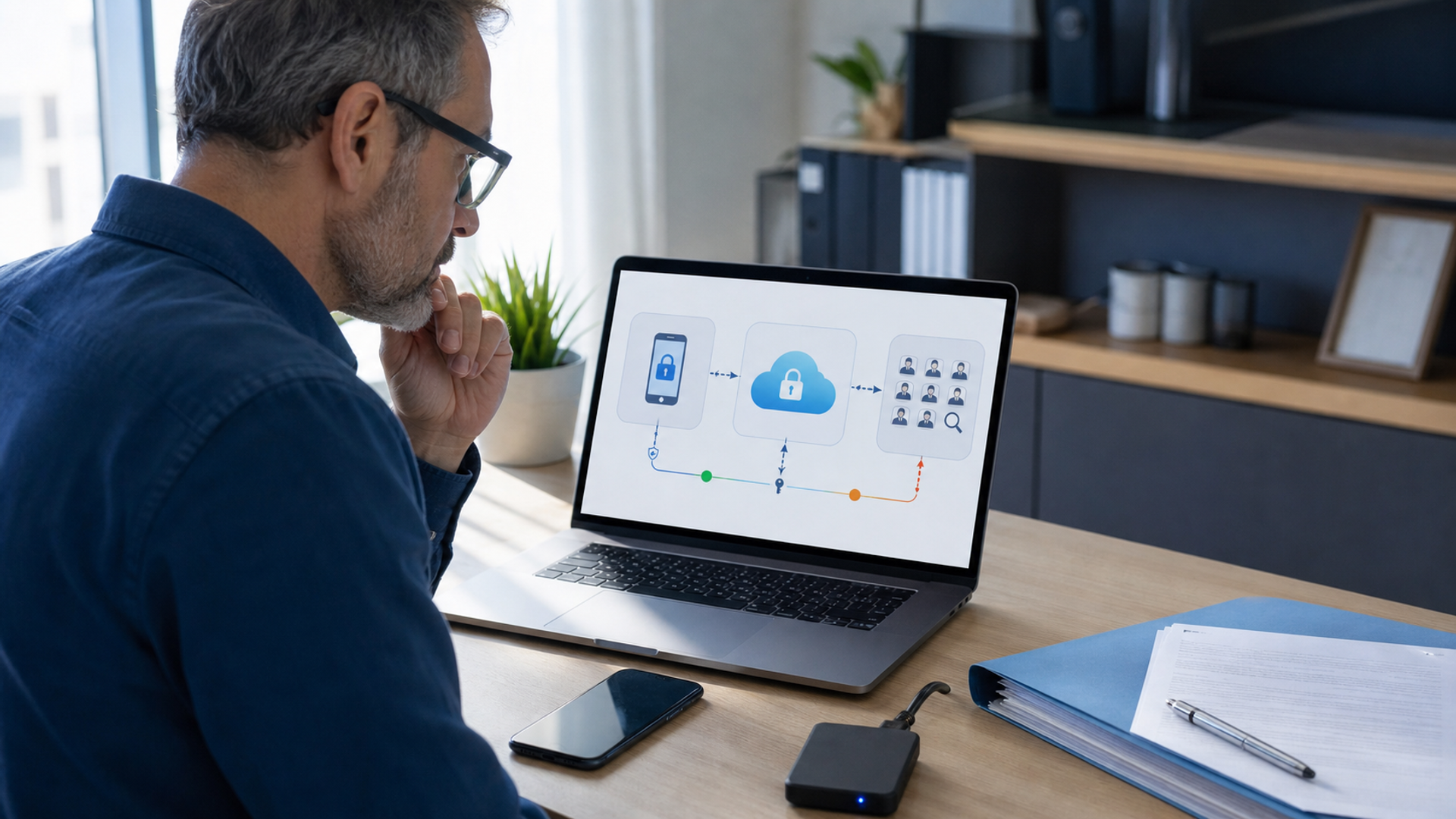
The July 2026 iCloud ruling did not order Apple to scan users' cloud files, approve Apple's privacy policy, or declare that technology companies may ignore unlawful material. It dismissed a specific US lawsuit because the court concluded that the claims would treat Apple as the publisher of content supplied by third parties, bringing them within Section 230 of the Communications Decency Act under binding Ninth Circuit precedent.
For an iCloud user, the immediate product effect is limited: the decision did not switch scanning on or off and did not change an account's encryption setting. Its wider significance is that a court treated the decision whether to deploy cloud-content detection as a form of content moderation protected by Section 230 in this case. The judge was openly troubled by the consequences and said any broader duty would need to come from lawmakers, not this court.
That distinction is essential. A dismissal based on statutory immunity is not a judicial endorsement of Apple's conduct, and a US district court ruling is not a universal rule for every cloud provider, jurisdiction or future claim.
What the court actually decided
The case is Amy et al. v. Apple Inc., No. 24-cv-08832-NW, in the US District Court for the Northern District of California. The named plaintiffs, using pseudonyms, brought a proposed class action alleging that Apple had not taken adequate steps to prevent known child sexual abuse material from being stored and shared through iCloud. This article avoids unnecessary detail about the underlying abuse.
On 13 July 2026, District Judge Noël Wise granted Apple's motion to dismiss the third amended complaint with prejudice. That means the complaint cannot simply be filed again in the same district court in another amended form. Counsel for the plaintiffs told Reuters that they were considering an appeal, so the possibility of appellate review should not be confused with the current district-court outcome.
The order addressed product-liability, negligence and emotional-distress claims under state law. The court reasoned that the duties the plaintiffs sought to impose would require Apple to monitor, block or otherwise engage with third-party content. Under the precedent the judge was required to apply, that would treat Apple as a publisher.
Section 230(c)(1) says that a provider or user of an interactive computer service shall not be treated as the publisher or speaker of information provided by another information content provider. It is often summarised too broadly as a complete shield for online companies. In practice, its application depends on the defendant, the source of the information and the duty a claim would impose. It also has statutory exceptions, and it does not erase every promise, product-design duty or legal obligation a service may have.
Here, however, the court found the claims inseparable from third-party content. Detecting the prohibited material would require reviewing content, while blocking or reporting it would require moderation decisions. Calling the problem a product-design defect did not change that relationship in the judge's analysis.
The court also stressed the limits of its role. It said current law did not obligate companies to create or deploy proactive detection technology for this purpose, even though nothing prevented them from doing so. The order described the human consequences of the legal gap in unusually forceful terms and invited lawmakers to address it. That is the opposite of an unqualified approval of Apple's policy.
Ruling-implication matrix
The safest way to understand the decision is to separate what it established from what it left untouched.
| Question | What the ruling means | What it does not mean | Practical implication |
|---|---|---|---|
| Did Apple win this case? | Yes. The third amended complaint was dismissed with prejudice at district-court level | The court did not find that every allegation about iCloud or Apple's choices was false | Treat the present lawsuit as dismissed, but watch for an appeal or materially different claims |
| Why did Section 230 apply? | The court found that the proposed duties would require Apple to monitor or moderate third-party content, treating it as a publisher | Section 230 is not a blanket finding that every cloud product design is lawful or safe | Future cases may turn on a different duty, promise, statute, jurisdiction or factual record |
| Did the court approve Apple's decision not to deploy the proposed scanning system? | No. The court said existing law required dismissal under binding precedent | Immunity is not policy approval, technical validation or a privacy certification | Consumers should evaluate iCloud's actual encryption and sharing settings, not infer them from the judgment |
| Did the ruling require cloud scanning? | No | It did not prohibit voluntary detection measures or prevent legislatures from creating duties | Product policy and legislation may still change independently of the case |
| Did it change iCloud encryption? | No product setting was changed by the order | It did not turn Advanced Data Protection on, expand it or remove it | Users must check their own account configuration and data categories |
| Does end-to-end encryption cover all iCloud data? | Apple says Advanced Data Protection extends end-to-end encryption to most categories, including Photos, iCloud Drive, backups and Notes | Mail, Contacts and Calendars are not end-to-end encrypted under Apple's current table; some sharing modes and metadata remain under standard protection | Classify data by category and sharing method instead of treating “iCloud” as one encryption state |
| Is this the final national answer? | It is a current Northern District of California decision applying Ninth Circuit law | It is not a Supreme Court ruling, a global privacy law or a final answer to every Section 230 theory | Organisations operating across regions should obtain jurisdiction-specific legal advice |
| Did the judgment decide how scanning should be engineered? | No. The legal analysis focused on the duty and publisher role | It did not validate the accuracy, security or proportionality of any detection technology | Technical and human-rights evaluation remains necessary before adopting any scanning system |
Section 230 without the slogan
Section 230 is sometimes described as “the 26 words that created the internet”, but that shorthand can hide the decisive question: what duty is the plaintiff trying to enforce?
The order applied a Ninth Circuit approach that asks where the duty comes from and what the defendant would need to do to satisfy it. A duty based on the service's role in publishing another person's content is likely to encounter Section 230. A duty arising from an independent promise, contract or action may be different. In this case, the court said the proposed safeguards could not be implemented without monitoring and moderating content, so the publisher role was central.
The judge also rejected the argument that Apple became the creator of the unlawful content by materially contributing to it. The complaint did not allege that Apple created, modified or augmented the files themselves. The court treated the underlying content as supplied by third parties.
None of that removes the harm alleged by the plaintiffs. The order expressly acknowledged it. Nor does it settle the policy argument over how cloud providers should balance child safety, security, privacy, reporting and encryption. It tells us who, under the law the court applied, could create a new proactive duty: legislators rather than this district judge.
The privacy question the case exposes
Cloud-content scanning and end-to-end encryption involve a genuine architectural tension. If a provider cannot decrypt a category of data, it cannot simply inspect that plaintext on its servers. A system can attempt detection on the user's device, before encryption, or use more complex cryptographic designs, but those alternatives create their own security, accuracy, governance and mission-creep questions.
Apple announced a system called NeuralHash in 2021 but did not proceed with the proposed hybrid client-server approach for iCloud Photos. In material quoted by the court, Apple said that after consulting child-safety advocates, human-rights organisations, privacy and security technologists and academics, it concluded the system could not be implemented without imperilling user security and privacy. That is Apple's stated rationale, not a factual finding that no safe detection system could ever exist.
The court's order did not conduct a comparative engineering audit of NeuralHash, PhotoDNA, on-device detection or other designs. It therefore cannot support claims that one approach is accurate, ineffective, safe or unconstitutional. Those questions require separate technical evidence.
Apple continues to operate child-safety features that are distinct from blanket iCloud-file scanning. Its current Communication Safety documentation says supported content analysis occurs on the child's device, with warnings and interventions, and that Apple does not receive an indication merely because the system detects nudity. A user can separately choose to report a sender, in which case Apple may review submitted material. This distinction illustrates why “Apple scans” or “Apple does not scan” is too crude a description of a suite of different services.
What iCloud users should understand about encryption
Under Apple's current documentation, standard data protection is the default. Data is encrypted in transit and at rest, but Apple holds service keys for many categories so that it can assist with recovery. Some categories, including iCloud Keychain passwords and Health data, are always end-to-end encrypted.
Advanced Data Protection is optional and expands end-to-end encryption to 25 categories, including iCloud Backup, Photos, Notes and iCloud Drive. With it enabled, the trusted devices hold the keys for those protected categories and Apple says it cannot decrypt them. The user also assumes more recovery responsibility: losing devices and recovery methods can mean losing access to data.
The word “majority” matters. iCloud Mail, Contacts and Calendars remain under standard protection because of interoperability requirements described by Apple. Some metadata remains available under standard encryption. Shared Albums, iWork collaboration and “anyone with the link” sharing do not retain Advanced Data Protection's end-to-end protection. Other shared content can remain end-to-end encrypted only when all participants have Advanced Data Protection enabled.
The result is not a binary privacy switch. A person's Photos library, a shared album, an emailed attachment and a collaboration link can have different encryption and access properties inside the same Apple account.
Cloud privacy decision checklist
The ruling is a prompt to inspect cloud architecture rather than to make a brand-level judgement. Consumers and organisations can use this checklist:
Identify the data category. Separate backups, photos, documents, mail, contacts, calendars, passwords and health records. They may not share the same encryption model.
Check the current protection mode. Do not assume Advanced Data Protection is enabled. Confirm it in account settings and review Apple's current availability and requirements for the relevant region.
Document recovery responsibility. If end-to-end encryption removes provider-assisted recovery, set up a recovery contact or recovery key and store it independently.
Review every sharing route. Shared Albums, public links and collaboration tools can change the encryption state even when the original file is end-to-end encrypted.
Minimise sensitive cloud copies. Decide whether a file needs automatic backup, multiple synced devices or a permanent shared link.
Secure the endpoints. End-to-end encryption does not help if an unlocked Mac, compromised Apple Account or malicious app can read the decrypted file. Use strong device credentials, two-factor authentication and prompt software updates.
Separate personal and organisational risk. A regulated business may need retention, discovery, access logging and key-management controls that a consumer account does not provide.
Ask what the provider can see. Review content, metadata, account information, access logs and abuse-reporting pathways separately.
Check connected applications. Third-party apps, browser extensions and exported files can move data outside the cloud provider's protection model.
Plan for law and policy changes. Section 230, child-safety duties, encryption rules and provider features can change. Record the date of the policy and legal basis relied upon.
What businesses and mobile professionals should do now
No emergency migration follows from the ruling. The correct response is a data-flow review. Map which iCloud categories hold confidential material, whether Advanced Data Protection is active, which devices can decrypt the data and which sharing modes are used. Then compare that state with contractual, regulatory and incident-response obligations.
For highly sensitive material, consider whether consumer cloud sync is appropriate at all. A managed enterprise system may offer stronger identity controls, audit records, data-loss prevention and administrator-managed keys, although those features can also give the organisation more access to content. Privacy is not maximised by encryption alone; it is the result of deliberate choices about access, recovery, monitoring, retention and accountability.
Do not treat this case as permission to make unsupported statements to customers. A business should not claim that Apple “cannot access iCloud” without specifying the category and account setting. It should not claim that Section 230 guarantees immunity for its own service. And it should not state that a dismissal proves a particular scanning design is safe or unnecessary.
The durable takeaway
The Apple ruling is legally important because it applies Section 230 to claims that would have required a cloud provider to inspect and moderate user-stored content. It is politically important because the judge highlighted a painful gap between the current legal framework and the harms alleged. It is not, however, a product review or a privacy certificate.
For users, the most useful action is mundane but powerful: verify which data is end-to-end encrypted, understand the exceptions, secure account recovery and control how files are shared. For policymakers and providers, the harder work remains unresolved—protecting children while preserving the security and privacy of millions of lawful users.
The secure phone guide separates device security from cloud-service policy. The SIM-swap protection plan covers a different account-takeover path that cloud encryption alone cannot prevent.
Sources and verification
Amy et al. v. Apple Inc., order dismissing the third amended complaint — primary court order, filed 13 July 2026.
47 U.S.C. § 230, Cornell Legal Information Institute — statutory text and source notes.
Eric Goldman's legal analysis of Amy v. Apple — specialist analysis of the publisher-duty reasoning and encryption implications.
Reuters report on the dismissal — reporting on the parties' responses and possible appeal.
Apple's iCloud data security overview — current category-by-category encryption and sharing details.
Apple's Advanced Data Protection setup guide — recovery, web-access and sharing implications.
Apple's Communication Safety documentation — current description of on-device analysis and optional reporting.
Verification note: The court record, statute, legal reporting and Apple product documentation were checked on 22 July 2026. Litigation can change on appeal, and cloud features vary by region and software version. This article is an editorial explanation, not legal advice.
![How to Scan Receipts and Documents with Your Phone [Full Guide]](https://cdn.sanity.io/images/e0gp1l2g/production/0db13feec1d5e72b8a8a5f976d1f3e86619c9228-3840x1860.webp?w=180&h=180&q=78&auto=format&fit=crop)
![How to Scan Receipts and Documents with Your Phone [Full Guide]](https://cdn.sanity.io/images/e0gp1l2g/production/0db13feec1d5e72b8a8a5f976d1f3e86619c9228-3840x1860.webp?w=800&h=450&q=82&auto=format&fit=crop)
![Top 10 Two-Tone Carbon-Fibre Watches for Men [2026 List]](https://cdn.sanity.io/images/e0gp1l2g/production/18870799ba33fab0e038968359cd5772d7d7db30-1024x576.webp?w=800&h=450&q=82&auto=format&fit=crop)
![Top 10 Luxury Watches with Digital Complication Displays for Men [Latest]](https://cdn.sanity.io/images/e0gp1l2g/production/c4f6bf8c080f291c39f7cc85c7344ecff2fd3799-1024x553.webp?w=800&h=450&q=82&auto=format&fit=crop)