

Discover the Top 10 Agent AI Trends 2026 for Productivity Revolution
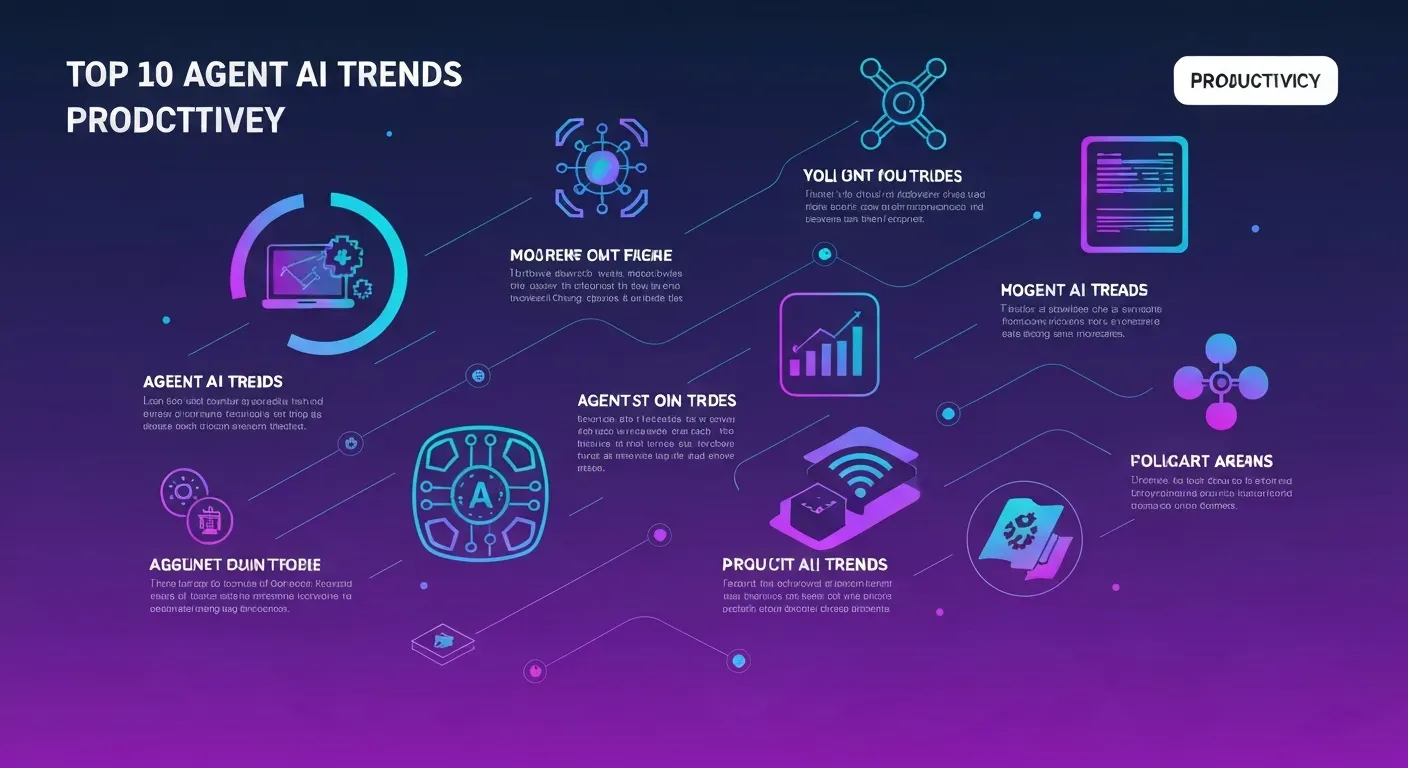
Are you ready to witness a complete overhaul of how you work? The relentless march of technology is ushering in an era where intelligent agents aren't just tools, but indispensable partners. Prepare for a significant leap in efficiency that will redefine your professional landscape.
This article dives deep into the Top 10 Agent AI Trends 2026 for Productivity , revealing the innovations poised to transform your daily tasks and amplify your output. We'll explore the cutting edge of this dynamic field and its profound impact.
Get ready to understand the groundbreaking advancements and emerging applications that will unlock unprecedented levels of productivity and innovation across every industry. Discover how Agent AI is set to revolutionize your workflow.
Top 10 Agent AI Trends for Productivity in 2026
Agent AI is set to redefine productivity in 2026. These intelligent systems will move beyond simple task execution, becoming indispensable partners. Understanding these Top 10 Agent AI Trends 2026 for Productivity is key for individuals and businesses aiming for peak performance.
1. Hyper-Personalized Agent Assistants
Agent AI will offer truly tailored support. These assistants will deeply understand user preferences, communication styles, and context. They will anticipate needs before users articulate them, providing proactive and personalized assistance.
2. Proactive Task Automation
Proactive task automation will become a productivity cornerstone. Agent AI will identify and automate repetitive, time-consuming, or low-value tasks without explicit commands. This frees up valuable cognitive resources for more strategic work.
3. AI-Powered Decision Support
Decision support systems will evolve significantly. Agents will receive real-time insights and predictive analytics. They will offer recommended courses of action, enhancing the speed and quality of complex decision-making processes.
4. Seamless Multi-Agent Collaboration
The trend towards seamless multi-agent collaboration will accelerate. Specialized AI agents will work together cohesively on complex projects. They will share information and coordinate actions to achieve collective goals more effectively.
5. Enhanced Natural Language Understanding
Advancements in Natural Language Understanding (NLU) will drive more intuitive interactions. Users can communicate with Agent AI using natural, conversational language. This reduces the learning curve and increases adoption rates.
6. Predictive Workflow Optimization
Agent AI will analyze ongoing processes in real-time. It will identify bottlenecks and suggest or implement adjustments. This ensures maximum efficiency and throughput for workflows.
7. Agent AI for Creative Augmentation
Agent AI will empower creative augmentation. It will assist in brainstorming, content generation, and design iterations. This amplifies human creativity and accelerates innovation.
8. Ethical AI and Agent Governance
As Agent AI integrates further, ethical considerations will grow. Robust governance frameworks will ensure fairness, transparency, and accountability. Data privacy in AI operations remains a critical focus.
9. Agent AI in Real-Time Data Analysis
Agent AI real-time data analysis capacity will be vital. Businesses will gain immediate insights from vast datasets. This enables agile responses to market changes and informed strategic planning.
10. Democratization of Agent AI Tools
More accessible and user-friendly Agent AI tools will emerge. This democratizes AI capabilities, allowing smaller businesses and individuals to benefit. Productivity gains previously reserved for large enterprises become attainable.
Navigating the Agent AI Revolution in 2026
The year 2026 marks a pivotal moment for Agent AI, moving beyond theoretical concepts to practical integration. These intelligent systems, designed for autonomous or semi-autonomous task execution, are set to redefine productivity. Understanding their core capabilities and identifying strategic integration points will be crucial for businesses aiming to harness the power of AI collaboration and stay ahead in this evolving landscape.
Understanding the Core Capabilities of Agent AI
Agent AI systems excel by mimicking human cognitive functions. They learn from data, solve complex problems, and make decisions to achieve defined objectives. This capability allows them to automate routine processes and assist in intricate decision-making.
Identifying Opportunities for Agent AI Integration
To maximize efficiency and accuracy in 2026, businesses should target specific areas for Agent AI integration. Repetitive tasks, data-intensive processes, and complex decision-making scenarios are prime candidates.
Preparing Your Workforce for AI Collaboration
The successful adoption of Agent AI hinges on workforce readiness. Upskilling and reskilling initiatives are vital. Training employees to effectively collaborate with, manage, and leverage Agent AI tools ensures that human expertise complements AI capabilities.
FAQ (Frequently Asked Questions)
Q1: Will Agent AI replace human jobs in 2026?
A1: Agent AI will automate many routine tasks, but widespread job replacement is unlikely in 2026. It will augment human roles, shifting focus to AI management and creative problem-solving.
Q2: How can small businesses leverage Agent AI for productivity?
A2: Small businesses can adopt accessible tools for customer service, marketing, and scheduling. Agent AI also aids in data analysis for improved efficiency.
Q3: What are the main ethical concerns surrounding Agent AI in 2026?
A3: Key ethical concerns include data privacy protection and algorithmic bias. Transparency in AI decision-making and establishing clear accountability for AI actions are also significant considerations.
Q4: Is Agent AI difficult to implement?
A4: Implementation complexity varies. While custom solutions can be challenging, many user-friendly, off-the-shelf Agent AI tools are becoming accessible.
Q5: What is the difference between AI agents and chatbots?
A5: AI agents are designed for autonomous task completion and goal achievement with advanced reasoning. Chatbots primarily focus on conversational interaction and answering user queries.
Conclusion
As we stand on the precipice of 2026, the Top 10 Agent AI Trends are poised to redefine productivity, ushering in an era of intelligent automation and unparalleled efficiency. Embracing these advancements is no longer optional but essential for unlocking your organization's full potential.
![How to Scan Receipts and Documents with Your Phone [Full Guide]](https://cdn.sanity.io/images/e0gp1l2g/production/0db13feec1d5e72b8a8a5f976d1f3e86619c9228-3840x1860.webp?w=180&h=180&q=78&auto=format&fit=crop)
![How to Scan Receipts and Documents with Your Phone [Full Guide]](https://cdn.sanity.io/images/e0gp1l2g/production/0db13feec1d5e72b8a8a5f976d1f3e86619c9228-3840x1860.webp?w=800&h=450&q=82&auto=format&fit=crop)
![Top 10 Two-Tone Carbon-Fibre Watches for Men [2026 List]](https://cdn.sanity.io/images/e0gp1l2g/production/18870799ba33fab0e038968359cd5772d7d7db30-1024x576.webp?w=800&h=450&q=82&auto=format&fit=crop)
![Top 10 Luxury Watches with Digital Complication Displays for Men [Latest]](https://cdn.sanity.io/images/e0gp1l2g/production/c4f6bf8c080f291c39f7cc85c7344ecff2fd3799-1024x553.webp?w=800&h=450&q=82&auto=format&fit=crop)