Key Takeaways
- Zircon is a natural gemstone mineral; cubic zirconia (CZ) is a man-made material commonly used as a diamond simulant.
- The similar names do not mean the materials are related in the way buyers may assume.
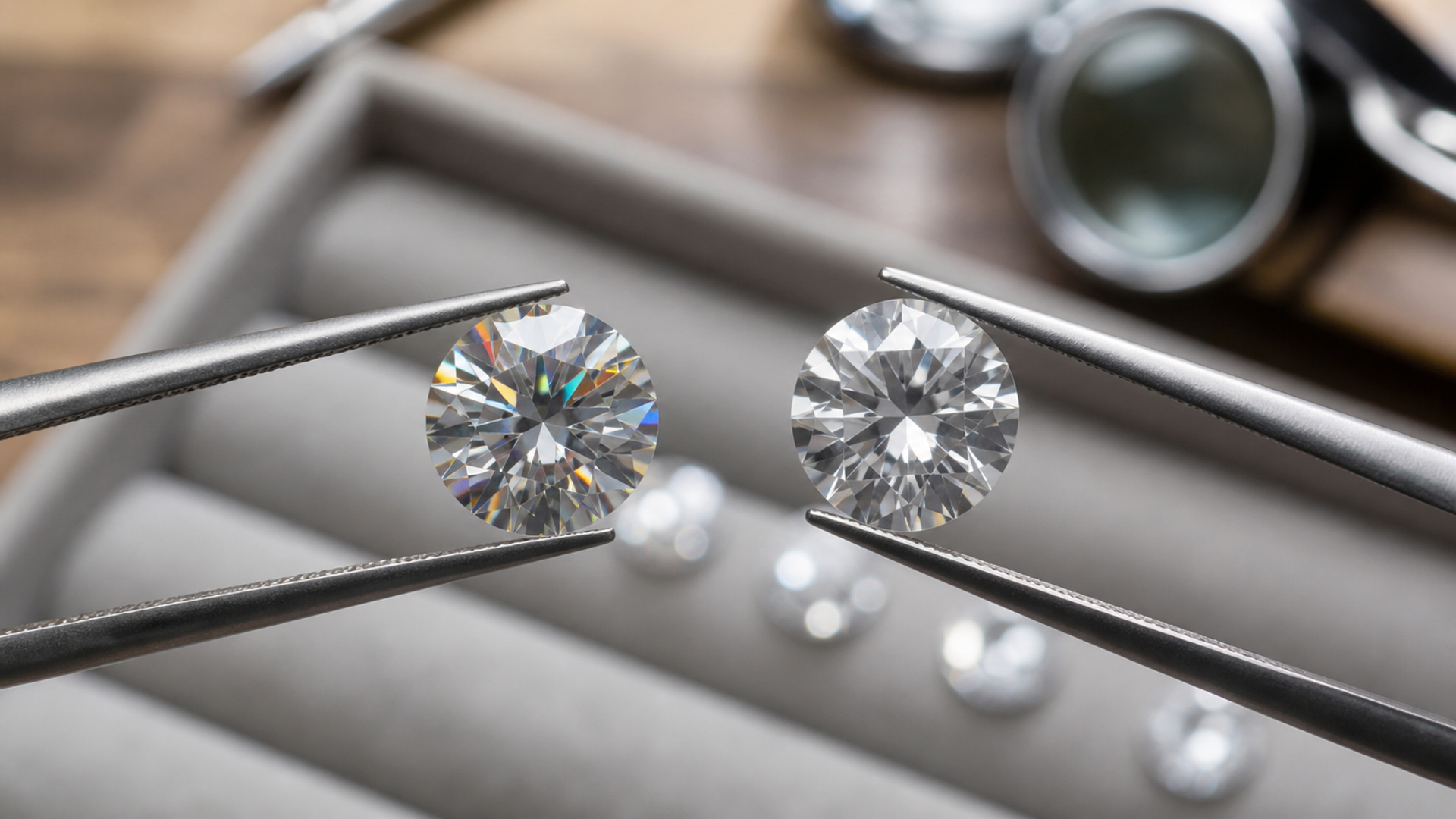
- Photographs and sparkle alone cannot reliably identify a mounted stone.
- Ask for exact material disclosure and an independent gem identification report when needed.
Zircon and cubic zirconia are not the same gemstone. Zircon is a naturally occurring mineral, zirconium silicate (ZrSiO4), that appears in a range of colours. Cubic zirconia, often shortened to CZ, is a laboratory-produced crystalline material used as a diamond simulant. The names are similar, but the composition, origin and gemological properties differ. When buying jewellery, read the full stone description and ask the seller to identify the material rather than relying on a product photo or the word “zircon” alone.
What is natural zircon?
Zircon is a mineral that forms naturally and has long been cut as a gemstone. It can occur in blue, red, yellow, green, orange and brown, among other hues. Colourless zircon is known for strong brilliance and flashes of spectral colour called fire. The Gemological Institute of America (GIA) identifies zircon chemically as ZrSiO4 and notes its high refractive properties and pronounced double refraction.
Those features help explain why colourless zircon has sometimes been mistaken for diamond. Zircon is nevertheless its own gem, not a type of diamond. It may also receive treatments; GIA notes that processes can alter colour, apparent clarity or durability. A buyer should ask whether a stone has been treated and whether the treatment needs specific care, instead of assuming that every zircon is untreated.
Natural zircon varies in quality and condition. GIA lists a Mohs hardness range of 6 to 7.5 across zircon types and cautions that zircon can be brittle despite being relatively hard. This means hardness alone does not describe how well a mounted stone will handle knocks or abrasion. Setting, cut, wear pattern and the wearer’s activities all matter.
What is cubic zirconia?
Cubic zirconia is a man-made crystalline material with a cubic crystal structure. Jewellery sellers commonly use it as a diamond simulant: a material chosen to resemble another gem while having different chemical composition and physical properties. GIA describes CZ among the common diamond simulants and distinguishes simulants from laboratory-grown diamonds. A simulant is not a diamond, whether its appearance is convincing or not.
“Cubic zirconia” and “zircon” share part of a name because both relate to zirconium compounds, but that does not make them the same material. CZ is also not the same thing as a laboratory-grown diamond. A lab-grown diamond has the same essential chemical composition and crystal structure as a mined diamond, while a simulant like CZ has different composition and structure.
CZ can be manufactured in different sizes and colours. That consistency may make it useful in fashion jewellery, but it does not establish the quality or origin of any individual piece. The buyer should still confirm that the description, invoice and any certificate state CZ if that is what the setting contains.
Zircon vs cubic zirconia at a glance
| Question | Zircon | Cubic zirconia (CZ) |
|---|---|---|
| What is it? | A naturally occurring mineral and gemstone | A laboratory-produced crystalline material |
| Composition | Zirconium silicate (ZrSiO4) | Zirconium dioxide in a stabilised cubic crystal form |
| Common jewellery role | Gemstone in its own right | Diamond simulant or coloured jewellery material |
| Does the name mean diamond? | No | No |
| Can a photograph prove which one it is? | No | No |
This is a category-level comparison, not a quality ranking. Natural zircon may be more or less desirable depending on colour, clarity, cut, size, treatment and personal taste. CZ quality and appearance also vary by manufacture and cut. Neither name alone tells you what a particular item is worth or how it will wear.
Why the names create confusion
In everyday search and retail language, “zircon” is sometimes used loosely when a seller means cubic zirconia. A listing might also say “zirconia” without clearly specifying whether it means CZ, a ceramic component or another material context. Buyers may therefore see two descriptions and assume the terms are synonyms.
Read the full wording, not just a shortened product title or tag. Ask: “Is the centre stone natural zircon, cubic zirconia (CZ), or another material?” If the seller says “zirconia,” ask them to define it in writing. In a finished piece, also check whether the stated material applies to the centre stone, accent stones or a different component.
Be cautious when a description uses several terms interchangeably. A seller should be able to name the stone consistently on the product page, receipt and any accompanying report. If the distinction is important to you and the answer remains vague, pause the purchase until it is clarified.
Can you identify one by looking?
Not reliably from a website photo. Cut, lighting, camera processing, stone size and setting can change the visual impression. Zircon’s brilliance and double refraction can create distinctive effects under suitable viewing conditions, but those characteristics are not a dependable at-home authentication method, especially when the stone is mounted. CZ can also be cut to imitate diamond-like appearance.
Do not rely on a scratch test, thermal tester or online “sparkle comparison” to settle the question. Such methods can damage jewellery or produce misleading results when used by a non-specialist. A gem professional can examine the stone with appropriate instruments, and a qualified laboratory can provide a report when more formal identification is required.
GIA says it evaluates zircon and can issue a colored-stone identification report that assesses characteristics and identifies whether material is natural or laboratory-grown, along with detectable treatments. Whether that report is proportionate depends on the stone, price and purchase context. For a modest fashion piece, clear written seller disclosure may be enough; for a significant purchase, independent documentation can reduce ambiguity.
Which one is right for your jewellery?
Choose natural zircon if you specifically want a natural gemstone with its own mineral identity and are comfortable evaluating colour, cut, treatment and care. Choose CZ if you want a diamond-like simulant and the seller has disclosed it clearly. There is no need to treat one as a dishonest version of the other: they serve different preferences, provided the material is represented accurately.
For frequently worn jewellery, consider the setting and exposure as well as the stone. GIA recommends storing zircon carefully because it can be brittle and its facet junctions can abrade if it rubs against other gems. Separate storage helps prevent contact damage. Remove jewellery before rough work and follow the care instructions provided for the specific piece. Ask the seller before using ultrasonic or steam cleaning; do not assume every stone, treatment and setting can tolerate the same method.
For CZ, follow the maker’s cleaning guidance too. A setting can include other materials or treatments that determine how it should be cleaned. Avoid comparing stones only by price: product quality, setting, workmanship, documentation and seller terms are separate considerations.
Questions to ask before buying
- What is the exact material of the centre stone: natural zircon, cubic zirconia, or something else?
- Is the stone natural, laboratory-produced, treated or simulated?
- Does the description apply to the centre stone or only to accent details?
- Can the seller provide an independent identification report if the purchase warrants one?
- What care and storage does the seller recommend for this stone and setting?
- Are the description and return terms stated in writing on the receipt or order confirmation?
For VERTU product references, use the exact wording on the official page. The VERTU LUMINA AI Bracelet product page, for example, describes natural mother-of-pearl and precision-set zircon as materials; that product-specific wording should not be generalized to unrelated items. VERTU’s materials section provides broader context on material descriptions. Neither link substitutes for gem identification of another seller’s jewellery.
Frequently asked questions
Is zircon the same as cubic zirconia?
No. Zircon is a natural mineral gemstone; cubic zirconia is a laboratory-produced simulant material. The similar names do not make them interchangeable.
Is zircon a natural gemstone?
Yes. Zircon occurs naturally and is used as a gemstone. Individual stones may have treatments, so ask the seller to disclose them.
Is cubic zirconia a real diamond?
No. CZ can resemble diamond but has different composition and crystal structure. It is a diamond simulant, not a mined or laboratory-grown diamond.
How can I tell zircon from CZ?
Ask for exact written disclosure and seek qualified gemological identification when the distinction matters. Appearance in a photo is not sufficient proof.
Which is more durable for daily jewellery?
Neither should be judged by name alone. Zircon can be brittle despite its hardness range, and the setting and wear conditions matter; request care guidance for the exact piece.
Conclusion
Zircon is a natural gemstone; cubic zirconia is a different, laboratory-produced material commonly used as a diamond simulant. Their names are easy to confuse, but clear disclosure resolves most buying uncertainty. Check the full product description, ask what each stone is, and use a qualified gem professional or report when a high-value decision calls for independent identification.