Lab grown leather has moved from a laboratory demonstration toward a material that luxury makers may eventually specify, but a promising sample is not the same thing as a finished product at commercial scale. On 2 November 2026, Qorium announced its new name, Reyva, and described a process that cultivates animal-cell-derived collagen into sheets before tanning. The news raises a useful question for leather buyers: what would have to be proven before a new material can stand beside conventional or exotic leather in a lasting luxury object?
Key Takeaways
- Reyva says it cultivates collagen from animal cells, then tans the resulting sheets; it calls the material real leather.
- A reported 87% carbon-footprint reduction is a projection for full-scale production in 2029 using renewable electricity, not a measured result for all products sold today.
- Uniform sheet size and thickness could improve cutting yield, but durability, finishing, repairs and availability require product-level evidence.
- “Cultivated,” “animal-free” and “synthetic” are not interchangeable descriptions; ask how the material is made.
- There is no evidence that a current VERTU exotic-skin product uses Reyva leather. Existing specifications should remain tied to the actual product.
What is lab grown leather in Reyva’s process?
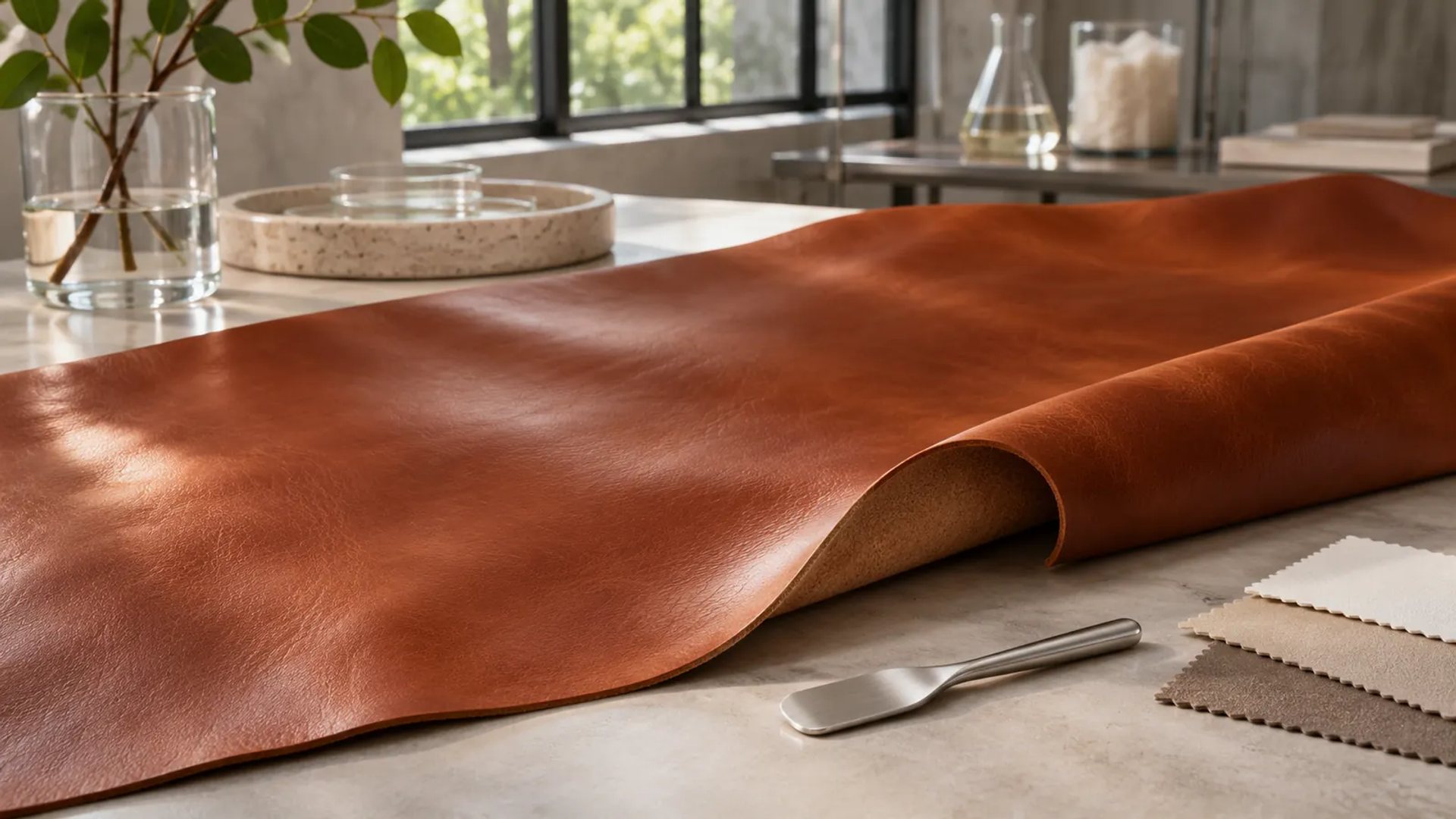
Reyva, formerly Qorium, says it starts with animal cells and cultivates collagen, the structural protein associated with conventional leather. Its process produces sheets that are then tanned. That is different from a plastic-coated textile sold as “vegan leather,” and also different from a hide taken from an animal and processed by a tannery. The distinction matters because the raw material, surface structure, manufacturing constraints and potential care requirements may differ even when the finished article looks familiar.
Reyva’s own description is a company claim about a developing material. A buyer should not infer that every cultivated sheet has the same grain, softness, abrasion resistance or ageing behaviour as a particular calfskin or exotic hide. Those properties depend on formulation, processing, finishing and the design of the object. The responsible comparison starts with the specific finished material, not a broad category label.
The company’s November announcement presents its rebrand as a move toward commercial scale rather than proof that mass production is already established. It says capacity will grow progressively in Maastricht and that it works with luxury, fashion and automotive partners. The precise availability of a handbag panel, phone covering or watch strap would need a named supplier, product specification and release date.
Why do uniform sheets matter to a luxury workshop?
A natural hide has irregular edges, variation in thickness and marks that a cutter may need to work around. Uniform cultivated sheets could offer greater control over dimensions and shape, potentially improving material yield. That could be valuable for repeated panels or consistent colours. Yet yield is not the only measure of quality. A maker also considers how a material stretches around a curve, how an edge can be finished, whether a seam holds, how it responds to oils and light, and whether a panel can be replaced years later.
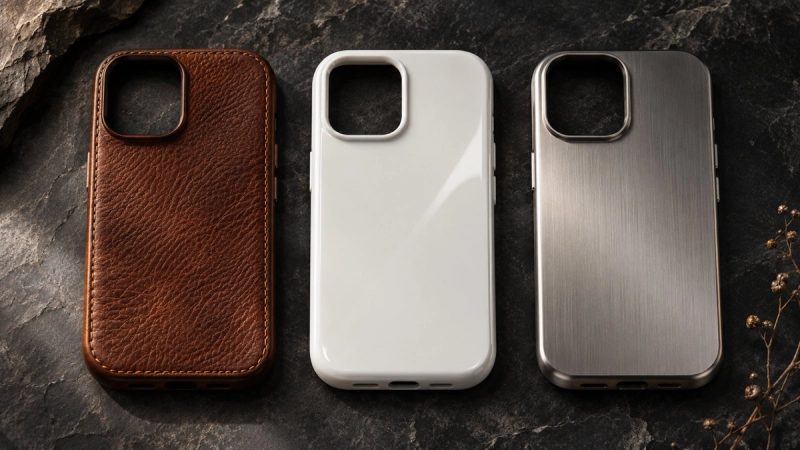
Imagine a small leather panel wrapped around a phone body. The designer must account for corners, camera openings, adhesive or stitching, hand feel and wear against pockets. A perfectly uniform sheet might simplify cutting, but it does not prove that the panel will age attractively or remain secure. The point is a design test, not a claim that any particular VERTU phone uses the new material. For a watch strap, flex cycles and skin contact would create another set of tests; for a large bag, drape and crease behaviour would matter more.
Luxury often values material variation as well as precision. A cultivated sheet may allow new forms of consistency, while conventional leather can retain distinctive natural character. Neither is automatically better for every object. The design brief should identify whether the customer is paying for repeatability, tactile nuance, rarity, traceable production, repairability or a combination. A credible new material must be judged against that brief rather than against a fashionable label.
Does the 87% carbon figure describe today’s products?
No. Reyva’s 2 November announcement cites an independent life-cycle assessment by CE Delft projecting that its cultivated leather could have an 87% lower carbon footprint than conventional cow-derived leather at full-scale production in 2029 with renewable electricity. The company gives a projected 10.5 kg CO₂-equivalent per square metre at the tannery gate, including finishing, against a conventional French calf-leather benchmark of 77–83 kg. These figures have a defined scenario, comparison material and boundary; they are not an observed universal saving for each item currently produced.
Change the energy source, process yield, finishing recipe, transport or system boundary and the comparison can change. It also compares with French calf leather, not with every exotic hide or alternative material. A claim about a finished handbag would need additional data for hardware, lining, assembly, packaging, use and end of life. The company says it will update the assessment as primary production data becomes available. That is the right reason to cite the number with its assumptions, rather than to turn it into an unqualified environmental slogan.
Other impacts deserve separate measurement: water, land use, chemical inputs, waste and product lifetime. A material with lower manufacturing emissions could still disappoint if it fails quickly and cannot be repaired. Conversely, a durable product cannot claim low environmental impact solely because it lasts. Comparing materials responsibly requires a matched functional unit, documented production conditions and evidence about the finished object’s usable life.
Is cultivated leather the same as exotic leather?
No. Exotic leather is a broad market term for hides from particular animals, finishes and regulated supply chains. Cultivated collagen sheets are a different production route. Even if a surface can be embossed with a reptile-like pattern, that does not make it the same material or establish the same provenance. A buyer should ask whether the description refers to the source of the collagen, the structure of the material, a surface pattern or the legal name on a product label.
The important questions for a luxury maker include species or cell source, tanning chemistry, traceability, finish, abrasion and flex performance, repair route and any applicable labelling rule in the sales market. Aesthetic resemblance is one factor, not a substitute for material disclosure. If the design depends on a particular natural grain or piece-to-piece variation, a uniform sheet may change the object’s character. If the design depends on precise, repeatable cutting, the cultivated process may create a new opportunity. Neither outcome should be presumed without samples and testing.
For current VERTU exotic-skin products, the official product page and knowledge base remain the controlling sources for the actual material. It would be misleading to imply that Reyva supplies VERTU, that a current alligator finish has been replaced, or that its environmental profile is identical to a cultivated calf comparison. The new technology is an industry development, not a retroactive specification for existing products.
What would a buyer need to see before trusting a finished product?
Start with identification: the exact material name, animal-cell source, manufacturer and finishing process. Then ask for evidence at the level of the object being sold. How does it perform under repeated bending, handling, perspiration, light and routine cleaning? Can a damaged panel be repaired or replaced? What warranty covers coating separation, colour transfer or premature wear? A polished photograph cannot answer these questions.
| Claim | Evidence to request | Why it matters |
|---|---|---|
| “Real leather” | Material composition and market-specific labelling basis | Separates source and process from appearance |
| “Lower footprint” | Life-cycle assessment, year, energy scenario and boundary | Prevents a projected process result becoming a product-wide promise |
| “Luxury durability” | Finished-product wear tests and repair policy | Shows how it behaves in the actual design |
| “Commercially available” | Named product, quantity and delivery terms | Distinguishes samples from reliable supply |
These checks are not an attempt to disqualify a new material. They give a promising technology the same scrutiny that a high-value conventional material should receive. Luxury buyers have reason to care about how an object looks on day one and how it behaves after years of handling. A maker who can document both has a stronger story than one relying on novelty alone.
How can brands discuss the material without overstating it?
Name the stage of development. “Prototype,” “pilot,” “commercial-scale plan” and “available in this product” are different statements. Cite the company and date when describing a projected environmental result. Explain the comparison benchmark and energy assumption in the same paragraph. If a partnership has been announced, do not infer that a retail product exists unless one is named. A customer should be able to trace each claim to a document or a physical product.
Good material writing also relates process to use. Instead of saying that cultivated leather will transform luxury, explain a testable possibility: uniform sheets could allow consistent small panels, subject to successful finishing and wear trials. That sentence gives the reader a reason to care while leaving the uncertain part visible. A statement about better cutting yield should be paired with data when a production line can provide it. Until then, it remains a plausible design advantage rather than a guaranteed saving.
Frequently asked questions
Is lab grown leather real leather?
Reyva describes its cell-derived, tanned collagen material as real leather. The exact legal labelling and composition of a finished item should be checked in its market; the phrase alone does not establish identical properties to a conventional hide.
Is cultivated leather vegan?
Not necessarily. Reyva says its process starts from animal cells, so “animal-free” would be misleading without a clear, source-specific definition. Ask the manufacturer about the biological starting material.
Does the 87% figure apply to a bag sold today?
No. It is a projected process comparison at full scale in 2029 under renewable electricity assumptions, not a measured footprint for every finished bag.
Will cultivated leather replace exotic skins?
That is unknown. Performance, aesthetics, supply, regulation and customer preference all matter. A surface pattern that resembles an exotic hide does not make the materials equivalent.
Does VERTU currently use Reyva leather?
No such use was verified for this article. Check the current official VERTU listing for the material used in any specific product.
Conclusion
Lab grown leather now has a more concrete luxury-industry proposition: controlled sheets, a declared collagen-based process and a scale-up plan. Its strongest claims remain conditional until finished products and production data can be inspected. For a buyer or maker comparing it with conventional or exotic leather, the right questions concern material identity, documented performance, repair and environmental boundaries—not whether a new name alone makes an object more responsible.
Sources and editorial scope
Process, scale-up and projected life-cycle figures are attributed to Reyva’s press materials and its 2 November 2026 announcement. This is a sourced analysis, not an independent laboratory test or an announcement of a VERTU–Reyva partnership.