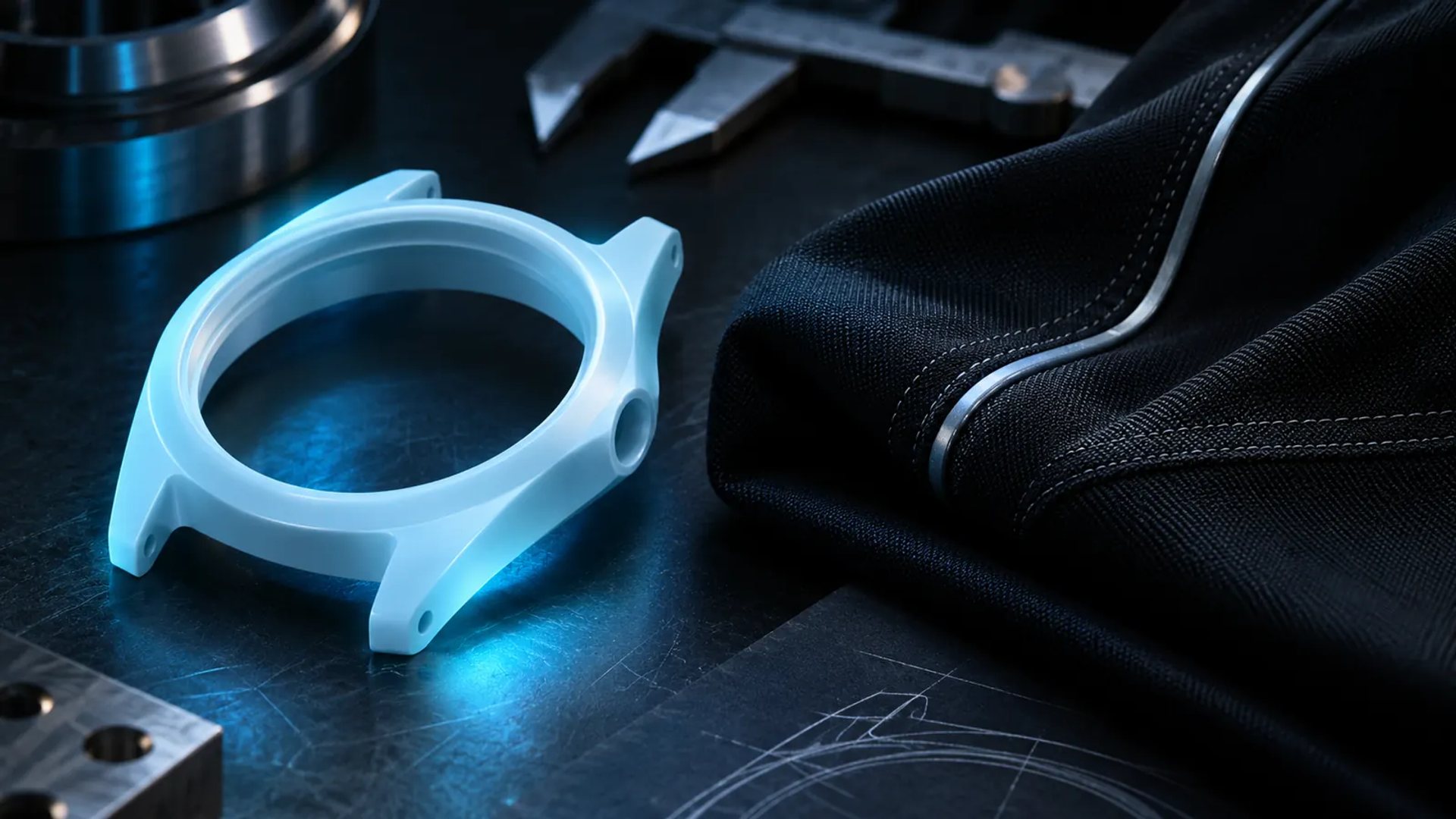
IWC x Mercedes made news at the 2026 Las Vegas Grand Prix with bespoke racing suits inspired by IWC’s luminous Ceralume watch. The official announcement describes a design collaboration between IWC Schaffhausen and the Mercedes-AMG PETRONAS Formula One team; it does not announce a newly co-developed luminous ceramic watch. The distinction matters because the story is about a material idea crossing from watchmaking into team clothing, rather than a new product specification buyers can order.
Key Takeaways
- IWC says it worked with Mercedes-AMG PETRONAS on bespoke racing suits for the 2026 Las Vegas Grand Prix.
- The suits take visual inspiration from the Big Pilot’s Watch Perpetual Calendar Ceralume; the team apparel is not itself a ceramic watch case.
- IWC describes Ceralume as a proprietary luminous ceramic technology used in a limited watch introduced earlier in 2026.
- Compare the claims for the original watch and the later suits separately before inferring availability, performance or construction.
What did IWC and Mercedes announce?
In its 18 November 2026 press release, IWC says the two partners designed a set of bespoke racing suits for the Las Vegas Grand Prix. The design draws on the two aesthetic expressions of the Big Pilot’s Watch Perpetual Calendar Ceralume. This is a specific partnership action with a defined occasion. It is not evidence that Mercedes made the ceramic, that the suits have the watch’s luminescent construction or that a new watch edition accompanied the race.
Formula One partnerships often place a mark on a sleeve or a dial. Here the material’s appearance leads the brief: the watch’s luminous identity becomes a visual language for clothing worn in a high-visibility night race. That is what makes the example interesting to a reader of luxury materials. An idea developed at the scale of a case can help organise an entirely different object, even when the second object is not made from the first object’s material.
What is Ceralume in the original watch?
IWC introduced the Big Pilot’s Watch Perpetual Calendar Ceralume at Watches and Wonders in April 2026. Its launch statement describes a luminous ceramic case, a white dial and a white rubber strap enriched with luminous pigments. The company says the pigments store light and allow a blue glow for more than 24 hours. The watch was limited to 250 pieces. These are manufacturer claims for that watch under IWC’s described conditions, not independent measurements of every item inspired by it.
The official product page lists a 46.5 mm case. Its scale, materials and perpetual calendar complication make it a very different ownership proposition from a small everyday digital watch. The technical point is not that ceramic is automatically superior to other case materials. It is that the luminous effect is integrated into the case material story, while the dial and strap use their own pigment-rich finishes. An accurate explanation keeps these components distinct.
Why does a night race suit this material idea?
Las Vegas presents a visual environment of artificial light, reflective surfaces and fast-moving images. A glow-associated watch provides a recognisable design cue for that setting. This is editorial interpretation of the chosen occasion; IWC’s release establishes the partnership and inspiration, not a controlled test of how spectators perceive the suits. Readers should see the race clothing as communication: it carries the watch’s visual theme into a different medium.
That transition is more demanding than applying a logo. The colours, lines and contrast have to read on a moving person and on camera. The original watch has a case, dial and strap that can be examined close up. A racing suit is seen from a distance, often for seconds. Its job is to evoke the watch without pretending to reproduce its physical substance. A material-led collaboration succeeds when the relationship is clear and the construction of each object remains honestly described.
Is luminous ceramic the same as a luminous finish?
No. A material claim describes what a component is made from; a finish claim may describe a coating, pigment or applied layer. IWC’s watch combines a luminous ceramic case with a dial and strap whose glow involves pigments. The racing suits are inspired by the watch’s appearance. Treating all three as “luminous ceramic” would erase the manufacturing distinction that makes the watch noteworthy in the first place.
| Object | What IWC identifies | What not to infer |
|---|---|---|
| Big Pilot’s Ceralume case | Proprietary luminous ceramic | Every ceramic watch glows the same way |
| Watch dial and strap | White surfaces enriched with luminous pigments | They are made from the same ceramic as the case |
| 2026 team racing suits | Bespoke clothing inspired by the watch’s two visual expressions | The clothing is ceramic or a newly released watch |
A buyer comparing watches should ask where the claimed property sits: in the bulk material, the surface, the dial markers or another component. This question applies well beyond luminous design. “Sapphire”, “ceramic” and “titanium” are useful terms only when the maker states which part uses them and what the property does for ownership.
What can watch buyers verify?
Start with the exact reference. For the Ceralume watch, IWC identifies the model and publishes a product page with case size and its own description of the complication. Check the release date, edition size and current availability separately. A limited edition is a production fact when documented, not evidence of a particular resale outcome. If considering a watch seen through a team partnership, confirm whether the pictured item is the actual commercial reference or a campaign prop.
- Identify the named product and reference number on the maker’s site.
- Locate the material claim at the component level: case, dial, crystal, strap or finish.
- Separate a manufacturer duration claim from an independently measured result.
- Confirm whether a collaboration produced a product, an event object or a campaign.
- Check current availability and after-sales terms for the exact region.
For this story, the third and fourth checks are crucial. “More than 24 hours” refers to IWC’s described glow performance for the watch’s luminous treatment. The November announcement refers to suits inspired by that watch. Neither statement proves how long an individual viewer can see a garment glow under race conditions. That would require a separate clothing-specific claim or test.
What does the partnership show about luxury craft?
It shows that a distinctive process can become an identifiable language. A luminous ceramic case is a technical achievement; its colour and after-dark character can also become cues that designers translate into other forms. The translation is strongest when the audience can trace it back to a real, documented object. Without that anchor, the aesthetic risks becoming a generic futuristic glow.
The same principle applies when comparing different makers, but it does not license cross-brand specifications. VERTU’s own watches and devices should be described through their current official product pages and knowledge base. This IWC partnership does not establish any VERTU luminous ceramic technology or racing affiliation. A reader interested in materials can carry over the question—what is the material, where is it used and why does it matter?—without transferring another company’s claims.
Why is this not simply an F1 watch collaboration?
The phrase “IWC x Mercedes” can refer to a long partnership and several kinds of output. In the November 2026 announcement, the output is bespoke racing suits. The underlying watch debuted earlier in April. A headline that combines the partners with the word “Ceralume” might reasonably make a searcher expect a new watch, so the first paragraph must make the news item plain. Accurate entity relationships help readers and search engines alike: IWC made a watch; IWC and the team designed suits; the suits drew on the watch’s aesthetics.
This separation also makes the story more interesting. It lets readers examine how a material innovation travels through design culture. A conventional product-release article would ask whether the new watch is worth buying. This piece asks how a watchmaking technique shapes an image at a night race. Both questions can be useful, but they need different evidence and should not be answered with the same promotional language.
Frequently asked questions
Did IWC and Mercedes release a Ceralume watch in November 2026?
IWC’s November announcement concerns bespoke racing suits inspired by the Big Pilot’s Watch Perpetual Calendar Ceralume. The watch itself was introduced in April 2026.
Are the racing suits made of luminous ceramic?
The IWC announcement describes suits inspired by the watch’s visual expressions. It does not say the clothing is made from the watch’s ceramic case material.
How long does the Ceralume watch glow?
IWC says luminous pigments in the watch’s design can produce a vivid blue glow for more than 24 hours. Treat this as the maker’s stated performance, not an independent test of the suits.
How many Ceralume watches were made?
IWC’s April 2026 launch material says the Big Pilot’s Watch Perpetual Calendar Ceralume is limited to 250 pieces. Confirm availability with the brand or an authorised retailer.
Conclusion
The IWC x Mercedes Las Vegas story is a disciplined example of material-led communication: a luminous ceramic watch supplied the design language for bespoke racing suits. Its value as an editorial subject lies in that precise relationship. Keep the watch’s ceramic case, its pigment-rich companion surfaces and the clothing’s visual inspiration separate, and the partnership becomes easier to understand without overstating what was actually launched.
Sources and editorial scope
Partnership facts are from IWC’s November 2026 release. Watch construction, edition size and manufacturer glow claim are from IWC’s April launch and its product page. Interpretations of material storytelling are editorial analysis, not an independent product test.