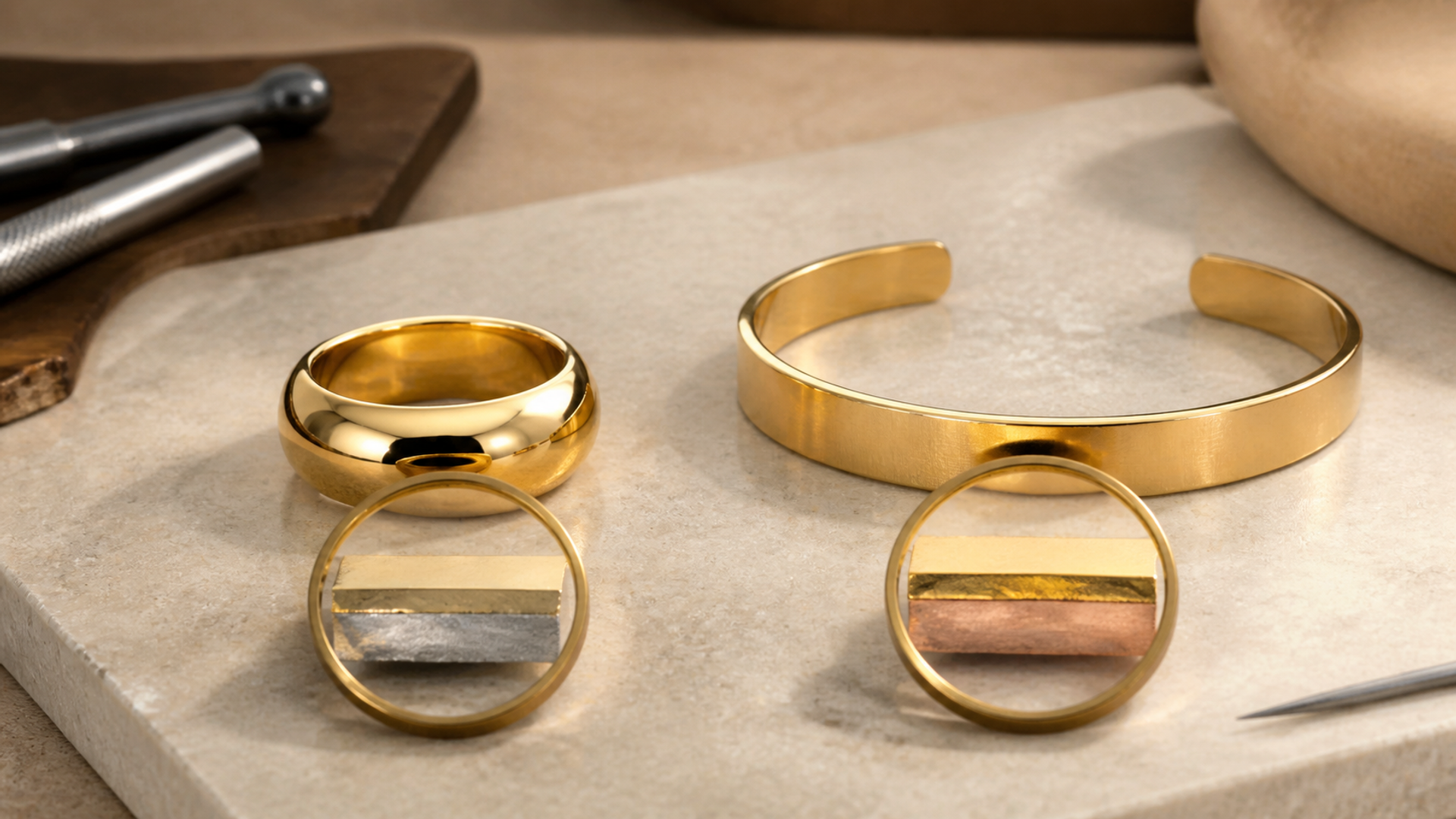
Gold vermeil and gold-plated jewellery can look almost identical in a product image while placing gold over different foundations. Vermeil conventionally uses sterling silver beneath the gold finish; ordinary plated pieces may use brass, steel or another disclosed base. Thickness, karat fineness, surface preparation, wear pattern and repair access matter more than the colour on day one.
Start beneath the gold colour
Choose vermeil when a precious-silver base, disclosed finish and a realistic re-plating route justify the premium. Choose conventional gold plating when fashion variety and lower entry cost outweigh a shorter cosmetic horizon. Choose solid gold or defer when daily wear, skin response, repairability or heirloom intent makes a surface coating the wrong architecture.
| Decision factor | Gold vermeil | Conventional gold-plated jewellery | Solid gold or defer |
|---|---|---|---|
| Base metal | Sterling silver is verified and marked where required | The exact brass, steel or alloy is disclosed | Solid gold avoids a plated base decision |
| Gold layer | Fineness and application are documented | Plating process and care limits are documented | Metal content is integral rather than a surface finish |
| Skin response | The known metals suit the wearer | The disclosed base and barrier suit the wearer | Defer when allergy history is unresolved |
| Wear pattern | Re-plating and edge wear are acceptable | Faster fashion wear is priced in | Solid construction suits constant friction |
| Repair | A jeweller can solder, polish and re-finish the piece | Repair cost stays below replacement value | Long-term repair access justifies higher capital |
| Evidence | Invoice, marks and description agree | Marketing names match the actual materials | Independent verification resolves uncertainty |
This gold vermeil vs gold plated matrix is the article's working value object. Read the gold vermeil vs gold plated rows together: the decisive failure mode depends on this topic's evidence, operating context and reader objective.
What the legal and material language establishes
Evidence 1. FTC consumer guidance explains that gold-plated jewellery carries a layer of gold over another metal and advises buyers to understand markings and seller descriptions.
Evidence 2. UK guidance for gold-plated silver articles treats the silver foundation and permitted description as material facts rather than decorative language.
Evidence 3. Plating durability is not established by colour alone; thickness, adhesion, friction, cosmetics, sweat and cleaning all affect visible wear.
Evidence 4. Sterling silver beneath vermeil can tarnish where exposed, while an undisclosed base metal can create different repair and skin-contact consequences.
Reader-visible sources checked for this article:
consumer.ftc.gov — reader-visible current or official evidence
gov.uk — reader-visible current or official evidence
For gold vermeil vs gold plated, these sources establish only the claims inside their documented scope. Recheck every changeable specification, availability condition, price, policy or service term in the relevant market before acting.
Test wear, repair and disclosure
Read base metal as a stop/go test: sterling silver is verified and marked where required supports the first option; the exact brass, steel or alloy is disclosed supports the second; and solid gold avoids a plated base decision supports the third. Record which source proves the condition and when it was checked.
A buyer can resolve gold layer without starting from a brand preference. Ask whether fineness and application are documented; compare that with whether plating process and care limits are documented; then use metal content is integral rather than a surface finish as the third route's safeguard. An unknown condition stays unknown.
On skin response, popularity is not enough. The evidence for option one is that the known metals suit the wearer. Option two means the disclosed base and barrier suit the wearer. Option three is rational where defer when allergy history is unresolved. Recheck any changeable term immediately before commitment.
The decision changes at wear pattern. Choose the first path only if re-plating and edge wear are acceptable; move to the second when faster fashion wear is priced in; use the third when solid construction suits constant friction. Save the downside that would make this row fail.
For repair, the first route works when a jeweller can solder, polish and re-finish the piece; the second requires repair cost stays below replacement value. The control for the third is long-term repair access justifies higher capital. Verify this row against the exact product, property, account or environment before it can reverse the decision.
The evidence row exposes a practical boundary. Route one assumes invoice, marks and description agree, while route two is defensible only when marketing names match the actual materials. Route three depends on independent verification resolves uncertainty. If that evidence is absent, keep the more reversible option.
Facts that would reverse the current choice
Reversal control 1 — Base metal. Before choosing Gold vermeil, write down how the decision changes if “Sterling silver is verified and marked where required” proves false. Do the same for Conventional gold-plated jewellery and “The exact brass, steel or alloy is disclosed”. Keep the Solid gold or defer route available until “Solid gold avoids a plated base decision” is verified. This control belongs to gold vermeil vs gold plated; update it from the cited source or exact supplier rather than copying a generic checklist.
Reversal control 2 — Gold layer. Before choosing Gold vermeil, write down how the decision changes if “Fineness and application are documented” proves false. Do the same for Conventional gold-plated jewellery and “Plating process and care limits are documented”. Keep the Solid gold or defer route available until “Metal content is integral rather than a surface finish” is verified. This control belongs to gold vermeil vs gold plated; update it from the cited source or exact supplier rather than copying a generic checklist.
Reversal control 3 — Skin response. Before choosing Gold vermeil, write down how the decision changes if “The known metals suit the wearer” proves false. Do the same for Conventional gold-plated jewellery and “The disclosed base and barrier suit the wearer”. Keep the Solid gold or defer route available until “Defer when allergy history is unresolved” is verified. This control belongs to gold vermeil vs gold plated; update it from the cited source or exact supplier rather than copying a generic checklist.
Reversal control 4 — Wear pattern. Before choosing Gold vermeil, write down how the decision changes if “Re-plating and edge wear are acceptable” proves false. Do the same for Conventional gold-plated jewellery and “Faster fashion wear is priced in”. Keep the Solid gold or defer route available until “Solid construction suits constant friction” is verified. This control belongs to gold vermeil vs gold plated; update it from the cited source or exact supplier rather than copying a generic checklist.
Reversal control 5 — Repair. Before choosing Gold vermeil, write down how the decision changes if “A jeweller can solder, polish and re-finish the piece” proves false. Do the same for Conventional gold-plated jewellery and “Repair cost stays below replacement value”. Keep the Solid gold or defer route available until “Long-term repair access justifies higher capital” is verified. This control belongs to gold vermeil vs gold plated; update it from the cited source or exact supplier rather than copying a generic checklist.
Reversal control 6 — Evidence. Before choosing Gold vermeil, write down how the decision changes if “Invoice, marks and description agree” proves false. Do the same for Conventional gold-plated jewellery and “Marketing names match the actual materials”. Keep the Solid gold or defer route available until “Independent verification resolves uncertainty” is verified. This control belongs to gold vermeil vs gold plated; update it from the cited source or exact supplier rather than copying a generic checklist.
Read the product description as a material record
Save the base metal, gold fineness, plating method, dimensions, weight, hallmarks and exclusions. Ask the seller to reconcile any conflict between title, invoice and care card.
Map contact and abrasion
Mark clasp, ring underside, chain links, watch-side wrist and pendant edges. Predict where clothing, skin and hard surfaces will remove finish first.
Price restoration
Obtain a realistic cleaning, polishing and re-plating route before purchase. Confirm whether stones, glue, enamel or hollow construction limit heat and chemical treatment.
Run a controlled wear log
Photograph the same surfaces in neutral light at purchase and after defined wears. Keep perfume, chlorine, creams and abrasive storage out of the trial unless they are part of normal use.
Three jewellery wardrobes
Occasional statement jewellery
Well-disclosed plating can deliver variety when the buyer accepts cosmetic wear and careful storage. Define the fact that would reverse this recommendation before committing.
Daily ring or bracelet
Constant friction may make solid gold or a repairable alternative better value than repeated surface restoration. Define the fact that would reverse this recommendation before committing.
Gift with uncertain skin history
Clear metal disclosure and a generous return route matter more than a prestige-sounding finish name. Define the fact that would reverse this recommendation before committing.
Action checklist
Identify the base metal.
Check gold fineness.
Save the seller description.
Inspect hallmarks.
Map friction points.
Ask about nickel and alloys.
Price re-plating.
Read care exclusions.
Photograph condition.
Keep the invoice.
Continue the decision
The linked VERTU articles expand adjacent parts of the gold vermeil vs gold plated decision. They do not substitute for the external evidence above.
The vermeil-plated verdict
Choose vermeil when a precious-silver base, disclosed finish and a realistic re-plating route justify the premium. Choose conventional gold plating when fashion variety and lower entry cost outweigh a shorter cosmetic horizon. Choose solid gold or defer when daily wear, skin response, repairability or heirloom intent makes a surface coating the wrong architecture.
Keep the gold vermeil vs gold plated decision reversible until its material cost, safety, access, privacy and compatibility facts are verified. Unknown evidence stays unknown; it is never silently scored as favourable.