The final creates an immediate rush for souvenirs, signed pieces and supposed match-used objects. Value depends on category before condition: official merchandise, a limited product, signed memorabilia and a match-used object are different claims requiring different evidence.
The short answer: Buy the evidence chain before the story: identify exactly what the object is, who issued it and how ownership can be verified later.
The question is more useful when it is converted into checks a reader can repeat. The matrix below separates what can be verified now from what still depends on a seller, service provider, venue or changing software policy. Details that vary by model, market, condition or account should be confirmed on the current source before money, access or irreplaceable evidence changes hands.
Decision matrix
| Decision point | Why it matters | Practical action |
|---|---|---|
| Name the category precisely | Misclassification is the fastest way to overpay | Write the claim in one sentence before reviewing evidence |
| Start with official licensing | Licensing confirms authorised merchandise, not a signature or match use | Compare tags, product identifiers and official-store records |
| Treat signatures as a separate claim | A generic certificate can be printed by the same seller | Prefer witnessed signing records, reputable authenticators and traceable serials |
| Demand a chain for match use | The more valuable the story, the stronger the chain should be | Seek team, auction-house or rights-holder records and consistent wear details |
| Understand digital authentication | The phone scan is evidence only if the domain, serial and transfer process are credible | Record the official verification result and transfer instructions at purchase |
| Preserve the package | Condition work that removes evidence can reduce confidence | Store documents separately, photograph details and avoid speculative restoration |
Use the table as a sequence rather than a scorecard. A strong result in one row does not cancel a serious failure elsewhere: excellent hardware cannot repair a missing return route, a convincing story cannot replace provenance, and a convenient service does not justify unlimited data access.
Collectors should separate the object from the story attached to it. Condition can be photographed, provenance can be traced and service history can be recorded; atmosphere and seller confidence cannot substitute for those things. The more exceptional the claimed history or premium, the more independent the evidence should become. Preservation also starts before purchase, because cleaning, heat, moisture or careless handling can erase clues that a later specialist would need.
A sensible collector file contains more than a certificate. Photograph labels, construction details and condition; save the invoice and seller identity; record how any digital verification was reached; and note every gap in the chain. If an independent specialist is needed, arrange that before irreversible work. The object should be capable of carrying its history forward without depending on the present seller's description. That is what makes later insurance, service, resale or scholarly review possible.
1. Name the category precisely
A replica, signed retail product and match-used object are not interchangeable. That matters because misclassification is the fastest way to overpay.
Write the claim in one sentence before reviewing evidence. Record the result while the evidence is visible and repeat the check under the conditions in which the device, object or service will actually be used.
A stadium date or player name on an object does not make it match-used. Provenance and condition should be documented before cleaning, restoration or a change of ownership alters the evidence.
2. Start with official licensing
Licensing confirms authorised merchandise, not a signature or match use. The useful evidence is observable: fIFA identifies labels, legal notices, holograms and licensed-product marks as authentication characteristics.
The practical move is to compare tags, product identifiers and official-store records. Keep the answer with its date and source, especially where a model, account, venue or regional policy can change.
Packaging quality alone is weak evidence because it can also be copied. Provenance and condition should be documented before cleaning, restoration or a change of ownership alters the evidence.
3. Treat signatures as a separate claim
Start with the behaviour, not the label. A signed item needs evidence connecting the signer, object and event, so a generic certificate can be printed by the same seller.
Prefer witnessed signing records, reputable authenticators and traceable serials. The test should be clear enough for a partner, support adviser, specialist or future buyer to repeat without relying on your memory.
Do not accept a photograph of a player near an unrelated shirt. Provenance and condition should be documented before cleaning, restoration or a change of ownership alters the evidence.
4. Demand a chain for match use
Match-issued and match-worn claims require assignment, timing and custody evidence. Read that alongside the practical consequence: the more valuable the story, the stronger the chain should be.
A defensible response is to seek team, auction-house or rights-holder records and consistent wear details. If the seller or provider supplies the evidence, verify both its origin and its relevance to the exact item or account.
Grass stains and laundering are not proof of a particular match. Provenance and condition should be documented before cleaning, restoration or a change of ownership alters the evidence.
5. Understand digital authentication
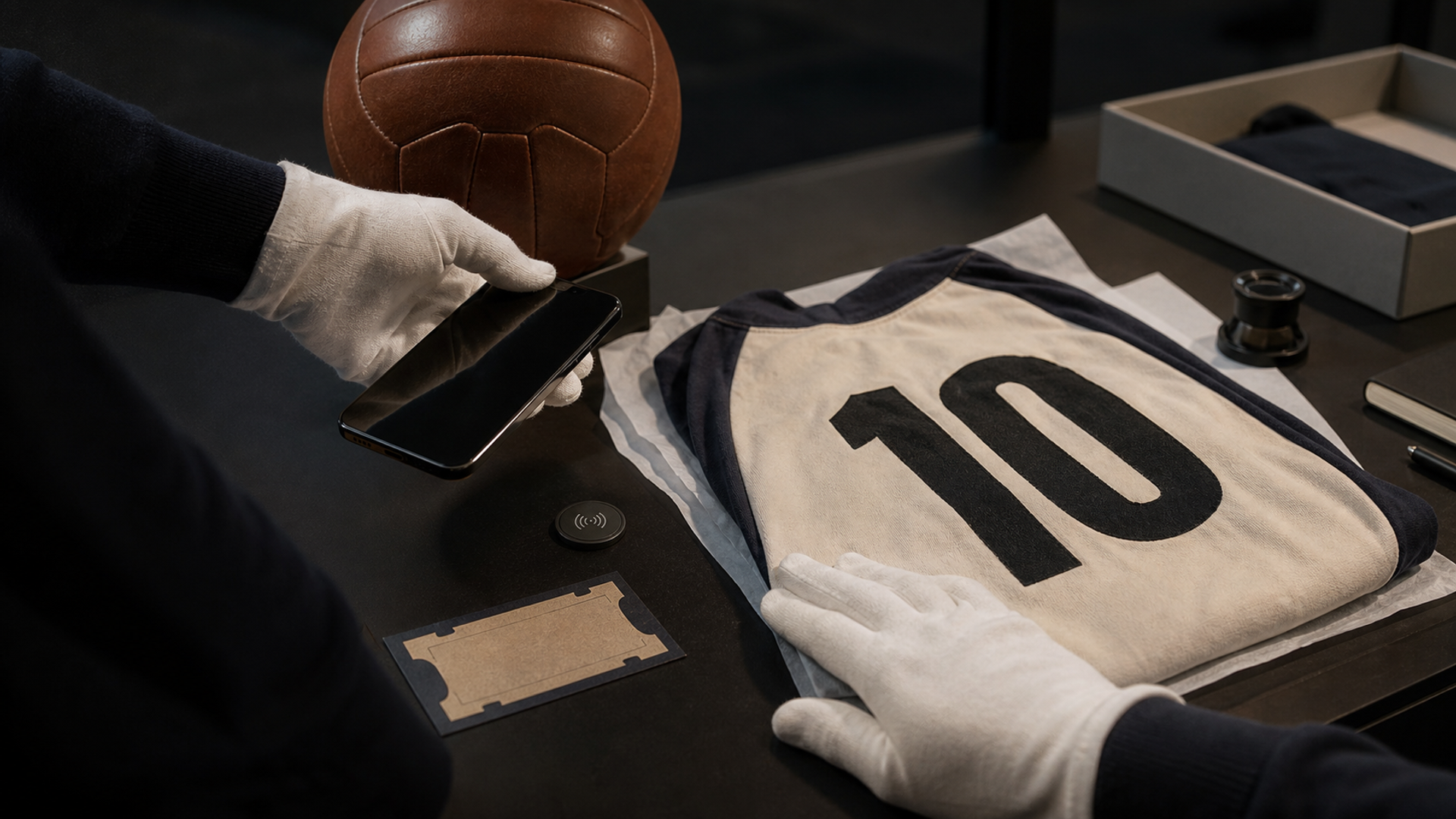
The decision turns on a simple fact: nFC can connect an object to an issuer record when the system is genuine and available. As a result, the phone scan is evidence only if the domain, serial and transfer process are credible.
Record the official verification result and transfer instructions at purchase. Then test the result once outside the ideal demonstration: different light, a longer session, an interrupted connection or another ordinary use condition.
A loose NFC sticker or unknown app is not a provenance system. Provenance and condition should be documented before cleaning, restoration or a change of ownership alters the evidence.
6. Preserve the package
Condition work that removes evidence can reduce confidence. A buyer can test the premise because tags, receipts, certificates and shipping records may matter later.
Use this as the next action: store documents separately, photograph details and avoid speculative restoration. Preserve the controlling page, result and date without saving secrets or publishing personal identifiers.
Do not wash or reframe a premium object before documenting its state. Provenance and condition should be documented before cleaning, restoration or a change of ownership alters the evidence.
A realistic scenario
A seller offers three items after the final: an official-looking replica ticket, a signed shirt with a generic certificate and a numbered host-city jersey with NFC authentication. Each may be genuine, but each claim has a different burden of proof and a different ceiling of collectability.
Apply the matrix to the actual situation, not an ideal showroom version of it. Identify the exact item, account, venue or service; preserve the current evidence; run the least destructive test first; and calculate the downside if the claim fails. A lower offer, narrower permission, service appointment, different product or decision to wait can all be successful outcomes.
The pre-decision checklist
Before proceeding, make sure you can do each of the following:
Write the claim in one sentence before reviewing evidence.
Compare tags, product identifiers and official-store records.
Prefer witnessed signing records, reputable authenticators and traceable serials.
Seek team, auction-house or rights-holder records and consistent wear details.
Record the official verification result and transfer instructions at purchase.
Store documents separately, photograph details and avoid speculative restoration.
This list is deliberately practical. It should be possible to complete it without handing a seller unnecessary personal data or accepting a verbal promise that cannot be checked later. If one missing answer controls safety, privacy, repair cost or authenticity, resolve that answer before optimising secondary features.
Build a record you can use later
Create a compact evidence folder for this decision. Save the controlling official page, receipt or reference, non-secret screenshots, the result and the date. Add software versions where behaviour can change, or condition photographs where physical value matters. Keep serials, identity data and account-recovery details private.
The record should let a support team, specialist, insurer or future buyer understand why the decision was reasonable at the time. A short, labelled chain is more credible than a large folder of unexplained screenshots. It also gives you a baseline if a hinge changes, an algorithm is updated, a ticket account closes, a service entitlement differs or a collector later questions provenance.
For adjacent decisions, see the VERTU guides on watch provenance guide and what makes luxury technology collectible. These links answer the next practical question; they do not replace the primary evidence for this topic.
Sources and verification
The cited pages control the key rule, product context or official claim and may change after publication. Recheck availability, regulatory status, event controls, service entitlement and regional terms before acting. Where health, safety, legal or financial consequences are involved, this article offers general decision support rather than professional advice.
Final decision
Buy the evidence chain before the story: identify exactly what the object is, who issued it and how ownership can be verified later. Revisit the conclusion when the source, physical condition, permission boundary or support route changes. A decision remains strong when another person can understand the evidence, reproduce the important check and see what would make you stop.