Luxury technology becomes collectible when its value survives the end of normal software support. That survival can come from exceptional industrial design, identifiable authorship, scarce and documented production, repairable construction, meaningful materials or a clear place in technological history. Price and rarity alone are insufficient. An obsolete object becomes a collectible only when people still have a reason to study, preserve or use it.
The six-part collectibility test
| Factor | Strong signal | Weak signal |
|---|---|---|
| Design authorship | Recognisable designer, workshop or coherent design language | Generic hardware with decorative finish |
| Historical meaning | Introduced a form, interface or cultural behaviour | Followed an existing trend late |
| Provenance | Serial, archive, invoice, edition record and known ownership | Unverifiable “rare” claim |
| Material integrity | Material changes gracefully and can be conserved | Coating degrades with no repair path |
| Serviceability | Battery, display, controls or finish can be maintained | Sealed dependence on unavailable parts |
| Software independence | Core object retains function or meaning offline | Entire experience disappears with a server |
No object needs a perfect score. An early digital camera may be awkward but historically decisive. A finely made phone may lose network compatibility yet remain an important example of craft meeting communications technology. The framework prevents the collector from treating a limited colour as equivalent to a meaningful object.
Design must exist beneath decoration
Luxury materials can intensify a good design, but they cannot create one. Leather, ceramic, sapphire or precious metal should change tactility, durability, construction or visual identity. If the underlying object is anonymous, expensive surface treatment may age as merchandising rather than authorship.
Look for decisions that remain visible with the device switched off: proportion, hinge movement, key feel, lens placement, acoustic form, fastening and the relationship between hand and object. These are easier to preserve than a cloud service and more likely to communicate a period's values.
Software dependence is the central risk
A mechanical camera can often make an image decades later if film and service exist. A connected object may stop at login. Collectors should map dependency before purchase:
Does basic operation require an account?
Is setup possible if the original app leaves an app store?
Are date, language and settings stored locally?
Does the object rely on a proprietary cloud for essential functions?
Can data be exported in a standard format?
Is there a documented reset and offline display mode?
An object can still be collectible when the answers are unfavourable, but it becomes an archival artefact rather than a dependable tool. That distinction should affect price, storage and expectations.
Provenance is more than a box
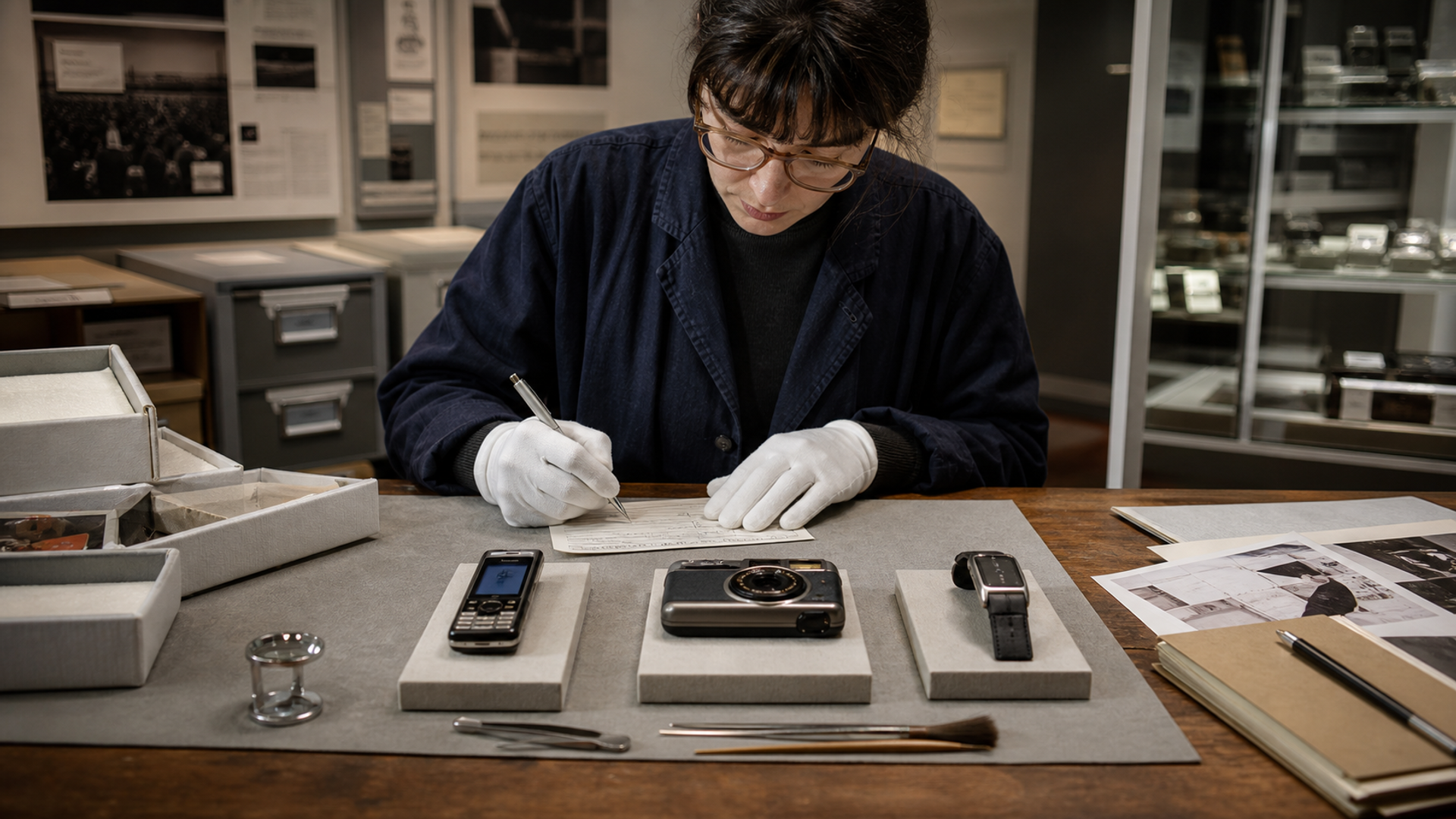
Original packaging helps establish completeness, yet the stronger record is a chain of identity: serial number, sales invoice, edition documentation, service receipts, correspondence and photographs of condition over time. Digital objects add another layer—original software media, manuals, compatible accessories and evidence of the last functioning configuration.
Collectors should preserve information without exposing personal data. Redact addresses and account credentials from copies, remove active SIM cards, sign out of services and document the reset. A device sold with the previous owner's private content is not better provenance; it is a security failure.
Serviceability creates cultural longevity
Battery chemistry ages even when an object is unused. Adhesives dry, displays deteriorate and proprietary cables disappear. Before acquiring a high-value device, ask who can open it, which parts are consumable and whether replacement destroys originality.
There is no universal answer to restoration. A replaced battery may be necessary to preserve function. Replacing a distinctive original display or case can erase historical evidence. Document every intervention and keep removed parts when safe. Conservation should be reversible where possible and honest where it is not.
Scarcity needs a reason
Numbered editions are easy to understand but easy to overvalue. Ask why production was limited. A technically difficult material, hand process, collaboration or experimental architecture carries more interpretive value than an arbitrary quantity attached to an ordinary object.
Market price is not proof of collectibility. Thin supply can create short spikes, while culturally important devices may remain inexpensive for years. Buy because the object completes a documented thesis—early mobile photography, physical interaction, luxury communications, wearable computing—not because a seller predicts appreciation.
Building a luxury-technology archive
Use an archive card for every acquisition:
| Field | Record |
|---|---|
| Identity | Maker, model, reference, serial and production date |
| Meaning | Why this object matters in one paragraph |
| Configuration | Software version, accessories and supported connections |
| Condition | Photographs and disclosed repairs |
| Dependencies | Account, app, cloud, battery and network requirements |
| Care | Storage charge, humidity, temperature and inspection schedule |
| Exit | How personal data will be removed before sale or transfer |
The archive card forces a collector to articulate value before nostalgia or scarcity does the work. It also gives a future conservator information that the object itself cannot reveal.
The lasting object
Collectible luxury technology sits between design history and systems archaeology. Its attraction is not that it defeats obsolescence; very little technology does. The attraction is that the object still explains something after obsolescence arrives—how people communicated, travelled, created, displayed status or imagined the future.
Choose objects with authorship, evidence and a plausible conservation path. Preserve their software context as carefully as their surfaces. The most enduring collection will not be the one with the highest original retail total, but the one whose objects can still tell a precise story when their screens no longer light.
A 30-day rule before acquisition
Do not buy a newly announced “collector's edition” on scarcity language alone. Save the product page, technical documentation and service terms, then wait 30 days where availability permits. During that period, write the object's historical thesis without using price, edition size or investment language. If the explanation still depends entirely on being difficult to obtain, the object is scarce but not yet culturally legible. If the design, technology or craft remains interesting without the sales story, it may deserve a place in the archive.
Compare the proposed object with an ordinary production version. Record exactly what differs: construction, designer, process, software, accessories and documentation. A colour change may be personally desirable, but it should not be promoted into technical significance. This distinction keeps the collection intellectually honest.