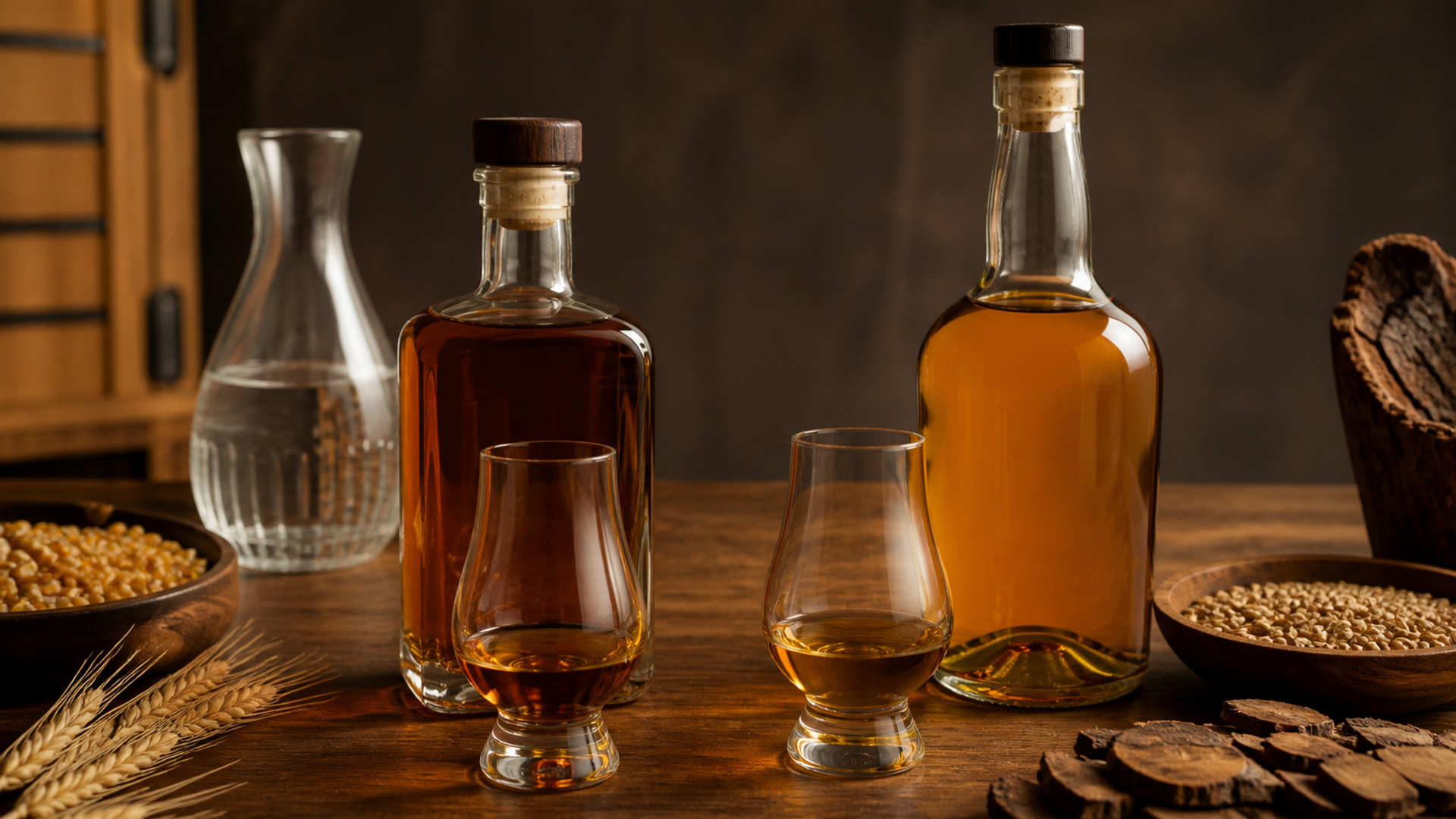
Bourbon versus Scotch compares two regulated whisky traditions with enormous diversity inside each. Bourbon is a US category whose mash must contain at least 51 per cent corn and whose production rules include new charred oak containers. Scotch whisky is made in Scotland under its own rules and includes single malt, single grain and blended categories. Region, grain, still, maturation, cask, age, strength and bottling shape the glass more than a national stereotype.
Start with production and flavour
Choose bourbon when sweet corn-led character, new-oak vanilla and spice fit the palate. Choose Scotch when its wider malt, grain, cask and regional styles better suit the occasion. Taste both by style when the goal is learning, because one bottle cannot represent either tradition.
| Decision factor | Bourbon | Scotch whisky | Taste both by style |
|---|---|---|---|
| Sweetness | New charred oak and corn-led styles appeal | Malt, grain and cask balance appeals | Compare blind |
| Smoke | UnsMoked bourbon profile is preferred | Peated Scotch is intentionally desired | Choose unpeated Scotch |
| Cask influence | Vanilla and char lead | Refill, bourbon or wine-cask nuance leads | Compare maturation styles |
| Strength | The bourbon proof suits the serve | The Scotch strength suits the serve | Add measured water |
| Food | Rich sweet-spice pairing fits | Malt, coastal or smoky pairing fits | Serve a flight |
| Value | Bottle provenance and proof justify price | Age, cask and producer justify price | Ignore prestige without evidence |
This bourbon vs scotch matrix is the article's working value object. Read the bourbon vs scotch rows together: the decisive failure mode depends on this topic's evidence, operating context and reader objective.
What the legal categories establish
Evidence 1. US TTB standards require bourbon whisky to be produced in the United States from a mash of at least 51 per cent corn and stored in new charred oak containers.
Evidence 2. The Scotch Whisky Association describes five Scotch categories, including single malt, single grain and three blended forms.
Evidence 3. Scotch must be produced and matured in Scotland under its governing rules, while category does not guarantee one flavour profile.
Evidence 4. Age statement, cask history, filtration, colouring rules, bottling strength and storage condition can materially change the experience.
Reader-visible sources checked for this article:
ttb.gov — reader-visible current or official evidence
scotch-whisky.org.uk — reader-visible current or official evidence
For bourbon vs scotch, these sources establish only the claims inside their documented scope. Recheck every changeable specification, availability condition, price, policy or service term in the relevant market before acting.
Taste without prestige shortcuts
A buyer can resolve sweetness without starting from a brand preference. Ask whether new charred oak and corn-led styles appeal; compare that with whether malt, grain and cask balance appeals; then use compare blind as the third route's safeguard. An unknown condition stays unknown.
On smoke, popularity is not enough. The evidence for option one is that unsMoked bourbon profile is preferred. Option two means peated Scotch is intentionally desired. Option three is rational where choose unpeated Scotch. Recheck any changeable term immediately before commitment.
The decision changes at cask influence. Choose the first path only if vanilla and char lead; move to the second when refill, bourbon or wine-cask nuance leads; use the third when compare maturation styles. Save the downside that would make this row fail.
For strength, the first route works when the bourbon proof suits the serve; the second requires the Scotch strength suits the serve. The control for the third is add measured water. Verify this row against the exact product, property, account or environment before it can reverse the decision.
The food row exposes a practical boundary. Route one assumes rich sweet-spice pairing fits, while route two is defensible only when malt, coastal or smoky pairing fits. Route three depends on serve a flight. If that evidence is absent, keep the more reversible option.
Read value as a stop/go test: bottle provenance and proof justify price supports the first option; age, cask and producer justify price supports the second; and ignore prestige without evidence supports the third. Record which source proves the condition and when it was checked.
Facts that would reverse the current choice
Reversal control 1 — Sweetness. Before choosing Bourbon, write down how the decision changes if “New charred oak and corn-led styles appeal” proves false. Do the same for Scotch whisky and “Malt, grain and cask balance appeals”. Keep the Taste both by style route available until “Compare blind” is verified. This control belongs to bourbon vs scotch; update it from the cited source or exact supplier rather than copying a generic checklist.
Reversal control 2 — Smoke. Before choosing Bourbon, write down how the decision changes if “UnsMoked bourbon profile is preferred” proves false. Do the same for Scotch whisky and “Peated Scotch is intentionally desired”. Keep the Taste both by style route available until “Choose unpeated Scotch” is verified. This control belongs to bourbon vs scotch; update it from the cited source or exact supplier rather than copying a generic checklist.
Reversal control 3 — Cask influence. Before choosing Bourbon, write down how the decision changes if “Vanilla and char lead” proves false. Do the same for Scotch whisky and “Refill, bourbon or wine-cask nuance leads”. Keep the Taste both by style route available until “Compare maturation styles” is verified. This control belongs to bourbon vs scotch; update it from the cited source or exact supplier rather than copying a generic checklist.
Reversal control 4 — Strength. Before choosing Bourbon, write down how the decision changes if “The bourbon proof suits the serve” proves false. Do the same for Scotch whisky and “The Scotch strength suits the serve”. Keep the Taste both by style route available until “Add measured water” is verified. This control belongs to bourbon vs scotch; update it from the cited source or exact supplier rather than copying a generic checklist.
Reversal control 5 — Food. Before choosing Bourbon, write down how the decision changes if “Rich sweet-spice pairing fits” proves false. Do the same for Scotch whisky and “Malt, coastal or smoky pairing fits”. Keep the Taste both by style route available until “Serve a flight” is verified. This control belongs to bourbon vs scotch; update it from the cited source or exact supplier rather than copying a generic checklist.
Reversal control 6 — Value. Before choosing Bourbon, write down how the decision changes if “Bottle provenance and proof justify price” proves false. Do the same for Scotch whisky and “Age, cask and producer justify price”. Keep the Taste both by style route available until “Ignore prestige without evidence” is verified. This control belongs to bourbon vs scotch; update it from the cited source or exact supplier rather than copying a generic checklist.
Read the label
Record category, producer, age statement, strength, batch and cask information. Separate regulated terms from evocative place or heritage language. Record the exact model, recipe, room, climate, material or operating condition and the time of the check. Separate observed behaviour from a marketing label, and repeat the test in the intended setting rather than under ideal showroom conditions. If the label cannot support a claim, do not add rarity or quality by imagination. Save the evidence that would reverse the choice, because a change in fit, specification, maintenance, service, price or environment must reopen the decision rather than inherit an old conclusion.
Build a fair flight
Use equal glasses, equal measures and similar strength where possible. Taste neat, then with measured water, recording aroma, palate, finish and alcohol integration. Record the exact model, recipe, room, climate, material or operating condition and the time of the check. Separate observed behaviour from a marketing label, and repeat the test in the intended setting rather than under ideal showroom conditions. If proof explains the preference, compare again after dilution rather than attributing it to country. Save the evidence that would reverse the choice, because a change in fit, specification, maintenance, service, price or environment must reopen the decision rather than inherit an old conclusion.
Map flavour not status
Use broad axes such as sweet, cereal, fruity, smoky, maritime, spicy and oaky. Select a contrasting bottle within the same category before concluding that the entire tradition fails. Record the exact model, recipe, room, climate, material or operating condition and the time of the check. Separate observed behaviour from a marketing label, and repeat the test in the intended setting rather than under ideal showroom conditions. If one cask finish dominates, the decision may be about maturation rather than bourbon or Scotch. Save the evidence that would reverse the choice, because a change in fit, specification, maintenance, service, price or environment must reopen the decision rather than inherit an old conclusion.
Plan service and provenance
Buy from a reputable channel and inspect seal, fill level, label and storage history. Count guests, pour size, food and transport, and provide water without pressuring consumption. Record the exact model, recipe, room, climate, material or operating condition and the time of the check. Separate observed behaviour from a marketing label, and repeat the test in the intended setting rather than under ideal showroom conditions. If provenance or condition is uncertain, a prestigious name should not overcome the risk. Save the evidence that would reverse the choice, because a change in fit, specification, maintenance, service, price or environment must reopen the decision rather than inherit an old conclusion.
Three pours, three answers
Dessert and after-dinner pour
A bourbon with balanced oak can suit sweet-spice flavours. Define the fact that would reverse this recommendation before committing.
Seafood or contemplative tasting
An unpeated or coastal Scotch may offer a different structure. Define the fact that would reverse this recommendation before committing.
Curious new drinker
A small blind flight prevents one bottle becoming a national verdict. Define the fact that would reverse this recommendation before committing.
Action checklist
Read category.
Check strength.
Note age.
Verify provenance.
Use equal glasses.
Measure pours.
Taste blind.
Add water carefully.
Match food.
Record style not status.
Continue the decision
The linked VERTU articles expand adjacent parts of the bourbon vs scotch decision. They do not substitute for the external evidence above.
The bourbon-versus-Scotch verdict
Choose bourbon when sweet corn-led character, new-oak vanilla and spice fit the palate. Choose Scotch when its wider malt, grain, cask and regional styles better suit the occasion. Taste both by style when the goal is learning, because one bottle cannot represent either tradition.
Keep the bourbon vs scotch decision reversible until its material cost, safety, access, privacy and compatibility facts are verified. Unknown evidence stays unknown; it is never silently scored as favourable.