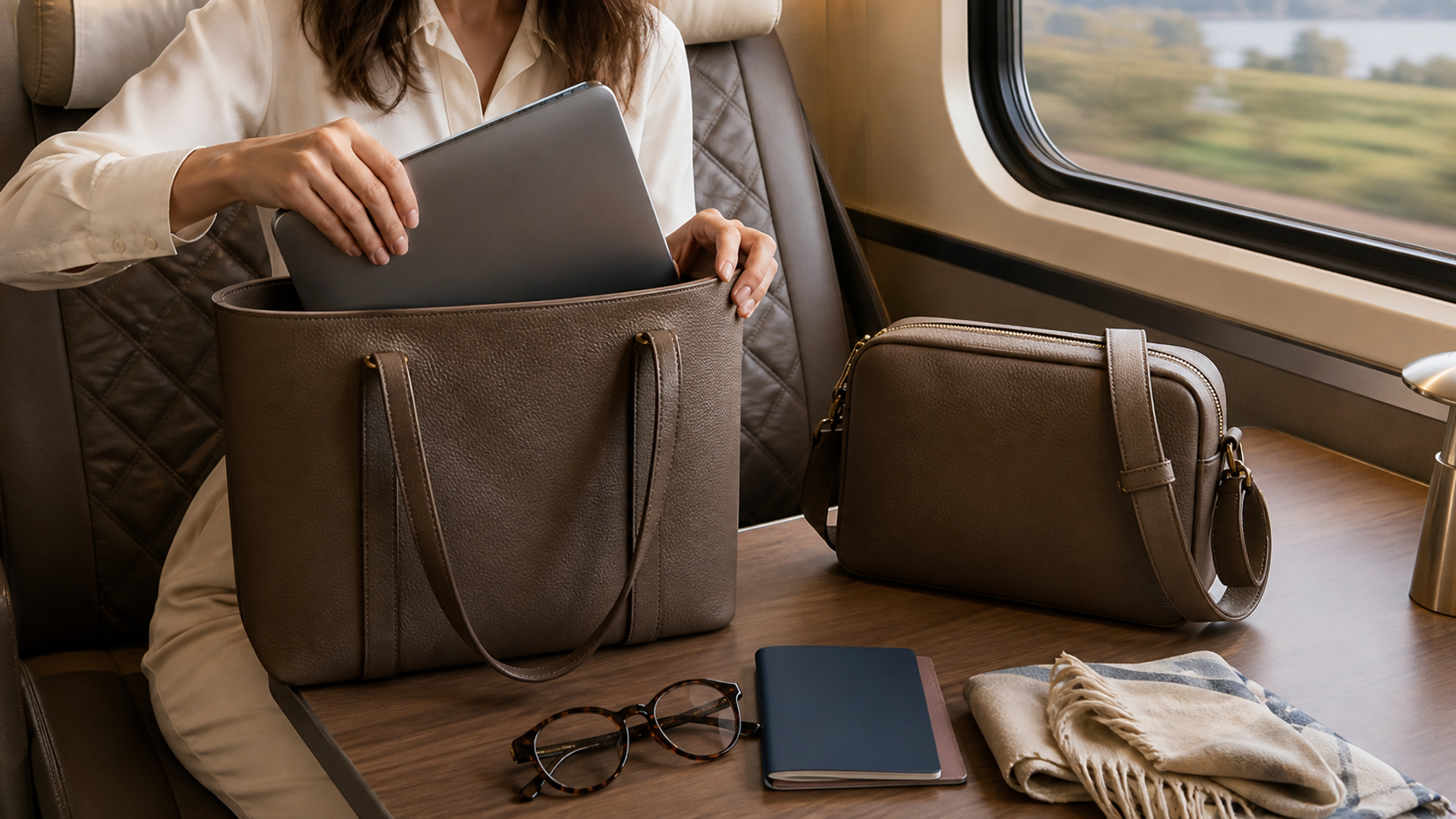
A tote and a shoulder bag organise movement differently. A tote usually offers a broad opening and space for laptop, layer and bottle; a shoulder bag can keep a smaller load closer and more controlled. The right choice depends on closure, load weight, access frequency, commute length, trolley use and whether the bag must move from transport to a meeting.
Pack the working day first
Choose a tote when laptop capacity and fast access lead, a shoulder bag when a smaller secured load and stable carry matter, or use both by itinerary. Pack the exact working load before buying because empty dimensions do not reveal shoulder strain, closure friction or usable organisation.
| Decision factor | Tote bag | Shoulder bag | Use different bags by itinerary |
|---|---|---|---|
| Working load | Laptop and documents need broad space | Essentials fit a controlled smaller volume | Match bag to each trip |
| Closure | Fast access is worth a wider opening | Zip or flap security leads | Keep valuables in a closed zone |
| Carry time | Short transfers suit handles or shoulder | Long walking needs stable close carry | Test for twenty minutes |
| Organisation | Pouches structure a large cavity | Built-in compartments suit the load | Avoid duplicate pockets |
| Travel | Trolley sleeve and upright shape help | Compact size stays on the body | Check airline personal-item size |
| Repair | Handles and base can be serviced | Strap anchors and closure can be serviced | Verify parts before purchase |
This tote bag vs shoulder bag matrix is the article's working value object. Read the tote bag vs shoulder bag rows together: the decisive failure mode depends on this topic's evidence, operating context and reader objective.
What bag evidence can establish
Evidence 1. Manufacturer dimensions describe the exterior, not the usable volume after pockets, structure and curved panels.
Evidence 2. A wide tote opening improves access but can expose contents unless a zip, central compartment or disciplined pouch system controls valuables.
Evidence 3. Shoulder comfort depends on empty weight, strap width, bag depth and the packed centre of gravity.
Evidence 4. Handles, strap anchors, zips, edge paint and base corners are high-stress areas whose repair route should be checked.
Reader-visible sources checked for this article:
tumi.com — reader-visible current or official evidence
briggs-riley.com — reader-visible current or official evidence
For tote bag vs shoulder bag, these sources establish only the claims inside their documented scope. Recheck every changeable specification, availability condition, price, policy or service term in the relevant market before acting.
Test access and carry comfort
For working load, the first route works when laptop and documents need broad space; the second requires essentials fit a controlled smaller volume. The control for the third is match bag to each trip. Verify this row against the exact product, property, account or environment before it can reverse the decision.
The closure row exposes a practical boundary. Route one assumes fast access is worth a wider opening, while route two is defensible only when zip or flap security leads. Route three depends on keep valuables in a closed zone. If that evidence is absent, keep the more reversible option.
Read carry time as a stop/go test: short transfers suit handles or shoulder supports the first option; long walking needs stable close carry supports the second; and test for twenty minutes supports the third. Record which source proves the condition and when it was checked.
A buyer can resolve organisation without starting from a brand preference. Ask whether pouches structure a large cavity; compare that with whether built-in compartments suit the load; then use avoid duplicate pockets as the third route's safeguard. An unknown condition stays unknown.
On travel, popularity is not enough. The evidence for option one is that trolley sleeve and upright shape help. Option two means compact size stays on the body. Option three is rational where check airline personal-item size. Recheck any changeable term immediately before commitment.
The decision changes at repair. Choose the first path only if handles and base can be serviced; move to the second when strap anchors and closure can be serviced; use the third when verify parts before purchase. Save the downside that would make this row fail.
Facts that would reverse the current choice
Reversal control 1 — Working load. Before choosing Tote bag, write down how the decision changes if “Laptop and documents need broad space” proves false. Do the same for Shoulder bag and “Essentials fit a controlled smaller volume”. Keep the Use different bags by itinerary route available until “Match bag to each trip” is verified. This control belongs to tote bag vs shoulder bag; update it from the cited source or exact supplier rather than copying a generic checklist.
Reversal control 2 — Closure. Before choosing Tote bag, write down how the decision changes if “Fast access is worth a wider opening” proves false. Do the same for Shoulder bag and “Zip or flap security leads”. Keep the Use different bags by itinerary route available until “Keep valuables in a closed zone” is verified. This control belongs to tote bag vs shoulder bag; update it from the cited source or exact supplier rather than copying a generic checklist.
Reversal control 3 — Carry time. Before choosing Tote bag, write down how the decision changes if “Short transfers suit handles or shoulder” proves false. Do the same for Shoulder bag and “Long walking needs stable close carry”. Keep the Use different bags by itinerary route available until “Test for twenty minutes” is verified. This control belongs to tote bag vs shoulder bag; update it from the cited source or exact supplier rather than copying a generic checklist.
Reversal control 4 — Organisation. Before choosing Tote bag, write down how the decision changes if “Pouches structure a large cavity” proves false. Do the same for Shoulder bag and “Built-in compartments suit the load”. Keep the Use different bags by itinerary route available until “Avoid duplicate pockets” is verified. This control belongs to tote bag vs shoulder bag; update it from the cited source or exact supplier rather than copying a generic checklist.
Reversal control 5 — Travel. Before choosing Tote bag, write down how the decision changes if “Trolley sleeve and upright shape help” proves false. Do the same for Shoulder bag and “Compact size stays on the body”. Keep the Use different bags by itinerary route available until “Check airline personal-item size” is verified. This control belongs to tote bag vs shoulder bag; update it from the cited source or exact supplier rather than copying a generic checklist.
Reversal control 6 — Repair. Before choosing Tote bag, write down how the decision changes if “Handles and base can be serviced” proves false. Do the same for Shoulder bag and “Strap anchors and closure can be serviced”. Keep the Use different bags by itinerary route available until “Verify parts before purchase” is verified. This control belongs to tote bag vs shoulder bag; update it from the cited source or exact supplier rather than copying a generic checklist.
Pack the real working day
Load the exact laptop, charger, bottle, glasses, wallet, notebook and layer. Close the bag and confirm that heavy items do not distort the base.
Walk before deciding
Carry the loaded bag for twenty minutes, climb stairs and sit on public transport. Note slipping, pressure, swing and whether a coat changes the fit.
Design the security routine
Choose where passport, phone and wallet stay. Practise paying and passing security without leaving the main opening exposed.
Treat repairability as luxury
Ask how handles, straps, zips and lining are repaired in the markets used. Keep proof of purchase and material-care instructions.
Three carry patterns
Laptop commute
A structured closed tote can win when the device and documents dominate the load. Define the fact that would reverse this recommendation before committing.
Long walking itinerary
A smaller shoulder bag can protect comfort when only essentials are carried. Define the fact that would reverse this recommendation before committing.
Mixed business travel
Using a tote on travel days and a shoulder bag at destination can avoid one compromised design. Define the fact that would reverse this recommendation before committing.
Action checklist
Pack the exact laptop.
Weigh the empty bag.
Test the closure.
Walk for twenty minutes.
Check strap width.
Inspect base structure.
Test trolley stability.
Plan valuable-item zones.
Confirm repair access.
Keep care instructions.
Continue the decision
The linked VERTU articles expand adjacent parts of the tote bag vs shoulder bag decision. They do not substitute for the external evidence above.
The tote-shoulder verdict
Choose a tote when laptop capacity and fast access lead, a shoulder bag when a smaller secured load and stable carry matter, or use both by itinerary. Pack the exact working load before buying because empty dimensions do not reveal shoulder strain, closure friction or usable organisation.
Keep the tote bag vs shoulder bag decision reversible until its material cost, safety, access, privacy and compatibility facts are verified. Unknown evidence stays unknown; it is never silently scored as favourable.