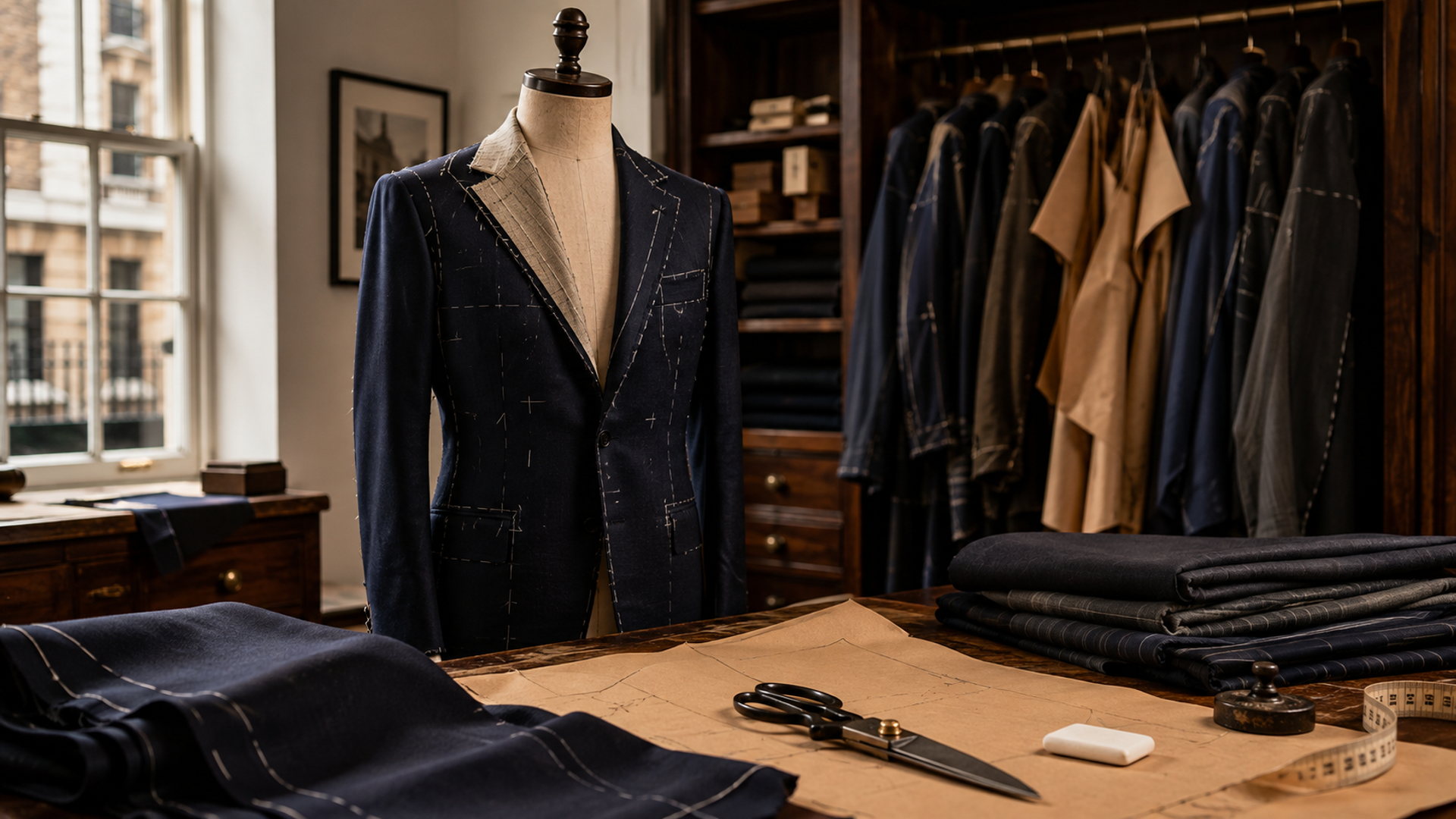
A Savile Row suit is not defined by a London postcode alone. The meaningful distinction is the process: who cuts the individual pattern, where the garment is made, how many fittings occur, which parts are shaped by hand and who remains responsible when the fit changes. Ready-to-wear, made-to-measure and bespoke can all produce good clothing, but they solve different problems and carry different time, alteration and price commitments. A buyer should therefore compare houses through process evidence and silhouette rather than fame. The suit must work while sitting, travelling and moving, not merely hold a clean pose in front of a fitting-room mirror.
Direct answer: suits savile row
Choose a house whose silhouette suits you and ask for the exact process in writing. Confirm individual pattern cutting, fitting schedule, make location, cloth allowance, alteration policy, delivery timing and what happens after weight or posture changes. Budget for travel and future maintenance as well as the commission price.
| Decision factor | Evidence to collect | Why it changes the answer | Control before purchase |
|---|---|---|---|
| Cut and silhouette | house examples show shoulder, chest, waist and trouser balance | a skilled process can still produce a style the client dislikes | try or inspect the house line before commissioning |
| Pattern method | cutter explains whether an individual paper pattern is created | made-to-measure adjustments are not identical to bespoke drafting | ask who owns and updates the pattern |
| Fittings | schedule names basted, forward and final stages as applicable | complex posture needs observation over time | keep the same cutter involved |
| Make and handwork | house states workshop location and construction choices | labels do not reveal who performed the work | request process detail without fetishising stitch counts |
| Cloth | bunch, weight and fibre are matched to climate and use | delicate cloth can shorten practical life | choose resilience for the actual wardrobe |
| Aftercare | alteration and repair route is documented | a suit is a maintained object | retain spare cloth and fitting records |
This matrix is the article-specific value object for suits savile row. It prevents a famous name, a single specification or one price from silently becoming the recommendation.
Current evidence baseline
Evidence 1. The Savile Row Bespoke Association sets membership standards relating to individual cutting and the bespoke making process. Source.
Evidence 2. The UK Intellectual Property Office recognises Savile Row as a geographically and commercially significant tailoring designation. Source.
Evidence 3. The Woolmark Company publishes fibre and garment-care guidance relevant to wool suiting. Source.
Evidence 4. UK consumer law requires services to be performed with reasonable care and skill. Source.
For suits savile row, these sources support only the claims directly attached above. They do not establish permanent availability, universal authenticity, future appreciation or suitability for every owner.
How the decision factors change the result
Cut and silhouette. Collect evidence showing that house examples show shoulder, chest, waist and trouser balance. This changes the decision because a skilled process can still produce a style the client dislikes. The practical control is to try or inspect the house line before commissioning. Record the exact object, date, source and assumption that would reverse the conclusion. If the evidence remains unavailable, mark this factor unknown rather than converting uncertainty into a favourable score.
Pattern method. Collect evidence showing that cutter explains whether an individual paper pattern is created. This changes the decision because made-to-measure adjustments are not identical to bespoke drafting. The practical control is to ask who owns and updates the pattern. Record the exact object, date, source and assumption that would reverse the conclusion. If the evidence remains unavailable, mark this factor unknown rather than converting uncertainty into a favourable score.
Fittings. Collect evidence showing that schedule names basted, forward and final stages as applicable. This changes the decision because complex posture needs observation over time. The practical control is to keep the same cutter involved. Record the exact object, date, source and assumption that would reverse the conclusion. If the evidence remains unavailable, mark this factor unknown rather than converting uncertainty into a favourable score.
Make and handwork. Collect evidence showing that house states workshop location and construction choices. This changes the decision because labels do not reveal who performed the work. The practical control is to request process detail without fetishising stitch counts. Record the exact object, date, source and assumption that would reverse the conclusion. If the evidence remains unavailable, mark this factor unknown rather than converting uncertainty into a favourable score.
Cloth. Collect evidence showing that bunch, weight and fibre are matched to climate and use. This changes the decision because delicate cloth can shorten practical life. The practical control is to choose resilience for the actual wardrobe. Record the exact object, date, source and assumption that would reverse the conclusion. If the evidence remains unavailable, mark this factor unknown rather than converting uncertainty into a favourable score.
Aftercare. Collect evidence showing that alteration and repair route is documented. This changes the decision because a suit is a maintained object. The practical control is to retain spare cloth and fitting records. Record the exact object, date, source and assumption that would reverse the conclusion. If the evidence remains unavailable, mark this factor unknown rather than converting uncertainty into a favourable score.
Worked decision scenario
Commission the same navy business suit on paper from three houses. Specify use, climate, travel frequency, silhouette, cloth weight, pockets and delivery deadline. Record commission price, VAT, number of London visits, travel cost, expected fittings, alteration policy and lead time. Add a five-year maintenance allowance and divide by realistic wears. The result makes a distant lower quote comparable with a local house that includes easier aftercare.
Begin with house style
Some cutters favour a structured shoulder and defined chest; others make a softer, lighter coat. Trousers also differ in rise, fullness and line. Bring photographs of clothing that feels right, but allow the cutter to explain whether that language works for your posture. A commission should be a conversation between house style and client, not a request to reproduce a celebrity image on a different body.
Bespoke is a sequence of decisions
The first order usually takes longer because the pattern, balance and preferences are being established. At fittings, wear the shoes, shirt and usual accessories. Sit, walk, reach and use the pockets. Discuss sleeve pitch, collar contact, trouser break and comfort without prescribing technical fixes too quickly. The cutter needs to observe the whole garment. Photographs from front, side and back create a useful record between visits.
Cloth should serve the calendar
Very fine cloth can feel seductive in a swatch while proving fragile under flights, desk work and frequent cleaning. Discuss fibre, weave, weight, recovery and season. A heavier high-twist wool may travel better than a delicate luxury blend. Pattern matching and extra cloth can affect cost. Ask for spare cloth where practical, because future repair or body changes are easier when the original material remains available.
Budget the relationship, not one suit
A successful first commission creates a pattern that can evolve. Future orders may be more efficient, yet style, body and workshop conditions still change. Include the cost of London visits, shirts, shoes, pressing, cleaning and alterations in the ownership budget. Do not order several suits before wearing the first one through real work. One season of feedback is more valuable than a wardrobe built on an untested fitting-room impression.
Judge luxury by correction and aftercare
Small imperfections are normal in a hand-shaped process; the important signal is how the house diagnoses and corrects them. Agree when the suit will be considered complete and how remote clients handle later adjustments. Store it on a supportive hanger, brush it and allow it to rest between wears. Dry-clean only when necessary. Long life comes from cloth choice, rotation, maintenance and a house willing to keep the garment working.
Evidence checklist
[ ] Compare house silhouettes
[ ] Confirm individual pattern process
[ ] Plan every fitting visit
[ ] Choose cloth for real use
[ ] Record make location
[ ] Agree alteration policy
[ ] Keep spare cloth
[ ] Test first suit before reordering
For the suits savile row decision, unchecked fields remain unknown and should not be converted into favourable assumptions merely to complete a purchase.
Reader-visible sources and method
The external pages above were checked for this suits savile row analysis. Price, availability, service, tax, regulation and platform terms must be reconfirmed for the buyer's market and date. Ranking pages informed a separate SERP benchmark; their wording and paragraph order were not copied.
Continue with adjacent VERTU editorial research
For suits savile row, these links provide adjacent premium-lifestyle and decision context; they do not replace specialist or official evidence for the exact decision.
Final judgement
Choose a house whose silhouette suits you and ask for the exact process in writing. Confirm individual pattern cutting, fitting schedule, make location, cloth allowance, alteration policy, delivery timing and what happens after weight or posture changes. Budget for travel and future maintenance as well as the commission price.
The useful standard for suits savile row is not certainty created by confident language. It is a decision whose evidence, downside and next review point are visible to the reader.