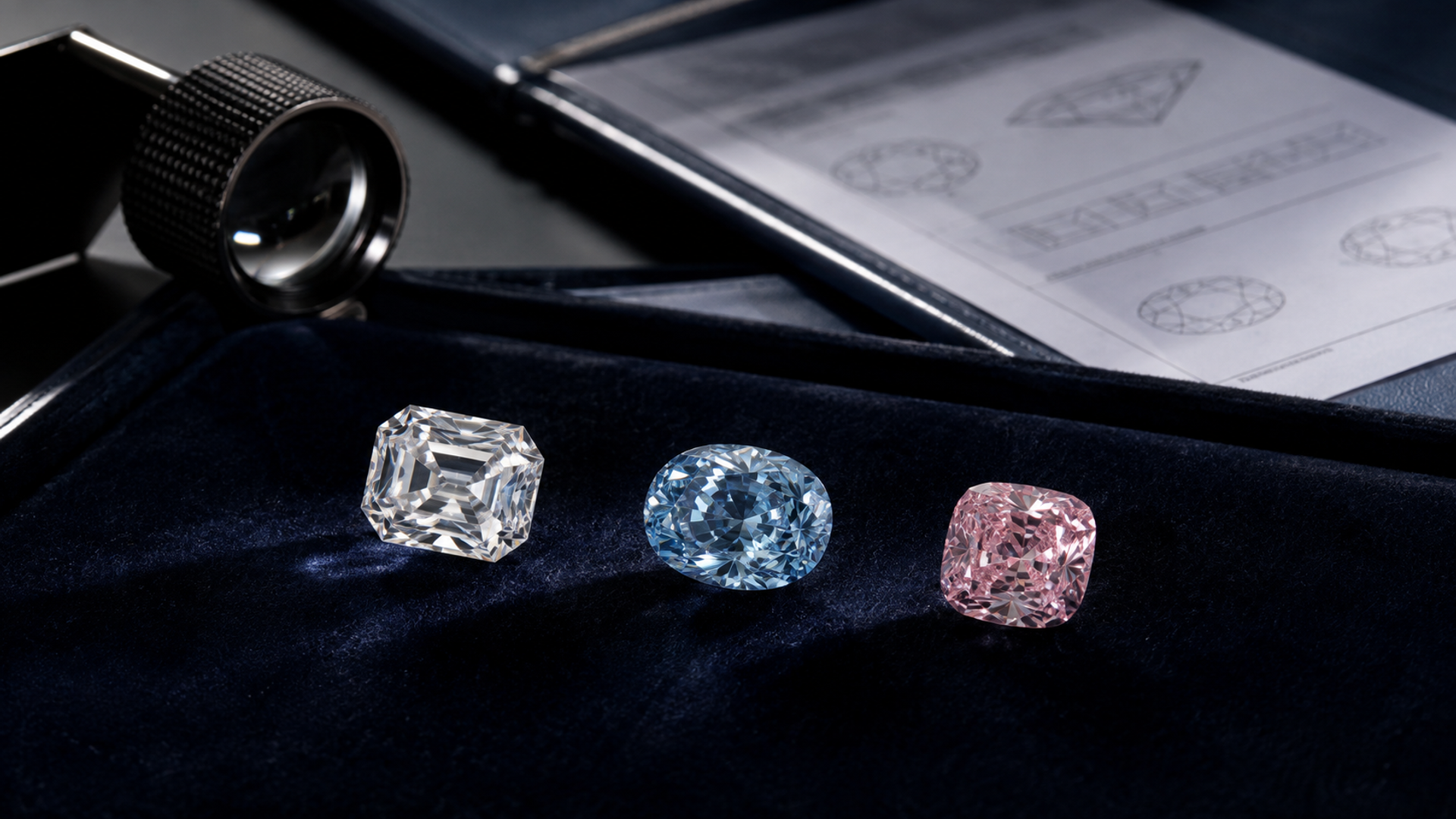
The world’s most expensive diamonds are often presented as a league table, but their prices do not form a universal rate card. A record can be driven by extraordinary size, saturated fancy colour, high clarity, historic provenance, a famous sale and competition between a very small number of buyers. Some stones later return to market under different conditions; others are privately placed and never tested again. The useful lesson is not that every large diamond is an investment. It is how multiple rarity dimensions and auction mechanics combine in one exceptional object.
Direct answer
Read record prices as object-specific outcomes. Verify the laboratory report, treatment and dimensions, distinguish colour rarity from carat weight, examine provenance and compare price per carat only among genuinely similar stones. Include buyer’s premium and currency when comparing auction totals.
The evidence-first decision matrix
| Decision factor | Evidence to collect | Why it changes the answer | Control |
|---|---|---|---|
| Colour | use laboratory hue, tone and saturation wording | fancy colour rarity is nonlinear | compare within the same colour grade |
| Size | record weight and face-up dimensions | large rough and cutting yield drive scarcity | avoid using carats alone |
| Clarity | read inclusions alongside transparency and appearance | clarity premiums vary by colour category | inspect the actual stone |
| Provenance | verify documented ownership and sale history | history can create a separate cultural premium | separate narrative from gem quality |
| Auction mechanics | include buyer premium, currency and bidder depth | hammer price is not total consideration | normalise sale terms |
| Liquidity | review repeat sales and time between them | record objects have very few comparables | avoid universal appreciation claims |
This matrix is the article-specific value object for costliest diamond in the world. It makes the reader’s trade-offs visible and prevents one price, one specification or one prestige cue from becoming the entire recommendation.
Current evidence baseline
Evidence 1. GIA explains the grading of natural fancy-colour diamonds and the importance of hue, tone and saturation. Source.
Evidence 2. GIA explains natural fancy-colour diamond grading and disclosure. Source.
Evidence 3. Christie’s jewellery department publishes catalogues and results for major diamond auctions, including sale-specific premiums and descriptions. Source.
Evidence 4. Sotheby’s jewellery department publishes auction catalogues and results for important diamonds and historic jewels. Source.
For costliest diamond in the world, these sources support only the claims attached to them. They do not prove permanent availability or universal authenticity for this specific decision. Its product specifications, prices, policies and service terms must be reconfirmed for the exact market and date.
How each factor changes the result
Colour
Collect evidence that use laboratory hue, tone and saturation wording. For costliest diamond in the world, this factor changes the answer because fancy colour rarity is nonlinear. The minimum colour control for this shortlist is to compare within the same colour grade. Record the exact costliest diamond in the world object, market, date and assumption. If colour evidence is missing, keep that field unknown instead of awarding a favourable conclusion. Compare colour across every shortlisted costliest diamond in the world option; otherwise a persuasive photograph or famous name can silently change the standard halfway through the decision.
Size
Collect evidence that record weight and face-up dimensions. For costliest diamond in the world, this factor changes the answer because large rough and cutting yield drive scarcity. The minimum size control for this shortlist is to avoid using carats alone. Record the exact costliest diamond in the world object, market, date and assumption. If size evidence is missing, keep that field unknown instead of awarding a favourable conclusion. Compare size across every shortlisted costliest diamond in the world option; otherwise a persuasive photograph or famous name can silently change the standard halfway through the decision.
Clarity
Collect evidence that read inclusions alongside transparency and appearance. For costliest diamond in the world, this factor changes the answer because clarity premiums vary by colour category. The minimum clarity control for this shortlist is to inspect the actual stone. Record the exact costliest diamond in the world object, market, date and assumption. If clarity evidence is missing, keep that field unknown instead of awarding a favourable conclusion. Compare clarity across every shortlisted costliest diamond in the world option; otherwise a persuasive photograph or famous name can silently change the standard halfway through the decision.
Provenance
Collect evidence that verify documented ownership and sale history. For costliest diamond in the world, this factor changes the answer because history can create a separate cultural premium. The minimum provenance control for this shortlist is to separate narrative from gem quality. Record the exact costliest diamond in the world object, market, date and assumption. If provenance evidence is missing, keep that field unknown instead of awarding a favourable conclusion. Compare provenance across every shortlisted costliest diamond in the world option; otherwise a persuasive photograph or famous name can silently change the standard halfway through the decision.
Auction mechanics
Collect evidence that include buyer premium, currency and bidder depth. For costliest diamond in the world, this factor changes the answer because hammer price is not total consideration. The minimum auction mechanics control for this shortlist is to normalise sale terms. Record the exact costliest diamond in the world object, market, date and assumption. If auction mechanics evidence is missing, keep that field unknown instead of awarding a favourable conclusion. Compare auction mechanics across every shortlisted costliest diamond in the world option; otherwise a persuasive photograph or famous name can silently change the standard halfway through the decision.
Liquidity
Collect evidence that review repeat sales and time between them. For costliest diamond in the world, this factor changes the answer because record objects have very few comparables. The minimum liquidity control for this shortlist is to avoid universal appreciation claims. Record the exact costliest diamond in the world object, market, date and assumption. If liquidity evidence is missing, keep that field unknown instead of awarding a favourable conclusion. Compare liquidity across every shortlisted costliest diamond in the world option; otherwise a persuasive photograph or famous name can silently change the standard halfway through the decision.
Worked comparison
Take three widely reported record diamonds: one colourless, one blue and one pink. Record report issuer, carat, colour grade, clarity, dimensions, provenance, hammer price, buyer premium, currency and sale date. Calculate price per carat but do not rank across colour categories without qualification. The exercise shows how a headline total and gemological rarity answer different questions.
For costliest diamond in the world, run a second comparison with the most optimistic assumption removed, then a third with the largest downside cost added. A costliest diamond in the world recommendation that survives all three scenarios is more useful than one built from a single ideal case. If its ranking changes, state the decisive assumption plainly.
Colour can dominate size
Fancy blue, pink, red and other colours are graded differently from colourless diamonds. Saturation and distribution can outweigh a simple weight comparison. Two stones described by casual observers as pink may occupy different laboratory categories and price universes. Always use the report wording and inspect whether the colour appears evenly across the face-up stone.
For costliest diamond in the world, apply this point to the exact reference, seller and market rather than to the category in general. Keep colour can dominate size photographs, written representations and the date of observation so that a later service, return or resale decision can reconstruct what was known.
Cutting is an irreversible rarity decision
Large rough presents a trade-off between preserving weight, improving colour and achieving attractive proportions. Fancy-colour cutters may use shapes that concentrate colour rather than pursue a standard colourless-diamond ideal. Compare dimensions, brightness, windowing and colour distribution. Price per carat can mislead when one stone presents much larger or more vividly.
For costliest diamond in the world, apply this point to the exact reference, seller and market rather than to the category in general. Keep cutting is an irreversible rarity decision photographs, written representations and the date of observation so that a later service, return or resale decision can reconstruct what was known.
Provenance creates a second asset
Royal, aristocratic, celebrity or museum history can add value independent of gem quality. Provenance should be documented through archives, catalogues and ownership records. A romantic name is not enough. When comparing records, separate the stone’s gemological attributes from the cultural premium that may not transfer to an unrelated diamond.
For costliest diamond in the world, apply this point to the exact reference, seller and market rather than to the category in general. Keep provenance creates a second asset photographs, written representations and the date of observation so that a later service, return or resale decision can reconstruct what was known.
Auction totals require normalisation
Published figures may quote hammer price, price with buyer’s premium or converted currency. Exchange rates and auction terms differ by date and location. Record the exact basis before comparing. A private sale may disclose only an estimate or reported figure, which is weaker evidence than a public result with terms.
For costliest diamond in the world, apply this point to the exact reference, seller and market rather than to the category in general. Keep auction totals require normalisation photographs, written representations and the date of observation so that a later service, return or resale decision can reconstruct what was known.
Records do not guarantee repeat performance
The next sale depends on timing, buyer concentration, condition, reporting and the object’s continued cultural relevance. Transaction costs are substantial and the buyer universe is small. Treat ownership as consumption and stewardship first. Any resale scenario should be separate, uncertain and net of fees, tax, insurance and long holding periods.
For costliest diamond in the world, apply this point to the exact reference, seller and market rather than to the category in general. Keep records do not guarantee repeat performance photographs, written representations and the date of observation so that a later service, return or resale decision can reconstruct what was known.
Buyer’s evidence checklist
[ ] Verify the laboratory report
[ ] Record dimensions as well as carats
[ ] Compare within colour categories
[ ] Document provenance
[ ] Normalise hammer and premium
[ ] Use sale-date currency
[ ] Check repeat transactions
[ ] Exclude appreciation from the base case
Unchecked costliest diamond in the world fields remain unknown. Do not convert them into favourable assumptions simply to finish this purchase or produce a confident ranking.
Sources and method
gia.edu — GIA explains the grading of natural fancy-colour diamonds and the importance of hue, tone and saturation.
gia.edu — GIA explains natural fancy-colour diamond grading and disclosure.
christies.com — Christie’s jewellery department publishes catalogues and results for major diamond auctions, including sale-specific premiums and descriptions.
sothebys.com — Sotheby’s jewellery department publishes auction catalogues and results for important diamonds and historic jewels.
The external pages above were checked specifically for costliest diamond in the world. Its ranking pages informed a separate SERP benchmark, but their wording, paragraph order and distinctive framing were not copied. This article adds a query-specific matrix, worked comparison and downside controls.
Continue with adjacent research
These internal links add adjacent ownership context to costliest diamond in the world. They do not replace the specialist inspection, laboratory evidence, official specification or seller terms required by this particular decision.
Final judgement
Read record prices as object-specific outcomes. Verify the laboratory report, treatment and dimensions, distinguish colour rarity from carat weight, examine provenance and compare price per carat only among genuinely similar stones. Include buyer’s premium and currency when comparing auction totals.
For costliest diamond in the world, the useful standard is not certainty created by confident language. It is a decision whose evidence, downside and next verification step remain visible to the reader.


![Top 10 Luxury Watches for a Dubai Desert Resort Escape [New]](https://cdn.sanity.io/images/e0gp1l2g/production/8b5e5b21db42a1c5f040e828bd041857353a8eb2-2560x1382.webp?w=800&h=450&q=82&auto=format&fit=crop)