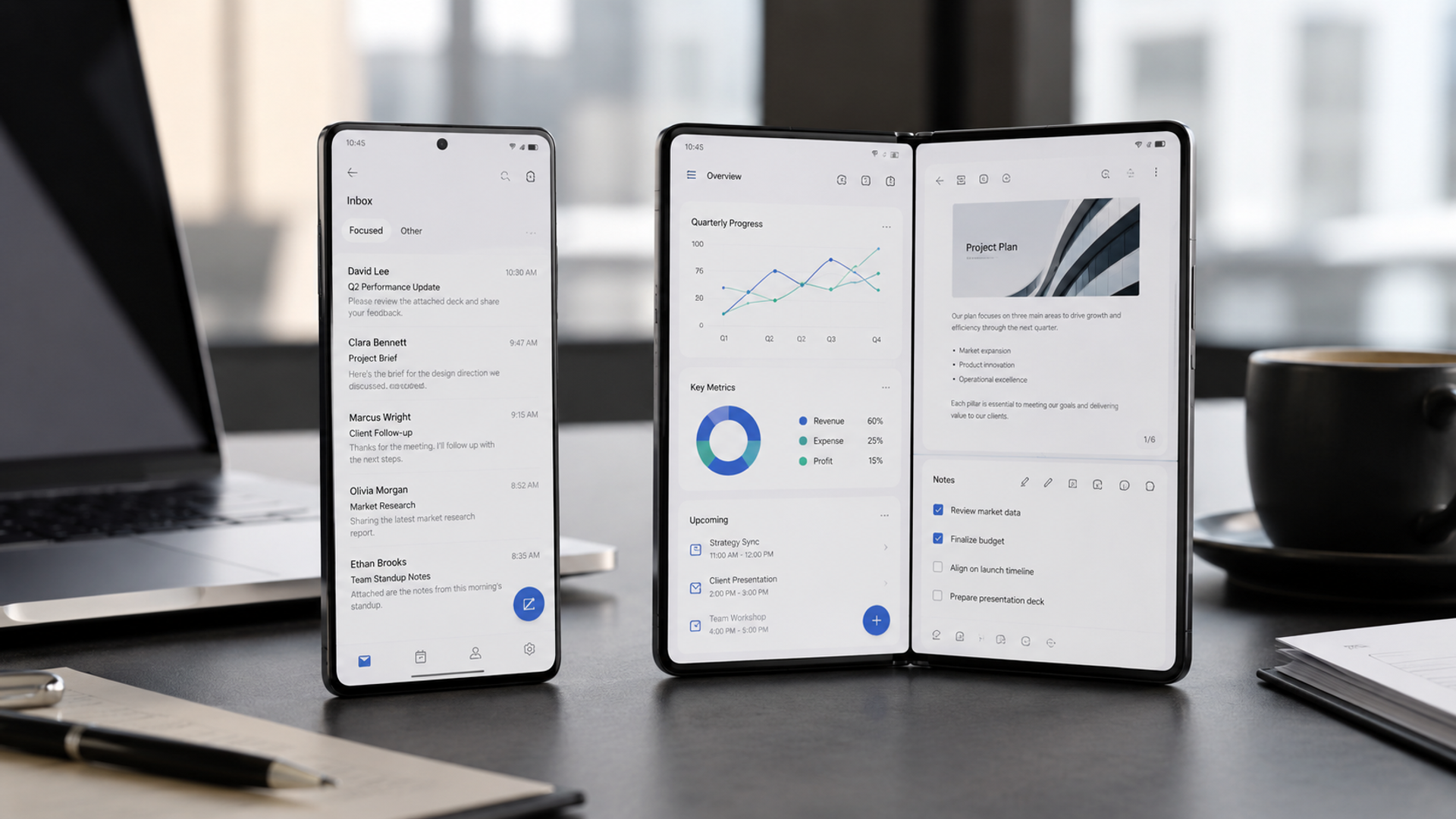
| Form Factor | Workflow Experience | Business Suitability |
|---|---|---|
| Standard Straight Screen | Good for passive tracking, but becomes cramped during active text execution. | Standard business operations and communication. |
| Large-Screen Foldable | Expands workspace dynamically, acting as a true pocket workstation. | High-stakes multitasking and deep data management. |
In the fast-paced landscape of modern enterprise, the definition of the "mobile office" has undergone a radical transformation. Corporate executives, founders, and high-level professionals are no longer willing to be anchored to heavy laptops during transit, nor are they satisfied with the passive consumption limits of standard handheld devices. To manage global supply chains, approve high-stakes mergers, and review live financial performance on the move, elite users require absolute visual leverage. This operational shift has triggered a massive demand for maximized display real estate, leaving decision-makers with a critical question: when evaluating premium mobile hardware, which form factor truly drives executive efficiency—traditional large-screen phones or the next-generation large-screen foldable?
Why Executives Prefer Large-Screen Mobile Phones
For a modern CEO or managing director, a smartphone is not a casual lifestyle accessory; it is the central command node of a multi-million dollar business. The historical preference for compact, one-handed devices has completely dissolved under the weight of modern data demands. Today's business leaders operate within continuous streams of information, including live market tickers, proprietary enterprise dashboards, and thousands of monthly high-priority communications.
The underlying motivation behind the surging popularity of large-screen mobile phones in corporate circles is simple: cognitive efficiency. A larger canvas directly reduces visual fatigue, minimizes navigation errors, and allows the human brain to process complex layouts faster. However, as business software becomes more complex, traditional straight-screen smartphones are hitting a physical ceiling. While they offer excellent performance, their static dimensions force a compromise between pocketability and actual working space. This is precisely why the business world is currently divided over whether to stick with a time-tested large-screen mobile phone or transition to an expansive large-screen foldable.
Large-Screen Straight Phones vs. Large-Screen Foldables for Executive Productivity
To determine which form factor delivers authentic corporate leverage, we must evaluate them not through abstract hardware benchmarks, but through the lens of concrete, high-stress corporate routines.
Scenario A: Financial Dashboards, Spreadsheets, and Data Analytics
The ability to make data-driven decisions on the fly is a core requirement for any corporate leader.
- Traditional Large-Screen Phones: When viewing massive financial spreadsheets, quarterly budget models, or cross-departmental Gantt charts, a standard large-screen phone forces the user into a constant state of horizontal scrolling and pinch-to-zoom. Text becomes microscopic, and context is easily lost when columns slide off-screen.
- Large-Screen Foldable Devices: Unfolding a premium large-screen foldable completely alters the data environment. By expanding into a tablet-like aspect ratio, it allows an executive to view comprehensive Excel grids, operational funnels, and real-time Key Performance Indicators (KPIs) simultaneously. Data cells remain legible, and the broader visual horizon allows for immediate pattern recognition without desktop scaling artifacts.
Scenario B: Virtual Boardrooms and Video Conferencing on the Move
Modern executive schedules are rarely linear, often requiring attendance at critical virtual board meetings while in transit.
- Traditional Large-Screen Phones: Attending a Microsoft Teams or Zoom call on a standard straight screen requires either a separate physical prop or balancing the phone precariously against a coffee cup. Furthermore, once a participant shares a presentation deck or a financial slide, the video feeds of board members are compressed into tiny, unrecognizable fragments at the edge of the screen, ruining non-verbal engagement.
- Large-Screen Foldable Devices: Foldables redefine mobile conferencing through structural adaptability. Using their self-standing hinge mechanism, these devices act as their own tripods on any flat surface. More importantly, their massive internal screen estate enables true split-screen multitasking. An executive can maintain a crystal-clear, top-half video feed of the boardroom while simultaneously utilizing the bottom half of the screen to cross-reference the meeting agenda or review the contract under discussion.
Scenario C: High-Volume Email Management and Document Editing
Corporate communication requires rapid, precise inputs, whether approving a global press release or drafting an urgent directive to regional managers.
- Traditional Large-Screen Phones: On a standard straight screen, activating the virtual keyboard instantly consumes up to 50% of the viewable screen real estate. This leaves a highly restricted window to read the actual email thread or document text you are replying to, forcing constant backtracking.
- Large-Screen Foldable Devices: The expansive interior width of a large-screen foldable accommodates a spacious, split-keyboard layout that mimics a physical typing experience. This layout permits rapid, two-handed thumb typing without accidental inputs. Users can run side-by-side app pairings—such as keeping an active Outlook thread open on the left panel while dragging and dropping PDF attachments or editing a corporate statement on the right panel.
Scenario D: Executive Travel and The "Laptop-Free" Transit
The ultimate test of a business smartphone occurs within the chaotic environment of international travel, from airport terminals to long-haul flights.
- Traditional Large-Screen Phones: Traditional flagships are incredibly durable and highly portable, but they remain structurally rigid. When an unexpected operational crisis hits during airport transfers, a straight-screen device lacks the interface depth to execute complex file reconfigurations, often forcing the executive to stop, unpack, and boot up a traditional laptop.
- Large-Screen Foldable Devices: A premium foldable functions as the ultimate "laptop killer" for light travel. It offers an instantaneous, dual-state utility: while walking through a security line, the device remains closed, operating with the swift efficiency of standard large-screen mobile phones. The moment the executive settles into their airline seat, the device opens into an expansive workspace capable of executing deep focus work, slide adjustments, and system overrides without needing a fold-out tray table.
Top Picks for Premium Large-Screen Mobile Phones and Mainstream Foldables
For professionals seeking to upgrade their corporate hardware, the current market presents distinct paths within both engineering categories.
The Traditional Flagship Giants
For users who prefer a classic, unyielding form factor, the market is led by ultra-premium traditional smartphones. Devices like the iPhone 16 Pro Max and the Samsung Galaxy S26 Ultra represent the absolute pinnacle of static mobile design. They offer blistering processor speeds, exceptional brightness for outdoor readability, and rock-solid software ecosystems. They are highly reliable communication tools, but their physical boundaries are unalterable; their screens cannot grow when your workload does.
The Mainstream Large-Screen Foldable Pioneers
Professionals looking to cross the threshold into expandable displays typically gravitate toward mass-market book-style foldables. The Samsung Galaxy Z Fold series and the Google Pixel Fold series have successfully proven the commercial viability of folding glass. These devices provide consumers with highly capable multitasking interfaces, thin folding profiles, and smooth app continuity when transitioning from the outer display to the inner canvas.
While these mainstream options offer excellent screen expansion, demanding executives who require an even more intelligent, workplace-optimized companion that truly understands their elite security and efficiency needs will find their ultimate match in a category of its own. That’s where VERTU ALPHAFOLD comes in.
Why VERTU ALPHAFOLD is the Ultimate Large-Screen Foldable Workstation for Professionals
When standard commercial devices fail to satisfy the combined operational and security demands of elite enterprise leaders, the VERTU ALPHAFOLD emerges as the definitive solution. This device is engineered specifically to serve as a high-powered, ultra-secure mobile command center that bridges the gap between peak computing utility and executive prestige.
VERTU ALPHAFOLD Workplace Capabilities
| Feature Category | Hardware & Software Integration | Professional Benefit |
|---|---|---|
| Display Architecture | 6.53-Inch Cover Screen + 8.05-Inch Internal Screen | Seamless transition from swift, one-handed mobile updates to a comprehensive desktop-sized visual canvas. |
| Enterprise Synergy | Native ERP Integration & Split-Screen Optimization | Renders heavy platforms (SAP, Salesforce) flawlessly without mobile formatting errors; facilitates side-by-side app pairing. |
| Elite Intelligence | Advanced On-Device Agentic AI System | Autonomously manages data calls, file structuring, and scheduling locally, eliminating external cloud vulnerabilities. |
| Data Protection | Ironclad Hardware-Level Encryption | Isolates sensitive corporate assets and communications within a secure, breach-proof private environment. |
The Perfect Dual-Screen Dimension
The architectural mastery of the VERTU ALPHAFOLD lies in its lack of physical compromise. When closed, it features a beautifully balanced 6.53-inch external cover screen. Unlike older, narrow foldable designs that feel awkward to type on, this cover screen matches the precise ergonomic feel and width of premium traditional large-screen phones, making it ideal for swift, one-handed operations on the move.
The moment deep analytical work is required, it unfolds seamlessly to reveal a breathtaking 8.05-inch internal screen. This massive folding canvas completely bypasses the limitations of traditional smartphones, presenting a true tablet-sized workspace that handles demanding enterprise media with absolute ease.
Native Enterprise ERP Integration and Split-Screen Multi-Tasking
Where the VERTU ALPHAFOLD truly distances itself from mass-market devices is its deep synergy with corporate infrastructure. Standard mobile devices often struggle with desktop-grade software, rendering corporate networks into broken, unreadable mobile layouts.
The 8.05-inch internal display of the ALPHAFOLD natively accommodates heavy Enterprise Resource Planning (ERP systems) such as SAP, Salesforce, and bespoke corporate intranets. Executives can review real-time supply chain logs, authorize massive financial disbursements, and manage corporate resource pipelines without interface glitches or rendering errors. Combined with its advanced split-screen multi-tasking software, users can run their ERP core on one side of the display while maintaining a secure communication channel on the other.
Advanced On-Device Intelligence and Elite Privacy Protocols
For a corporate leader, data security is paramount; a single corporate data breach can result in severe financial and reputational damage. The VERTU ALPHAFOLD is built from the ground up to protect high-stakes executive affairs:
- On-Device Privacy Protection: Sensitive corporate memos, financial records, and personal communications are isolated within an advanced, hardware-encrypted secure data environment, completely shielded from external software vulnerabilities.
- Autonomous Agentic AI Integration: Moving far beyond basic generative chatbots that merely spit out generic text, the ALPHAFOLD incorporates advanced agentic AI systems. This intelligent engine can autonomously call data, manage complex scheduling, and organize local files safely on-device, processing high-level executive requests without exposing sensitive corporate assets to external cloud networks.
Secure Enterprise Communications: Encrypted communication channels ensure that proprietary strategies, board conversations, and operational directives remain strictly confidential.
Conclusion
While traditional premium large-screen mobile phones remain reliable, highly optimized devices for everyday consumer habits, they are fundamentally limited by their rigid geometry. They function exceptionally well as passive windows to information, but they cannot adapt to the multitasking demands of a modern enterprise leader.
For the modern executive, entrepreneur, and C-suite visionary, choosing a large-screen foldable is no longer a matter of tech novelty—it is a calculated investment in operational speed. The ability to seamlessly transition from a standard handheld footprint to an immersive workstation gives leaders a distinct competitive edge.