| Feature | Flip Phone (Clamshell) | Book-Style Phone |
|---|---|---|
| Design Philosophy | Making a large phone compact | Making a normal phone a tablet |
| Primary Hinge | Horizontal (Folds top-to-bottom) | Vertical (Opens left-to-right) |
| Core Target | Lifestyle, fashion, portability | Productivity, business, media |
| Multitasking | Limited (Focus on single tasks) | Advanced (3+ apps simultaneously) |
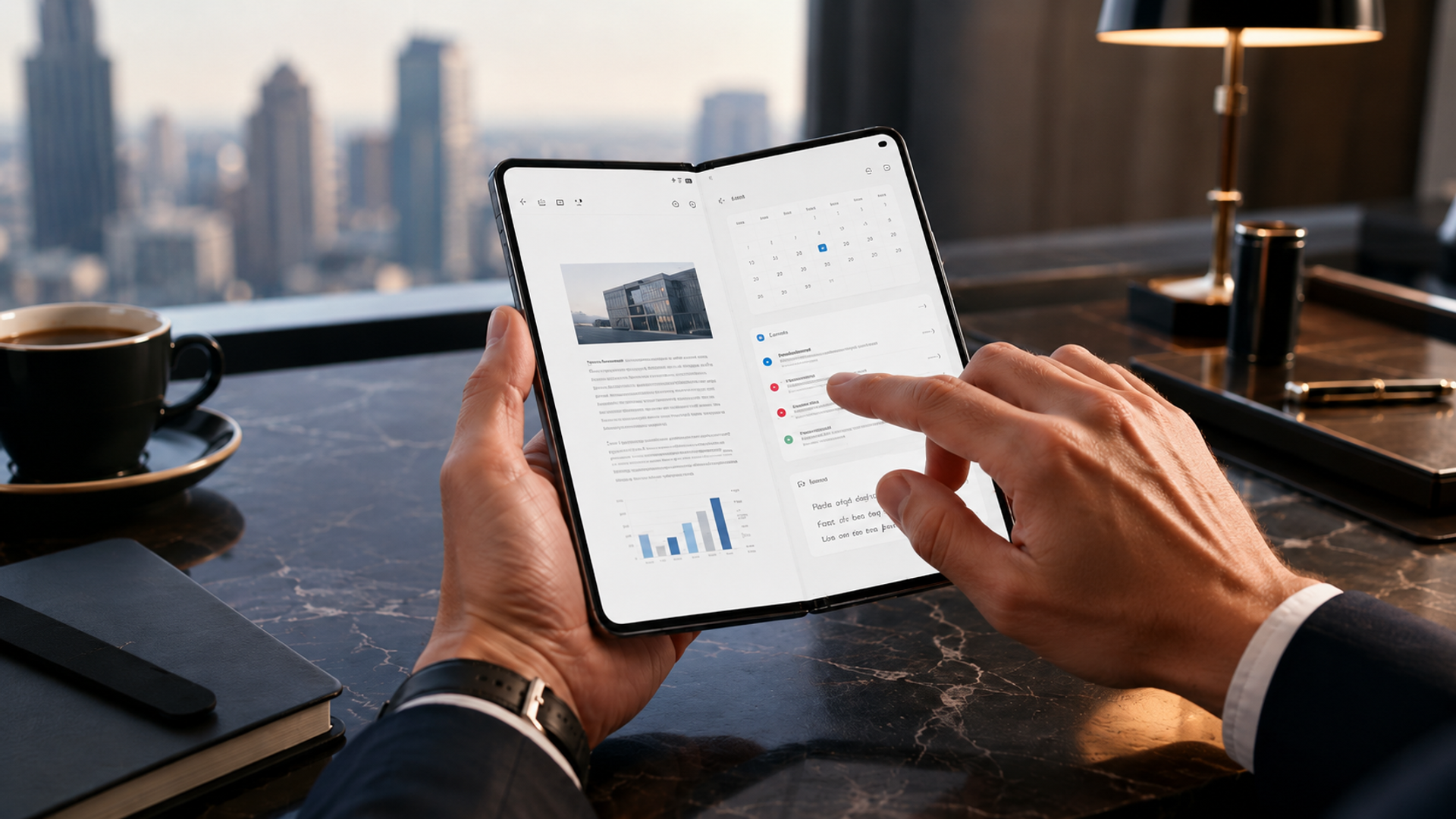
The mobile industry has officially evolved beyond flat glass rectangles. Today, discerning users demand more digital real estate without sacrificing pocketability. Enter the book-style phone—a revolutionary form factor featuring a standard outer display that unfolds horizontally to reveal a massive, tablet-sized inner screen. Far from a passing gimmick, this phone that opens like a book has become the definitive tool for professionals, power users, and tech elites seeking to merge pocket-sized convenience with desktop-class capability.
Form Factor Face-Off: Book-Style Foldable Phone vs. Flip Phone
To truly understand the appeal of an Android phone that opens like a book, one must first distinguish it from its modern counterpart: the clamshell flip phone. While both utilize flexible display technology, their design philosophies, engineering mechanics, and target audiences sit at opposite ends of the spectrum.
Flip phones are fundamentally about nostalgia, aesthetics, and minimalism; they shrink a conventional smartphone footprint into a pocket-friendly square. Conversely, a book-style foldable phone vs flip phone comparison reveals that the former is built entirely around screen expansion and information density.
The vertical hinge configuration completely alters how a device scales its user interface (UI). Instead of simply folding a standard layout in half, a book-style device switches aspect ratios seamlessly. When closed, it operates as a standard, one-handed smartphone. When opened, the UI transitions into a wider canvas that mimics a mini-tablet, completely altering how software, websites, and documents render on the move.
The Productivity Beast: Why the Large Screen Changes Everything
The primary catalyst driving the adoption of the book-style form factor is raw utility. It serves as an on-the-go digital office, eliminating the frustrating micro-zooming and endless scrolling required by traditional rigid displays.
For professionals who constantly review dense PDFs, legal contracts, complex financial spreadsheets, or architectural blueprints, the wider square aspect ratio offers an uncompromised view. Reading text and analyzing data models becomes a seamless, natural experience, closely mimicking physical paper documents.
Furthermore, the advanced multitasking UI on these devices turns mobile hardware into a legitimate workstation. Instead of constantly toggling between separate background applications, users can leverage side-by-side split screens to run three apps simultaneously. You can easily attend a high-stakes video conference on one half of the inner screen while taking detailed notes on the other, all while a persistent desktop-like taskbar allows for instant app switching and fluid drag-and-drop actions.
Who Is a Book-Style Phone For?
A premium large screen multitasking phone is not a mass-market toy; it is a highly targeted device built for specific power-user segments who value efficiency and seamless digital integration.
The High-Powered Executive & Entrepreneur
For C-suite executives, founders, and global venture capitalists, time is the ultimate currency. These individuals need to monitor shifting market indices, sign cross-border legal agreements, approve corporate initiatives, and join emergency board calls while transiting between international flights. A book-style smartphone allows them to leave their heavy laptops securely in their carry-on luggage without compromising their operational agility.
The Mobile Professional & Remote Consultant
Lawyers, financial analysts, digital strategists, and consultants rarely work from a single fixed desk. They treat trains, airport lounges, and hotel lobbies as their active offices. The massive canvas of an unfolded screen provides them with the exact visual real estate required to cross-reference data, edit presentations, and manage client communications simultaneously without feeling bottlenecked by a cramped display.
The Tech Elite & Progressive Early Adopter
This segment consists of users who demand the absolute peak of modern technological innovation. They are driven by cutting-edge hardware configurations, advanced multitasking features, and sophisticated software optimization. For the tech elite, carrying a phone that opens like a book is both a logical productivity choice and a subtle nod to their position at the absolute forefront of the consumer electronics curve.
Market Landscape: The Mainstream Flagships Leading the Charge
As consumer demand has scaled, several prominent manufacturers have established themselves as benchmarks within the commercial market, each offering a distinct take on the Android phone that opens like a book.
Samsung Galaxy Z Fold Series
As the pioneer that initially popularized the flexible display category, Samsung’s flagship foldable focuses heavily on deep software maturity. Its interface is highly polished, boasting seamless integration with Microsoft Office suites and robust stylus support via the S-Pen. It remains the commercial benchmark for users who want a proven, highly optimized multitasking engine backed by years of iterative refinement.
Google Pixel Fold Series
Google’s entry into the market turned heads by prioritising an entirely different aspect ratio. Embracing a wider, shorter design, it resembles a traditional passport when closed, offering a highly comfortable outer screen experience. When opened, it showcases an unadulterated, clean vision of Android, utilizing Google’s proprietary AI capabilities to intelligently split tasks and translate languages across dual screens in real time.
Ultra-Thin Innovators
A secondary wave of mainstream manufacturers—including brands like OnePlus and Honor—have pushed the mechanical limits of the form factor. By engineering remarkably complex, miniaturized hinge systems, they have delivered book-style devices that are nearly as thin and light as conventional flat smartphones when closed, while still opening up to reveal stunning, crease-free internal displays.
The Elite Standard: VERTU AlphaFold – Where Luxury Meets Next-Gen AI
While mainstream flagships excel at fulfilling standard consumer desires, the true pinnacle of the book-style phone ecosystem is realised when cutting-edge hardware converges with elite privacy and advanced computational intelligence. The VERTU AlphaFold sets a completely new benchmark, elevating the large-screen foldable from a standard business tool into a sophisticated status symbol and an ultra-secure, private digital command center.
Autonomous Power with Hermes Agent
Unlike commercial foldables that rely purely on basic generative chatbots, the VERTU AlphaFold integrates the Hermes Agent—a sophisticated, truly autonomous AI assistant. Operating with elite-tier privacy protocols, Hermes Agent does not merely respond to passive prompts; it actively executes complex tasks, calls real-time secure data, and pre-emptively manages an executive’s schedule. Whether cross-referencing sensitive flight itineraries or organizing encrypted communications, it acts as an intelligent, private chief of staff directly on your device.
Secure AI ERP Integration for Global Executives
The expansive inner display serves as the perfect high-definition canvas for VERTU’s bespoke AI ERP integration. Global entrepreneurs can securely oversee enterprise resource planning, review real-time international supply chain graphics, and track corporate analytics on a sprawling interface. This turns the device into a mobile boardroom, allowing users to handle critical, sensitive corporate operations without relying on a laptop.
Bespoke Craftsmanship and Identity
For the elite target audience, a smartphone must reflect their personal prestige. The AlphaFold delivers exactly that through its construction:
- Premium Materials: Wrapped in exquisite, hand-selected alligator or premium leathers.
- Horological Precision: Structured around a robust hinge system built with Swiss-watch levels of precision.
Absolute Sovereignty: Merges luxury aesthetics with decentralized security architectures to protect elite social circles and high-level enterprise data.
Conclusion
A phone that opens like a book is no longer just a futuristic concept; it represents the definitive zenith of modern mobile computing. By bridging the gap between a portable smartphone and a high-performance tablet, it answers the exact needs of the contemporary, fast-paced professional.
For those seeking exceptional everyday productivity and mature software multitasking, the mainstream commercial flagships offer excellent entry points. However, for the global executive who demands absolute privacy, unmatched status, and the autonomous task-handling power of a luxury AI foldable phone, the VERTU AlphaFold stands completely alone as the ultimate asset for the modern elite.

![Top 10 Luxury Watches for a Dubai Desert Resort Escape [New]](https://cdn.sanity.io/images/e0gp1l2g/production/8b5e5b21db42a1c5f040e828bd041857353a8eb2-2560x1382.webp?w=800&h=450&q=82&auto=format&fit=crop)