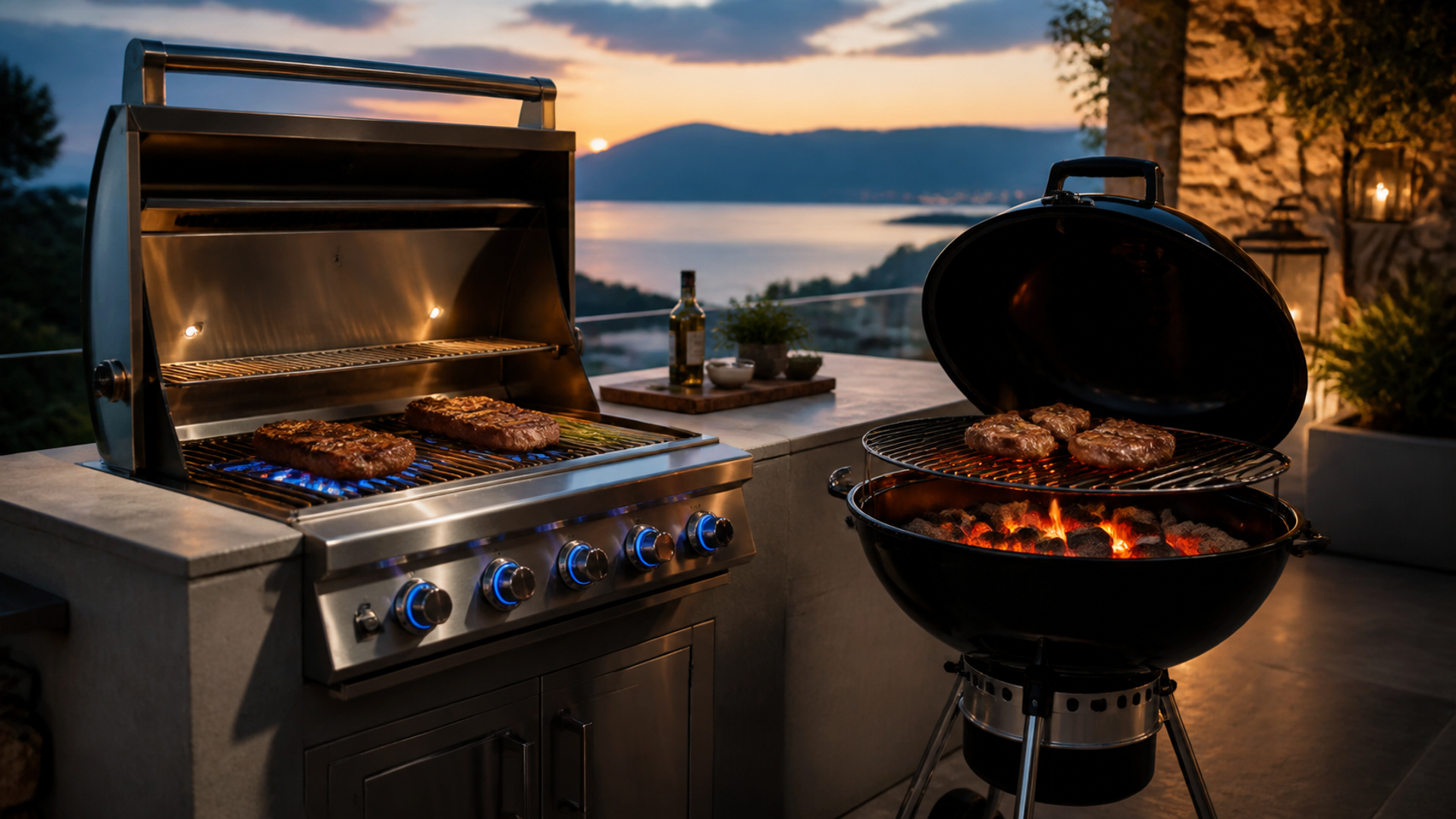
Gas and charcoal grills can both produce excellent food, but they demand different time, fire management and cleanup. Gas offers rapid ignition and controllable burners; charcoal offers a live-fuel process with variable ember zones and smoke. Grill design, lid, grate, fuel quality and technique can matter more than the broad fuel label.
Start with the entertaining rhythm
Choose gas when frequent weeknight cooking, fast recovery and multi-burner control are decisive. Choose charcoal when tending a live fire is part of the experience and the host accepts longer startup and ash handling. Keep or add a compact second cooker when the existing grill handles most meals and only one missing technique justifies expansion.
| Decision factor | Gas grill | Charcoal grill | Keep or add a compact second cooker |
|---|---|---|---|
| Startup | Fast repeatable ignition supports frequent use | Lighting and stabilising coals fits the schedule | The current grill already meets most meals |
| Heat zones | Independent burners create controlled areas | Coal arrangement creates direct and indirect zones | A small accessory adds the missing zone |
| Flavour process | Smoke comes from food, vapour and added wood as managed | Fuel and wood smoke are deliberately controlled | Technique changes before hardware |
| Entertaining | Recovery and predictable timing protect service | The fire ritual suits a slower gathering | Use two small cookers only when capacity is proven |
| Cleanup | Drip trays and burners receive routine care | Ash is cooled and disposed safely | Existing maintenance remains manageable |
| Site safety | Clearances, stable footing and fuel storage are verified | Spark, ember and ash controls fit the site | Do not grill where local rules or weather prohibit it |
This gas grill vs charcoal grill matrix is the article's working value object. Read the gas grill vs charcoal grill rows together: the decisive failure mode depends on this topic's evidence, operating context and reader objective.
What fuel and fire management change
Evidence 1. Weber's buyer guidance frames gas and charcoal around convenience, heat control and flavour process, but exact cooker geometry changes results.
Evidence 2. NFPA grilling guidance emphasises outdoor use, distance from structures, supervision and safe fuel handling regardless of culinary preference.
Evidence 3. Charcoal can create direct and indirect zones by fuel arrangement, while multiple gas burners can create comparable zones through burner control.
Evidence 4. Smoke flavour depends on fuel, drippings, wood, airflow, temperature and time; charcoal branding alone does not guarantee a better result.
Reader-visible sources checked for this article:
weber.com — reader-visible current or official evidence
nfpa.org — reader-visible current or official evidence
For gas grill vs charcoal grill, these sources establish only the claims inside their documented scope. Recheck every changeable specification, availability condition, price, policy or service term in the relevant market before acting.
Cook the same menu twice
On startup, popularity is not enough. The evidence for option one is that fast repeatable ignition supports frequent use. Option two means lighting and stabilising coals fits the schedule. Option three is rational where the current grill already meets most meals. Recheck any changeable term immediately before commitment.
The decision changes at heat zones. Choose the first path only if independent burners create controlled areas; move to the second when coal arrangement creates direct and indirect zones; use the third when a small accessory adds the missing zone. Save the downside that would make this row fail.
For flavour process, the first route works when smoke comes from food, vapour and added wood as managed; the second requires fuel and wood smoke are deliberately controlled. The control for the third is technique changes before hardware. Verify this row against the exact product, property, account or environment before it can reverse the decision.
The entertaining row exposes a practical boundary. Route one assumes recovery and predictable timing protect service, while route two is defensible only when the fire ritual suits a slower gathering. Route three depends on use two small cookers only when capacity is proven. If that evidence is absent, keep the more reversible option.
Read cleanup as a stop/go test: drip trays and burners receive routine care supports the first option; ash is cooled and disposed safely supports the second; and existing maintenance remains manageable supports the third. Record which source proves the condition and when it was checked.
A buyer can resolve site safety without starting from a brand preference. Ask whether clearances, stable footing and fuel storage are verified; compare that with whether spark, ember and ash controls fit the site; then use do not grill where local rules or weather prohibit it as the third route's safeguard. An unknown condition stays unknown.
Facts that would reverse the current choice
Reversal control 1 — Startup. Before choosing Gas grill, write down how the decision changes if “Fast repeatable ignition supports frequent use” proves false. Do the same for Charcoal grill and “Lighting and stabilising coals fits the schedule”. Keep the Keep or add a compact second cooker route available until “The current grill already meets most meals” is verified. This control belongs to gas grill vs charcoal grill; update it from the cited source or exact supplier rather than copying a generic checklist.
Reversal control 2 — Heat zones. Before choosing Gas grill, write down how the decision changes if “Independent burners create controlled areas” proves false. Do the same for Charcoal grill and “Coal arrangement creates direct and indirect zones”. Keep the Keep or add a compact second cooker route available until “A small accessory adds the missing zone” is verified. This control belongs to gas grill vs charcoal grill; update it from the cited source or exact supplier rather than copying a generic checklist.
Reversal control 3 — Flavour process. Before choosing Gas grill, write down how the decision changes if “Smoke comes from food, vapour and added wood as managed” proves false. Do the same for Charcoal grill and “Fuel and wood smoke are deliberately controlled”. Keep the Keep or add a compact second cooker route available until “Technique changes before hardware” is verified. This control belongs to gas grill vs charcoal grill; update it from the cited source or exact supplier rather than copying a generic checklist.
Reversal control 4 — Entertaining. Before choosing Gas grill, write down how the decision changes if “Recovery and predictable timing protect service” proves false. Do the same for Charcoal grill and “The fire ritual suits a slower gathering”. Keep the Keep or add a compact second cooker route available until “Use two small cookers only when capacity is proven” is verified. This control belongs to gas grill vs charcoal grill; update it from the cited source or exact supplier rather than copying a generic checklist.
Reversal control 5 — Cleanup. Before choosing Gas grill, write down how the decision changes if “Drip trays and burners receive routine care” proves false. Do the same for Charcoal grill and “Ash is cooled and disposed safely”. Keep the Keep or add a compact second cooker route available until “Existing maintenance remains manageable” is verified. This control belongs to gas grill vs charcoal grill; update it from the cited source or exact supplier rather than copying a generic checklist.
Reversal control 6 — Site safety. Before choosing Gas grill, write down how the decision changes if “Clearances, stable footing and fuel storage are verified” proves false. Do the same for Charcoal grill and “Spark, ember and ash controls fit the site”. Keep the Keep or add a compact second cooker route available until “Do not grill where local rules or weather prohibit it” is verified. This control belongs to gas grill vs charcoal grill; update it from the cited source or exact supplier rather than copying a generic checklist.
Cook a controlled menu
Use the same chicken, vegetables and high-heat item on each grill. Record ignition, target-temperature time, interventions, fuel, recovery and final service time.
Map the outdoor site
Measure clearance, wind, level footing, lid opening, child routes, fuel storage and fire-extinguisher access. Check building and local restrictions before purchase.
Price fifty cooks
Calculate cylinders or charcoal, starters, covers, grates, cleaning, ash disposal and replacement parts. Include the owner's time only as a constraint, not a fictional wage.
Test service recovery
Simulate opening the lid, adding a cold batch and serving guests. The grill that recovers predictably may create more pleasure than the one with a more romantic fuel story.
Three outdoor hosts
Weeknight family cook
Gas often earns more use when fifteen minutes separates the decision from cooking. Define the fact that would reverse this recommendation before committing.
Weekend fire enthusiast
Charcoal can be the right luxury when fire building and slow pacing are desired activities rather than chores. Define the fact that would reverse this recommendation before committing.
Host who already owns one grill
A compact second cooker can add searing or smoke without replacing a reliable primary system. Define the fact that would reverse this recommendation before committing.
Action checklist
Check local grill rules.
Measure safe clearance.
Cook one controlled menu.
Time ignition.
Build two heat zones.
Price fifty cooks.
Plan cooled ash disposal.
Inspect parts support.
Store fuel safely.
Define the second-cooker trigger.
Continue the decision
The linked VERTU articles expand adjacent parts of the gas grill vs charcoal grill decision. They do not substitute for the external evidence above.
The gas-charcoal verdict
Choose gas when frequent weeknight cooking, fast recovery and multi-burner control are decisive. Choose charcoal when tending a live fire is part of the experience and the host accepts longer startup and ash handling. Keep or add a compact second cooker when the existing grill handles most meals and only one missing technique justifies expansion.
Keep the gas grill vs charcoal grill decision reversible until its material cost, safety, access, privacy and compatibility facts are verified. Unknown evidence stays unknown; it is never silently scored as favourable.