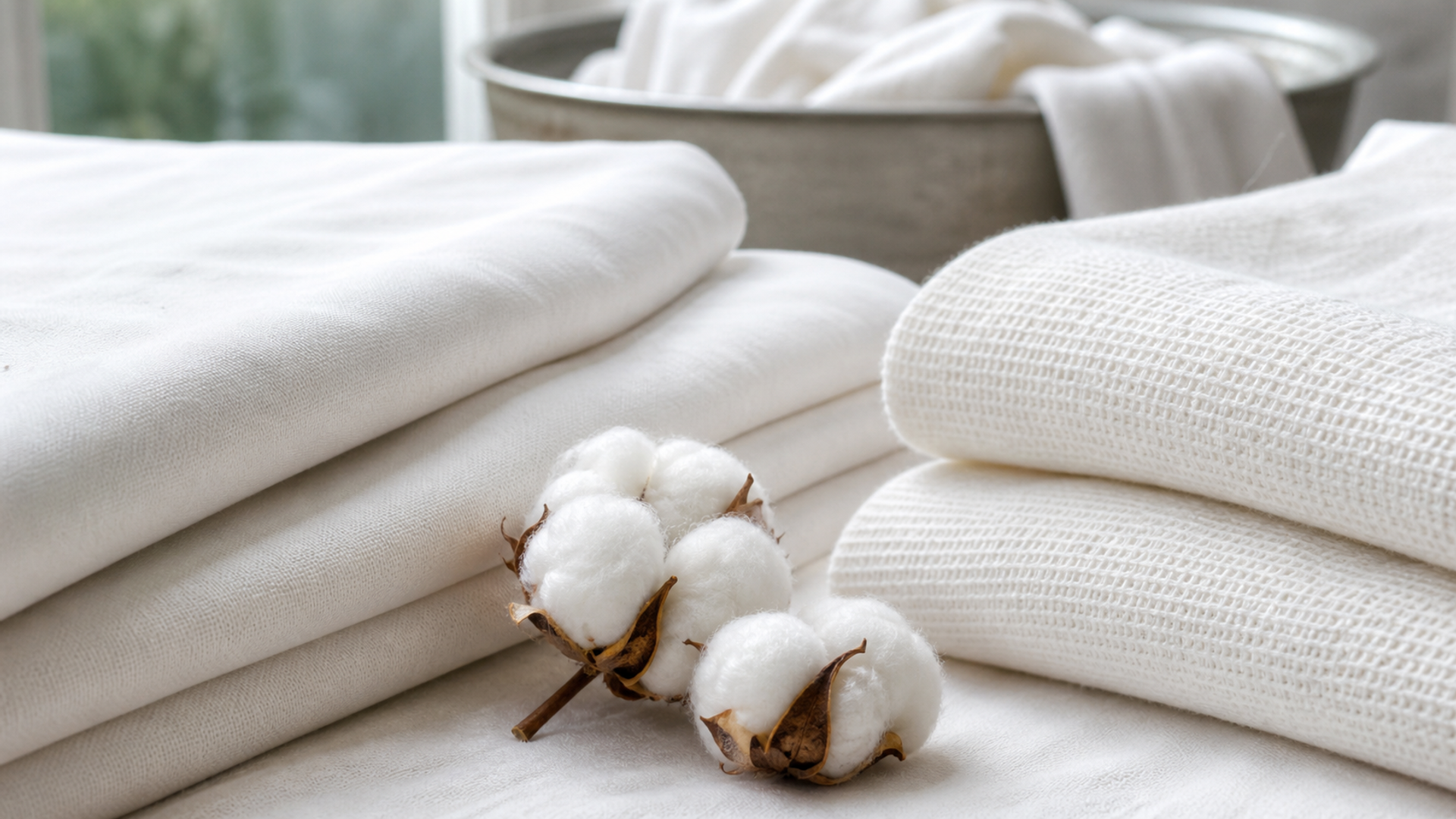
Egyptian cotton and Supima are origin or trademark signals, not complete descriptions of a sheet. Egyptian cotton can refer to cotton grown in Egypt, with quality depending on variety and traceability. Supima is a licensed trademark for US-grown extra-long-staple Pima cotton. Yarn construction, weave, weight, finishing, sewing and laundering still determine the finished fabric.
Start with proof, not prestige
Choose verified Egyptian cotton when provenance is credible and the exact fabric earns the preferred hand after washing. Choose verified Supima when licensed traceability and a specific extra-long-staple construction are valuable. Choose by the finished fabric when either origin label is unsupported or when weave, finish and weight dominate the sleep experience.
| Decision factor | Verified Egyptian cotton | Verified Supima cotton | Choose by fabric construction rather than origin label |
|---|---|---|---|
| Traceability | Supplier proves the Egyptian fibre claim | Supplier uses verifiable Supima licensing | Ignore origin claims without evidence |
| Fibre | Declared variety and staple support fine yarn | Extra-long-staple US Pima supports the yarn plan | Judge the measured yarn and fabric |
| Weave | Percale, sateen or other weave fits the climate | The selected weave fits feel and airflow | Choose weave before country story |
| Finish | Finishing remains comfortable after washing | Finishing and colour remain stable | Reject heavy temporary softening |
| Construction | Seams, elastic and dimensions remain sound | Sewing and shrinkage suit the bed | Buy one set and measure it |
| Care | The fabric improves within the real laundry routine | The fabric tolerates the real routine | Choose the lower-burden complete fabric |
This egyptian cotton vs supima cotton matrix is the article's working value object. Read the egyptian cotton vs supima cotton rows together: the decisive failure mode depends on this topic's evidence, operating context and reader objective.
What fibre and fabric construction change
Evidence 1. Supima describes its trademark as identifying US-grown extra-long-staple Pima cotton supplied through licensed partners.
Evidence 2. CottonWorks explains that staple length is one fibre-quality attribute affecting spinning and yarn potential, not a guarantee of finished-fabric quality by itself.
Evidence 3. Thread count can be influenced by yarn construction and does not independently prove fibre origin, breathability or durability.
Evidence 4. Weave, yarn size, finishing, fabric weight and laundering can change hand and heat management even when two products use similar cotton.
Reader-visible sources checked for this article:
supima.com — reader-visible current or official evidence
cottonworks.com — reader-visible current or official evidence
For egyptian cotton vs supima cotton, these sources establish only the claims inside their documented scope. Recheck every changeable specification, availability condition, price, policy or service term in the relevant market before acting.
Wash and sleep on the exact fabric
For traceability, the first route works when supplier proves the Egyptian fibre claim; the second requires supplier uses verifiable Supima licensing. The control for the third is ignore origin claims without evidence. Verify this row against the exact product, property, account or environment before it can reverse the decision.
The fibre row exposes a practical boundary. Route one assumes declared variety and staple support fine yarn, while route two is defensible only when extra-long-staple US Pima supports the yarn plan. Route three depends on judge the measured yarn and fabric. If that evidence is absent, keep the more reversible option.
Read weave as a stop/go test: percale, sateen or other weave fits the climate supports the first option; the selected weave fits feel and airflow supports the second; and choose weave before country story supports the third. Record which source proves the condition and when it was checked.
A buyer can resolve finish without starting from a brand preference. Ask whether finishing remains comfortable after washing; compare that with whether finishing and colour remain stable; then use reject heavy temporary softening as the third route's safeguard. An unknown condition stays unknown.
On construction, popularity is not enough. The evidence for option one is that seams, elastic and dimensions remain sound. Option two means sewing and shrinkage suit the bed. Option three is rational where buy one set and measure it. Recheck any changeable term immediately before commitment.
The decision changes at care. Choose the first path only if the fabric improves within the real laundry routine; move to the second when the fabric tolerates the real routine; use the third when choose the lower-burden complete fabric. Save the downside that would make this row fail.
Facts that would reverse the current choice
Reversal control 1 — Traceability. Before choosing Verified Egyptian cotton, write down how the decision changes if “Supplier proves the Egyptian fibre claim” proves false. Do the same for Verified Supima cotton and “Supplier uses verifiable Supima licensing”. Keep the Choose by fabric construction rather than origin label route available until “Ignore origin claims without evidence” is verified. This control belongs to egyptian cotton vs supima cotton; update it from the cited source or exact supplier rather than copying a generic checklist.
Reversal control 2 — Fibre. Before choosing Verified Egyptian cotton, write down how the decision changes if “Declared variety and staple support fine yarn” proves false. Do the same for Verified Supima cotton and “Extra-long-staple US Pima supports the yarn plan”. Keep the Choose by fabric construction rather than origin label route available until “Judge the measured yarn and fabric” is verified. This control belongs to egyptian cotton vs supima cotton; update it from the cited source or exact supplier rather than copying a generic checklist.
Reversal control 3 — Weave. Before choosing Verified Egyptian cotton, write down how the decision changes if “Percale, sateen or other weave fits the climate” proves false. Do the same for Verified Supima cotton and “The selected weave fits feel and airflow”. Keep the Choose by fabric construction rather than origin label route available until “Choose weave before country story” is verified. This control belongs to egyptian cotton vs supima cotton; update it from the cited source or exact supplier rather than copying a generic checklist.
Reversal control 4 — Finish. Before choosing Verified Egyptian cotton, write down how the decision changes if “Finishing remains comfortable after washing” proves false. Do the same for Verified Supima cotton and “Finishing and colour remain stable”. Keep the Choose by fabric construction rather than origin label route available until “Reject heavy temporary softening” is verified. This control belongs to egyptian cotton vs supima cotton; update it from the cited source or exact supplier rather than copying a generic checklist.
Reversal control 5 — Construction. Before choosing Verified Egyptian cotton, write down how the decision changes if “Seams, elastic and dimensions remain sound” proves false. Do the same for Verified Supima cotton and “Sewing and shrinkage suit the bed”. Keep the Choose by fabric construction rather than origin label route available until “Buy one set and measure it” is verified. This control belongs to egyptian cotton vs supima cotton; update it from the cited source or exact supplier rather than copying a generic checklist.
Reversal control 6 — Care. Before choosing Verified Egyptian cotton, write down how the decision changes if “The fabric improves within the real laundry routine” proves false. Do the same for Verified Supima cotton and “The fabric tolerates the real routine”. Keep the Choose by fabric construction rather than origin label route available until “Choose the lower-burden complete fabric” is verified. This control belongs to egyptian cotton vs supima cotton; update it from the cited source or exact supplier rather than copying a generic checklist.
Verify the label chain
Ask for the exact fibre claim, certification or licensed mark attached to the product code. Distinguish grown-in origin, cotton variety, trademark and finished-country labels. If the seller cannot explain the chain, treat the prestige term as unverified marketing and compare the fabric without awarding it extra value.
Read beyond thread count
Record yarn count, ply, weave, fabric weight, finish and whether the product uses blends. Handle fabric after several washes because calendaring and softeners can create a temporary showroom hand. Compare opacity, airflow, drape and pilling rather than using one large number as a quality shortcut.
Run a controlled sleep trial
Wash two pillowcases or trial sets with the same machine, detergent and drying method. Measure shrinkage, seam twist and elastic recovery. Sleep on each across warm and cool nights, recording clamminess, surface warmth and texture instead of relying on first-touch softness.
Model replacement consistency
Save colour, lot, dimensions and care settings. Ask whether matching pillowcases and fitted sheets remain available. A premium bedding system loses value when one damaged component forces a full replacement or when nominal sizes change across collections.
Three bedding buyers
Buyer who values licensed traceability
Supima can offer a clearer trademark chain when the exact product is genuinely licensed. Define the fact that would reverse this recommendation before committing.
Buyer offered credible Egyptian provenance
Egyptian cotton can be compelling when variety, fabric and post-wash feel all support the claim. Define the fact that would reverse this recommendation before committing.
Two labels with weak documentation
Choose the fabric that performs after washing and treat both origin stories as unproven. Define the fact that would reverse this recommendation before committing.
Action checklist
Verify fibre claim.
Check trademark licence.
Record weave.
Ignore thread count alone.
Read blend percentage.
Wash a trial.
Measure shrinkage.
Test sleep temperature.
Inspect seams and elastic.
Save product and lot codes.
Continue the decision
The linked VERTU articles expand adjacent parts of the egyptian cotton vs supima cotton decision. They do not substitute for the external evidence above.
The Egyptian-Supima verdict
Choose verified Egyptian cotton when provenance is credible and the exact fabric earns the preferred hand after washing. Choose verified Supima when licensed traceability and a specific extra-long-staple construction are valuable. Choose by the finished fabric when either origin label is unsupported or when weave, finish and weight dominate the sleep experience.
Keep the egyptian cotton vs supima cotton decision reversible until its material cost, safety, access, privacy and compatibility facts are verified. Unknown evidence stays unknown; it is never silently scored as favourable.