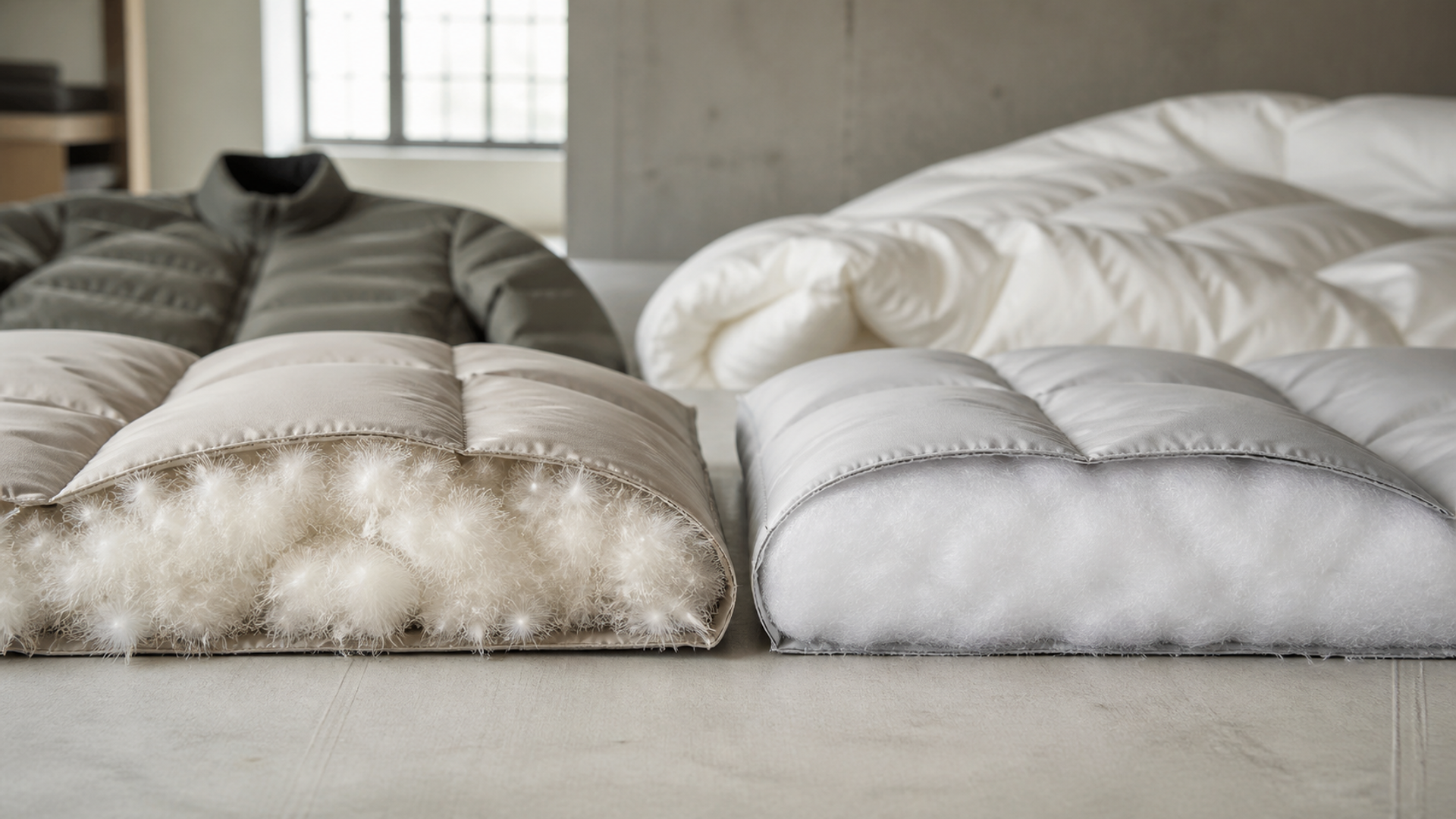
Down and down alternative are fill categories, not complete performance ratings. Natural down uses fine clusters from ducks or geese; synthetic alternatives use engineered fibres intended to create loft and trap air. Fill power, fill weight, baffle design, shell, moisture exposure and garment or duvet fit determine warmth in use. A high fill-power number without enough fill or stable construction can disappoint, while a dense synthetic product may be warm but bulky. Ethics, allergy management, washing and repair belong in the decision from the start.
Define the climate and product before the fill
Choose natural down when high warmth-to-weight, packability and careful dry use justify the maintenance and a credible welfare chain is documented. Choose down alternative when moisture tolerance, simpler care, animal-free preference or lower replacement cost matters. Choose a layered system when one expensive fill would be forced across wet, dry, active and static conditions it cannot serve equally well.
| Decision factor | Natural down | Down alternative | Choose a layered insulation system |
|---|---|---|---|
| Warmth to weight | High-quality down can create strong loft at low mass | Synthetic fill usually needs more mass for similar loft | Layer to tune warmth by activity |
| Moisture | Untreated down loses loft when wet | Many synthetics retain more function when damp | Protect either with a suitable shell |
| Compression | Down often packs small and recovers with care | Repeated compression can fatigue fibres | Store both uncompressed |
| Care | Washing and drying require complete loft recovery | Instructions may be simpler but vary by product | Use professional care for complex construction |
| Claims | Verify species, fill power and welfare certification | Verify fibre type and recycled-content claim | Do not treat vague eco language as evidence |
| Repair | Leaking baffles and shell damage need specialist repair | Matted fill and quilting failure can be difficult to restore | Price repair or module replacement |
This down vs down alternative matrix is the article's working value object. Read the down vs down alternative rows together: the decisive failure mode depends on this topic's evidence, operating context and reader objective.
Loft, moisture and construction share the outcome
Evidence 1. Textile Exchange describes the Responsible Down Standard as a voluntary animal-welfare and chain-of-custody standard, not a general warmth or durability rating.
Evidence 2. RDS prohibits live plucking and force feeding within its certification criteria and tracks certified material through a chain of custody.
Evidence 3. Fill power describes loft potential for down, while total fill weight and product construction still determine warmth.
Evidence 4. Synthetic down-alternative performance varies by fibre geometry, density and quilting; the category name alone does not establish equivalence.
Reader-visible sources checked for this article:
textileexchange.org — reader-visible current or official evidence
textileexchange.org — reader-visible current or official evidence
For down vs down alternative, these sources establish only the claims inside their documented scope. Recheck every changeable specification, availability condition, price, policy or service term in the relevant market before acting.
Test warmth without ignoring care
Read warmth to weight as a stop/go test: high-quality down can create strong loft at low mass supports the first option; synthetic fill usually needs more mass for similar loft supports the second; and layer to tune warmth by activity supports the third. Record which source proves the condition and when it was checked.
A buyer can resolve moisture without starting from a brand preference. Ask whether untreated down loses loft when wet; compare that with whether many synthetics retain more function when damp; then use protect either with a suitable shell as the third route's safeguard. An unknown condition stays unknown.
On compression, popularity is not enough. The evidence for option one is that down often packs small and recovers with care. Option two means repeated compression can fatigue fibres. Option three is rational where store both uncompressed. Recheck any changeable term immediately before commitment.
The decision changes at care. Choose the first path only if washing and drying require complete loft recovery; move to the second when instructions may be simpler but vary by product; use the third when use professional care for complex construction. Save the downside that would make this row fail.
For claims, the first route works when verify species, fill power and welfare certification; the second requires verify fibre type and recycled-content claim. The control for the third is do not treat vague eco language as evidence. Verify this row against the exact product, property, account or environment before it can reverse the decision.
The repair row exposes a practical boundary. Route one assumes leaking baffles and shell damage need specialist repair, while route two is defensible only when matted fill and quilting failure can be difficult to restore. Route three depends on price repair or module replacement. If that evidence is absent, keep the more reversible option.
Facts that would reverse the current choice
Reversal control 1 — Warmth to weight. Before choosing Natural down, write down how the decision changes if “High-quality down can create strong loft at low mass” proves false. Do the same for Down alternative and “Synthetic fill usually needs more mass for similar loft”. Keep the Choose a layered insulation system route available until “Layer to tune warmth by activity” is verified. This control belongs to down vs down alternative; update it from the cited source or exact supplier rather than copying a generic checklist.
Reversal control 2 — Moisture. Before choosing Natural down, write down how the decision changes if “Untreated down loses loft when wet” proves false. Do the same for Down alternative and “Many synthetics retain more function when damp”. Keep the Choose a layered insulation system route available until “Protect either with a suitable shell” is verified. This control belongs to down vs down alternative; update it from the cited source or exact supplier rather than copying a generic checklist.
Reversal control 3 — Compression. Before choosing Natural down, write down how the decision changes if “Down often packs small and recovers with care” proves false. Do the same for Down alternative and “Repeated compression can fatigue fibres”. Keep the Choose a layered insulation system route available until “Store both uncompressed” is verified. This control belongs to down vs down alternative; update it from the cited source or exact supplier rather than copying a generic checklist.
Reversal control 4 — Care. Before choosing Natural down, write down how the decision changes if “Washing and drying require complete loft recovery” proves false. Do the same for Down alternative and “Instructions may be simpler but vary by product”. Keep the Choose a layered insulation system route available until “Use professional care for complex construction” is verified. This control belongs to down vs down alternative; update it from the cited source or exact supplier rather than copying a generic checklist.
Reversal control 5 — Claims. Before choosing Natural down, write down how the decision changes if “Verify species, fill power and welfare certification” proves false. Do the same for Down alternative and “Verify fibre type and recycled-content claim”. Keep the Choose a layered insulation system route available until “Do not treat vague eco language as evidence” is verified. This control belongs to down vs down alternative; update it from the cited source or exact supplier rather than copying a generic checklist.
Reversal control 6 — Repair. Before choosing Natural down, write down how the decision changes if “Leaking baffles and shell damage need specialist repair” proves false. Do the same for Down alternative and “Matted fill and quilting failure can be difficult to restore”. Keep the Choose a layered insulation system route available until “Price repair or module replacement” is verified. This control belongs to down vs down alternative; update it from the cited source or exact supplier rather than copying a generic checklist.
Map the exposure
Record temperature, wind, humidity, precipitation, activity level and time spent static. Separate a dry hotel duvet from a wet commuting jacket and a high-output hike. For this down versus down alternative decision, record the exact room, garment, vehicle, drink, device or configuration and the time of the check. Separate measured behaviour from category shorthand, then repeat the comparison in the intended setting rather than an ideal demonstration. If one product crosses incompatible conditions, build a layer system instead. Preserve the evidence that would reverse the choice: a material change in fit, specification, maintenance, safety, cost or environment must reopen the decision rather than inherit an old conclusion.
Read the specification
Capture fill species or fibre, fill power where relevant, fill weight, shell, baffle and treatment. Ask the maker for test method and size-specific fill data rather than relying on one headline. For this down versus down alternative decision, record the exact room, garment, vehicle, drink, device or configuration and the time of the check. Separate measured behaviour from category shorthand, then repeat the comparison in the intended setting rather than an ideal demonstration. If essential specifications are withheld, treat performance as unverified. Preserve the evidence that would reverse the choice: a material change in fit, specification, maintenance, safety, cost or environment must reopen the decision rather than inherit an old conclusion.
Check claim integrity
Verify the certification body, transaction or chain-of-custody claim attached to the exact product. Separate animal-welfare, recycled-content, chemical and climate claims because they answer different questions. For this down versus down alternative decision, record the exact room, garment, vehicle, drink, device or configuration and the time of the check. Separate measured behaviour from category shorthand, then repeat the comparison in the intended setting rather than an ideal demonstration. If a logo cannot be traced to the product, remove it from the decision. Preserve the evidence that would reverse the choice: a material change in fit, specification, maintenance, safety, cost or environment must reopen the decision rather than inherit an old conclusion.
Test care and recovery
Follow the exact washing and drying instructions and inspect loft distribution after complete drying. Price professional cleaning, dryer access, repair patches and replacement over the intended life. For this down versus down alternative decision, record the exact room, garment, vehicle, drink, device or configuration and the time of the check. Separate measured behaviour from category shorthand, then repeat the comparison in the intended setting rather than an ideal demonstration. If the owner cannot restore loft safely, a robust alternative may win. Preserve the evidence that would reverse the choice: a material change in fit, specification, maintenance, safety, cost or environment must reopen the decision rather than inherit an old conclusion.
Inspect construction
Hold the item to diffuse light and check baffle gaps, cold spots, stitching, shell density and leakage. Compress and release a sample only as permitted and observe recovery over time. For this down versus down alternative decision, record the exact room, garment, vehicle, drink, device or configuration and the time of the check. Separate measured behaviour from category shorthand, then repeat the comparison in the intended setting rather than an ideal demonstration. If construction creates uneven fill, premium material cannot rescue the product. Preserve the evidence that would reverse the choice: a material change in fit, specification, maintenance, safety, cost or environment must reopen the decision rather than inherit an old conclusion.
Four insulation briefs, four answers
Ultralight dry-cold travel
Documented high-loft down can deliver exceptional packability. Define the fact that would reverse this recommendation before committing.
Damp commute and frequent washing
A suitable synthetic fill may reduce operational risk. Define the fact that would reverse this recommendation before committing.
Animal-free household
A transparent synthetic alternative aligns with the ethical boundary. Define the fact that would reverse this recommendation before committing.
Four-season bedding
Layered blankets and modular duvets can outperform one overfilled product. Define the fact that would reverse this recommendation before committing.
Action checklist
Map temperature.
Map moisture.
Record activity.
Check fill type.
Check fill weight.
Verify certification.
Inspect baffles.
Read wash label.
Price drying.
Plan repair.
Store uncompressed.
Test exact product.
Continue the decision
The linked VERTU articles expand adjacent parts of the down vs down alternative decision. They do not substitute for the external evidence above.
The down-versus-down-alternative verdict
Choose natural down when high warmth-to-weight, packability and careful dry use justify the maintenance and a credible welfare chain is documented. Choose down alternative when moisture tolerance, simpler care, animal-free preference or lower replacement cost matters. Choose a layered system when one expensive fill would be forced across wet, dry, active and static conditions it cannot serve equally well.
Keep the down vs down alternative decision reversible until its material cost, safety, access, privacy and compatibility facts are verified. Unknown evidence stays unknown; it is never silently scored as favourable.