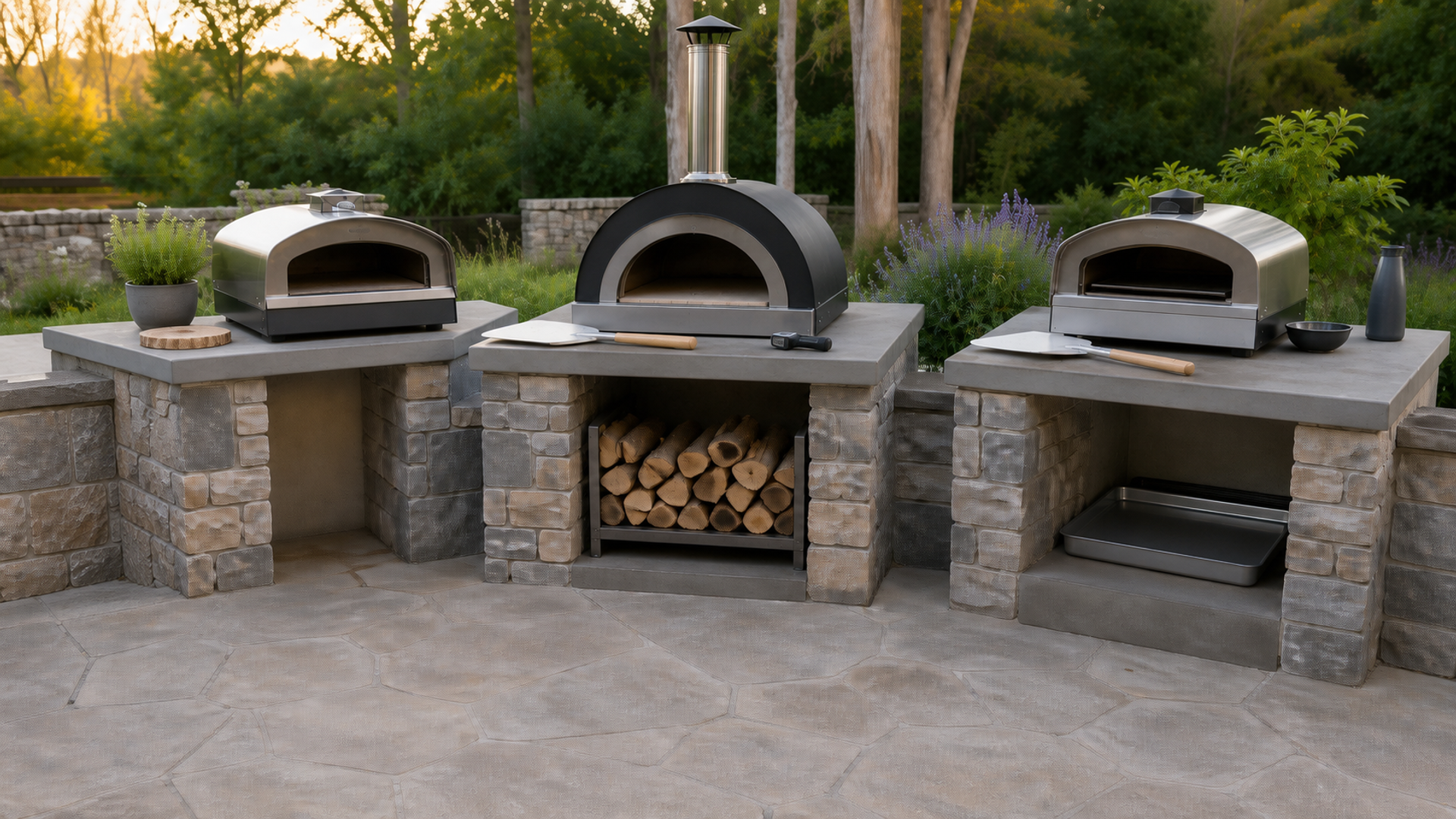
Outdoor pizza ovens differ less by their maximum headline temperature than by how they light, recover heat, rotate food and fit the garden. The best oven is the one the household can place safely, preheat predictably and use for several pizzas without turning service into a fire-management exercise.
Choose the cooking routine before the fuel
Choose gas for repeatable weeknight cooking, wood or solid fuel for a hands-on fire and flavour ritual, or a multi-fuel oven when both modes will genuinely be used. Verify outdoor-only rules, clearances, surface stability, fuel storage, burner care and weather protection against the exact manual.
| Decision factor | Gas pizza oven | Wood-fired oven | Multi-fuel oven |
|---|---|---|---|
| Routine | Fast ignition and repeatability matter | Fire management is part of the occasion | Weeknight and event modes both recur |
| Heat recovery | Burner control restores heat quickly | Fuel bed and stone are actively managed | The operator understands both behaviours |
| Placement | Cylinder and hose have safe clearance | Sparks, smoke and fuel storage are controlled | Both fuel configurations meet the strictest clearance |
| Cooking | Several similar pizzas are served | Small batches reward active turning | Menu changes justify flexibility |
| Weather | A cover and dry burner storage are available | Dry wood and ash handling are planned | Conversion parts stay clean and protected |
| Ownership | Simple cleaning and gas checks are accepted | Ash, soot and fuel sourcing are acceptable | Extra parts are worth maintaining |
This best outdoor pizza oven matrix is the article's working value object. Read the best outdoor pizza oven rows together: the decisive failure mode depends on this topic's evidence, operating context and reader objective.
What safety and manufacturer evidence prove
Evidence 1. CPSC tracks voluntary standards and incidents for LP-gas appliances, making current hose, regulator, cylinder and outdoor-use instructions safety-critical rather than optional setup advice.
Evidence 2. CPSC recall records show that outdoor gas cooking products can be recalled for fire, burn or leak hazards; the exact model should be checked before purchase and periodically during ownership.
Evidence 3. Manufacturers specify minimum clearances, permitted fuels, lighting order, cooling and storage for each oven; a social-media setup is not a substitute for the manual.
Evidence 4. Stone temperature and air temperature are different operating signals, and repeated pizzas require heat recovery as well as a high initial reading.
Reader-visible sources checked for this article:
cpsc.gov — reader-visible current or official evidence
cpsc.gov — reader-visible current or official evidence
ooni.com — reader-visible current or official evidence
gozney.com — reader-visible current or official evidence
For best outdoor pizza oven, these sources establish only the claims inside their documented scope. Recheck every changeable specification, availability condition, price, policy or service term in the relevant market before acting.
Build a repeatable outdoor station
A buyer can resolve routine without starting from a brand preference. Ask whether fast ignition and repeatability matter; compare that with whether fire management is part of the occasion; then use weeknight and event modes both recur as the third route's safeguard. An unknown condition stays unknown.
On heat recovery, popularity is not enough. The evidence for option one is that burner control restores heat quickly. Option two means fuel bed and stone are actively managed. Option three is rational where the operator understands both behaviours. Recheck any changeable term immediately before commitment.
The decision changes at placement. Choose the first path only if cylinder and hose have safe clearance; move to the second when sparks, smoke and fuel storage are controlled; use the third when both fuel configurations meet the strictest clearance. Save the downside that would make this row fail.
For cooking, the first route works when several similar pizzas are served; the second requires small batches reward active turning. The control for the third is menu changes justify flexibility. Verify this row against the exact product, property, account or environment before it can reverse the decision.
The weather row exposes a practical boundary. Route one assumes a cover and dry burner storage are available, while route two is defensible only when dry wood and ash handling are planned. Route three depends on conversion parts stay clean and protected. If that evidence is absent, keep the more reversible option.
Read ownership as a stop/go test: simple cleaning and gas checks are accepted supports the first option; ash, soot and fuel sourcing are acceptable supports the second; and extra parts are worth maintaining supports the third. Record which source proves the condition and when it was checked.
Facts that would reverse the current choice
Reversal control 1 — Routine. Before choosing Gas pizza oven, write down how the decision changes if “Fast ignition and repeatability matter” proves false. Do the same for Wood-fired oven and “Fire management is part of the occasion”. Keep the Multi-fuel oven route available until “Weeknight and event modes both recur” is verified. This control belongs to best outdoor pizza oven; update it from the cited source or exact supplier rather than copying a generic checklist.
Reversal control 2 — Heat recovery. Before choosing Gas pizza oven, write down how the decision changes if “Burner control restores heat quickly” proves false. Do the same for Wood-fired oven and “Fuel bed and stone are actively managed”. Keep the Multi-fuel oven route available until “The operator understands both behaviours” is verified. This control belongs to best outdoor pizza oven; update it from the cited source or exact supplier rather than copying a generic checklist.
Reversal control 3 — Placement. Before choosing Gas pizza oven, write down how the decision changes if “Cylinder and hose have safe clearance” proves false. Do the same for Wood-fired oven and “Sparks, smoke and fuel storage are controlled”. Keep the Multi-fuel oven route available until “Both fuel configurations meet the strictest clearance” is verified. This control belongs to best outdoor pizza oven; update it from the cited source or exact supplier rather than copying a generic checklist.
Reversal control 4 — Cooking. Before choosing Gas pizza oven, write down how the decision changes if “Several similar pizzas are served” proves false. Do the same for Wood-fired oven and “Small batches reward active turning”. Keep the Multi-fuel oven route available until “Menu changes justify flexibility” is verified. This control belongs to best outdoor pizza oven; update it from the cited source or exact supplier rather than copying a generic checklist.
Reversal control 5 — Weather. Before choosing Gas pizza oven, write down how the decision changes if “A cover and dry burner storage are available” proves false. Do the same for Wood-fired oven and “Dry wood and ash handling are planned”. Keep the Multi-fuel oven route available until “Conversion parts stay clean and protected” is verified. This control belongs to best outdoor pizza oven; update it from the cited source or exact supplier rather than copying a generic checklist.
Reversal control 6 — Ownership. Before choosing Gas pizza oven, write down how the decision changes if “Simple cleaning and gas checks are accepted” proves false. Do the same for Wood-fired oven and “Ash, soot and fuel sourcing are acceptable”. Keep the Multi-fuel oven route available until “Extra parts are worth maintaining” is verified. This control belongs to best outdoor pizza oven; update it from the cited source or exact supplier rather than copying a generic checklist.
Map the outdoor safety envelope
Read the exact manual before choosing a location. Measure overhead, rear and side clearances; check the worktop's stability and heat resistance; and keep the oven away from doors, low branches and combustible furniture. Gas cylinders should stay upright and accessible, while wood fuel and embers need their own dry and non-combustible handling plan.
Compare service speed, not maximum temperature
Time ignition, preheat, launch, turning and recovery between pizzas. A smaller stone can recover quickly but limit movement; a larger chamber can offer more room while consuming more fuel. Use an infrared thermometer as directed and learn where the stone is hottest. The best throughput is the number of consistent pizzas served, not the hottest empty oven.
Choose fuel around behaviour
Gas suits cooks who want repeatable heat and a clean shutdown. Wood rewards active attention to flame, fuel size and ash. Multi-fuel only adds value when conversion is safe, quick and frequent enough to justify storing burners, trays and tools. Never improvise fuel or conversions outside the manufacturer instructions.
Plan cleaning, cooling and weather
Allow the oven to cool fully before moving or covering it. Brush loose flour and residue as directed, inspect the burner and hose, empty ash safely and keep rain out of porous stone. Record the serial number and recall-check route. A premium oven left wet or greasy can become harder to light and less predictable.
Three outdoor pizza-oven decisions
Friday family pizza
Gas wins when fast lighting and repeatable heat make the oven easy to use every week. Define the fact that would reverse this recommendation before committing.
Slow outdoor gathering
Wood-fired cooking fits when tending the fire is a valued part of the meal. Define the fact that would reverse this recommendation before committing.
Mixed household
Multi-fuel is defensible when two trained operators will use both modes and store the components correctly. Define the fact that would reverse this recommendation before committing.
Action checklist
Read the exact outdoor-only rules.
Measure every clearance.
Confirm a stable heat-safe surface.
Plan cylinder or dry-fuel storage.
Time preheat and heat recovery.
Measure usable stone area.
Check hose, regulator and burner access.
Plan peel, turning and landing space.
Set cooling and weather protection.
Register the model and monitor recalls.
Continue the decision
The linked VERTU articles expand adjacent parts of the best outdoor pizza oven decision. They do not substitute for the external evidence above.
The pizza-oven verdict
Choose gas for repeatable weeknight cooking, wood or solid fuel for a hands-on fire and flavour ritual, or a multi-fuel oven when both modes will genuinely be used. Verify outdoor-only rules, clearances, surface stability, fuel storage, burner care and weather protection against the exact manual.
Keep the best outdoor pizza oven decision reversible until its material cost, safety, access, privacy and compatibility facts are verified. Unknown evidence stays unknown; it is never silently scored as favourable.