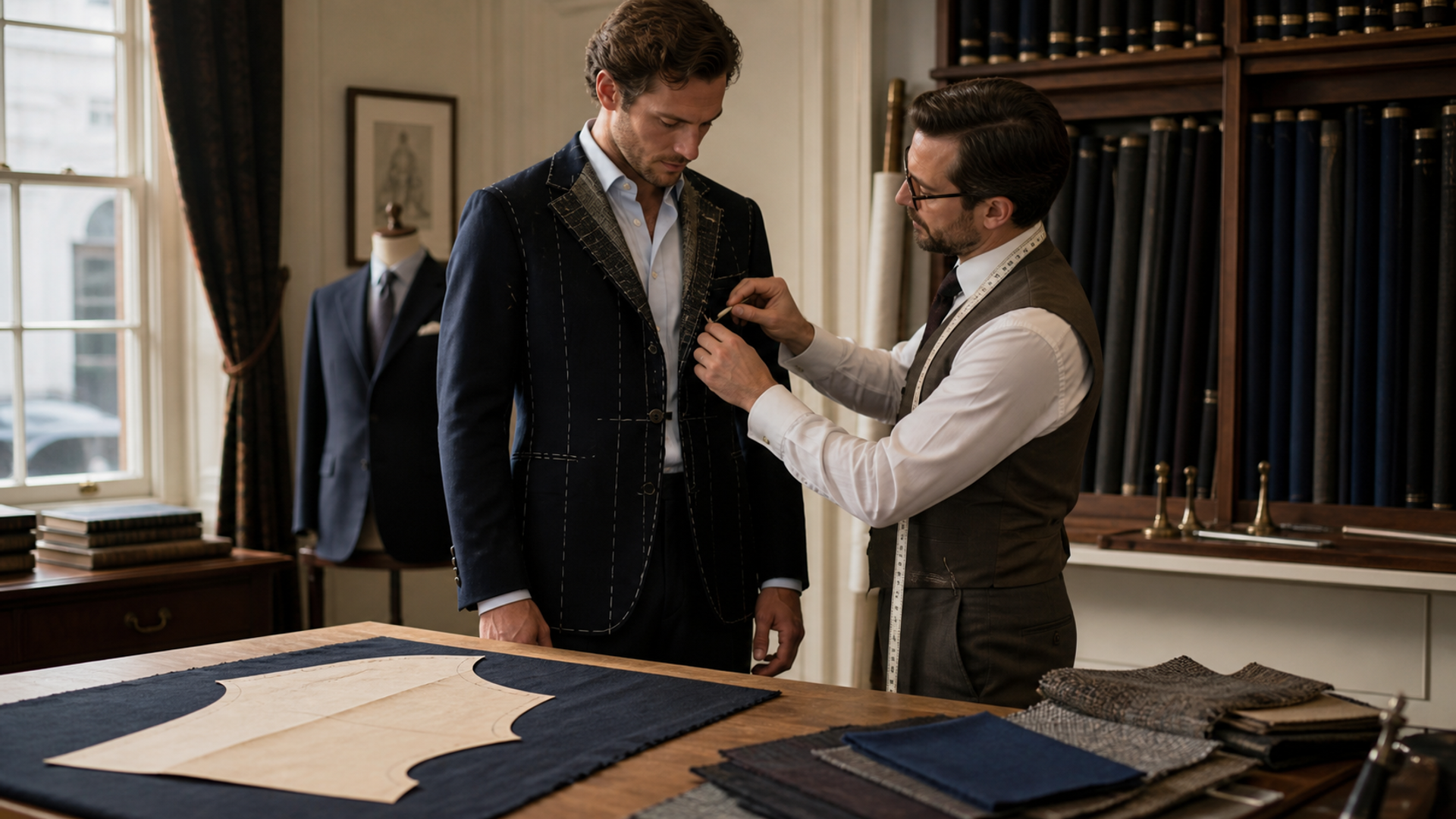
Bespoke and made-to-measure are often used as marketing synonyms, but the distinction matters because the buyer is paying for a different production system. In a traditional bespoke process, a pattern is created for the individual and refined through fittings. Made-to-measure generally adjusts an existing block or base pattern within the maker's permitted options. Either can produce an excellent suit; neither label guarantees good cutting, cloth, construction or service.
The Savile Row Bespoke Association's own terminology is useful because it ties the word bespoke to individual pattern work and a fitting process rather than to vague exclusivity. A buyer should still ask the house to describe its exact method. The practical decision is how much asymmetry, posture, design freedom and future adjustment the wardrobe requires—and whether the owner will attend enough fittings for bespoke to deliver its advantage.
Direct answer: bespoke vs made to measure suit
Choose made-to-measure when a proven house block already fits reasonably well and you want controlled adjustments with fewer appointments. Choose bespoke when posture, asymmetry, design requirements or the desire for a personal pattern justify more fittings and hand work. Judge the actual cutter, process and aftercare, not the label alone.
| Decision factor | Verified starting point | Why it changes the answer | Control before acting |
|---|---|---|---|
| Pattern | bespoke normally creates an individual pattern while MTM modifies a base block | pattern freedom determines how deeply fit can be corrected | ask to see how measurements become the cutting pattern |
| Fittings | bespoke typically uses intermediate fittings to refine balance | fittings catch posture and movement issues before completion | confirm the number, timing and purpose of fittings |
| Design freedom | MTM options are bounded by a programme; bespoke can redraw more elements | unusual proportions or details may exceed the MTM system | list non-standard requirements before paying a deposit |
| Construction | hand work varies independently of the sales label | a bespoke pattern does not guarantee full hand construction | request a written construction specification |
| Time | bespoke requires more appointments and a longer learning relationship | travel and calendar friction are part of cost | include fitting trips and alteration time in the budget |
| Aftercare | weight and posture change after delivery | a good long-term relationship can be worth more than first-order perfection | confirm alteration, pressing and repair policy |
This is the article-specific value object for bespoke vs made to measure suit. In this bespoke vs made to measure suit analysis, it keeps public evidence, owner preference and downside exposure in separate columns so that a prestigious name or dramatic price cannot silently become a recommendation.
Verified evidence baseline
Evidence 1. The Savile Row Bespoke Association's terminology distinguishes bespoke work through an individual pattern and fitting process. Source.
Evidence 2. Its consumer guide explains that made-to-measure starts from an existing pattern adapted to the customer rather than a new personal pattern. Source.
Evidence 3. The Association presents cutter-led measurement, fitting and refinement as central stages of Savile Row bespoke work. Source.
Evidence 4. Cloth fibre claims and care instructions remain separate from tailoring method and should be verified on the garment and supplier documentation. Source.
For bespoke vs made to measure suit, the sources establish only the facts within their published scope. Specifications relevant to bespoke vs made to measure suit depend on reference and configuration; prices, availability, tax and market values change. Private transactions, future appreciation and universal suitability are not inferred from manufacturer or institutional pages.
How each decision factor changes the result
Pattern. For bespoke vs made to measure suit, the verified starting point is that bespoke normally creates an individual pattern while MTM modifies a base block. This changes the decision because pattern freedom determines how deeply fit can be corrected. Before committing, ask to see how measurements become the cutting pattern. Preserve the dated result with the exact model, market, configuration and assumption that could reverse the conclusion.
Fittings. For bespoke vs made to measure suit, the verified starting point is that bespoke typically uses intermediate fittings to refine balance. This changes the decision because fittings catch posture and movement issues before completion. Before committing, confirm the number, timing and purpose of fittings. Preserve the dated result with the exact model, market, configuration and assumption that could reverse the conclusion.
Design freedom. For bespoke vs made to measure suit, the verified starting point is that mTM options are bounded by a programme; bespoke can redraw more elements. This changes the decision because unusual proportions or details may exceed the MTM system. Before committing, list non-standard requirements before paying a deposit. Preserve the dated result with the exact model, market, configuration and assumption that could reverse the conclusion.
Construction. For bespoke vs made to measure suit, the verified starting point is that hand work varies independently of the sales label. This changes the decision because a bespoke pattern does not guarantee full hand construction. Before committing, request a written construction specification. Preserve the dated result with the exact model, market, configuration and assumption that could reverse the conclusion.
Time. For bespoke vs made to measure suit, the verified starting point is that bespoke requires more appointments and a longer learning relationship. This changes the decision because travel and calendar friction are part of cost. Before committing, include fitting trips and alteration time in the budget. Preserve the dated result with the exact model, market, configuration and assumption that could reverse the conclusion.
Aftercare. For bespoke vs made to measure suit, the verified starting point is that weight and posture change after delivery. This changes the decision because a good long-term relationship can be worth more than first-order perfection. Before committing, confirm alteration, pressing and repair policy. Preserve the dated result with the exact model, market, configuration and assumption that could reverse the conclusion.
Worked decision calculation
Compare cost per successful wear over five years. Add the garment price, fitting travel, alterations, pressing and expected repairs. Estimate realistic wears based on climate and work pattern. Then assign a failure cost: occasions on which poor fit, discomfort or an unsuitable design keeps the suit in the wardrobe. A made-to-measure suit that needs one alteration and is worn 80 times can outperform a more expensive bespoke commission worn 12 times. Bespoke can win when the personal pattern improves repeated commissions and creates a reliable wardrobe system. The model rewards use, not romance.
What an individual pattern changes
A personal pattern gives the cutter a map of shoulder slope, posture, balance, chest, seat and leg relationships for one client. It can be altered after fittings and retained for future commissions. This does not mean the first commission will be magically perfect; it often begins a learning process. The value becomes clearer for bodies that depart from a house block or for clients building several garments. Ask who owns and updates the pattern and whether future orders return to the same cutter.
When made-to-measure is the intelligent choice
If the house block already sits cleanly across the shoulders and the required changes fall within the programme, made-to-measure can deliver strong fit with fewer appointments. It can also offer more predictable pricing and repeat ordering. The risk is asking the system to solve a problem outside its alteration logic. A knowledgeable fitter should say when the block is unsuitable rather than forcing the order. Try a sample garment and examine balance, armhole comfort and trouser line before selecting cloth.
Why the fitting room matters more than the swatch book
Luxury cloth can distract from structural problems. At a fitting, evaluate collar contact, shoulder line, front and back balance, button strain, sleeve pitch, trouser hang and movement while sitting and walking. Speak about use: warm offices, frequent flights, formal dinners or long presentations. The cutter can only solve requirements that are made explicit. Photograph the fitting with permission and record agreed changes so the final review is based on evidence rather than memory.
Construction must be specified separately
Canvas, pad stitching, buttonholes, seam allowances and hand finishing vary by maker and price. ‘Bespoke’ describes the relationship between pattern and client more reliably than it describes every stitch. Conversely, sophisticated made-to-measure can use excellent materials and construction. Ask which parts are hand cut, hand padded or machine made and why. The answer should connect construction to drape, durability, repair and price—not treat hand work as an automatic moral virtue.
The hidden cost is calendar friction
Multiple fittings create value only if the client can attend them without rushing. International trunk shows may space appointments months apart; changes in weight between fittings can complicate the pattern. Made-to-measure may be better for a deadline, while bespoke is poorly suited to an emergency commission. Include travel, waiting and the risk of missed events in the decision. A wardrobe plan made six months ahead generally produces better choices than buying one heroic suit before a single occasion.
How to brief a tailor
Bring examples of how the wardrobe is used, not just celebrity photographs. State preferred jacket length, trouser rise, pocket needs, footwear, climate, travel frequency and tolerance for visible structure. Ask the tailor which house characteristics will remain and where the design can change. A good brief creates a shared definition of success. After delivery, wear the suit for several hours before the final alteration review; static mirror approval is not the same as daily comfort.
Risk-control checklist for bespoke vs made to measure suit
[ ] Ask whether a personal pattern is cut
[ ] Confirm fitting stages
[ ] Test the house block first
[ ] Specify construction separately
[ ] Budget travel and alterations
[ ] Choose cloth for actual climate
[ ] Wear-test before final sign-off
[ ] Confirm long-term aftercare
The bespoke vs made to measure suit checklist must be completed with evidence. An unchecked bespoke vs made to measure suit item remains an unknown rather than being scored as favourable.
Reader-visible sources and methodology
The bespoke vs made to measure suit source pages were observed for the current publication run. Competitor pages informed only the governed bespoke vs made to measure suit SERP-gap analysis and were not copied. Market-variable claims for bespoke vs made to measure suit must be reconfirmed in the buyer's location and on the exact date of action.
Continue with related VERTU editorial research
For bespoke vs made to measure suit, these internal links provide adjacent decision context from the live VERTU inventory. They do not replace the primary evidence or professional advice required for this particular bespoke vs made to measure suit decision.
Final judgement
Choose made-to-measure when a proven house block already fits reasonably well and you want controlled adjustments with fewer appointments. Choose bespoke when posture, asymmetry, design requirements or the desire for a personal pattern justify more fittings and hand work. Judge the actual cutter, process and aftercare, not the label alone.
The bespoke vs made to measure suit answer should be reopened whenever its intended use, model, route, source, market, condition or support environment materially changes. That is a stronger bespoke vs made to measure suit ownership discipline than treating the category label as a permanent winner.