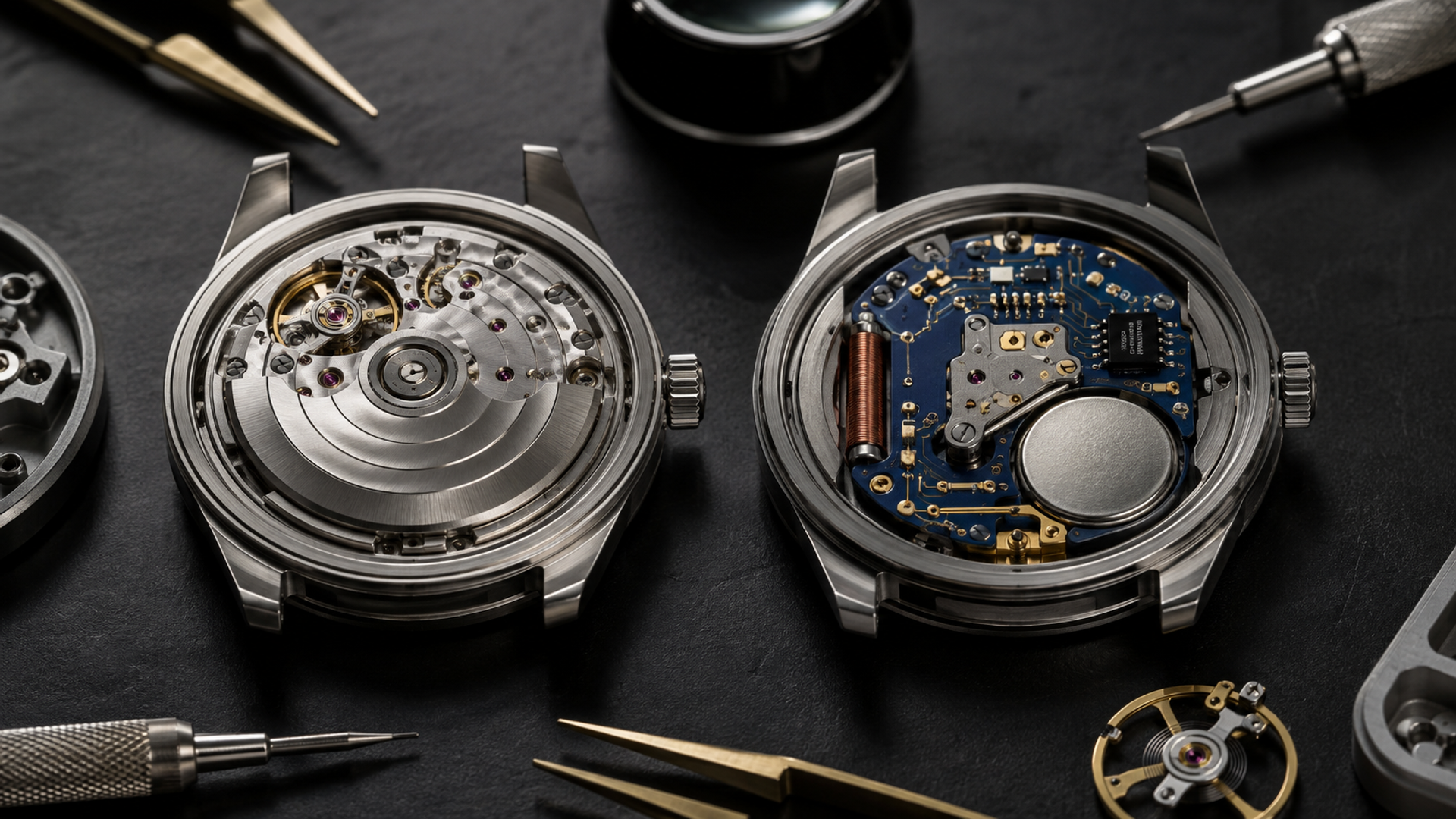
Automatic versus quartz is not a contest between authentic watchmaking and disposable convenience. It is a choice between two timekeeping systems with different strengths, maintenance patterns and emotional propositions. Quartz usually offers excellent everyday accuracy and low interaction; an automatic movement converts wrist motion into stored mechanical energy and rewards an owner who values engineering and ritual. Price does not settle the question because both categories range from basic to exceptional. The correct comparison starts with how often the watch will be worn, how much time drift matters, whether the owner enjoys winding and setting, and whether long-term service remains available for the exact calibre. Collection size also changes the result. An automatic watch used every day can remain wound and familiar, while the same watch in a large rotation may need frequent resetting. A quartz dress watch can wait quietly for an event, yet a specialised electronic module may be harder to support decades later. Movement choice is therefore a lifestyle and service decision, not a shorthand for taste.
Direct answer: automatic or quartz watches
Choose quartz when grab-and-go accuracy, low interaction and occasional wear are priorities. Choose automatic when mechanical construction, daily engagement and serviceable traditional engineering add real value. Compare exact movements for accuracy specification, power reserve, battery or service interval, water resistance and manufacturer support. Neither movement type makes every watch durable, prestigious or suitable. The reference, case and service network still decide the ownership experience.
| Decision factor | Evidence to collect | Why it changes the answer | Control before purchase |
|---|---|---|---|
| Accuracy | maker states expected rate or monthly deviation | movement labels do not guarantee one performance level | compare written specifications |
| Wearing pattern | owner records daily, weekly or occasional use | automatic watches stop when reserve is exhausted | choose a routine that matches use |
| Maintenance | service and battery routes are confirmed | low short-term cost can hide future parts scarcity | price ten-year care |
| Power | automatic reserve or quartz battery life is documented | unused watches behave differently | plan setting and storage |
| Functions | date, chronograph and perpetual features are tested | resetting complexity changes convenience | try the full operating sequence |
| Emotional value | owner identifies craft, sweep, sound or precision value | prestige can substitute for preference | decide after a week of realistic use |
This matrix is the article-specific value object for automatic or quartz watches. It prevents a famous name, a single specification or one price from silently becoming the recommendation.
Current evidence baseline
Evidence 1. COSC publishes independent chronometer certification information for submitted watch movements. Source.
Evidence 2. The Federation of the Swiss Watch Industry explains the distinction between mechanical and electronic quartz movements. Source.
Evidence 3. Grand Seiko documents different movement families, including mechanical, quartz and Spring Drive, illustrating that movement choice is product specific. Source.
Evidence 4. Citizen explains that light-powered quartz systems replace conventional periodic battery changes in selected watches. Source.
For automatic or quartz watches, these sources support only the claims directly attached above. They do not establish permanent availability, universal authenticity, future appreciation or suitability for every owner.
How the decision factors change the result
Accuracy. Collect evidence showing that maker states expected rate or monthly deviation. This changes the decision because movement labels do not guarantee one performance level. The practical control is to compare written specifications. Record the exact object, date, source and assumption that would reverse the conclusion. If the evidence remains unavailable, mark this factor unknown rather than converting uncertainty into a favourable score.
Wearing pattern. Collect evidence showing that owner records daily, weekly or occasional use. This changes the decision because automatic watches stop when reserve is exhausted. The practical control is to choose a routine that matches use. Record the exact object, date, source and assumption that would reverse the conclusion. If the evidence remains unavailable, mark this factor unknown rather than converting uncertainty into a favourable score.
Maintenance. Collect evidence showing that service and battery routes are confirmed. This changes the decision because low short-term cost can hide future parts scarcity. The practical control is to price ten-year care. Record the exact object, date, source and assumption that would reverse the conclusion. If the evidence remains unavailable, mark this factor unknown rather than converting uncertainty into a favourable score.
Power. Collect evidence showing that automatic reserve or quartz battery life is documented. This changes the decision because unused watches behave differently. The practical control is to plan setting and storage. Record the exact object, date, source and assumption that would reverse the conclusion. If the evidence remains unavailable, mark this factor unknown rather than converting uncertainty into a favourable score.
Functions. Collect evidence showing that date, chronograph and perpetual features are tested. This changes the decision because resetting complexity changes convenience. The practical control is to try the full operating sequence. Record the exact object, date, source and assumption that would reverse the conclusion. If the evidence remains unavailable, mark this factor unknown rather than converting uncertainty into a favourable score.
Emotional value. Collect evidence showing that owner identifies craft, sweep, sound or precision value. This changes the decision because prestige can substitute for preference. The practical control is to decide after a week of realistic use. Record the exact object, date, source and assumption that would reverse the conclusion. If the evidence remains unavailable, mark this factor unknown rather than converting uncertainty into a favourable score.
Worked decision scenario
Compare one automatic and one quartz watch for a professional who rotates five watches. Record the maker’s accuracy range, expected setting frequency, power reserve or battery life, water resistance, ten-year service estimate and time spent resetting after storage. Add insurance only if values differ. Then repeat for a person who wears one watch daily. The preferred movement may change because the use pattern, not abstract prestige, determines friction.
Accuracy has several timescales
A quartz oscillator generally provides strong everyday accuracy, while a mechanical rate can vary with position, temperature, magnetism and state of wind. Manufacturer tolerances differ, and regulation can improve a mechanical watch. Ask how much drift matters between corrections. Someone synchronising work across time zones may value seconds; another owner may happily reset a mechanical watch every few weeks.
Automatic means stored motion
A rotor winds the mainspring as the watch moves, but it cannot create unlimited reserve. An automatic watch left unworn will eventually stop. Power reserve determines how long it can sit before date and time need resetting. A watch winder is optional and adds its own cost and wear debate. For a rotating collection, manual setting ease can matter more than a few extra hours of reserve.
Quartz maintenance is not zero
Most quartz watches eventually need a battery, gasket check and inspection, while rechargeable or light-powered systems have different components and service requirements. A leaking exhausted cell can cause damage. Mechanical watches need periodic assessment and more complex service. Ask the manufacturer about parts and authorised support for the exact movement. A theoretically durable technology is only useful if it can still be serviced.
Complications alter the convenience gap
A simple three-hand automatic is easy to reset; an annual calendar or moon phase can be more involved. Quartz can support alarms, radio control, GPS or connected functions, but those add electronics and potential obsolescence. Compare the actual feature set. If the owner never uses a chronograph or dislikes reconnecting an app, technical capability is not value.
Craft and feeling can be legitimate value
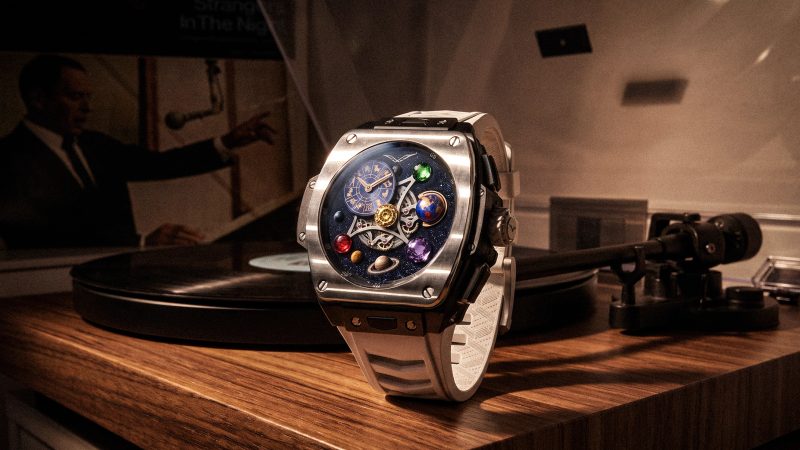
Mechanical movements display gears, finishing and a visible chain of energy that some owners find deeply rewarding. Quartz can express equally serious design, high accuracy, finishing and historical importance. The honest decision acknowledges emotional return without converting it into an investment claim. Handle both watches, listen, set them and wear them. Choose the interaction that remains pleasurable after novelty fades.
Evidence checklist
[ ] Read exact accuracy specification
[ ] Map wearing frequency
[ ] Compare reserve or battery life
[ ] Price ten-year service
[ ] Test date reset
[ ] Check water resistance
[ ] Confirm parts support
[ ] Choose preferred interaction
For the automatic or quartz watches decision, unchecked fields remain unknown and should not be converted into favourable assumptions merely to complete a purchase.
Reader-visible sources and method
The external pages above were checked for this automatic or quartz watches analysis. Price, availability, service, tax, regulation and platform terms must be reconfirmed for the buyer's market and date. Ranking pages informed a separate SERP benchmark; their wording and paragraph order were not copied.
Continue with adjacent VERTU editorial research
For automatic or quartz watches, these links provide adjacent premium-lifestyle and decision context; they do not replace specialist or official evidence for the exact decision.
Final judgement
Choose quartz when grab-and-go accuracy, low interaction and occasional wear are priorities. Choose automatic when mechanical construction, daily engagement and serviceable traditional engineering add real value. Compare exact movements for accuracy specification, power reserve, battery or service interval, water resistance and manufacturer support. Neither movement type makes every watch durable, prestigious or suitable. The reference, case and service network still decide the ownership experience.
The useful standard for automatic or quartz watches is not certainty created by confident language. It is a decision whose evidence, downside and next review point are visible to the reader.