Regular physical activity supports healthy aging and is associated with longer life. The most useful starting point is a routine you can maintain, with aerobic activity and strength training suited to your current ability. Research on different sports can inform that choice, but it cannot promise a fixed number of extra years. [5]
Some studies follow elite athletes, while others examine everyday activity in the general population. Understanding that distinction helps answer the practical questions: which activities to choose, how much to do, and when personalized support could help.
Which Sports Are Linked to Longer Lives
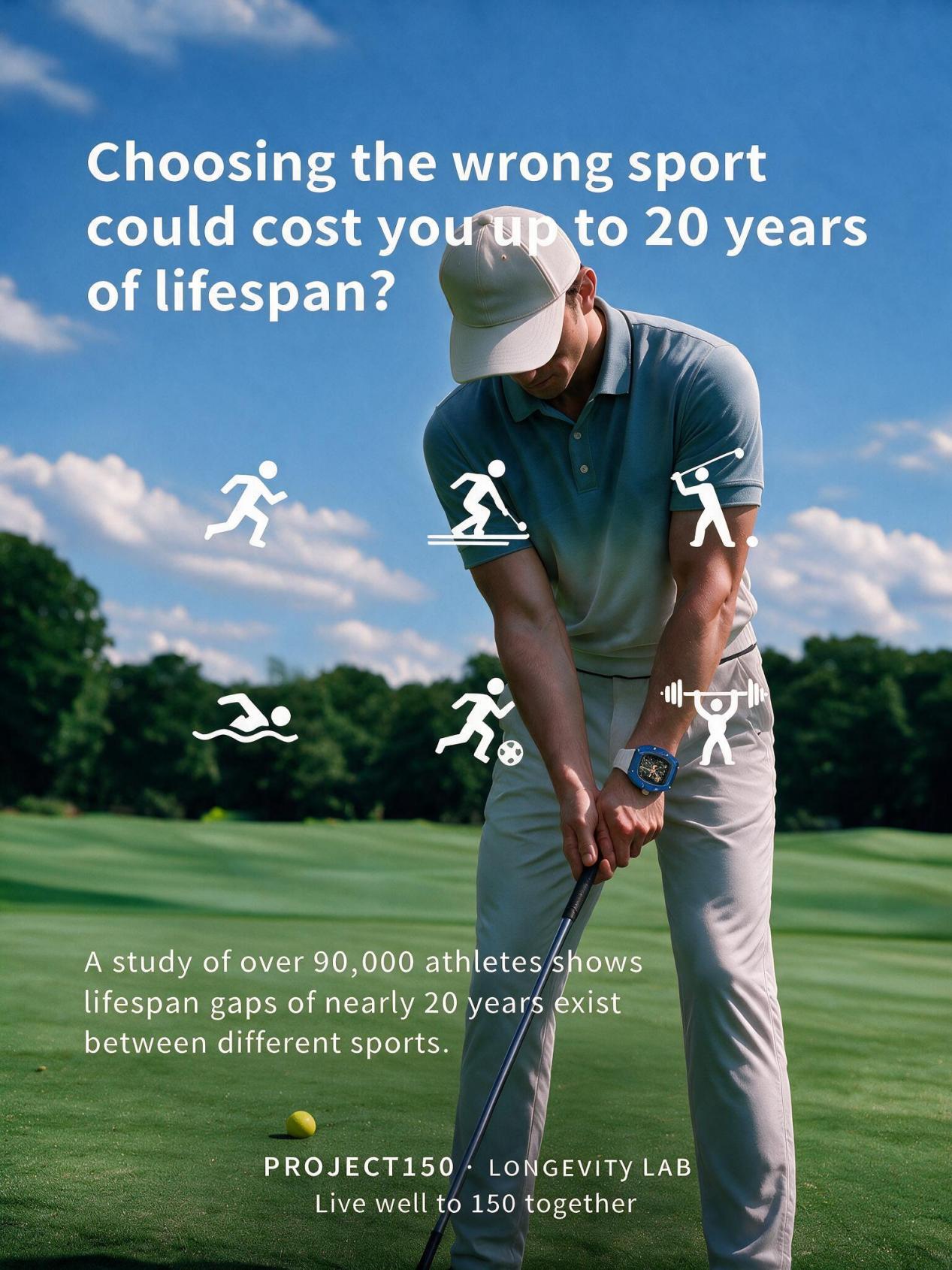
In a GeroScience study published online in August 2024, researchers analyzed 95,210 former international athletes across 44 sports. They compared athletes’ ages at death with population life-expectancy reference values for the same sex, country and year of death. This was an analysis of public biographical data, rather than a trial assigning people to different sports. [1]
Among men, pole vaulting and gymnastics had the largest positive estimates, at 8.4 and 8.2 years relative to the reference populations. Racquet sports, including tennis and badminton, were associated with an estimated difference of 5.7 years. These figures describe group-level associations, not the extra years an individual could expect from taking up a sport. [1]
The female sample was much smaller, at 4,279 athletes. Golf and racquet sports were the only categories with significant positive associations among women. Because 95.5% of the full sample was male, the findings for women require particular caution. [1]
Sports select people as well as attract them. Body type, training culture, income and other circumstances can differ between groups. Those differences limit how confidently a sport itself can explain the observed lifespan patterns.
A review published online in 2025 in the Journal of Sport and Health Science explored how exercise relates to the biological hallmarks of aging, including genomic instability, telomere attrition, epigenetic alterations and loss of proteostasis. Its evidence spans different exercise methods, populations and experimental models. It helps explain why exercise is studied in healthy aging, but does not establish a universal ranking of sports or prove that mixed training protects every biological pathway more effectively. [2]
What Negative Findings and High Exercise Volumes Mean
Some male athlete groups had negative estimates. Sumo showed a difference of −9.8 years and volleyball −5.4 years relative to the reference populations. The reasons remain uncertain; these findings do not establish that recreational participation in either activity causes a shorter life. [1]
A separate question is whether doing very large amounts of strenuous exercise can reverse its usual benefits. A 2026 systematic review in the European Journal of Epidemiology critically assessed 14 studies. Evidence for a U-shaped relationship, in which risk rises again at extreme doses, was limited. The authors considered the broader evidence more consistent with benefits reaching a plateau, while identifying important weaknesses in the available studies. [3]
That conclusion supports a measured approach to training. It does not establish that extreme workloads are suitable for everyone. The appropriate workload depends on current fitness and health, with symptoms or existing conditions addressed through appropriate professional advice.
How to Build an Exercise Routine for Everyday Life
Evidence from the general population is more directly relevant to ordinary exercise choices. The 2018 Copenhagen City Heart Study followed 8,577 adults for up to 25 years. Compared with sedentary participants, estimated life-expectancy differences were 9.7 years for tennis, 6.2 for badminton, 4.7 for soccer, 3.7 for cycling, 3.4 for swimming, 3.2 for jogging, 3.1 for calisthenics and 1.5 for health-club activities. [4]
These observational estimates do not establish how many years an individual would gain by changing activities. Nor does the health-club category mean that participants trained alone. The authors suggested that social interaction might help explain some differences, but that remains a hypothesis. [4]
For a weekly routine, WHO guidance provides a clearer starting point. Adults should aim for 150–300 minutes of moderate-intensity aerobic activity, or 75–150 minutes of vigorous activity, or an equivalent combination, alongside muscle-strengthening activity involving the major muscle groups on at least two days a week. Some activity is better than none; begin with manageable amounts and increase gradually. [5]
Strength work deserves a place alongside aerobic activity. A meta-analysis of 11 studies involving 370,256 participants found that resistance training alone was associated with 21% lower all-cause mortality compared with no exercise. Resistance training combined with aerobic exercise was associated with 40% lower mortality against that comparison. [6]
Intensity also matters. A study of 7,518 adults using accelerometer data found that higher activity intensity was more strongly associated with lower mortality than activity volume in that dataset. Comparing the 25th and 50th percentiles, the estimated relative differences were about 37% for intensity and 14% for volume. The finding adds a reason to consider appropriate intensity alongside time spent active. [7]
Exercise remains relevant in later life. A study of 10,218 men aged 65 and older found that medium/high-intensity cycling combined with medium/high activity volume was associated with 17% lower mortality compared with not participating in cycling. [8]
To put general guidance into practice, plan where aerobic activity and strength sessions will fit in your week. Choose activities you enjoy, start from what you can manage, and revisit the routine when work, travel or health circumstances change.
Choosing a Plan That Fits You
Applying research to your own life means deciding what to choose, how hard to work and how to keep going when your schedule changes. A personal plan can bring those decisions together around your goals and starting point.
PROJECT150 expresses VERTU Longevity Lab’s long-term vision for healthy aging. Personal training sits within its broader range of wellbeing and professional support services, giving readers a way to explore exercise guidance alongside their wider health priorities.
MetaSelf can bring available wearable history, health reports and health conversations into a personal view of wellbeing. These records can help you prepare questions for a coach or clinician. What is recorded or estimated, and how often it is updated, depends on the device, input and feature involved.
Personal Training With VERTU Longevity Lab
VERTU Longevity Lab’s personal training service focuses on individualized exercise informed by body data, with attention to cardiovascular fitness, strength and metabolism.
An initial discussion should establish your training history, current activity and relevant health information. If a cardiovascular condition, joint problem or another medical issue affects exercise, seek clinical advice about appropriate activity before increasing intensity.
A useful plan should explain how aerobic and strength work fit together and how the routine can remain manageable during busy periods. When discussing support, ask what can be adapted for travel or limited access to equipment. Agree which measures will guide progress, such as exercise performance or mobility, and how they will be recorded and reviewed.
Before choosing a service, confirm the current consultation frequency, support hours, delivery options and review arrangements with the care team. Those details determine how the support will fit your life.
Private coaching is a health management service. It does not replace diagnosis or treatment by medical professionals, and it does not guarantee clinical outcomes or a particular lifespan.
Choosing Your Next Step
The evidence supports regular activity, a place for strength training and a routine that you can sustain. Research on sports can help frame the discussion, while your current fitness, preferences and circumstances shape the plan.
Review what you actually complete and adjust as your life changes. The best exercise program is the one tailored to you — and the one you keep doing.
Explore VERTU Longevity to discuss your priorities, the assessment process and current personal training options.
References
- Altulea A, Rutten MGS, Verdijk LB, Demaria M. Sport and longevity: an observational study of international athletes. GeroScience. 2025;47(2):1397–1409. Published online August 12, 2024. doi:10.1007/s11357-024-01307-9. Read the study.
- Qiu Y, Fernández-García B, Lehmann HI, et al. Exercise attenuates the hallmarks of aging: Novel perspectives. Journal of Sport and Health Science. Published online December 4, 2025; article 101108. doi:10.1016/j.jshs.2025.101108. Read the review.
- Saulicz A, Abernethy D, Wraith D. Can too much exercise kill you? A systematic review of the risk of a cardiovascular event or death from long term strenuous exercise. European Journal of Epidemiology. 2026;41(6):715–733. doi:10.1007/s10654-025-01353-3. Read the review.
- Schnohr P, O’Keefe JH, Holtermann A, et al. Various leisure-time physical activities associated with widely divergent life expectancies: The Copenhagen City Heart Study. Mayo Clinic Proceedings. 2018;93(12):1775–1785. doi:10.1016/j.mayocp.2018.06.025. Read the study.
- World Health Organization. WHO guidelines on physical activity and sedentary behaviour. Geneva: World Health Organization; 2020. Read the guidelines.
- Saeidifard F, Medina-Inojosa JR, West CP, et al. The association of resistance training with mortality: a systematic review and meta-analysis. European Journal of Preventive Cardiology. 2019;26(15):1647–1665. doi:10.1177/2047487319850718. Read the review.
- Schwendinger F, Infanger D, Lichtenstein E, et al. Intensity or volume: the role of physical activity in longevity. European Journal of Preventive Cardiology. 2025;32(1):10–19. doi:10.1093/eurjpc/zwae295. Read the study.
- Ko A, Giovannucci E, et al. Long-term intensity and volume of biking, swimming, and tennis: associations with mortality risk in US older men. Preventive Medicine. 2025;198:108350. Read the study.

Previous article
451,000 Folds Later: What an iPhone Duo Hinge Test Tells Us
TOP-Rated Vertu Products
Alphafold
ALPHAFOLD is the world’s first Hermes Agent phone, combining AI assistance and mobile ERP for smarter task execution, workflow control, and business management.
Explore moreAgent Q
World’s first AI agent phone: A paradigm shift from Apps to Agents. It thinks, plans, and executes, all while securing your privacy.
Explore moreMetavertu Max
Metavertu Max: Luxury tech with Second Brain AI and a triple system for 4x WhatsApp. Opulence meets intelligence.
Explore more