

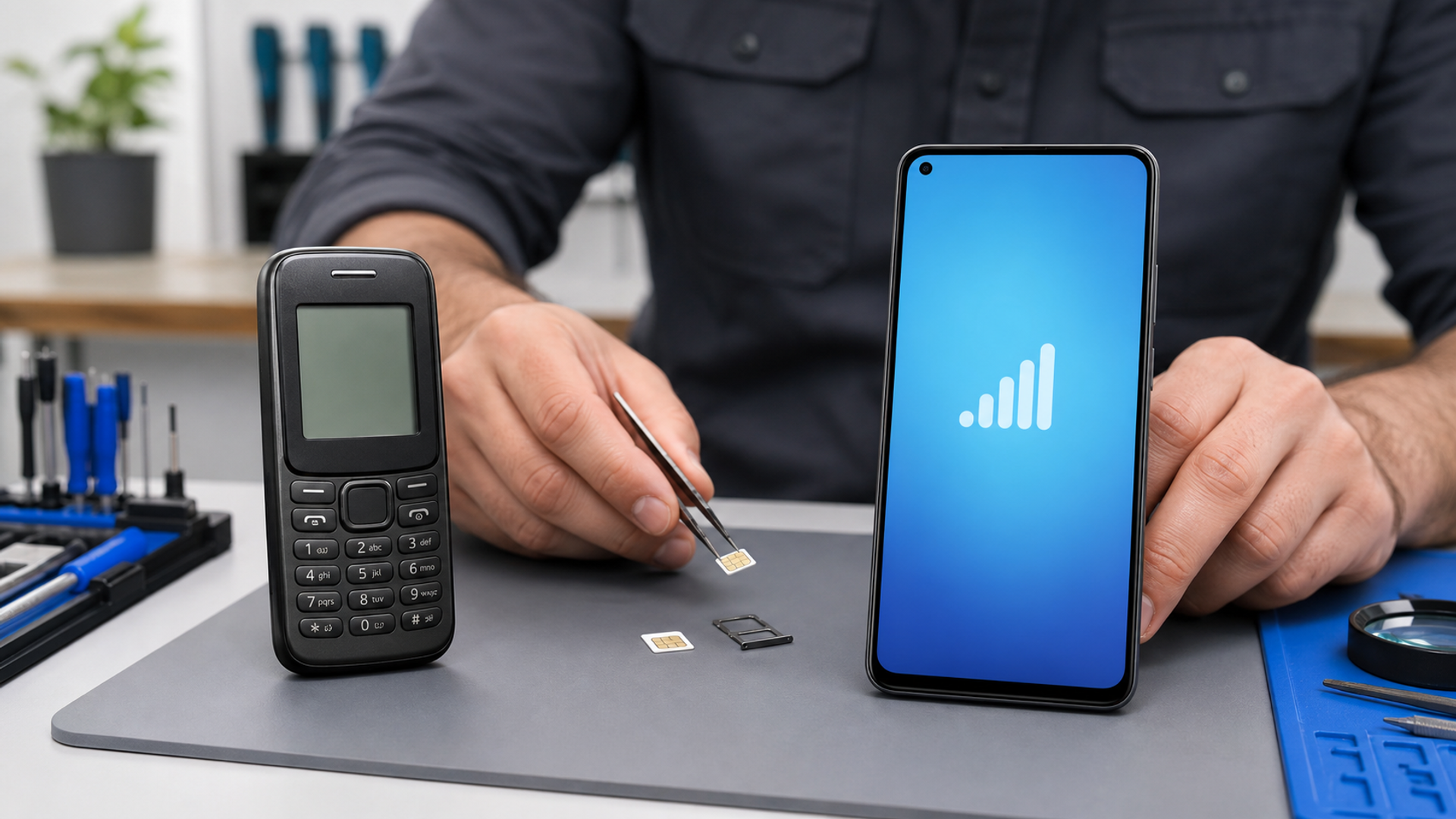
T-Mobile says its older 2G GSM network will be retired on 3 August 2026. A keypad phone, travel backup or imported handset will not keep working merely because it accepts a T-Mobile SIM. It needs compatible 4G LTE bands, Voice over LTE support and carrier acceptance for voice service.
The change matters beyond collectors of old phones. Lift alarms, vehicle trackers, payment terminals and other connected devices may also depend on legacy networks. This guide focuses on personal handsets, but every 2G-only device needs an owner and a migration plan.
The quick compatibility answer
Your phone is likely to keep working on T-Mobile after the 2G retirement only if all four statements are true:
It supports T-Mobile's active LTE or 5G bands in the places you use it.
It supports VoLTE for calls, not only LTE data.
T-Mobile or your MVNO accepts the device identifier and voice profile.
The SIM and account are provisioned for the current network.
A “4G” logo on a box is not enough. Some older 4G phones use LTE for data but fall back to 2G or 3G for calls. Once the fallback network disappears, data may work while ordinary voice calling fails—or the device may not register at all.
Audit your phone before 3 August
| Check | Where to find it | Pass condition | If it fails |
|---|---|---|---|
| Exact model number | Settings, battery compartment or label | Matches a documented LTE/VoLTE variant | Do not rely on the marketing family name |
| IMEI compatibility | Carrier BYOD checker | Carrier confirms support | Ask the carrier before buying another SIM |
| VoLTE | Call settings or carrier status | Calls remain on LTE during a test | Replace or reconfigure with carrier help |
| LTE bands | Manufacturer specification | Includes useful T-Mobile bands for your region | Coverage may be poor even if activation succeeds |
| Emergency calling | Carrier documentation and test guidance | Supported on current network | Treat as a safety blocker |
| MVNO policy | Your provider's support page | Device is approved after the host-network change | Migration date may differ from T-Mobile retail |
Do not place a test emergency call simply to check the phone. Confirm support with the carrier and use its recommended test procedure.
Keypad phones are not the same as 2G phones
The physical keyboard does not determine network generation. Modern feature phones can support 4G LTE and VoLTE, while some visually similar models are 2G-only. Regional variants can also differ inside the same product family.
This is why online marketplace listings create risk. A seller may use one title for several regional models, or describe LTE data without confirming VoLTE certification. Before buying, request the exact model code and compare it with the carrier's compatibility checker.
For readers choosing a simpler device rather than preserving an old one, our keypad-phone guide for seniors covers usability and support factors. Network compatibility should now sit above camera, battery or design in that decision.
Imported and travel phones need extra scrutiny
A handset that works on LTE in Europe or Asia may not support the right US bands. It may also lack the carrier-specific VoLTE profile required for calls. Roaming agreements do not override radio or provisioning limits.
Travellers should avoid assuming that an international 2G fallback will remain available. Governments and operators are retiring 2G and 3G on different schedules. The UK currently expects operators to switch off 2G between 2029 and 2033, while Germany's Telefónica has announced a later 2028 timetable. The date is therefore a network fact, not a universal phone expiry date.
The practical solution is to check every long-term SIM separately and keep an alternative communication path during migration. A dual-SIM phone only provides resilience when both lines use supported networks.
What could break besides calls?
Legacy phones may lose more than voice service. Depending on the device and network, affected functions can include text or multimedia messaging, caller ID behaviour, call forwarding, fixed dialling and data sessions. A connected accessory may fail silently if it has no screen to report the loss.
Make an inventory of devices associated with the number:
keypad and backup phones;
vehicle emergency or tracking units;
alarm communicators;
medical or safety devices;
payment terminals;
smart gates, meters or intercoms;
older watches or child trackers with cellular service.
For safety-critical equipment, contact the manufacturer or service provider. A replacement SIM cannot add an unsupported radio or VoLTE stack.
A safe migration sequence
Step 1: Keep the old phone active while testing
Do not cancel the line before the replacement has completed real calls, messages and data sessions in the places that matter.
Step 2: Test voice while mobile data is disabled and enabled
Watch the network indicator during a call. The carrier can confirm whether the call used VoLTE. Test voicemail, SMS and any authentication messages used by financial or work accounts.
Step 3: Move authentication carefully
List accounts that depend on the number. Prefer app-based passkeys or authenticator methods where appropriate, but keep recovery codes and verified contact details. Our executive authentication plan explains how to avoid making one phone number the only recovery path.
Step 4: Update emergency and family contacts
Confirm that speed dial, medical-contact details and assisted-living workflows still function. Simplicity is valuable only when the support chain remains intact.
Step 5: Recycle unsupported hardware securely
Back up required data, sign out, remove the SIM and memory card, perform the manufacturer's reset and use an approved electronics recycling service. If the phone contains sensitive messages, verify the reset rather than assuming removal of the SIM erased them.
What collectors should do with vintage phones
A retired network does not make the object worthless. It changes the use case. A vintage handset may remain a collectible, design object or offline archive, but it should not be sold as a dependable connected phone without precise compatibility evidence.
Collectors can preserve the battery safely, document the model and firmware, and keep original accessories. Swollen batteries need specialist handling. Avoid repeatedly charging an unstable cell simply to demonstrate that the display lights up.
Why LTE bands and VoLTE are separate checks
LTE bands determine whether the radio can reach the network. VoLTE determines whether voice calling can run over LTE using a supported service profile. A handset can pass the first test and fail the second. This is common with imported devices, early LTE phones and firmware built for another operator.
Carrier acceptance also matters. Two phones with similar hardware may receive different support because one has tested firmware and the other does not. Do not attempt to force an unsupported configuration through unofficial menus when the phone is intended for emergency or assisted use.
For a backup phone, perform three ordinary calls on different days and locations, send an SMS, receive an authentication message and leave a voicemail. Then restart the device and repeat registration. A single successful call beside a strong tower is not proof of dependable coverage.
A migration plan for families and small businesses
One person should own the inventory. Record the device, SIM number, user, purpose, network dependency and replacement status. Prioritise safety alarms and phones used by people who may struggle with a new interface.
When replacing a simple handset, preserve the things that made it usable: physical answer/end controls, loud audio, charging dock, emergency contact shortcut and a predictable menu. A technically compatible smartphone can be a poor replacement if the user cannot operate it under stress.
Businesses should include vehicle units, gates and payment devices in the same register. Confirm who will test each replacement and the date the legacy unit is removed. Keep a short parallel-running period, but do not let “temporary” dual operation continue without an owner.
The practical verdict
The 3 August date is a service deadline, not a reason to discard every keypad phone. Check the exact model, VoLTE, bands, carrier approval and SIM provisioning. If any one of those is uncertain, do not rely on the device for essential communication after the shutdown.
The wider lesson applies globally: a phone's physical longevity and its network longevity are different. Good ownership planning respects both.
![How to Scan Receipts and Documents with Your Phone [Full Guide]](https://cdn.sanity.io/images/e0gp1l2g/production/0db13feec1d5e72b8a8a5f976d1f3e86619c9228-3840x1860.webp?w=180&h=180&q=78&auto=format&fit=crop)
![How to Scan Receipts and Documents with Your Phone [Full Guide]](https://cdn.sanity.io/images/e0gp1l2g/production/0db13feec1d5e72b8a8a5f976d1f3e86619c9228-3840x1860.webp?w=800&h=450&q=82&auto=format&fit=crop)
![Top 10 Two-Tone Carbon-Fibre Watches for Men [2026 List]](https://cdn.sanity.io/images/e0gp1l2g/production/18870799ba33fab0e038968359cd5772d7d7db30-1024x576.webp?w=800&h=450&q=82&auto=format&fit=crop)
![Top 10 Luxury Watches with Digital Complication Displays for Men [Latest]](https://cdn.sanity.io/images/e0gp1l2g/production/c4f6bf8c080f291c39f7cc85c7344ecff2fd3799-1024x553.webp?w=800&h=450&q=82&auto=format&fit=crop)