

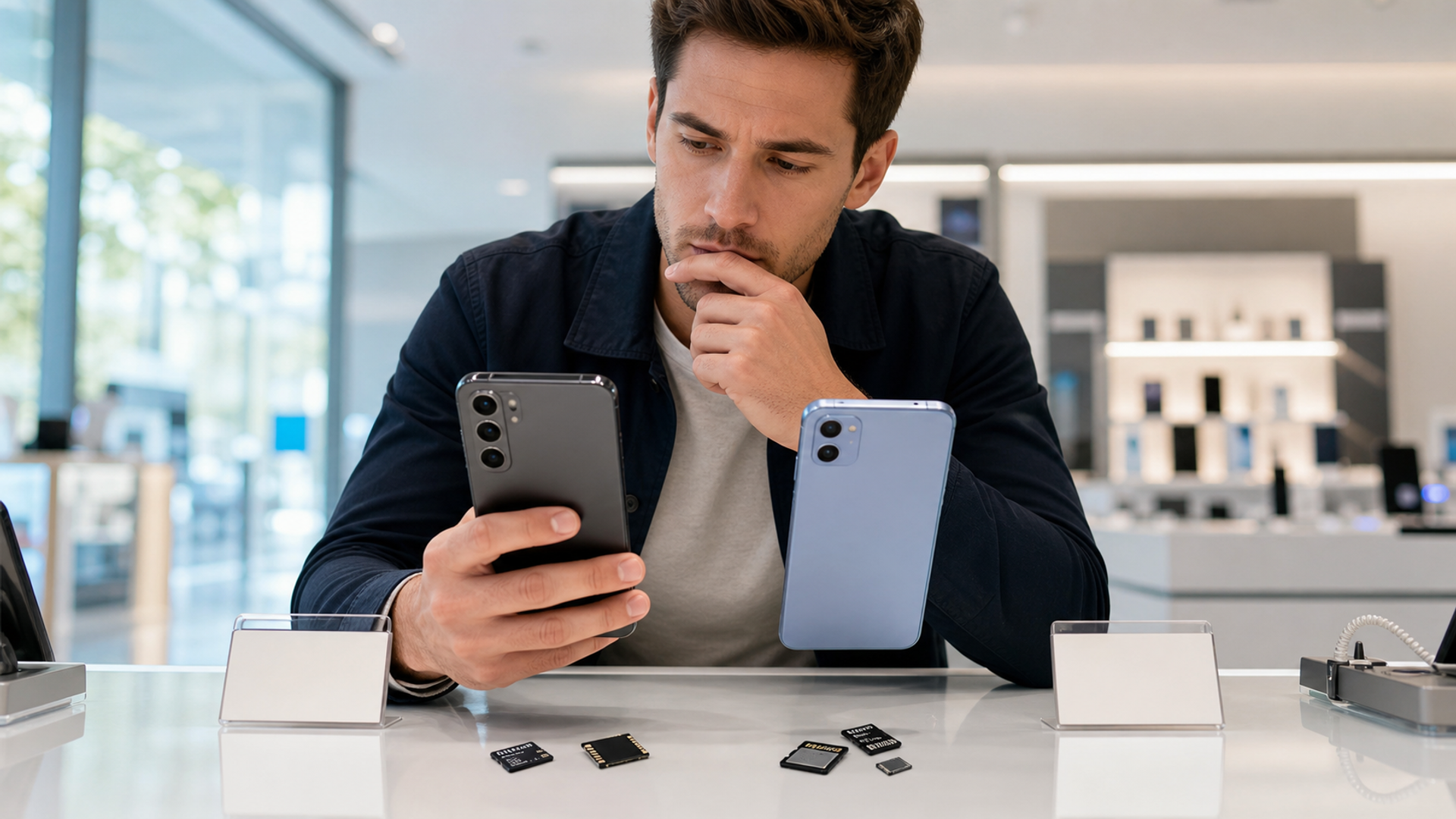
The best smartphone decision in 2026 may be less about the next camera feature and more about memory supply. Industry researchers say higher DRAM and NAND costs are squeezing lower-priced phones hardest, pushing manufacturers towards higher average prices, older components or fewer models. That does not mean every phone will become dramatically more expensive. It means waiting is no longer automatically the cheaper choice.
For a buyer, the sensible answer depends on price band, urgency and how long the current device can remain secure and useful. Premium phones are relatively protected from the worst supply shock; entry and mid-range models face more pressure.
What is happening to smartphone prices in 2026?
Counterpoint Research revised its 2026 smartphone forecast down as memory costs increased. Its December forecast estimated that bill-of-material costs had risen by roughly 25% for low-end phones, 15% for mid-range models and 10% for high-end devices, with wholesale average selling prices expected to move higher.
The pressure subsequently became more visible. Counterpoint reported that the share of phones priced at $99 or below fell from roughly 18–19% of sales in early 2025 to 12% by March 2026. Its analysis links the shortage to memory makers prioritising higher-value products, including memory for AI servers.
These figures describe an industry trend, not a guaranteed increase on a particular handset. Retail promotions, existing inventory, exchange rates and regional demand can still produce discounts. The useful conclusion is narrower: cheap hardware has less room to absorb component inflation.
Buy now or wait? A price-band decision matrix
| Your situation | Buy now | Wait | Keep current phone |
|---|---|---|---|
| Current phone no longer receives security updates | Yes, after checking support policy | Only for a confirmed launch within weeks | No |
| Entry-level budget and a reliable deal is available | Often sensible | Risk of fewer choices or older components | If battery and support remain adequate |
| Mid-range buyer with no urgent failure | Compare current discounts carefully | Reasonable if a specific announced model matters | Usually the lowest-cost option |
| Premium buyer replacing a three- to five-year-old phone | Buy when the right configuration appears | Wait for a confirmed product, not rumours | Viable if support and battery remain strong |
| Current phone only needs a battery replacement | Usually no | Not necessary | Repair first when safe and economical |
The matrix deliberately separates urgency from desire. A cracked camera lens, failing cellular modem or expired security support creates a real deadline. A marginal benchmark improvement does not.
Why entry-level phones face the hardest trade-off
Manufacturers can respond to higher memory costs in several ways: raise the price, reduce storage, use an older memory generation, limit production or withdraw a model. Each response changes value differently.
A price rise is visible. A component downgrade is harder to notice. Buyers should therefore compare the exact RAM and storage configuration, software-support period, cellular bands and charging standard rather than assuming that a 2026 model is automatically better than the 2025 version it replaces.
The cheapest offer can also become expensive if it reaches storage limits quickly or loses support early. Our business-phone selection framework starts with support, reliability and workflow fit before specifications.
Premium phones are not immune—but the economics differ
Counterpoint's research suggests premium portfolios have remained more resilient. A manufacturer has more margin to absorb a component increase, and buyers may value longer support, better resale and higher storage enough to tolerate a higher ticket price.
That does not justify paying for unused capacity. A 1TB phone is sensible for someone carrying large video, offline maps or confidential work files; it is unnecessary for a user who streams media and stores little locally. Decide storage from the next three years of use, not from the largest number on the product page.
Premium buyers should also distinguish price from value retention. A well-supported device that remains reliable for four years can be less costly per year than replacing a compromised mid-range phone twice. Conversely, a luxury finish cannot compensate for poor regional network support or an uncertain update policy.
The six checks to make before buying
1. Confirm the exact configuration
Retail listings often group several RAM and storage variants on one page. Record the model code, storage, region and warranty. A lower price may belong to a different configuration.
2. Read the software-support promise
Security updates influence useful life more than a small processor difference. Look for a clear policy from the manufacturer and confirm whether the period begins at launch or purchase.
3. Price a battery replacement
If the current phone is otherwise sound, a manufacturer-authorised battery replacement may buy another year or two. Do not attempt a repair on a swollen or damaged battery; use a qualified service provider.
4. Compare current stock with announced products
Waiting makes sense for an officially announced product with a known date. Waiting for leaks can leave a buyer paying more for depleted stock while the rumoured product changes or slips.
5. Check trade-in value separately
Promotional trade-ins can disguise the real purchase price. Compare the net cost with an independent resale option and read the condition rules before sending the existing device.
6. Calculate cost per supported year
Divide the net purchase price by the realistic years of secure use. This does not capture every benefit, but it prevents a discount from looking attractive when the support horizon is short.
Three buying strategies that make sense now
The urgent replacement: Buy a current, supported model with enough storage and confirmed regional compatibility. Reliability is worth more than timing the market.
The value optimiser: Watch confirmed retail pricing for four to six weeks, compare the previous flagship with the current mid-range and be willing to repair the existing phone.
The long-term owner: Choose support, repair access, battery health, storage and service before chasing launch-cycle novelty. Our 2026 luxury-phone guide applies the same ownership logic to the premium segment.
Compare deals without being fooled by the monthly price
Carrier finance can make a more expensive phone look cheaper by extending the term or attaching bill credits. Compare the full cash price, required tariff, deposit, trade-in, upgrade restrictions and amount still owed if you leave early. A “free” device tied to 36 months of service is a different decision from an unlocked handset bought outright.
Create a simple ownership sheet:
| Cost element | Record this number |
|---|---|
| Phone cash price | Full price before finance |
| Mandatory service premium | Extra tariff cost over the ownership period |
| Trade-in value | Guaranteed amount after condition rules |
| Repair allowance | Battery or screen provision |
| Accessories | Charger, case and required adapters |
| Expected resale | Conservative estimate, not an asking price |
| Supported years | Manufacturer policy and realistic use |
Subtract only guaranteed credits. Divide the remaining cost by supported years and compare equivalent storage configurations. This exposes a common 2026 trap: an older phone discounted heavily but offered with too little storage or a much shorter remaining support period.
Regional supply can reverse the global story
The memory shortage is global, but retail effects are local. One market may still hold discounted inventory while another receives a smaller allocation. Currency changes, import duties and carrier promotions can overwhelm the component-cost trend for a specific buyer.
Check at least two authorised channels and the manufacturer's regional store. Confirm that a lower-priced import supports local networks, warranty service and required software features. Grey-market savings can disappear after one failed repair or an unsupported eSIM configuration.
If the current model is available in the exact configuration you need, record the price and stock rather than assuming it will return. If you wait, define the trigger in advance: a confirmed launch date, a target price or a repair threshold. “Wait for something better” is not a buying strategy.
The practical verdict
Buy now if the existing phone is failing, unsupported or blocking essential work—and if a verified current offer meets the next several years of use. Wait if the present device is secure and a specific announced product would materially improve the decision. Keep the current phone if a battery or storage clean-up solves the actual problem.
The memory shortage makes indiscriminate waiting less attractive, especially at the lower end. It does not make panic-buying sensible. The winning decision is a supported configuration at a defensible total cost, not simply the newest model on the shelf.
![How to Scan Receipts and Documents with Your Phone [Full Guide]](https://cdn.sanity.io/images/e0gp1l2g/production/0db13feec1d5e72b8a8a5f976d1f3e86619c9228-3840x1860.webp?w=180&h=180&q=78&auto=format&fit=crop)
![How to Scan Receipts and Documents with Your Phone [Full Guide]](https://cdn.sanity.io/images/e0gp1l2g/production/0db13feec1d5e72b8a8a5f976d1f3e86619c9228-3840x1860.webp?w=800&h=450&q=82&auto=format&fit=crop)
![Top 10 Two-Tone Carbon-Fibre Watches for Men [2026 List]](https://cdn.sanity.io/images/e0gp1l2g/production/18870799ba33fab0e038968359cd5772d7d7db30-1024x576.webp?w=800&h=450&q=82&auto=format&fit=crop)
![Top 10 Luxury Watches with Digital Complication Displays for Men [Latest]](https://cdn.sanity.io/images/e0gp1l2g/production/c4f6bf8c080f291c39f7cc85c7344ecff2fd3799-1024x553.webp?w=800&h=450&q=82&auto=format&fit=crop)